


Mutual fund return figures can look contradictory when two calculators use different methods. The issue is usually not arithmetic. It is the cash-flow pattern. A lump sum has one investment date, while a SIP creates many investment dates and may include top-ups or redemptions.
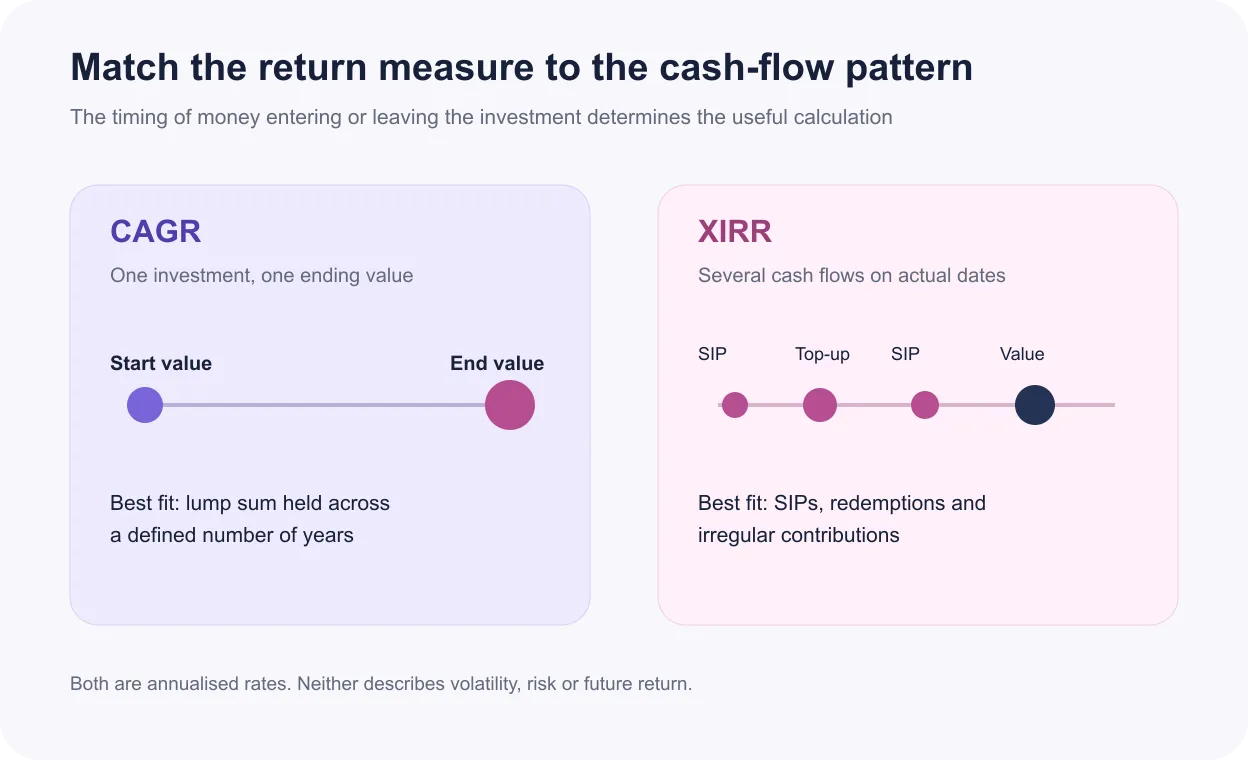
XIRR vs CAGR answers two related but different questions. CAGR measures the smoothed annual growth between a beginning value and an ending value. XIRR finds the annual rate that reconciles every dated contribution and withdrawal with the final portfolio value.
What Is CAGR in Mutual Funds?
CAGR in mutual funds means compound annual growth rate. It converts the total growth over a multi-year period into an equivalent constant annual rate. A fund did not necessarily earn that percentage each year. The calculation smooths the entire path into one comparable number.
CAGR works cleanly when ₹1,00,000 is invested once and grows to ₹1,50,000 after three years, with no contribution or withdrawal in between. It is also widely used for point-to-point scheme NAV and benchmark comparisons over identical periods.
The measure leaves out the journey. Two investments can have the same CAGR while experiencing very different drawdowns and volatility. It also becomes unsuitable for personal performance once cash is added or removed between the start and end dates.
See what markets are pricing in
Live indices, sector moves and market breadth — the backdrop to every story we publish.
What Is XIRR in Mutual Funds?
XIRR in mutual funds is the extended internal rate of return for a schedule of dated cash flows. Each SIP instalment is usually entered as a negative value because money leaves the investor. Redemptions and the final portfolio value are positive values because money returns to the investor.
Microsoft defines XIRR as the internal rate of return for cash flows that are not necessarily periodic. It discounts each flow using the number of days from the first date on a 365-day basis and solves for the rate at which their net present value equals zero.
This makes XIRR in mutual funds useful for SIPs, irregular top-ups, systematic withdrawals and portfolios assembled over time. It is investor-specific: two people in the same scheme can record different XIRRs because their dates, amounts and transaction histories differ.
XIRR vs CAGR: Key Differences
The central difference between XIRR and CAGR is whether the investor’s cash-flow timing matters. CAGR needs a beginning value, ending value and duration. XIRR needs each amount and its date, including a final positive value on the measurement date.
| Feature | CAGR | XIRR |
|---|---|---|
| Cash-flow pattern | One initial value and one ending value | Multiple contributions, withdrawals and final value |
| Timing | Uses total years | Uses actual transaction dates |
| Typical mutual fund use | Lump-sum or point-to-point scheme return | Personal SIP or irregular investment return |
| Required inputs | Beginning value, ending value, years | Values, corresponding dates and optional guess |
| What it hides | Interim volatility and cash flows | Interim volatility and risk despite reflecting cash-flow timing |
| Comparison rule | Compare the same period, plan, option and cash-flow convention | |
XIRR vs CAGR does not mean one rate is universally superior. Each is correct for a particular input pattern. Neither is a risk measure, and neither guarantees future returns. SEBI’s performance framework also emphasises standardised figures, relevant benchmarks and clear risk disclosure when scheme performance is presented.
An XIRR vs CAGR comparison is meaningful only after confirming that the underlying question, measurement date and cash-flow convention are aligned.
Get research like this in your inbox
The week’s research that mattered, in five minutes. Joined by 2L+ investors.
How to Calculate Mutual Fund Returns: CAGR vs XIRR
Start by deciding whose performance you are measuring. A scheme’s point-to-point NAV return is different from an investor’s money-weighted experience. Then use complete, consistently signed cash flows and a single valuation date.
CAGR Formula and Example
To understand how to calculate CAGR, use: CAGR = (Ending value ÷ Beginning value)1/n − 1, where n is the holding period in years. For ₹1,00,000 becoming ₹1,50,000 in exactly three years, CAGR is (1.5)1/3 − 1, or 14.47% a year.
When calculating CAGR in mutual funds, do not treat a partial year as a full year or ignore an intermediate redemption. Use precise elapsed time where the calculator supports it. For periods below one year, presenting a simple absolute return may be clearer than annualising a short observation.
XIRR Formula and Example
To learn how to calculate XIRR, prepare two aligned columns. The first contains signed cash flows; the second contains their actual dates. Excel syntax is =XIRR(values, dates, [guess]). The data must contain at least one negative and one positive value.
The final market value must be entered as a positive cash flow on the chosen valuation date, even if units have not been sold. Without it, the function sees only investments and cannot calculate a meaningful result. A #NUM! error may indicate missing signs, mismatched ranges or a cash-flow pattern for which the iterative calculation did not converge.
Example: CAGR vs XIRR for a Mutual Fund Investment
Consider two illustrations. The first is the three-year lump sum above, producing a 14.47% CAGR. The second has five ₹20,000 contributions on 5 January 2023, 20 May 2023, 1 December 2023, 15 June 2024 and 10 February 2025, followed by a ₹1,30,000 value on 5 January 2026. Applying the actual dates produces a 13.48% XIRR.
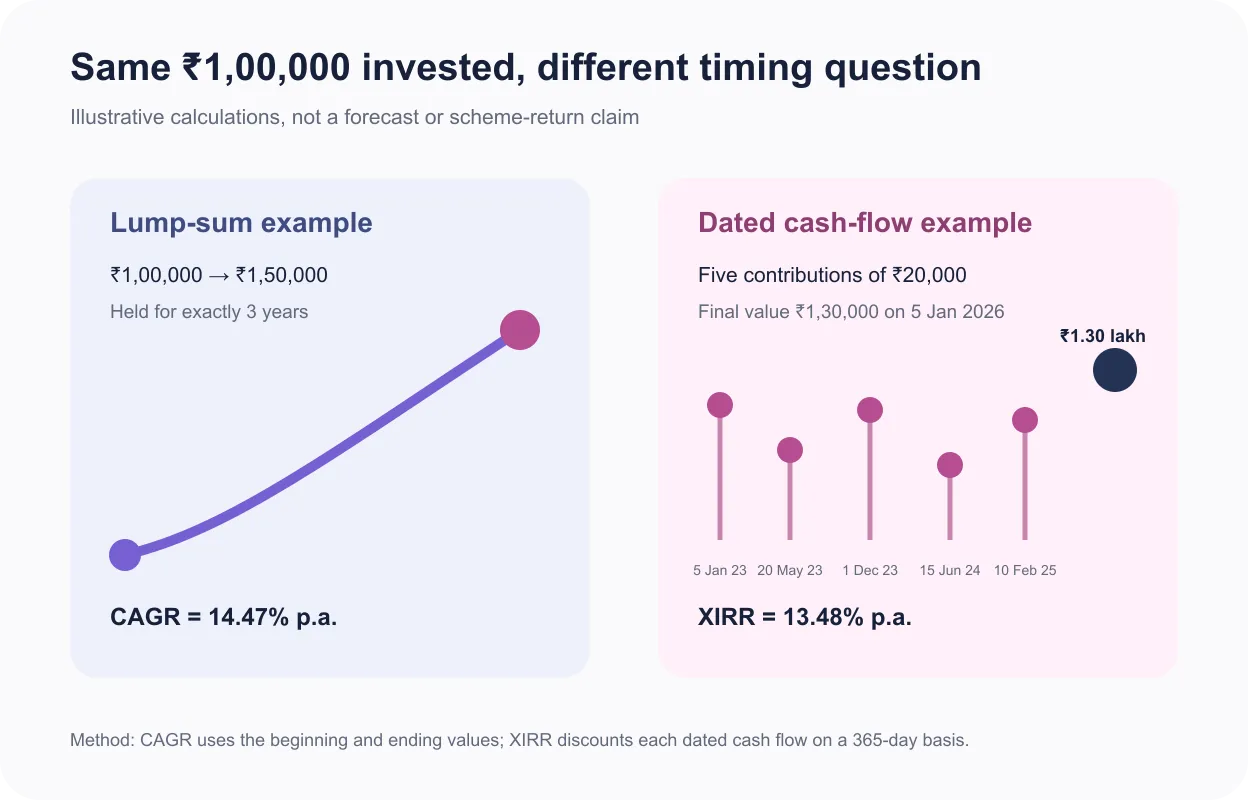
The results should not be compared as if they came from identical investments. The XIRR example had money entering later, so less capital was exposed for the full period. The example shows why timing belongs in the calculation, not that one method produces systematically higher or lower returns.
This XIRR vs CAGR example therefore illustrates method selection, not a performance contest between two portfolios.
When to Use CAGR vs XIRR
Use CAGR for a lump-sum holding without intermediate flows, a point-to-point NAV comparison, or a benchmark comparison over the same dates. Use XIRR for SIPs, irregular purchases, partial redemptions, dividends received as cash, or a portfolio that changes through time.
A practical XIRR vs CAGR rule is simple: if money moved between the starting and ending dates, test whether XIRR is required. For evaluating an XIRR in mutual funds portfolio , keep transaction-level records and compare results only after aligning the dates, plan type and benchmark period.
The difference between XIRR and CAGR also matters when reading fund factsheets. The scheme may show a standard point-to-point CAGR, while the investor dashboard shows a personal XIRR. Both can be valid because they answer different questions.
Common Mistakes While Comparing Fund Returns
A frequent mistake is comparing a direct-plan return with a regular-plan return or a growth option with a cash-distribution option. Expenses and cash flows differ. Another is comparing periods that end on different dates, which can materially change results in a volatile market.
Investors also omit redeemed amounts, reverse cash-flow signs, or enter the current value on the wrong date. When checking how to calculate XIRR, reconcile the transaction statement first. When reviewing how to calculate CAGR, confirm that no intermediate flow breaks the point-to-point assumption.
In any XIRR vs CAGR review, retain the supporting transaction dates so another reader can reproduce the number.
Do not use either annualised rate alone to select a fund. Review the benchmark, category, portfolio, expenses, drawdowns and consistency with the investor’s goal. Past performance may not persist, and a higher historical rate can reflect higher risk.
Is your portfolio built for what’s coming?
Get a free AI-powered review of your holdings — risk, overlap and quality in minutes.
FAQ
What is the difference between XIRR and CAGR?
The XIRR vs CAGR distinction begins with cash-flow timing. CAGR annualises the change between one beginning value and one ending value, while XIRR annualises a series of positive and negative cash flows using their actual dates.
How do you calculate XIRR in mutual funds?
List every investment as a negative cash flow, every redemption as a positive cash flow and the current value as a positive cash flow on the valuation date. In Excel or Google Sheets, apply XIRR to the values and corresponding dates.
How do you calculate CAGR in mutual funds?
Divide the ending value by the beginning value, raise the result to 1 divided by the number of years, and subtract 1. Multiply by 100 to express the result as a percentage.
When should you use XIRR instead of CAGR?
Use XIRR whenever the investment has multiple cash flows on different dates. CAGR is appropriate when there is one initial investment, no intermediate cash flow and one ending value.
Should I use XIRR for SIP returns?
Yes. SIP instalments enter at different times, so each amount has a different holding period. XIRR accounts for those dates and produces one annualised personal return for the complete cash-flow series.
Can CAGR be used for lump sum investments only?
CAGR is most useful for a lump sum with no intermediate contribution or withdrawal. It can also describe a scheme NAV or index moving from one point to another, but not an investor’s irregular cash-flow experience.