


India’s mutual fund rulebook was rewritten after nearly three decades of layered amendments. The new framework was notified on 14 January 2026, took effect on 1 April 2026 and replaced the 1996 regulations, subject to repeal-and-saving provisions for past actions and specified schemes.
The SEBI Mutual Fund Regulations 2026 are not simply a renumbering exercise. They consolidate provisions, clarify institutional responsibilities and revise how scheme expenses are defined. Investors should focus on the cost framework and disclosures, while fund houses face a reorganised compliance architecture.
The revised rulebook changes how costs and responsibilities are presented, while retaining core investor safeguards.
SEBI Mutual Fund Regulations 2026: What Changed?
SEBI’s stated objective was clearer language, less overlap and stronger transparency. Sponsor eligibility for conventional funds and MF Lite is consolidated. AMC and trustee duties are grouped under common themes. Prudential investment limits and valuation rules are organised for easier reference.
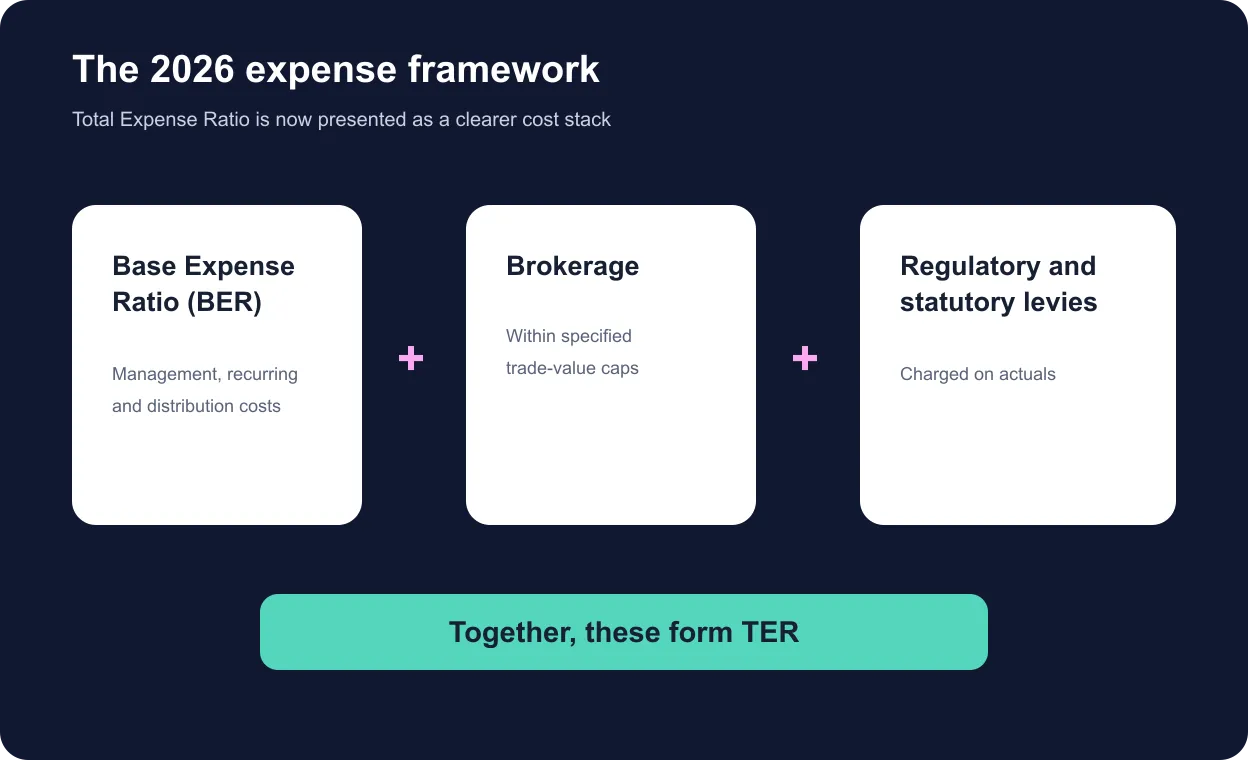
The expense overhaul is the most visible substantive change. The old ceilings often included statutory levies. The new Base Expense Ratio, or BER, excludes them. Total Expense Ratio, or TER, is presented as BER plus permitted brokerage and applicable regulatory and statutory levies.
The SEBI Mutual Fund Regulations 2026 also reduce brokerage caps, remove an additional expense allowance and enable more digital-first compliance. SEBI’s Board release said the review reduced the regulatory text from 162 to 88 pages and its word count from about 67,000 to 31,000. Shorter does not mean lighter supervision; it means related requirements were consolidated and redundancies removed.
Run the numbers on your next investment
Project returns on a lumpsum or SIP with our free calculators.
Changes Effective From April 1, 2026
The commencement date matters because the regulations and the updated Master Circular both became effective on 1 April 2026. The Master Circular, issued on 20 March, incorporates relevant circulars through that date and replaced the June 2024 master circular.
The legal hierarchy is important. Regulations set the binding architecture. Circulars and the Master Circular provide detailed operating directions. Scheme documents apply those requirements to a particular product. An investor should not use a summary article as a substitute for the current regulation, circular or scheme disclosure.
SEBI’s regulations page records a further amendment dated 7 July 2026. Consequently, anyone checking a current obligation should consult the consolidated version marked as last amended, not only the January notification. This article explains the April reset and notes the later amendment rather than implying the rulebook stopped changing.
| Date | Official action | Practical meaning |
|---|---|---|
| 17 Dec 2025 | SEBI Board approved the comprehensive review | Key expense and compliance changes announced |
| 14 Jan 2026 | New regulations notified | Formal replacement framework published |
| 20 Mar 2026 | Updated Master Circular issued | Operating directions consolidated |
| 1 Apr 2026 | Regulations and Master Circular effective | AMCs, trustees and service providers transition |
| 7 Jul 2026 | Amendment regulations published | Use the latest consolidated text for current compliance |
Key Rule Changes for AMCs and Investors
For fund houses, the regulations reorganise eligibility, governance, scheme operations, investment conditions, valuation, winding up, inspections and MF Lite within a coherent structure. Trustees retain an oversight role, while AMC boards remain responsible for managing operations, risks and compliance under defined duties.
For investors, the clearest improvement is the expense vocabulary. BER covers the base cost envelope, including investment management, recurring and permitted distribution expenses. Statutory levies no longer sit inside that ceiling. This helps a reader distinguish controllable scheme costs from taxes and levies charged under law.
Initial issue expenditure through the allotment of units must be borne by the AMC, trustees or sponsor, rather than passed to the scheme. Expenditure above permitted base limits is similarly borne outside the scheme under the conditions in the regulations. This aligns responsibility with the entities launching and operating products.
The rulebook also recognises established product structures such as Specialised Investment Funds and MF Lite. Their inclusion does not mean every scheme follows identical limits. Scheme category, underlying exposure, plan type, AUM and specific circulars continue to determine the applicable requirements.
A useful way to read the architecture is to separate entity-level duties from scheme-level limits. Sponsors establish the fund and must satisfy eligibility conditions. Trustees hold the mutual fund property for unit holders and oversee whether the AMC acts within the trust deed and regulations. The AMC makes investment and operating decisions, maintains systems and appoints regulated service providers. Custodians, registrars, brokers and depositories perform distinct functions. Consolidating these roles makes accountability easier to trace, but it does not merge them or allow one entity to ignore another's control responsibilities.
Impact on Costs, Disclosures and Operations
BER ceilings were recalibrated because statutory levies moved outside the base limit. For index funds and ETFs, the ceiling moved from 1.00% including statutory levies to 0.90% excluding them. For a fund of funds investing in liquid schemes, index funds or ETFs, the revised ceiling is also 0.90%, excluding levies.
For other open-ended schemes, ceilings remain slab-based. Up to ₹500 crore of daily net assets, the revised BER is 2.10% for equity-oriented schemes and 1.85% for other schemes, excluding levies. Rates step down as assets rise. These are ceilings, not promises that a fund will charge the maximum.
Brokerage caps changed more directly. The old cash-market cap was 12 basis points including statutory levies; the new cap is 6 basis points excluding levies. Derivatives moved from 5 basis points including levies to 2 basis points excluding levies. SEBI also removed the additional five basis points previously permitted as a transitional expense for schemes with exit loads.
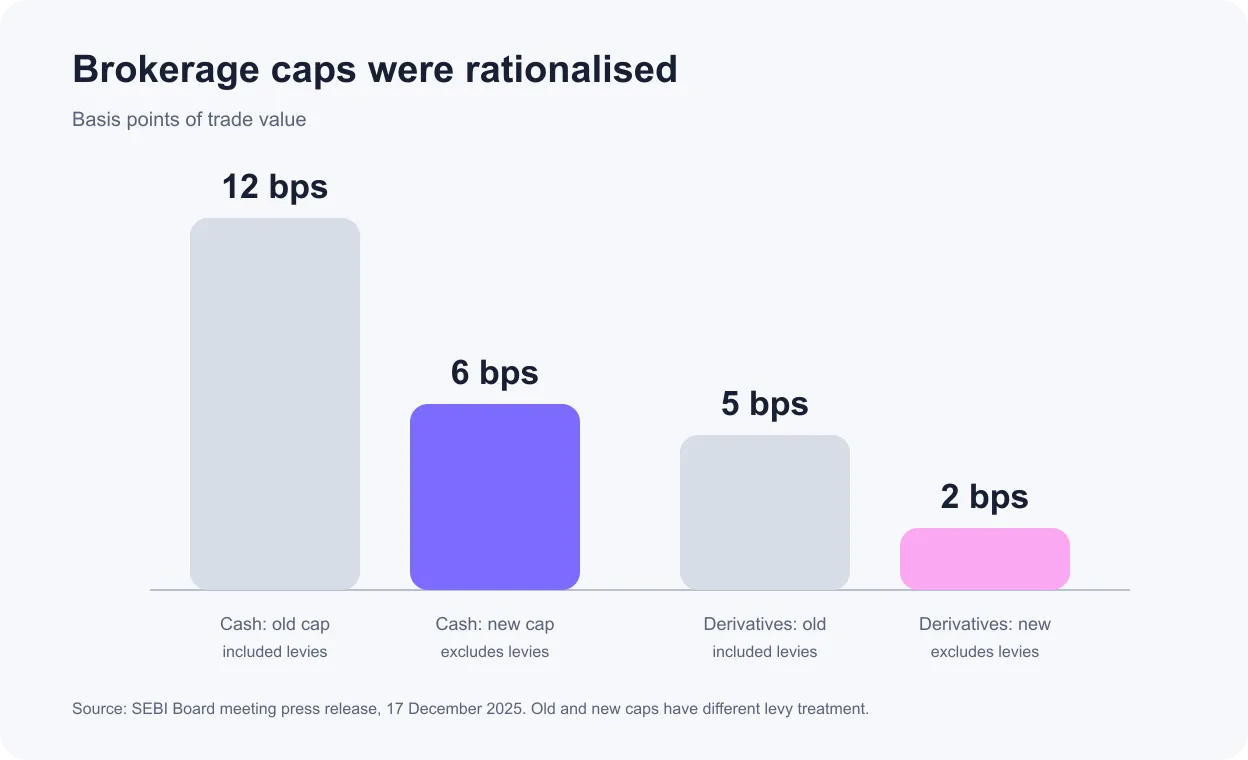
The comparison requires care: a lower BER number does not mechanically equal an identical fall in TER because levies are now shown outside BER and charged on actuals. Investors should compare the final TER actually disclosed for the same scheme and plan over time.
Consider a simplified cost example. Suppose a scheme reports BER of 1.20%, permitted brokerage of 0.03% and applicable regulatory and statutory levies of 0.04% for the measurement period. Its TER would be 1.27%, subject to the detailed regulatory method and actual charges. The example is explanatory, not a universal formula for calculating a published daily ratio. Brokerage varies with trading, levies follow the relevant laws and rates, and different plans of the same scheme can have different base costs. Always use the AMC's disclosed ratio for comparison.
Operationally, the framework supports fewer duplicative filings, digital monitoring of advertisements, email or SMS communication and website disclosures in place of some newspaper requirements. Separate half-yearly portfolio disclosure was removed where it duplicated other reporting. The aim is easier compliance without removing material information.
For fund houses, transition work includes remapping regulation references in scheme documents, updating expense labels, adapting controls, training teams and testing investor communications. A compliant document can confuse readers if terminology is mixed. Clear implementation therefore depends on consistent definitions across factsheets, websites, notices and operational systems.
Get research like this in your inbox
The week’s research that mattered, in five minutes. Joined by 2L+ investors.
Changes Relevant to Passive and Active Funds
Passive funds receive a clearly stated 0.90% BER ceiling for index funds and ETFs, excluding statutory levies. In practice, many products may charge well below the ceiling. Investors should therefore compare actual TER, tracking difference, tracking error, liquidity and the benchmark rather than relying on the regulatory maximum.
The borrowing framework was also clarified. SEBI’s Board release highlighted borrowing by equity-oriented index funds and ETFs for specified execution-related needs and intra-day mechanisms for redemption timing mismatches. This is operational liquidity management, not general permission to add portfolio leverage.
Active funds remain subject to category and AUM-linked ceilings, investment limits, valuation principles and governance requirements. The SEBI Mutual Fund Regulations 2026 do not abolish the distinction between direct and regular plans. Direct plans continue to exclude distribution commission and should carry lower expenses than their regular-plan counterparts under applicable rules.
Both active and passive schemes remain responsible for fair valuation, portfolio compliance and investor disclosures. Passive management does not remove counterparty, liquidity, operational or tracking risk. Active management does not justify an expense merely because it fits below a ceiling.
What Investors Need to Review in Their Portfolios
Start with the AMC’s daily TER disclosure and compare the direct or regular plan actually held. Look for changes in BER, total expenses and portfolio turnover. Review scheme communications issued around the transition, but do not assume that every change requires investor action.
Next, confirm that the benchmark, category and mandate still match the financial goal. Costs matter because they compound, yet a lower-cost unsuitable fund is not automatically better. For passive products, compare tracking outcomes; for active funds, assess process, risk, portfolio consistency and performance after expenses.
Review nominee and contact details, consolidated account statements and any email or SMS about material changes. Use official AMC, AMFI and SEBI sources rather than forwarded summaries. If a scheme’s economics or mandate changed materially, compare alternatives after considering tax, exit load and the consequences of switching.
Finally, distinguish a ceiling from an actual charge. A scheme can operate below its allowed BER. Statutory levies may vary with portfolio transactions. High turnover may affect brokerage and transaction-related costs. Read the scheme information document and statement of additional information for the product-specific application.
Investors should also compare communications with portfolio facts. A notice about a revised expense framework does not necessarily signal a change in the scheme's investment objective. Conversely, an unchanged TER does not prove that portfolio risk is unchanged. Check the latest factsheet for sector concentration, credit quality, duration, market-cap exposure, overseas holdings and derivatives use as relevant. For an ETF, inspect exchange liquidity and bid-ask spreads alongside fund-level cost. For a fund of funds, understand both the wrapper's permitted charge and the expenses of underlying schemes.
What Has Not Changed
Core investor-protection principles remain. Mutual fund assets are held for unit holders, schemes must follow disclosed objectives and limits, and AMCs and trustees remain accountable within the regulatory structure. Valuation must reflect realisable value and be conducted in good faith under approved policies and SEBI guidelines.
The rewrite does not guarantee returns, eliminate market risk or make all funds comparable. NAV can rise or fall with underlying assets. Credit, duration, equity, liquidity, concentration and tracking risks still depend on the portfolio. Regulation sets boundaries and disclosure duties; it does not select the right scheme for a person.
The SEBI Mutual Fund Regulations 2026 also preserve past actions through repeal-and-saving clauses. Certain close-ended schemes launched under the previous framework continue under the 1996 provisions until winding up. This avoids treating the transition as a legal blank slate.
Tax rules, investment objectives and risk appetite remain separate decisions. A cost change does not alter an investor’s horizon. Likewise, clearer digital disclosure is only useful when investors read the correct plan and current version.
The transition also does not erase the role of investor consent or exit facilities where another rule requires them for a fundamental attribute change. Nor does it replace grievance channels. Investors can first approach the AMC, then use SEBI's complaint-redress mechanisms as applicable. Distribution relationships remain important: a regular plan can include distribution costs, while a direct plan does not pay distributor commission. Advice, distribution and execution are different services, so investors should know which service they receive and how the intermediary is compensated.
SEBI Circulars and Official Sources to Track
The primary documents are the notified regulations, the consolidated version on SEBI’s regulations page and the Master Circular dated 20 March 2026. The Master Circular is extensive because it combines detailed directions on schemes, disclosures, expenses, operations and service providers.
Check later circulars by date and subject. The regulations expressly allow SEBI to issue binding clarifications and guidelines. A later circular or amendment may refine a general provision, so an older article or scheme document can become incomplete even if it was accurate when published.
For scheme-level information, use the AMC website and AMFI disclosure pages. Verify the exact scheme, plan and date. Maintain copies of communications that affect expenses, features or investor rights. When interpreting a compliance obligation, professional legal or regulatory advice may be necessary.
The SEBI Mutual Fund Regulations 2026 should therefore be read as the foundation, not the only document. The Master Circular supplies the operating layer, and current scheme documents show how the requirements apply to an investor’s holding.
See what markets are pricing in
Live indices, sector moves and market breadth — the backdrop to every story we publish.
FAQ
What changed in SEBI mutual fund rules from April 1, 2026?
The 2026 regulations replaced the 1996 framework, reorganised and simplified provisions, introduced a clearer BER and TER cost structure, reduced brokerage caps, removed the temporary five-basis-point expense allowance and updated compliance processes.
Which mutual fund regulations changed in 2026?
The changes cover sponsor eligibility, AMC and trustee responsibilities, expenses, investment and valuation provisions, disclosures, borrowing, inspections and MF Lite. Operational details also sit in the March 20, 2026 Master Circular.
How do the new SEBI rules affect investors?
Investors receive clearer expense components and digital disclosures, while lower brokerage limits and removal of an additional allowance may reduce certain scheme costs. Actual effects depend on each scheme’s portfolio, plan and expenses.
Did SEBI change mutual fund costs or disclosures in 2026?
Yes. BER excludes statutory levies, TER combines BER with brokerage and applicable regulatory and statutory levies, and AMCs must continue prominent daily TER disclosure. Several communications move toward digital delivery.
Which changes affect passive funds?
Index funds and ETFs have a 0.90% BER ceiling under the revised framework, excluding statutory levies. Equity-oriented index funds and ETFs also gained clearer borrowing flexibility for specified execution-related needs.
Where can investors check the latest SEBI mutual fund circulars?
Use SEBI’s Legal section for regulations and circulars, especially the consolidated regulations and the Master Circular for Mutual Funds. AMC and AMFI websites provide scheme-level expense and disclosure information.