


India's investment-product ladder used to have a conspicuous gap. Mutual funds offered pooled, regulated portfolios at accessible ticket sizes, while Portfolio Management Services opened the door to more customised mandates only from ₹50 lakh. Investors who wanted a sophisticated strategy without moving directly to PMS or an Alternative Investment Fund had few standardised choices.
SEBI introduced the Specialised Investment Fund, or SIF, to address that gap. The framework took effect on 1 April 2025 and sits inside the mutual-fund regulations. It allows eligible asset managers to offer defined equity, debt and hybrid strategies with greater flexibility, including limited long-short exposure, while retaining pooled-fund governance, valuation and disclosure requirements.
This guide explains what is SIF in practical terms, how the ₹10 lakh threshold works, which strategies are permitted, and how SIF vs PMS and SIF vs mutual fund comparisons should be made. A Specialised Investment Fund can expand the opportunity set, but that flexibility brings higher complexity, derivative risk and a need for closer due diligence.
What is Specialised Investment Funds (SIF)
A Specialised Investment Fund is not a separate unregulated product and it is not simply a lower-ticket PMS. It is a category created under SEBI's mutual-fund framework for investment strategies that may use tools and portfolio construction methods beyond those normally available to conventional schemes. The investor buys units in a pooled strategy, while the AMC manages one common portfolio according to the Investment Strategy Information Document, or ISID.
The answer to what is SIF therefore has two parts. Legally and operationally, it remains connected to a registered mutual fund, its trustees and its AMC. Economically, it can behave differently because the mandate may include sector rotation, tactical asset allocation, short positions through derivatives or more concentrated exposure. In SIF India , the product is intended for investors who can commit at least ₹10 lakh and understand a risk profile above that of a typical mutual-fund scheme.
See what markets are pricing in
Live indices, sector moves and market breadth — the backdrop to every story we publish.
Key Features That Set SIFs Apart
The first defining feature is strategy flexibility. A Specialised Investment Fund may take limited unhedged derivative positions where its approved category allows them. That can help a manager express negative views, reduce selected risks or change net market exposure. It can also magnify losses when the thesis, timing or hedge is wrong. “Long-short” should never be read as “low risk”.
The second feature is the ₹10 lakh aggregate threshold at PAN level. The amount is measured across all strategies offered by the same SIF, rather than separately for every plan. The third is product labelling. SEBI requires a distinct SIF brand and a risk band so investors do not confuse these strategies with ordinary mutual funds. The fourth is manager eligibility: an AMC must meet the prescribed route based on track record and assets under management, or appoint investment professionals with the specified experience.
These features explain why a specialised investment fund is neither an ordinary retail product nor a bespoke account. Units, NAVs, disclosures and trustees provide a familiar pooled structure, while strategy rules create a more complex return path. Investors should read the actual ISID because two products carrying the SIF label can have materially different asset mixes, short limits and redemption terms.
SEBI's Regulatory Framework and Minimum Investment Norms
SEBI's February 2025 circular created the operating framework, effective from 1 April 2025. In a specialised investment fund, an investor must ordinarily maintain at least ₹10 lakh in aggregate across the investment strategies offered by one SIF at PAN level. Accredited investors are exempt from this minimum. If market movements take the holding below ₹10 lakh, the investor is not forced to add money merely because prices fell. A breach caused by redemption, however, triggers the framework's notice and remedial process.
The specialised investment fund minimum is an eligibility filter, not an assurance of sophistication or safety. A ₹10 lakh investment can still be unsuitable when it represents too much of a household's liquid wealth. The SIF must also comply with portfolio, valuation, exposure, disclosure and risk-management rules. Strategy documents must explain the investment objective, permitted instruments, benchmark, liquidity, fees, risk band and material tax considerations.
| Regulatory element | SIF position | Why it matters |
|---|---|---|
| Minimum investment | ₹10 lakh aggregate at PAN level across one SIF's strategies | Investors must monitor the combined holding, not only one strategy. |
| Accredited investors | Minimum threshold does not apply | Accreditation changes eligibility, not the underlying market risk. |
| Product structure | Investment strategy under a registered mutual fund | Units represent a pooled portfolio rather than individually owned securities. |
| Risk disclosure | Mandatory risk band and strategy-specific documents | The label alone cannot describe expected volatility or loss. |
| Derivatives | Permitted within strategy and exposure limits | Short exposure and leverage-like behaviour require closer monitoring. |
How Does a SIF Actually Work?
For a specialised investment fund, an AMC first launches an approved investment strategy with an ISID. Investors subscribe for units, and their money enters a common portfolio. The manager then buys securities and uses permitted derivatives according to the strategy. NAV is calculated from the marked value of the portfolio after liabilities and expenses, divided by units outstanding. Purchases and redemptions occur at applicable NAVs subject to cut-off, exit-load and liquidity rules.
Suppose an equity long-short strategy holds ₹80 of long equity exposure and uses futures to create ₹20 of short exposure for every ₹100 of net assets. The short book may reduce damage if the selected stocks fall, but it can also lose when those stocks rise. Gross activity, option premiums and unhedged positions remain subject to limits. A Specialised Investment Fund must therefore be assessed through net exposure, gross exposure, security selection and derivative construction, not only its long holdings.
Unlike PMS, an investor does not own a separate basket of securities in a personal demat account. Unlike many conventional schemes, the strategy can change exposure more actively within its mandate. That distinction is central to comparisons among SIF, PMS and mutual funds.
Investment Strategies Offered Under SIFs
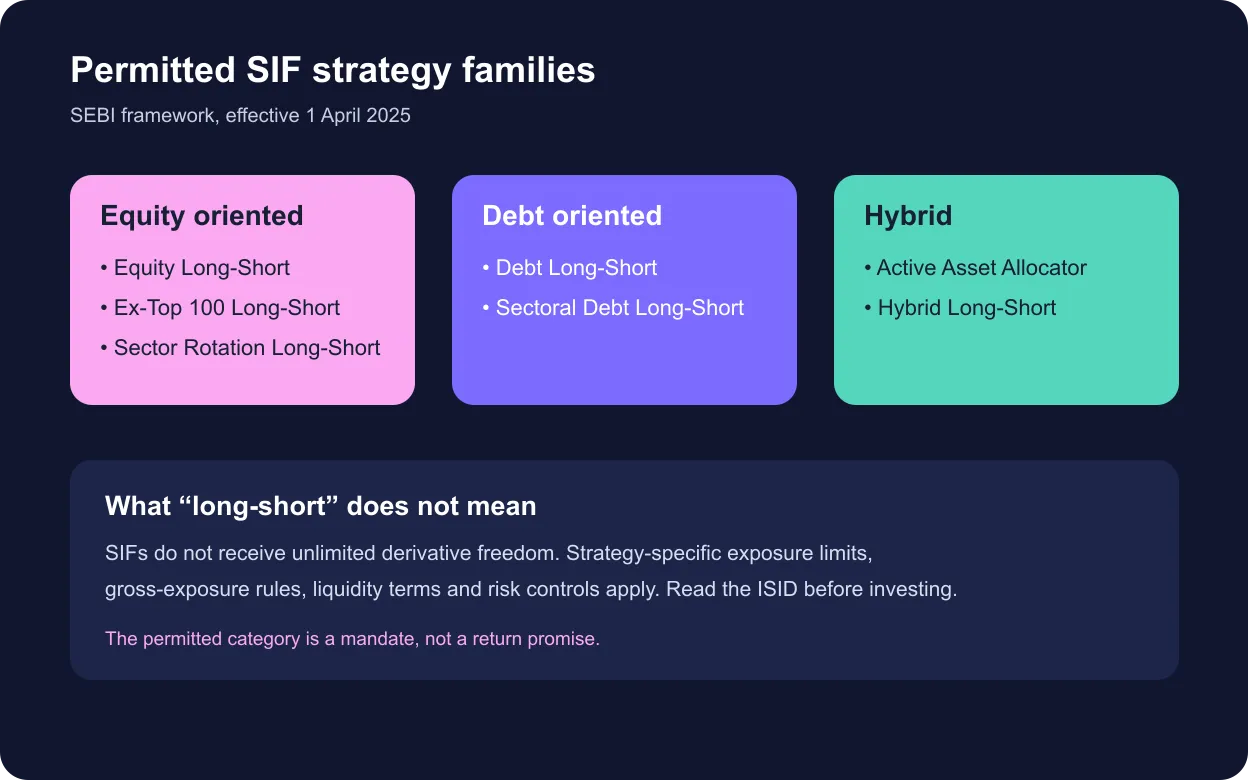
For a specialised investment fund, SEBI initially permitted equity-oriented, debt-oriented and hybrid families. Equity categories include Equity Long-Short, Equity Ex-Top 100 Long-Short and Sector Rotation Long-Short strategies. Debt categories include Debt Long-Short and Sectoral Debt Long-Short strategies. Hybrid categories include Active Asset Allocator Long-Short and Hybrid Long-Short strategies.
The category name defines important portfolio boundaries, but the ISID supplies the operational detail. An ex-top-100 strategy, for example, must direct the prescribed share of assets outside the largest 100 companies by market capitalisation. A sector-rotation strategy can shift emphasis across sectors, while a debt long-short strategy may combine physical debt with permitted derivative views on rates or credit. Investors should check whether the benchmark and redemption frequency fit the actual mandate.
Why Consider a Specialised Investment Fund: Key Benefits
A specialised investment fund can give an experienced investor access to strategies that are difficult to reproduce through long-only mutual funds. Limited short exposure may help express relative-value ideas, reduce selected market risks or seek returns in weak markets. Active allocation can also let a manager move between asset classes within a defined hybrid mandate.
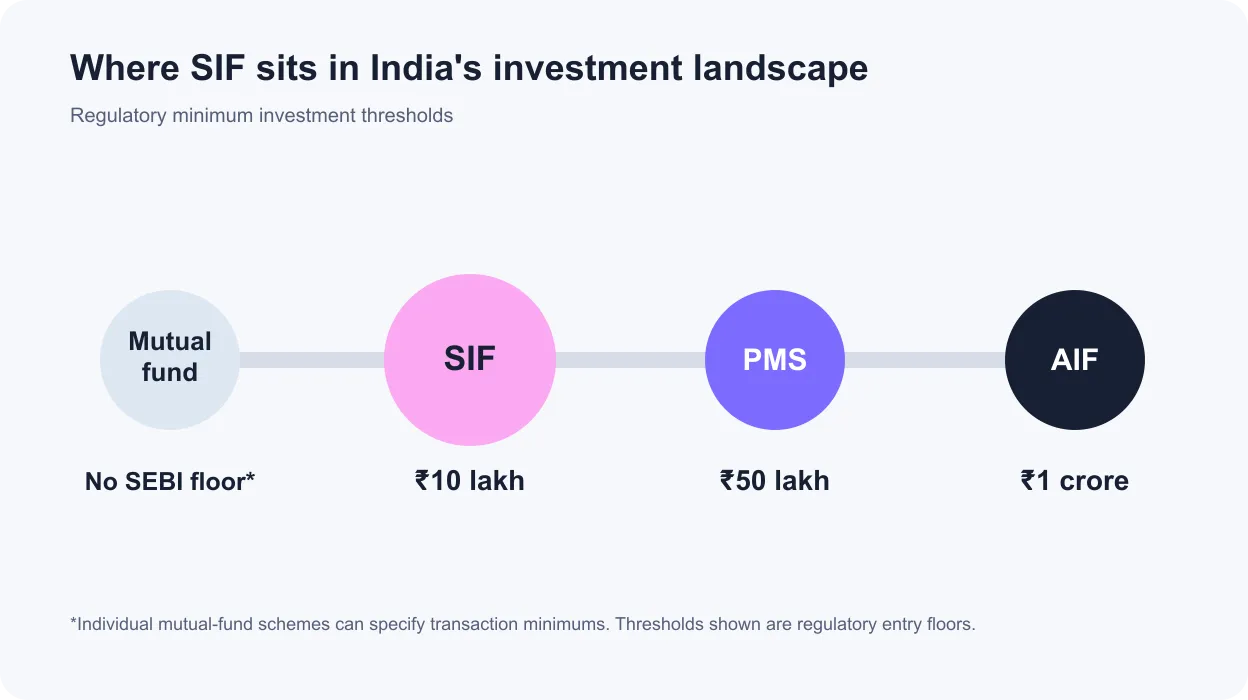
The pooled structure can be simpler than opening a customised PMS relationship. It brings common valuation, unit accounting, a published NAV and scheme-level disclosures. The ₹10 lakh threshold is also materially below the ₹50 lakh PMS minimum and the usual ₹1 crore AIF minimum. For a suitable investor, this makes the SIF India framework a more accessible route to sophisticated portfolio construction.
These are capabilities, not guaranteed benefits. A hedge can be expensive, a short can move sharply against the manager and frequent repositioning can increase turnover. The relevant question is whether the specific process has a credible edge after costs, not whether the product uses more tools.
Risks You Should Know Before Investing in SIF
The most visible specialised investment fund risk is market loss. Long positions can fall and short positions can rise. Derivative contracts introduce basis, liquidity, counterparty and rollover risks in addition to the underlying market view. A manager can be broadly correct about a sector and still lose because the selected hedge, contract month or timing behaves differently.
Concentration is another concern. A narrowly defined specialised investment fund may overlap with direct equities, factor funds or PMS holdings already in the portfolio. Liquidity can also vary. Open-ended strategies can offer frequent dealing, while interval strategies permit transactions only at stated windows. A stressed market can widen spreads and make portfolio exits more expensive even when investor redemptions remain available.
Model and manager risk matter because the framework allows greater discretion. Back-tested relationships can fail, risk controls can react too late and a change in personnel can alter execution. Finally, the short operating history of SIF India means investors may have limited live evidence across a full market cycle. The ISID, monthly portfolio, risk band, stress disclosures and manager commentary should be reviewed together.
Get research like this in your inbox
The week’s research that mattered, in five minutes. Joined by 2L+ investors.
How Are SIFs Taxed?
Tax treatment depends on the strategy's classification, the investor's status, holding period and the law in force on the transaction date. An equity-oriented specialised investment fund may generally follow the tax framework applicable to equity-oriented mutual-fund units when it meets the statutory conditions. Other strategies can fall under the rules applicable to non-equity mutual-fund units. Distributions, redemption gains, Securities Transaction Tax and withholding can therefore differ by strategy.
Specialised investment fund tax should not be inferred from the SIF label. The current Statement of Additional Information and ISID should state the applicable position, and the AMC may deduct tax where required. Non-resident investors also need to consider treaty eligibility and documentation. Since tax rules change, investors should obtain advice based on their residence, holding period and chosen strategy instead of relying on a generic rate table. The same caution applies across SIF India products.
SIF vs Mutual Funds: What's the Difference?
The SIF vs mutual fund comparison starts with a shared foundation: both are pooled products governed within SEBI's mutual-fund framework. Investors hold units, portfolios are valued at scheme level and trustees oversee the AMC. The difference is the permitted complexity. A conventional scheme normally follows long-only portfolio limits, while a SIF can employ specified long-short or active-allocation strategies with limited unhedged derivative exposure.
Ticket size and disclosure language also differ. Ordinary schemes can accept much smaller investments, whereas the specialised investment fund threshold is ₹10 lakh across one SIF. Conventional schemes use the Riskometer; SIF strategies use a dedicated risk band intended to communicate a higher and more nuanced risk range. Distribution also requires specific certification.
| Feature | Conventional mutual fund | Specialised Investment Fund |
|---|---|---|
| Investor threshold | No ₹10 lakh regulatory floor | ₹10 lakh aggregate at PAN level |
| Typical strategy | Long-only equity, debt or hybrid mandate | Defined long-short or active-allocation mandate |
| Portfolio ownership | Pooled units | Pooled units |
| Risk display | Riskometer | Dedicated SIF risk band |
| Complexity | Varies, generally lower | Higher derivative and strategy complexity |
A SIF vs mutual fund decision should therefore be based on need. An investor does not graduate from mutual funds merely by accumulating more money. If a simple diversified fund already fits the goal, more complexity may add cost without improving the outcome.
SIF vs PMS vs AIF: A Quick Comparison
The SIF vs PMS comparison is often reduced to ₹10 lakh versus ₹50 lakh, but ownership is equally important. PMS clients generally own securities in their own accounts and can receive client-level portfolios, subject to the mandate. SIF investors own units in one pooled strategy, so every investor in a plan receives the same portfolio outcome before individual taxes.
The SIF vs PMS trade-off also covers customisation, reporting and fees. PMS can offer a more tailored relationship, while a specialised investment fund can provide standardised access and NAV-based liquidity. AIFs occupy a broader private-fund category, often with a ₹1 crore minimum, commitment and drawdown mechanics, longer lock-ins and exposure to private or complex assets depending on category.
| Feature | SIF | PMS | AIF |
|---|---|---|---|
| Usual regulatory minimum | ₹10 lakh aggregate | ₹50 lakh | ₹1 crore |
| Ownership format | Units in pooled strategy | Client-level securities/portfolio | Units or interests in pooled fund |
| Customisation | Low | Potentially higher | Usually strategy-level |
| Liquidity | Open-ended or interval, as specified | Mandate and portfolio dependent | Often limited; Category I and II are close-ended |
| Typical use | Listed-market sophisticated strategies | Managed listed portfolio | Private markets or complex alternatives |
Neither SIF vs PMS nor SIF versus AIF has a universal winner. The correct structure depends on desired assets, control, liquidity, tax administration, fee tolerance and the evidence behind the manager's process.
Who Should Consider Investing in a SIF?
A specialised investment fund may suit an experienced investor with a diversified core portfolio who wants a specific satellite exposure, such as a controlled equity long-short strategy or tactical hybrid allocation. The investor should be able to explain the source of expected return, understand how derivatives change the payoff and tolerate periods when the strategy lags a simple benchmark.
It is less suitable for someone using emergency money, saving for a near-term non-negotiable goal or choosing solely on recent returns. Meeting the ₹10 lakh minimum does not establish risk capacity. Position size should be judged against total financial assets, liabilities and liquidity needs. For many households, diversified mutual funds remain a clearer core even after SIF India products become available.
Steps to Start Investing in a SIF
- Define the role. Decide whether the specialised investment fund is intended to diversify, hedge, seek tactical returns or replace an existing holding.
- Verify eligibility. Confirm the PAN-level aggregate threshold and complete KYC and other onboarding requirements.
- Read the ISID and SAI. Review the mandate, derivatives, benchmark, liquidity, fees, risk band, taxation and manager credentials.
- Compare alternatives. Run both SIF vs mutual fund and SIF vs PMS comparisons using the same objective and after-cost basis.
- Choose a sensible allocation. Avoid allowing the minimum ticket to dictate an oversized position.
- Invest through an authorised channel. Use the AMC or a properly registered and certified distributor, and retain transaction records.
- Monitor the strategy. Review portfolio exposure, performance attribution, drawdown, personnel and mandate compliance rather than daily NAV noise.
Things to Check Before You Invest
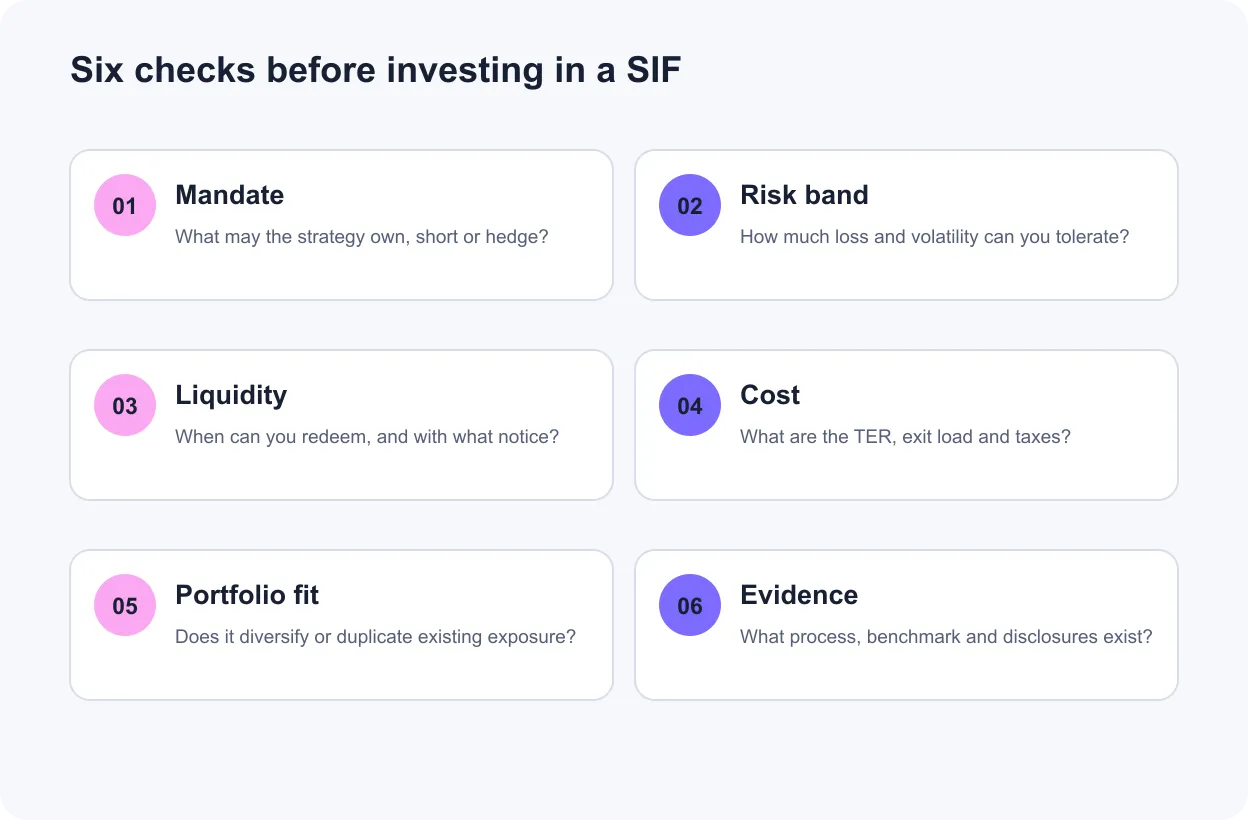
Begin with the mandate. Identify what the manager can buy, short or hedge and the maximum exposure allowed. Then examine the evidence: experience with the stated strategy, a relevant benchmark, live performance where available and an explanation of how risk is controlled. A specialised investment fund with a clever label but an unclear process is difficult to monitor.
Specialised investment fund costs deserve their own line in the decision. Review the total expense ratio, exit load, transaction intensity and tax implications. For interval strategies, note the dealing window and notice period. Check portfolio overlap with mutual funds, direct stocks and PMS holdings. A new wrapper does not create diversification when the underlying exposures are already present.
Final Takeaway
The Specialised Investment Fund fills a real structural gap. It gives eligible investors access to regulated pooled strategies with more flexibility than conventional mutual funds and a lower threshold than PMS. The strongest use case is not “higher return”, but a clearly defined portfolio job that requires tools unavailable in a simpler product.
That flexibility increases the burden on the investor. Strategy limits, short exposure, liquidity, fees, tax and manager execution all matter. A sound SIF vs mutual fund or SIF vs PMS comparison begins with the desired outcome and ends with after-cost risk, not the prestige of the wrapper. For SIF India to add value, investors must treat the ISID as the starting point and size the allocation within a diversified plan.
Is your portfolio built for what’s coming?
Get a free AI-powered review of your holdings — risk, overlap and quality in minutes.
FAQ
What is a Specialised Investment Fund (SIF)?
A SIF is a SEBI-regulated investment product offered within the mutual-fund framework that can use more flexible strategies, including limited long-short exposure. It ordinarily requires an aggregate investment of ₹10 lakh at PAN level across one SIF's strategies.
What is the minimum investment for SIF in India?
The standard minimum is ₹10 lakh in aggregate across all strategies offered by one SIF at PAN level. Accredited investors are exempt from the threshold. Investors should read the current ISID for contribution, redemption and breach rules.
How is SIF different from PMS?
A SIF is pooled and has a ₹10 lakh threshold. PMS manages a client-level portfolio and has a ₹50 lakh regulatory minimum. The SIF vs PMS choice therefore affects ownership, customisation, reporting, liquidity and fees.
How is SIF different from a mutual fund?
Both operate within the mutual-fund framework, but the SIF can use specified sophisticated strategies and limited unhedged derivative exposure. The SIF vs mutual fund comparison also includes a higher entry threshold and a distinct risk band.
Who should invest in a Specialised Investment Fund?
It may suit experienced investors who meet the threshold, understand the mandate and derivative risks, can tolerate loss and liquidity constraints, and need the strategy as part of a broader portfolio. It should not be selected only because it is new or complex.