


Alternative Investment Funds give sophisticated investors access to strategies that conventional funds may not offer. If you are asking what is AIF , the short answer is a privately pooled vehicle that collects capital from investors and deploys it under a defined policy.
The AIF meaning covers private equity, venture capital, private credit, infrastructure and complex listed-market strategies. An AIF for HNI portfolios may improve access and diversification, but it also brings illiquidity, higher fees and manager risk.
What Is an Alternative Investment Fund (AIF)?
Under SEBI rules, an AIF is an Indian privately pooled vehicle established as a trust, company, LLP or body corporate. It raises money from sophisticated investors for a stated strategy. When comparing alternative investment fund India choices, read the placement memorandum, not only the category label.
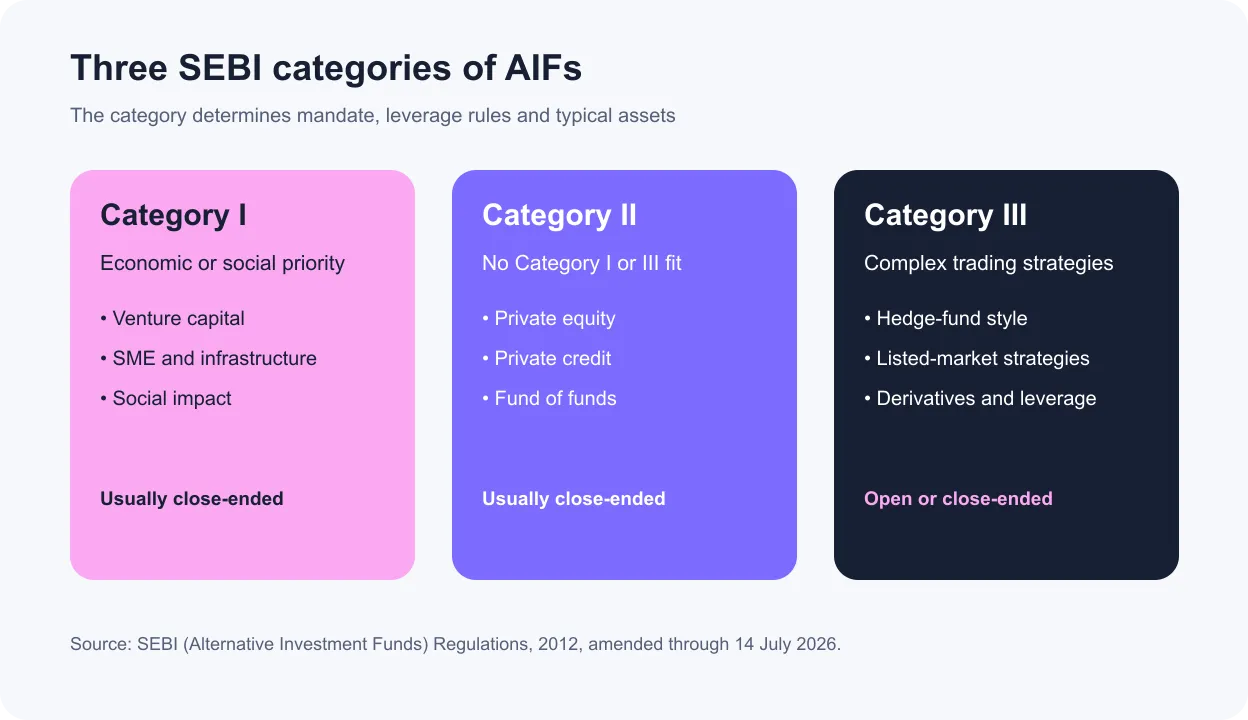
Categories of AIFs in India: I, II and III
Category I supports areas such as venture capital, SMEs, infrastructure and social impact. Category II includes private equity, debt funds and funds of funds without routine leverage. Category III may pursue complex trading strategies and use leverage. This category framework is central to the AIF meaning.
See what markets are pricing in
Live indices, sector moves and market breadth — the backdrop to every story we publish.
Minimum Investment and Eligibility Criteria
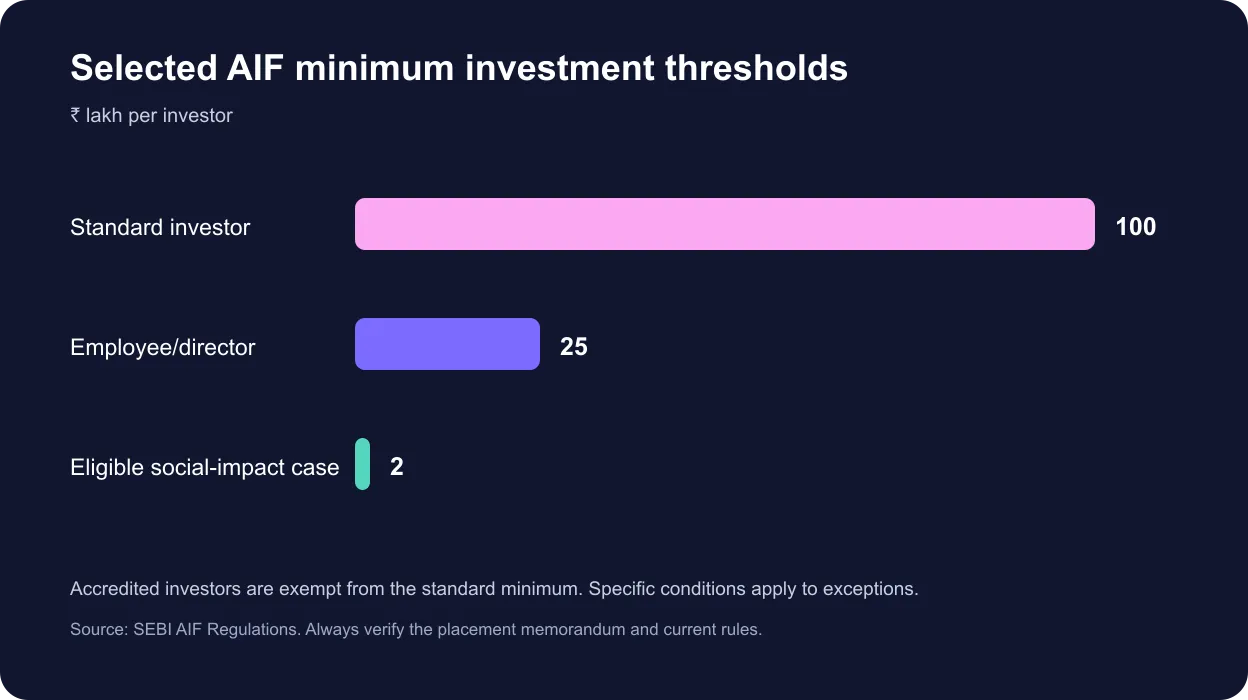
The usual minimum is ₹1 crore per investor. Employees or directors of the AIF or manager may invest from ₹25 lakh; accredited investors are exempt. A specified social-impact case has a ₹2 lakh minimum for individuals. An alternative investment fund India offer must also satisfy scheme-corpus and documentation rules.
How AIFs Differ from PMS and Mutual Funds
The AIF vs PMS distinction starts with pooling. AIF investors hold interests in a common scheme; PMS clients generally have client-level portfolios. In an AIF vs PMS comparison, the standard minimums are ₹1 crore and ₹50 lakh respectively. Mutual funds are more liquid, accessible and tightly standardised.
| Feature | AIF | PMS | Mutual fund |
|---|---|---|---|
| Standard minimum | ₹1 crore | ₹50 lakh | No comparable SEBI floor |
| Structure | Pooled scheme | Client-level portfolio | Pooled scheme |
| Liquidity | Often limited | Portfolio dependent | Usually higher |
| Typical complexity | High | High | Lower |
Key Benefits of Investing in AIFs
An AIF for HNI allocation can provide private-market access, specialist sourcing and exposure beyond listed stocks and bonds. The best case is a clearly defined portfolio role supported by manager access, governance and disciplined portfolio construction. Alternative investment fund India products should not be chosen merely because they appear exclusive or report an attractive recent return.
Get research like this in your inbox
The week’s research that mattered, in five minutes. Joined by 2L+ investors.
Risks and Considerations for HNI Investors
Capital may be locked for years, valuations can be judgement-based and exits may depend on market conditions. Fees, carried interest and concentration can reduce returns. Before selecting an AIF for HNI wealth, assess cash-flow commitments, conflicts, leverage, valuation policy and manager history.
Who Should Invest in an AIF?
An AIF for HNI portfolios may suit investors with surplus long-term capital, a diversified liquid core and the ability to absorb loss. It is unsuitable when the ₹1 crore commitment strains liquidity or when the investor cannot evaluate the strategy and placement memorandum.
How to Get Started with AIF Investing
Define the portfolio need, verify SEBI registration, read the placement memorandum and compare fees, tenure, drawdowns and exits. Run an AIF vs PMS comparison on ownership and liquidity, then review alternative investment fund India options within the same category. Seek independent tax and legal advice.
Conclusion
The practical AIF meaning is specialist access with specialist risk. A sound AIF vs PMS decision depends on structure, control and liquidity, not only minimum investment. Choose an AIF for HNI allocation only when its mandate adds something useful to the total portfolio. Suitability matters more than exclusivity.
Is your portfolio built for what’s coming?
Get a free AI-powered review of your holdings — risk, overlap and quality in minutes.
FAQ
What is AIF (Alternative Investment Fund)?
An AIF is a privately pooled, SEBI-regulated investment vehicle that follows a stated alternative strategy for sophisticated investors.
What is the minimum investment for AIF in India?
The standard minimum is ₹1 crore per investor. Employees or directors may invest from ₹25 lakh, accredited investors are exempt, and specified social-impact cases have separate rules.
What is the difference between AIF and PMS?
AIFs pool investors into one fund or scheme. PMS generally manages securities in a client-level portfolio and has a ₹50 lakh regulatory minimum.
What are the categories of AIF in India?
Category I covers priority sectors, Category II includes private equity and debt-style funds, and Category III may use complex or leveraged trading strategies.
Why do HNIs invest in AIFs?
HNIs may seek private-market access, specialist expertise or diversification, but must accept higher fees, illiquidity and strategy risk.