


Learning how to read an annual report helps investors move beyond headlines and management presentations. The document brings audited financial statements, board commentary, governance disclosures and detailed notes into one place.
Good annual report analysis is not a cover-to-cover reading contest. It is a structured comparison of narrative and numbers across several years. This guide explains the main annual report sections , a sensible reading order and the disclosures that deserve follow-up.
Use the report as an evidence trail, connecting management claims to audited numbers and notes.
What Is an Annual Report and Why Does It Matter?
An annual report is a yearly communication containing financial statements and statutory disclosures alongside management and board reports. Under India’s Companies Act, financial statements, the auditor’s report and the Board’s report are connected parts of the reporting package. Listed entities also follow SEBI disclosure requirements.
For investors, the document shows how a company made money, funded operations, invested, borrowed, paid shareholders and governed itself. It also explains accounting policies and estimates that cannot be understood from a single profit figure. This is why learning how to read annual report material matters before valuation.
The report does not remove uncertainty. Management prepares the accounts and describes performance; auditors provide an opinion on the financial statements, not a guarantee of future success. Effective annual report analysis compares disclosures with prior years, competitors and exchange announcements.
A reader deciding how to read an annual report should first define the question. A long-term shareholder may focus on cash generation, capital allocation and governance, while a lender may emphasise liquidity and covenants. Write down the investment thesis before reading, then record evidence that supports or contradicts it. This prevents a large document from becoming a collection of disconnected facts.
See what markets are pricing in
Live indices, sector moves and market breadth — the backdrop to every story we publish.
Where to Find a Company's Annual Report
Start with the investor-relations section of the company’s official website. For a listed company, also use official stock-exchange filing pages. Confirm the legal entity, financial year and publication version rather than relying on a third-party summary.
Download both current and previous reports. Check whether the PDF includes standalone financials, consolidated financials or both. Consolidated accounts usually provide the better group-wide view when subsidiaries are material, while standalone accounts can still reveal parent-company dividends, loans and investments.
Anyone learning how to analyse annual report disclosures should also gather quarterly results, investor presentations and material-event filings. The annual document is central, but significant developments after year-end may appear elsewhere first.
The Best Order to Read an Annual Report
A focused process starts with the independent auditor’s report, then the three financial statements and notes. Next read MD&A, the Board’s report and governance sections. This order reduces the chance that a polished narrative anchors the interpretation before the evidence is examined.
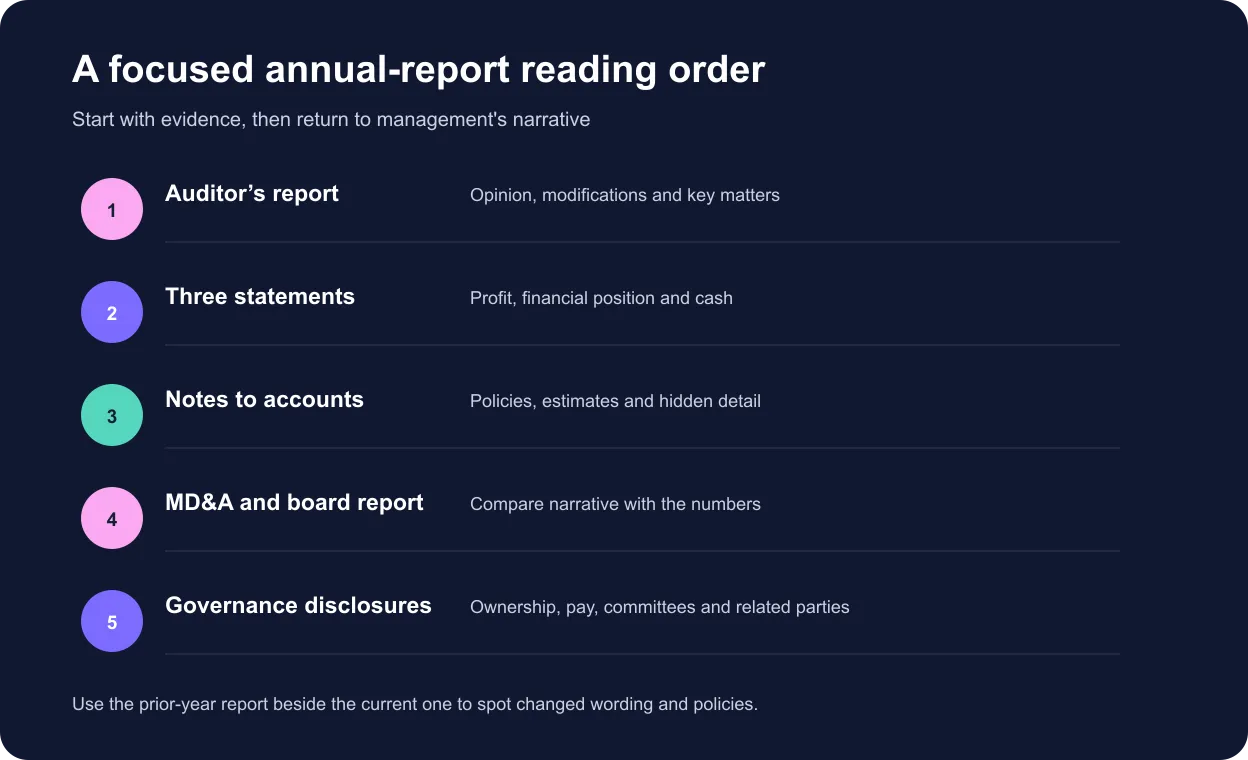
Within the annual report sections, mark every item that needs reconciliation: adjusted profit versus statutory profit, segment growth versus total revenue, debt changes versus financing cash flow, and management targets versus later outcomes. Keep a short question list instead of highlighting entire pages.
For a first pass on how to read an annual report, spend time on changes rather than decorative pages. Search the PDF for “qualification,” “emphasis,” “related party,” “contingent,” “impairment,” “pledge,” “default” and “restatement.” Context still matters, but targeted searches improve coverage.
When learning how to analyse annual report information, build a three-year comparison sheet. Capture revenue, operating profit, operating cash, capital expenditure, debt, diluted shares and major related-party balances. Beside each figure, note the relevant page and policy. This compact record makes trend breaks visible and creates an audit trail for every conclusion without copying the entire document.
Management Discussion & Analysis (MD&A)
The MD&A annual report section connects industry conditions and operational performance with the financial outcome. SEBI’s framework expects discussion of industry structure, opportunities and threats, segment or product performance, outlook, risks, controls and financial performance.
Separate description from evidence. If management cites strong demand, compare volume, pricing, receivables and inventory. If it blames an external shock, check whether peers faced the same effect. If margins improved, identify whether the cause was price, mix, temporary input costs or accounting classification.
A useful MD&A annual report review compares prior promises with actual delivery. Track capacity additions, market-share claims, margin guidance and debt-reduction plans. Annual report analysis becomes more valuable when it measures consistency over time instead of judging one year in isolation.
Profit & Loss, Balance Sheet and Cash Flow Statement
The profit and loss statement reports revenue, expenses, finance costs, tax and profit for a period. Compare growth with margins and earnings per share. Identify exceptional items and changes in other income. Profit growth driven mainly by non-operating gains deserves different treatment from growth in core operations.
The balance sheet reports assets, liabilities and equity at year-end. Examine cash, receivables, inventory, fixed assets, goodwill, debt, provisions and working capital. Rising receivables may be reasonable during expansion, but persistent growth faster than sales needs explanation.
The cash flow statement annual report section classifies cash into operating, investing and financing activities under Ind AS 7. Operating cash shows cash generated by core activities after working-capital effects. Investing cash captures assets and investments; financing cash captures debt, equity, dividends and similar funding flows.
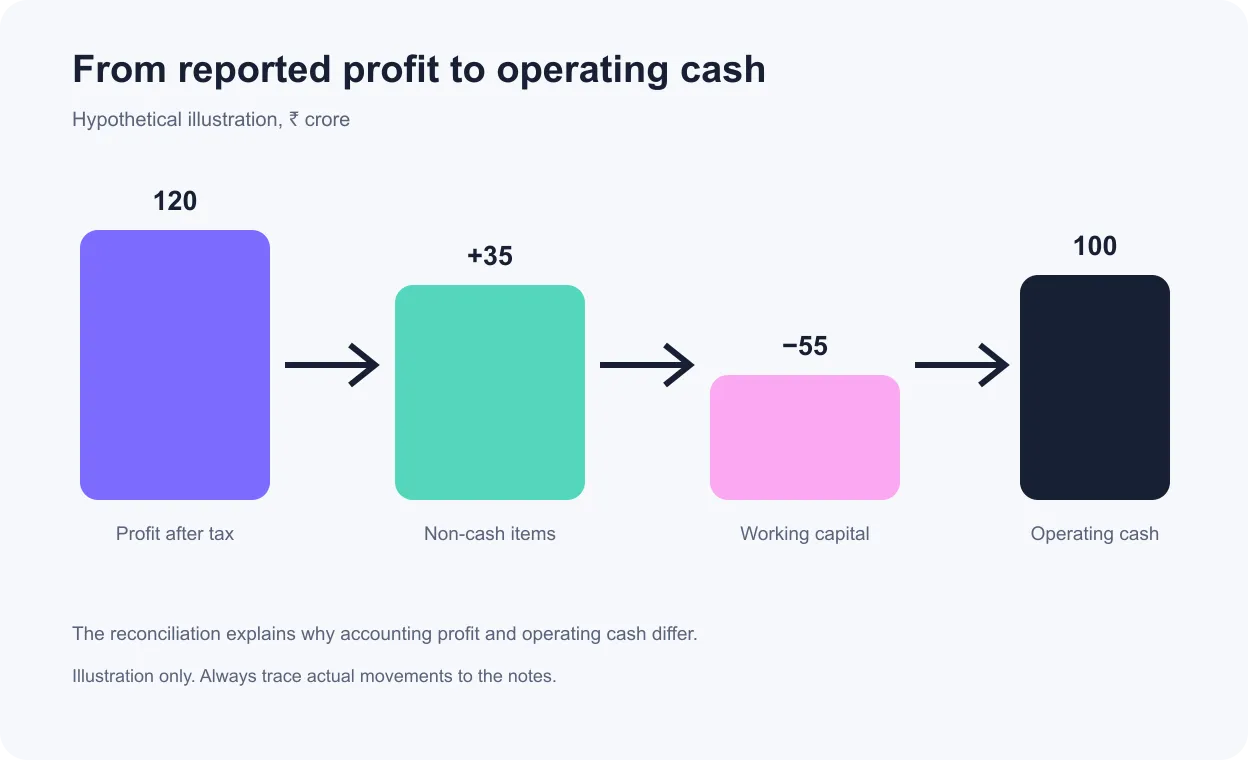
To understand the cash flow statement annual report, reconcile profit with operating cash, then compare operating cash with capital expenditure. A single weak year may reflect temporary working capital; a multi-year gap may signal aggressive revenue recognition, poor collection or a structurally cash-hungry model.
Another lesson in how to read an annual report is to reconcile statement totals with their notes. Segment revenue should connect to consolidated revenue, debt notes to balance-sheet borrowings and dividend payments to financing cash flow. Differences may have valid consolidation or non-cash explanations, but unexplained gaps are questions for further research rather than numbers to ignore.
Get research like this in your inbox
The week’s research that mattered, in five minutes. Joined by 2L+ investors.
Notes to Accounts, Related Parties and Contingent Liabilities
Notes are not an appendix to skip. They define accounting policies, break totals into components and disclose judgements. Review revenue recognition, useful lives, impairment, provisions, leases, employee benefits, taxes and financial instruments. Policy changes can alter comparability even when the business has not changed.
Related-party disclosures identify transactions and balances involving promoters, subsidiaries, associates, key management and connected entities. Not every transaction is problematic, but investors should assess commercial rationale, pricing, approvals, size and repetition. Loans, guarantees and asset transfers deserve particular attention.
Contingent liabilities cover possible obligations whose outcome or amount is uncertain. Compare them with net worth, cash and profit, and read the nature of disputes. Learning how to read annual report notes means asking whether several individually small risks could become material together.
| Disclosure | What to inspect | Question to ask |
|---|---|---|
| Receivables | Ageing, concentration and credit losses | Is cash collection keeping pace with sales? |
| Related parties | Nature, amount, balance and approvals | Is the transaction commercially reasonable? |
| Contingencies | Tax, legal, guarantees and commitments | Could the downside be material? |
| Goodwill | Acquisitions and impairment assumptions | Are expected benefits still credible? |
| Debt | Maturity, security, covenants and rates | Can cash flows meet obligations? |
Auditor's Report and Key Audit Matters
Read the audit opinion first. An unmodified opinion is not a statement that the company is risk-free; it says the financial statements are presented fairly, in all material respects, under the applicable framework. Modified opinions, emphasis paragraphs and going-concern disclosures require careful follow-up.
Under ICAI’s SA 701, key audit matters are selected from matters communicated with those charged with governance and judged most significant in the audit. They often involve revenue recognition, impairment, litigation, inventory or complex estimates. Read why the matter was significant and how the auditor addressed it.
Key audit matters do not automatically signal wrongdoing, and their absence does not eliminate risk. Good annual report analysis links each matter to the relevant note, accounting judgement and year-on-year change. Also review internal financial-control reporting and explanations of qualifications.
Investors studying how to read annual report audit language should distinguish a key audit matter from a modified opinion. A key matter describes an area requiring significant auditor attention. A qualified, adverse or disclaimer opinion changes the conclusion on the statements or the auditor's ability to conclude. Read the basis paragraph and management's response in full.
Corporate Governance and Shareholding Disclosures
Governance disclosures cover board composition, committees, attendance, remuneration, policies and compliance. Look beyond the number of independent directors. Assess relevant experience, tenure, meeting participation, committee leadership and whether pay outcomes align with long-term performance.
Review promoter and public shareholding, pledged shares, institutional changes and dilution. A pledge is not automatically a failure, but rising pledge levels can create financing and control risk. Compare equity issuance with acquisitions, employee compensation and per-share growth.
For how to analyse annual report governance, connect related parties, remuneration and capital allocation. Repeated transactions with promoter-linked entities, unexplained loans or weak disclosure quality deserve questions. The annual report sections should form one consistent account of ownership and oversight.
How to read an annual report also means checking whether board oversight matches the company's risks. A lender-heavy business needs strong audit and risk controls; a consumer company may require expertise in brands and distribution. Review committee attendance and changes in directors or senior management. Sudden departures are not proof of a problem, but they should be compared with subsequent disclosures.
Common Red Flags to Look For
Red flags include modified audit opinions, repeated restatements, auditor resignations, delayed filings, unexplained policy changes and large contingent liabilities. Financial patterns include receivables or inventory rising much faster than sales, persistent profit without operating cash and repeated “one-off” adjustments.
Also watch for frequent equity dilution, aggressive acquisitions, high promoter pledging, related-party transactions without clear rationale and debt maturities unsupported by cash generation. In the cash flow statement annual report, financing inflows that repeatedly fund operating shortfalls may indicate a fragile model.
No single signal proves misconduct. The purpose of how to read annual report disclosures is to identify inconsistencies that need evidence. Compare multiple years, read exchange filings and distinguish temporary stress from recurring behaviour. A disciplined how to read annual report process ends with a list of facts, assumptions and unanswered questions.
Finish with a written summary that separates verified facts, management claims, estimates and unresolved questions. Note which risks may be reflected in the price only after completing the business review. Save the report, comparison sheet and source links together. At the next annual cycle, begin by checking whether last year's promises, risks and accounting judgements changed as expected. This creates continuity and reduces hindsight bias.
Is your portfolio built for what’s coming?
Get a free AI-powered review of your holdings — risk, overlap and quality in minutes.
FAQ
What is an annual report?
An annual report is a company’s yearly package of audited financial statements, management and board commentary, governance disclosures and statutory information. Its exact contents depend on the company and applicable Indian law and listing requirements.
Which sections of an annual report should investors read first?
Begin with the auditor’s opinion and key audit matters, then review the financial statements, cash flows and notes. Read management commentary after forming an initial view from the evidence.
What is MD&A in an annual report?
Management Discussion and Analysis explains industry conditions, opportunities, threats, segment performance, outlook, risks, internal controls and the relationship between operational and financial performance.
How do you read an annual report's cash flow statement?
Separate operating, investing and financing cash flows. Reconcile operating cash with profit, examine working capital, capital expenditure, borrowing and dividends, and compare the pattern over several years.
What red flags should investors look for?
Watch for modified audit opinions, repeated cash conversion weakness, rising receivables, unexplained related-party dealings, contingent liabilities, dilution, high promoter pledging, frequent policy changes and management narratives that conflict with the accounts.
Where can I find a company's annual report?
Use the investor-relations section of the company website or official stock-exchange filings. Check the company name, financial year and whether the document contains standalone, consolidated or both sets of accounts.