


Options trading for beginners starts with understanding a contract, not predicting the next market move. An option buyer obtains a right, but not an obligation, to buy or sell an underlying asset at a strike price by the applicable expiry. The seller accepts the corresponding obligation.
Learning how to trade options also means learning how premium, time decay, implied volatility, liquidity and lot size affect outcomes. This guide explains how to start options trading in India with defined risk and why leverage deserves caution.
What Is Options Trading?
Options are exchange-traded derivatives whose value depends on an underlying index or security. A call gives its buyer the right to buy; a put gives its buyer the right to sell. In both cases, the buyer pays a premium. This foundation is essential for options trading for beginners.
To understand how to do options trading , learn five fields on an order ticket: underlying, call or put, strike, expiry and quantity. A buyer’s loss is generally limited to premium paid, while an uncovered seller may face losses far beyond premium received. Knowing how to trade options therefore requires separating buyer and seller payoffs.
See what markets are pricing in
Live indices, sector moves and market breadth — the backdrop to every story we publish.
How to Start Options Trading in India
Anyone researching how to start options trading needs a trading and demat relationship with a SEBI-registered intermediary and activation of the derivatives segment. Complete the broker’s suitability and documentation process, read the risk disclosure, and verify exchange specifications.
For options trading for beginners, cash-market knowledge should come first. Learn calls, puts, moneyness, premium and expiry. Paper-trade one defined-risk setup before funding it. How to do options trading safely is less about finding a shortcut and more about imposing a rupee loss limit.
Step-by-Step: Placing Your First Options Trade
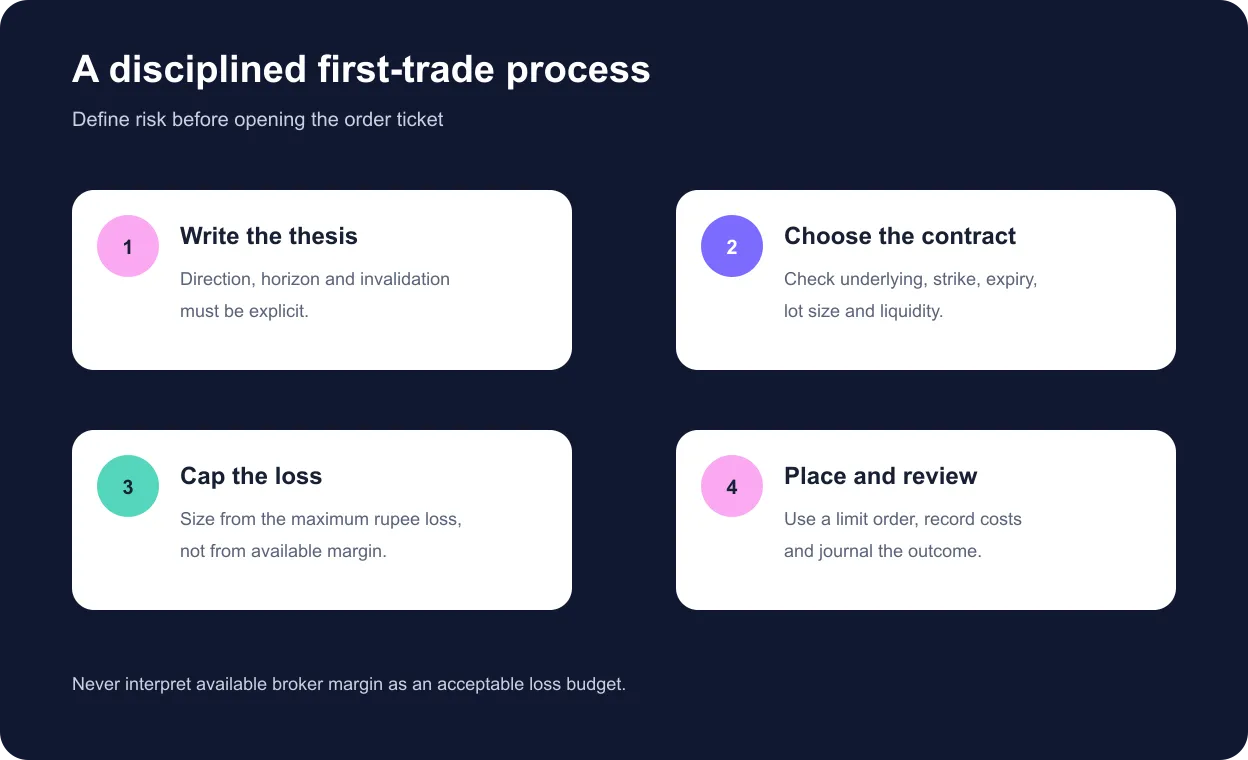
First, write a directional view and the condition that would prove it wrong. Second, choose the underlying and expiry. Third, inspect bid-ask spread and traded volume. Fourth, calculate premium multiplied by lot size before deciding how to trade options.
Next, choose quantity from your loss budget, not broker margin. Enter a limit order, define the exit and avoid changing it emotionally. After closing, record premium, charges and execution quality. This repeatable sequence explains how to do options trading without treating every trade as a fresh gamble. Practise how to trade options and how to do options trading on paper first.
Risks and Benefits of Options Trading
The main option trading risks and benefits arise from asymmetric payoffs. Buyers can define maximum premium loss and use calls or puts for directional exposure or hedging. Yet a purchased option can expire worthless even when the broad direction was correct because timing, strike and volatility matter.
Sellers receive premium but face margin demands and potentially severe losses, especially when uncovered. Time decay helps sellers and hurts buyers, while a fall in implied volatility can reduce an option’s price. Options trading for beginners should therefore favour transparent, defined-risk positions over naked selling.
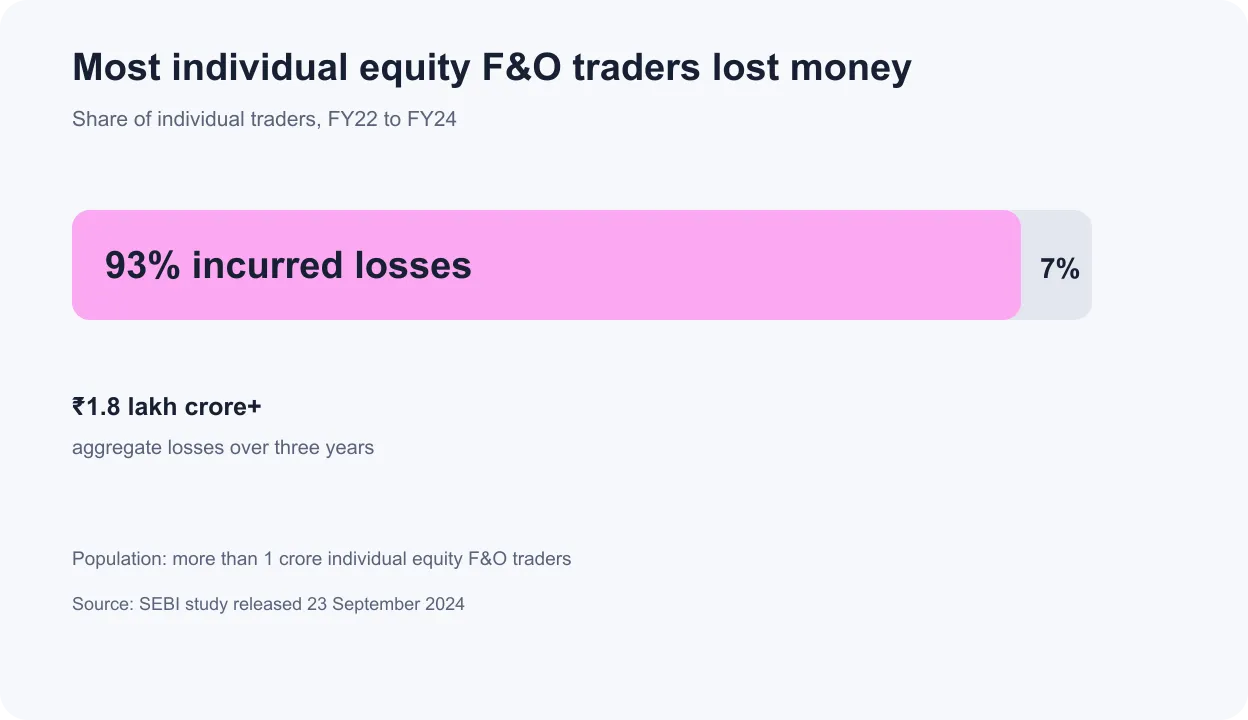
SEBI reported that 93% of more than one crore individual equity F&O traders incurred losses during FY22 to FY24, with aggregate losses above ₹1.8 lakh crore. Any discussion of option trading risks and benefits must put that evidence ahead of exceptional profit stories.
Get research like this in your inbox
The week’s research that mattered, in five minutes. Joined by 2L+ investors.
How Much Capital Do You Need to Begin?
There is no responsible universal starting figure. Capital depends on premium, exchange lot size, strategy and broker margin. When deciding how to start options trading, calculate the maximum rupee loss for the entire position, then keep that amount within a small pre-set part of risk capital.
| Input | What to check | Why it matters |
|---|---|---|
| Premium and lot size | Full contract outlay | Shows buyer’s premium at risk |
| Bid-ask spread | Difference between quotes | Raises entry and exit cost |
| Seller margin | Broker and clearing requirement | Can rise when volatility increases |
| Risk budget | Maximum acceptable rupee loss | Controls position size |
| Charges and taxes | Brokerage, statutory charges and STT | Reduces net return |
Options trading for beginners is not made safer merely by buying a low-priced contract. Cheap out-of-the-money options may have a high probability of expiring worthless. How to trade options responsibly begins with payoff and probability, not the smallest displayed premium.
Is Options Trading Profitable for Beginners?
Profit is possible, but consistency requires an edge after costs and disciplined execution. The loss data show why promises are misleading. A useful answer to how to do options trading is to measure results across many comparable trades, including brokerage, slippage and taxes.
Beginners should set learning goals before return goals. Track whether entries matched the plan, losses stayed within limits and sizing remained consistent. Options trading for beginners becomes dangerous when a short winning streak is mistaken for skill or when losses trigger larger positions.
Common Mistakes New Options Traders Make
Common errors include buying only because premium looks cheap, ignoring expiry, trading illiquid strikes, averaging a losing position and selling uncovered options without understanding tail risk. Another mistake is studying how to trade options from screenshots that omit losing trades and costs.
Anyone learning how to do options trading should avoid using emergency savings or borrowed money. Review option trading risks and benefits before each strategy, keep a trade journal and stop when the daily loss cap is reached. Knowing how to start options trading includes knowing when not to trade.
Conclusion
Options trading for beginners should be approached as risk education. Learn the contract, practise how to trade options, size from maximum loss and verify NSE specifications. How to do options trading well is a process, not a prediction contest. Review how to trade options and how to do options trading with fixed rules.
Start small only after understanding option trading risks and benefits. A defined-risk structure, liquid contract, written exit and honest journal offer a sounder foundation than leverage or tips.
Is your portfolio built for what’s coming?
Get a free AI-powered review of your holdings — risk, overlap and quality in minutes.
FAQ
How do I start options trading as a beginner?
Begin with cash-market knowledge, complete the broker’s derivatives activation process, learn contract specifications and practise a defined-risk setup. Start only with capital you can afford to lose.
How do you trade options step-by-step?
Form a market view, select the underlying and expiry, compare strikes and liquidity, calculate the maximum loss, choose quantity, place a limit order, monitor the exit rule and journal the result.
What are the risks and benefits of options trading?
Options can provide defined-risk exposure, hedging and strategic flexibility. Risks include total premium loss for buyers, potentially very large losses for uncovered sellers, time decay, volatility changes, leverage and execution costs.
How much money do I need to start options trading in India?
There is no universal amount. The requirement depends on premium, lot size, strategy and broker margin. Your risk budget should be smaller than available capital and based on the maximum plausible loss.
Is options trading profitable for beginners?
It can produce profits, but profitability is not assured. SEBI found that 93% of individual equity F&O traders incurred losses during FY22 to FY24, making risk control and realistic expectations essential.