


Intraday trading for beginners means opening and closing a market position within the same trading day. The practical intraday trading meaning is simple, but execution is demanding because price, liquidity, costs and emotion change quickly.
Learning how to do intraday trading begins before an order is placed. A trader needs a defined setup, entry condition, invalidation level, position size and daily loss cap. This guide covers each intraday trading basic without presenting short-term trading as easy income.
A trading day should begin with a written risk plan, not an impulsive order.
What Is Intraday Trading?
The intraday trading meaning is that buy and sell transactions are completed on the same session. A long trader buys first and sells later; a short intraday trader sells first and buys back, subject to broker and exchange rules. Positions are not intended for overnight delivery.
Knowing how to do intraday trading requires understanding order types. A market order seeks immediate execution but gives less price control. A limit order controls price but may remain unfilled. A stop order activates after a trigger, yet the final execution may differ in a fast market.
For intraday trading for beginners, the key distinction is between a planned trade and constant activity. The intraday trading basic workflow is observe, wait for the setup, calculate risk, place the order and exit according to a written rule.
See what markets are pricing in
Live indices, sector moves and market breadth — the backdrop to every story we publish.
How Intraday Trading Differs from Delivery Trading
Delivery investing carries shares beyond the session and exposes the investor to overnight news and gaps. Intraday positions are closed during the day, removing overnight exposure but compressing decisions into hours or minutes. That time pressure is central to the intraday trading meaning. The intraday trading meaning excludes planned overnight holding.
| Feature | Intraday trading | Delivery trading |
|---|---|---|
| Holding period | Opened and closed the same day | Held beyond the session |
| Main exposure | Fast price moves, execution and leverage | Business, valuation and overnight developments |
| Decision horizon | Minutes to hours | Days to years |
| Capital treatment | Broker product rules may permit leverage | Usually funded for delivery |
| Cost sensitivity | High because turnover can be frequent | Generally lower with infrequent trades |
One of the perceived benefits of intraday trading is avoiding overnight gaps. However, repeated brokerage, taxes, exchange charges, bid-ask spreads and slippage can consume small gains. Learning how to do intraday trading includes calculating net, not headline, returns. The intraday trading meaning also makes execution costs unusually visible.
How to Start Intraday Trading as a Beginner
Begin with a trading and demat arrangement through a SEBI-registered intermediary. Review the broker’s intraday product, leverage, risk controls and automatic square-off time. NSE’s normal equity market currently runs from 9:15 a.m. to 3:30 p.m., subject to holidays and special sessions.
Next, choose a small list of liquid securities and one observable setup. Paper-trade it across different market conditions. Anyone asking how to do intraday trading should record entry, stop, target, charges and whether rules were followed, not only profit or loss. Studying how to do intraday trading requires reviewing failed setups too.
Intraday trading for beginners should start without borrowed money and without using the maximum available leverage. The intraday trading basic lesson is that position size comes from acceptable loss: planned rupee loss divided by risk per share.
Benefits of Intraday Trading
The benefits of intraday trading can include no overnight market exposure, quick feedback on a defined setup and the ability to remain in cash when no opportunity exists. Capital is committed for a shorter period, although that does not make its use automatically efficient.
Another part of the intraday trading meaning is flexibility across rising and falling prices, where permitted. Yet the benefits of intraday trading depend on liquidity, discipline and an edge after costs. Frequent activity alone is not a benefit. The intraday trading meaning does not imply constant trading.
For intraday trading for beginners, the most useful potential benefit is measurable learning. A journal can reveal whether results come from a repeatable setup or random outcomes. Understanding how to do intraday trading means testing that evidence over many trades.
Get research like this in your inbox
The week’s research that mattered, in five minutes. Joined by 2L+ investors.
Risks of Intraday Trading for Beginners
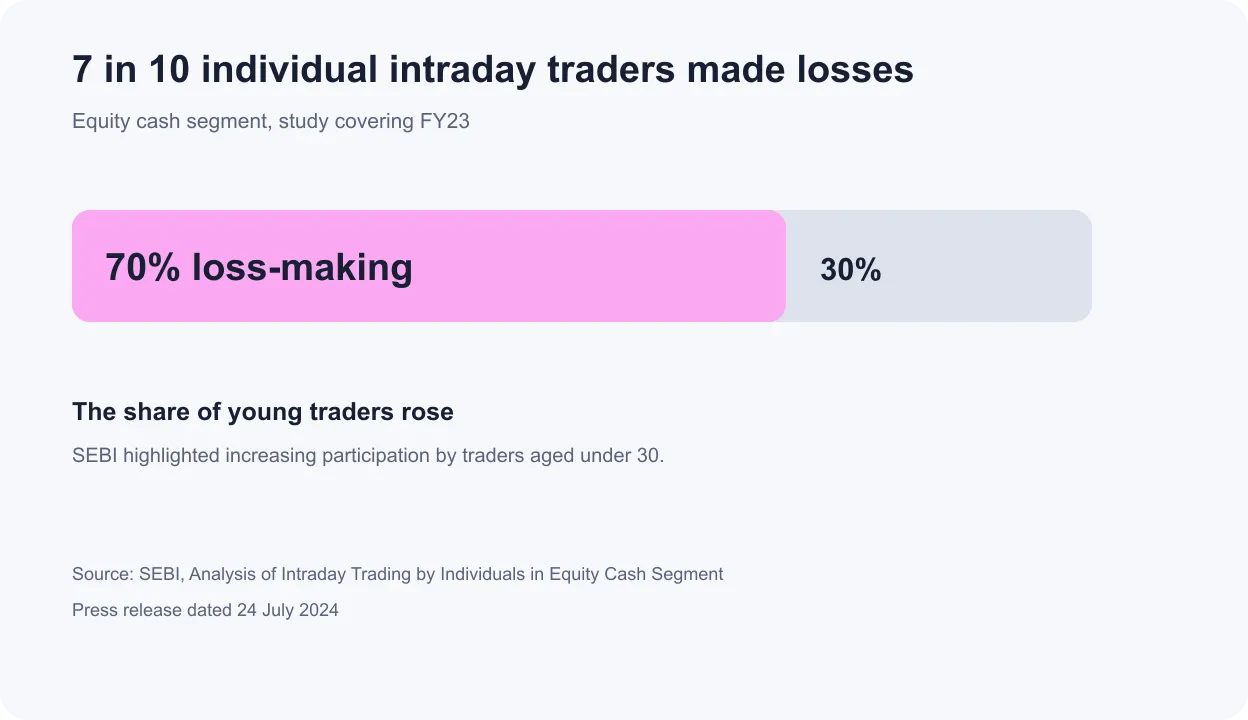
SEBI found that 7 out of 10 individual intraday traders in the equity cash segment made losses in its FY23 study. This evidence should frame every discussion of the benefits of intraday trading and every promise about easy daily income.
Risks include leverage, gaps between expected and executed prices, sudden liquidity loss, false breakouts, technology outages and emotional revenge trading. For intraday trading for beginners, a stop-loss order is a risk tool, not a guaranteed execution price.
How to do intraday trading safely also requires controlling turnover. A small apparent edge can disappear after charges and slippage. The intraday trading meaning is therefore not “risk ends by closing time”; risk is concentrated within the session. Understanding how to do intraday trading includes planning for failed orders. This risk concentration defines the intraday trading meaning.
Capital Required to Start Intraday Trading in India
No fixed amount suits everyone. Required capital depends on share price, position size, stop distance, liquidity, broker rules and costs. When planning how to do intraday trading, decide the maximum loss first and calculate quantity from that limit. Capital discipline is part of the intraday trading meaning.
Suppose a hypothetical setup risks ₹4 per share and the trader’s maximum planned loss is ₹400. Before costs and slippage, the risk-based quantity is 100 shares. This intraday trading basic calculation is not a recommendation and should be reduced when execution is uncertain.
Intraday trading for beginners should use risk capital only. Emergency funds, rent money and borrowed capital are unsuitable. Available margin can be far larger than the loss a person can absorb, so how to do intraday trading is never answered by a broker’s leverage number.
Tips for Managing Risk in Intraday Trades
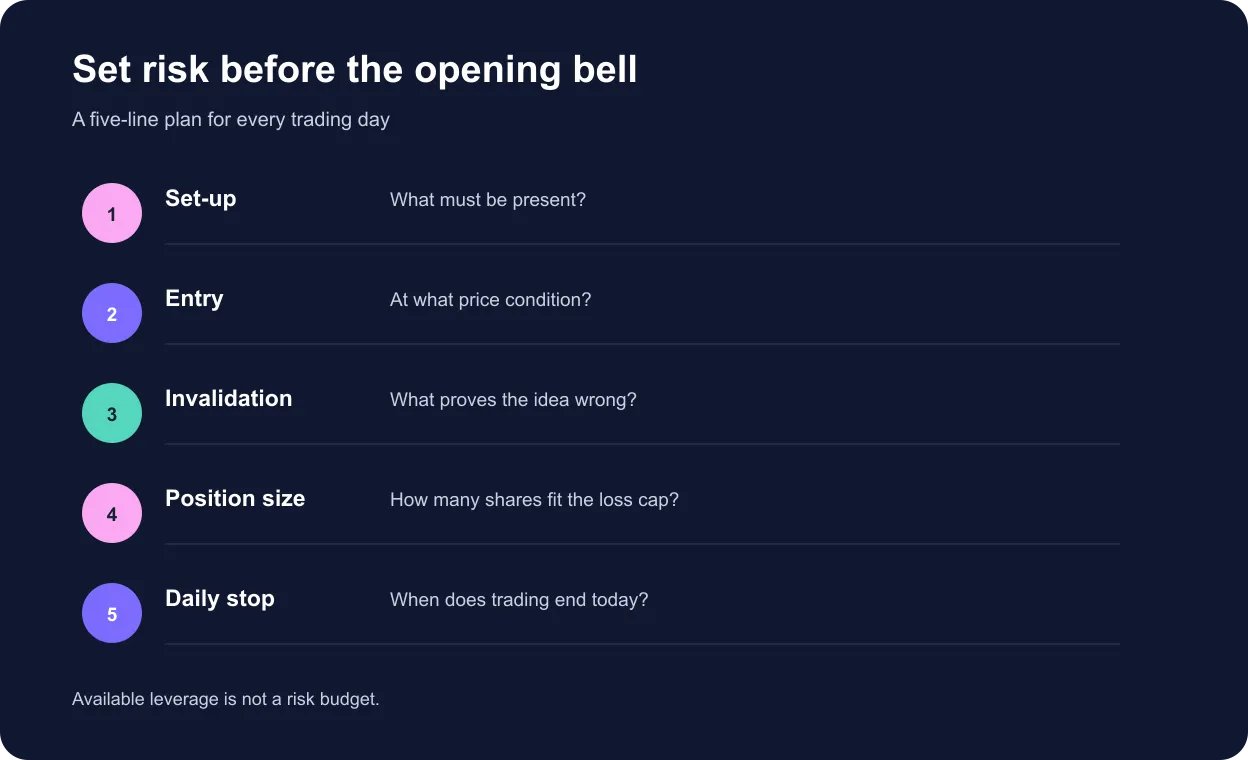
Write five items before the session: setup, entry, invalidation, quantity and daily stop. Then use alerts and limit orders where appropriate. A daily stop prevents one difficult session from turning into repeated attempts to recover losses.
To learn how to do intraday trading, review process metrics: rule adherence, average planned risk, slippage and costs. Do not widen a stop merely to avoid recording a loss. Stop trading if market liquidity changes or the platform behaves unexpectedly. Practising how to do intraday trading means respecting that stop.
For intraday trading for beginners, fewer high-quality decisions are usually more useful than constant orders. The intraday trading basic discipline is to preserve capital and attention. The benefits of intraday trading only matter if losses remain controlled.
Conclusion
The intraday trading meaning is same-session entry and exit, but success requires much more than speed. Learn how to do intraday trading through a narrow setup, risk-based sizing, realistic costs and a daily stop. This disciplined closure completes the intraday trading meaning.
Intraday trading for beginners should remain a controlled learning exercise. Balance the benefits of intraday trading against SEBI’s loss evidence, avoid leverage-driven sizing and judge progress by consistent decisions rather than one day’s result.
Is your portfolio built for what’s coming?
Get a free AI-powered review of your holdings — risk, overlap and quality in minutes.
FAQ
What is intraday trading meaning?
It means buying and selling a position within the same trading day rather than carrying it overnight. Broker treatment, product rules and auto square-off timing should be checked before placing an order.
How do I start intraday trading as a beginner?
Learn order types and transaction costs, select liquid securities, define one testable setup, practise without leverage, and set both per-trade and daily loss limits before using real capital.
What are the benefits of intraday trading?
Potential benefits include avoiding overnight price gaps, receiving rapid feedback and using capital for shorter holding periods. These advantages do not overcome costs, leverage risk or the high loss rate among individuals.
What are the risks of intraday trading for beginners?
Major risks include rapid losses, leverage, slippage, poor liquidity, technology failure, emotional overtrading and transaction costs. Stop orders can also execute away from their trigger during fast markets.
How much capital is needed to start intraday trading in India?
There is no universal minimum. Capital should follow the maximum planned rupee loss, position size, liquidity and charges, not the highest exposure a broker makes available.