


Quick Answer
Portfolio management services in India have historically produced mixed results against the Nifty 50. SEBI's PMSI data shows that while some alpha-generating PMS strategies outperform over five-year periods, many fail to beat a simple index after accounting for PMS charges. This article analyses real return data, survivorship bias, and factor analysis, and helps you decide whether PMS investment is right for your portfolio.
See what markets are pricing in
Live indices, sector moves and market breadth — the backdrop to every story we publish.
The Question Every PMS Investor Should Ask
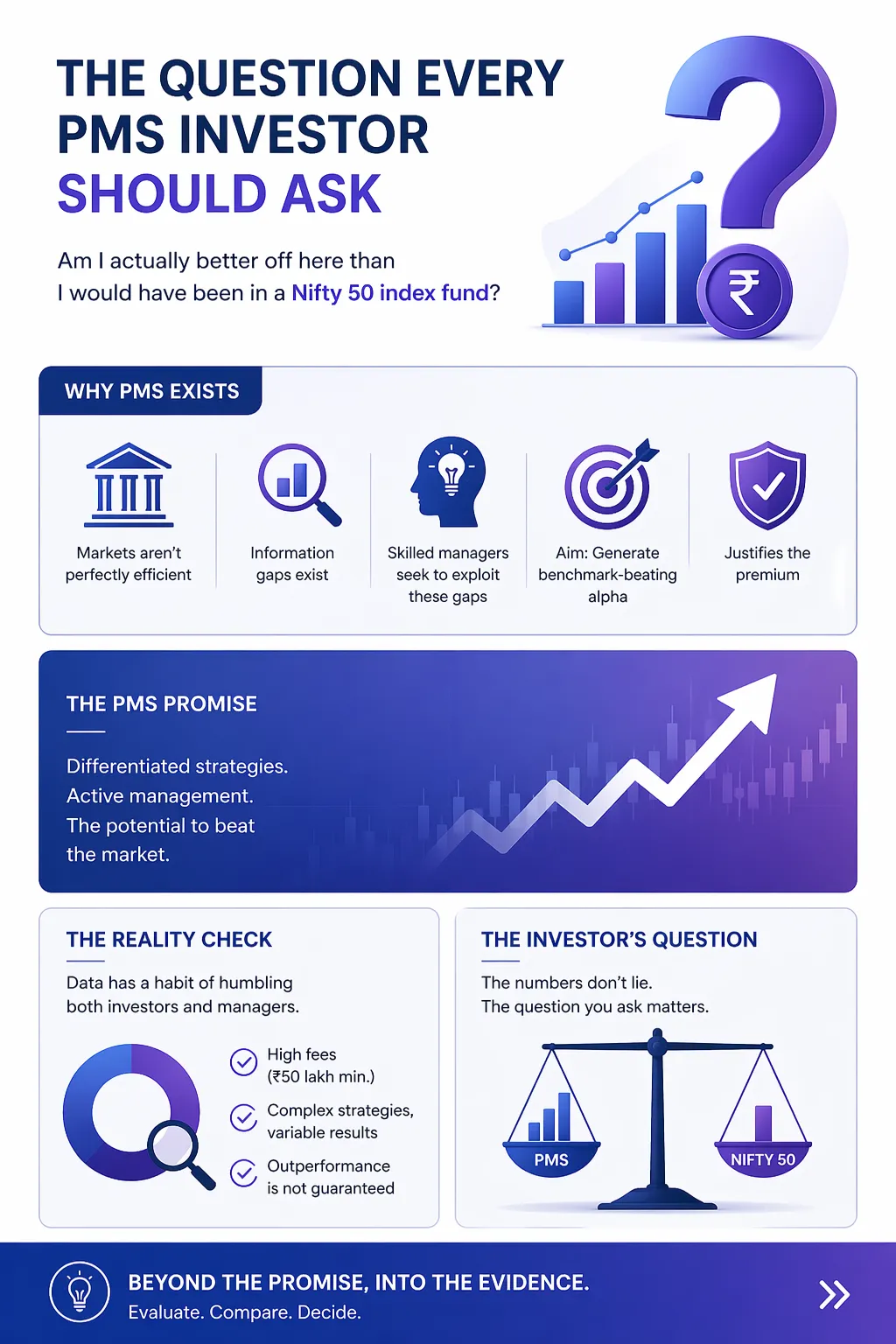
There is a version of this question that never quite leaves an investor's mind once they have written a cheque for ₹50 lakh. It sounds simple: Am I actually better off here than I would have been in a Nifty 50 index fund?
It is a fair question. Portfolio management services in India charge considerably more than mutual funds, carry a ₹50 lakh minimum entry threshold, and often promise differentiated strategies, quantitative, factor-based, thematic, concentrated equity. The implied pitch is almost always the same: we can beat the market. The evidence, however, is more complicated.
Active portfolio management has a long intellectual history. The argument for it is intuitive. Markets are not perfectly efficient, especially in a country like India, where institutional coverage of mid and small-cap companies remains patchy, and information asymmetry is real. Skilled fund managers, the argument goes, can exploit these gaps to generate benchmark-beating alpha PMS strategies that justify the premium.
But intuitions are not data. And in finance, data has a habit of humbling both investors and managers alike. So let us look at what the actual numbers say.
How PMS Returns Are Reported: TWRR, XIRR, and Why Comparisons Are Tricky
Before comparing any PMS performance figures against an index, you need to understand how those figures are actually calculated. This is not a trivial point.
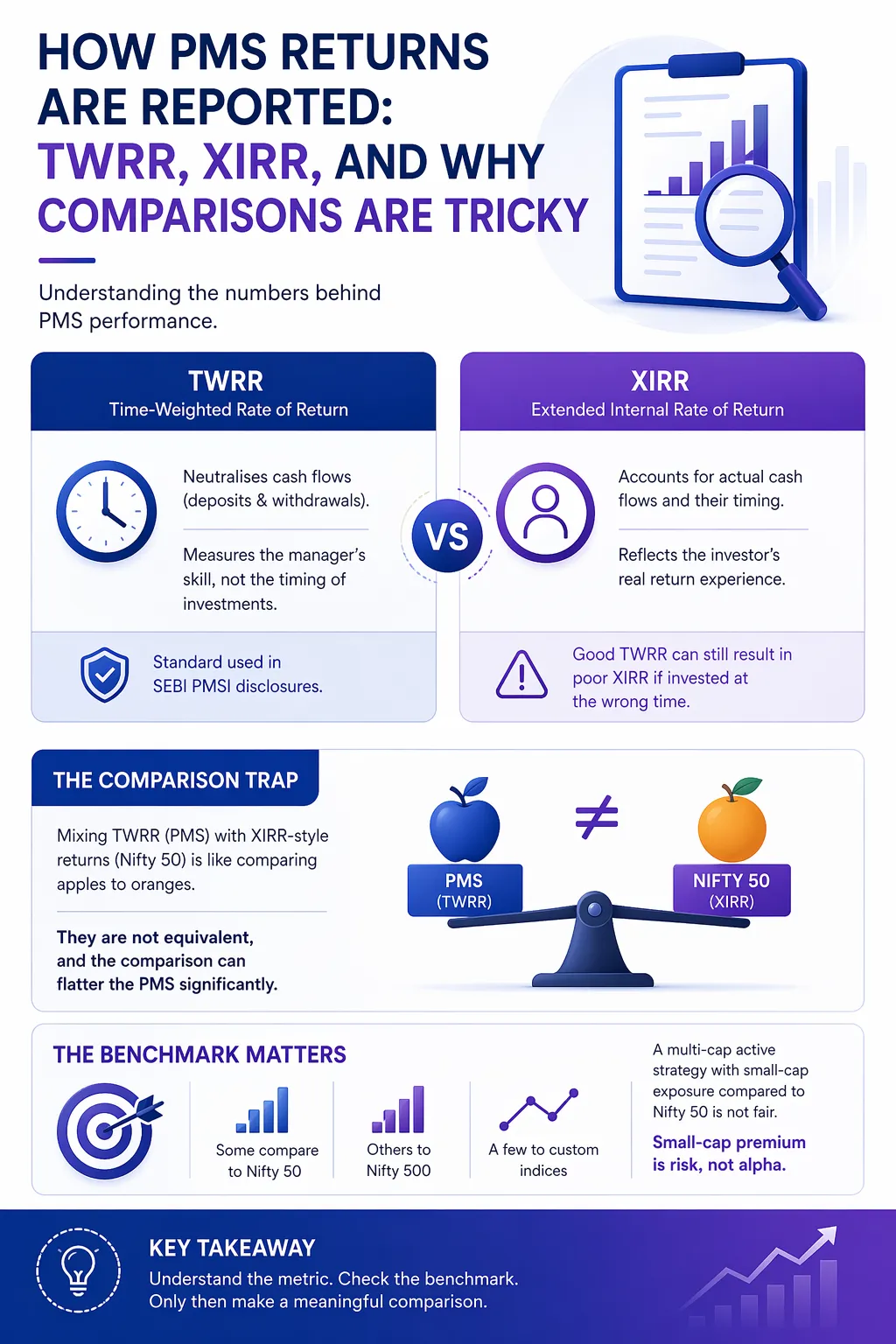
SEBI mandates that registered PMS service providers report returns using the Time-Weighted Rate of Return (TWRR). TWRR is designed to neutralise the impact of cash flows, specifically deposits and withdrawals by the client, so that what you are measuring is the manager's skill, not the timing of your investments. This is the standard used in all SEBI PMSI disclosures.
XIRR, by contrast, measures the actual return experienced by the investor, accounting for when they put in money and when they took it out. A manager who is skilled at TWRR could still produce a poor XIRR outcome for a client who invested at a market peak.
This distinction matters when you see a PMS returns India comparison table that mixes TWRR numbers for the PMS with XIRR-style calculations for the Nifty 50. They are not equivalent, and the comparison can flatter the PMS significantly.
The benchmark also matters. Some strategies compare themselves to the Nifty 50, others to the Nifty 500, and a few to custom indices that were never meant to be investable. A multi-cap active investing strategy that includes small-cap names and then compares itself to the Nifty 50 is not making a fair comparison. The small-cap premium is real, but it is not a manager's alpha; it is just risk.
What the SEBI PMSI Data Actually Shows: 3-Year and 5-Year PMS Returns
SEBI's PMSI (PMS Industry Insight) platform publishes performance data for registered PMS service providers. It is publicly available at pmsi.sebi.gov.in and updated quarterly. If you have not visited it, you should.
The headline finding from PMSI data across major PMS investment categories is roughly this: over 3-year periods, a meaningful number of discretionary equity PMS strategies have beaten the Nifty 50 on a TWRR basis. The picture over 5 years is more mixed. Returns tend to cluster around broad market returns, with a spread wide enough that manager selection becomes the dominant variable.
Based on publicly available PMSI disclosures as of early 2026, the average 5-year TWRR across equity-focused PMS strategies appears to range from approximately 14% to 22% per annum, depending on the category and year of inception. The Nifty 50 TRI delivered approximately 18–19% CAGR over the same five-year window ending March 2026. The Nifty 500 TRI, which includes mid and small caps, delivered closer to 22–24%.
This means that the average PMS performance figure, when stated on a gross basis, is not dramatically different from what an index investor would have received and, in some cases, trails the broader Nifty 500.
PMS vs Nifty 50 vs Nifty 500: The Head-to-Head Numbers
Here is a simplified comparison. These figures are illustrative of typical ranges drawn from SEBI PMSI data and publicly available index return data; they do not represent any single fund's performance and are not a recommendation.
Category | 3-Year TWRR (Gross) | 5-Year TWRR (Gross) | Benchmark |
Large-cap PMS (median) | ~17–19% | ~16–18% | Nifty 50 TRI: ~18–19% |
Multi-cap PMS (median) | ~18–22% | ~17–20% | Nifty 500 TRI: ~22–24% |
Mid/Small-cap PMS (median) | ~22–28% | ~19–23% | Nifty Midcap 150: ~25–27% |
Factor/Quant PMS (top quartile) | ~24–30% | ~22–26% | Style-adjusted benchmark |
Source: SEBI PMSI data (2023–2026), NSE index factsheets. Past performance is not indicative of future returns. All investments are subject to market risk.
A few things stand out in this data. First, the best alpha-generating PMS strategies are genuinely concentrated in factor-based and quantitative approaches. Second, the median large-cap PMS is struggling to beat a basic Nifty 50 index fund on a gross basis before fees. Third, factor investing strategies that tilt toward quality, momentum, or value factors show the most consistent outperformance over 5-year periods.
Get research like this in your inbox
The week’s research that mattered, in five minutes. Joined by 2L+ investors.
Survivorship Bias: Why Average PMS Returns Look Better Than They Are
This is the part that most PMS investment marketing material glosses over. And it is important.
Survivorship bias refers to the statistical distortion that occurs when underperforming or defunct funds are excluded from performance calculations. When a PMS strategy is shut down because it performed poorly, because the fund manager left, or because the AUM dropped below a viable level, its track record disappears from most industry averages. Only the winners remain in the sample.
The result is that any PMS performance average you read is probably overstated relative to what the average investor would have actually experienced. Studies of mutual fund performance globally and early academic work on Indian PMS returns suggest that survivorship bias can inflate reported average returns by 1–2% per annum over longer periods. That is not a small number.
For the best PMS India lists compiled by aggregator platforms, the bias is even more pronounced. Top-performing strategies of the past five years look spectacular in retrospect. But an investor choosing from the full universe of managers five years ago, including the ones that no longer exist today, would have had a very different distribution of outcomes.
This does not mean PMS services do not create value. It means the reported data systematically overstate how much.
What Separates Outperforming PMS from Underperforming Ones: Factor Analysis
If survivorship-adjusted data show that median active portfolio management does not reliably beat the market after fees, why do some managers consistently outperform? The answer, when you look at the data carefully, is almost always explainable through factor exposure.
Factor investing is the practice of systematically overweighting securities that share characteristics of quality, value, momentum, low volatility, or size that have historically been associated with excess returns above a market-cap-weighted benchmark. Academic research going back to Fama and French (1992) established that size and value factors explained much of active fund performance. More recent work has added momentum and profitability.
When you run factor attribution on the top-performing PMS returns in India strategies over the past five years, a consistent pattern emerges: the outperformers tend to have significant and deliberate factor tilts. A quality-and-momentum-oriented benchmark-beating alpha PMS strategy, for example, naturally avoids the weakest performers in the index while concentrating on businesses with strong earnings trends and high return on equity.
Portfolio risk management also separates the best managers from the rest. The PMS strategies that protected capital during the 2020 COVID crash and the 2022 mid-cap correction, while still participating in the recovery, delivered superior risk-adjusted returns, not just raw alpha. Drawdown management is an underrated skill.
Wright Research's own factor investing approach is built around exactly these principles, using quantitative signals to identify quality businesses trading at reasonable valuations, while maintaining systematic portfolio risk management to limit downside exposure.
The Cost Drag: How Fees Eat Into Gross Alpha
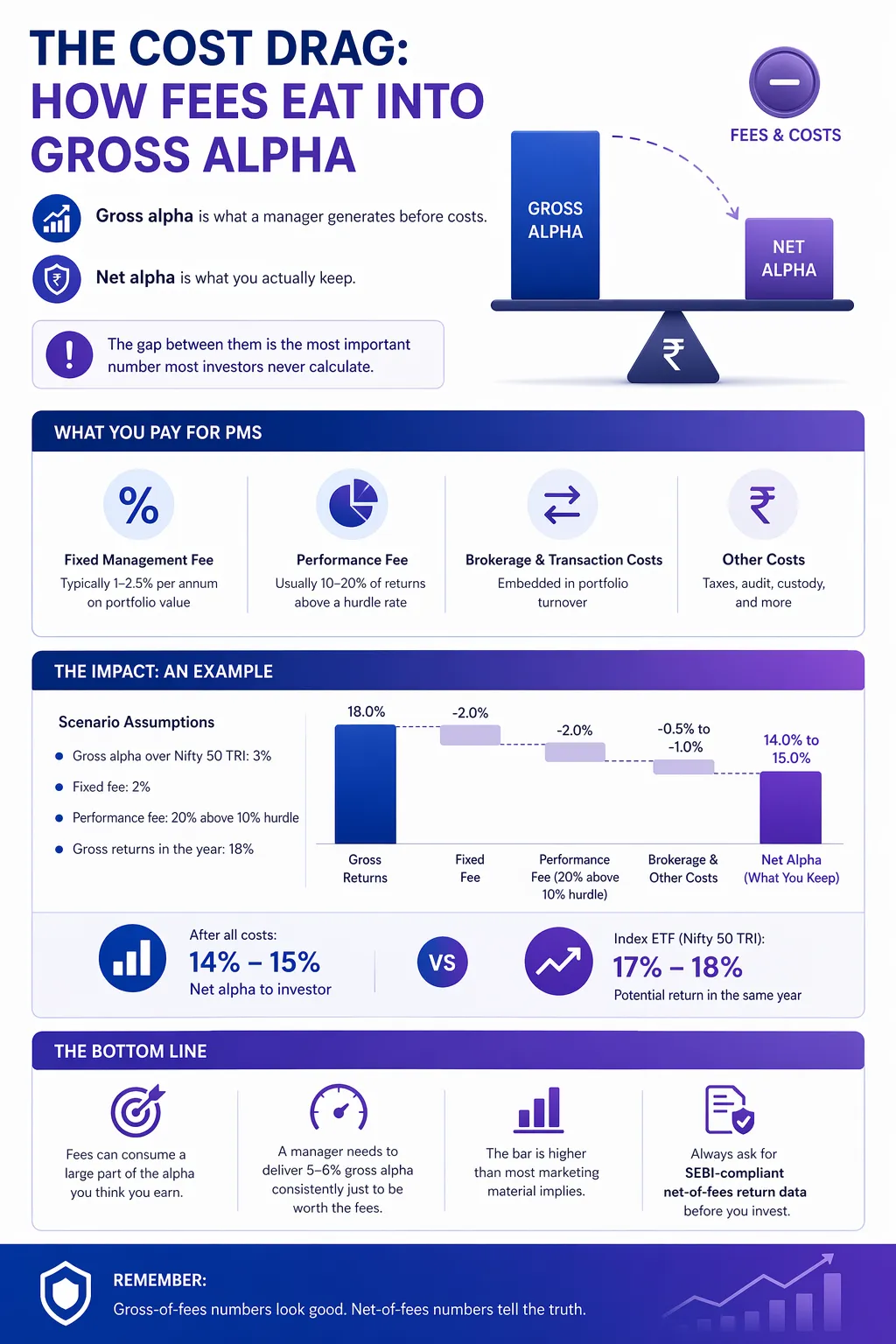
Gross alpha is what a manager generates before costs. Net alpha is what you actually keep. The gap between them is the most important number that most investors never calculate.
PMS charges in India typically include a fixed management fee, usually 1–2.5% per annum on the portfolio value, and a profit-sharing or performance fee that ranges from 10–20% of returns above a hurdle rate. There are also brokerage and transaction costs embedded in portfolio turnover.
If a manager generates gross alpha of 3% above the Nifty 50 TRI but charges a 2% fixed fee and 20% profit share above a 10% hurdle, the net alpha available to you as an investor narrows considerably in most market environments. In a year where gross returns are 18%, PMS charges of 3–4% (combined fixed + performance) can reduce your effective return to 14–15%. An index ETF would have delivered closer to 17–18%.
This is not an argument against PMS investment. It is an argument for being explicit about fee structures before committing capital. A genuinely skilled manager who generates 5–6% gross alpha consistently is worth the fee. But the bar is higher than most marketing material implies.
Always ask for SEBI-compliant net-of-fees return data before evaluating any PMS services provider. Gross-of-fees numbers are not meaningless, but they are not what you will receive.
Should You Choose PMS Over an Index Fund? The Honest Answer
Let us be direct about this. For most retail investors with portfolios under ₹50 lakh, the question is whether theoretical portfolio management services are not accessible below that threshold. But for HNI investors who qualify, the answer depends on three things.
First, your time horizon. Active investing via PMS tends to have a higher variance of outcomes, which means the probability of outperformance increases substantially over periods of 7 years or more. Five years is roughly where the break-even point lies between active and passive strategies on a risk-adjusted basis.
Second, manager selection. The difference in outcomes between the top quartile and bottom quartile of PMS returns in India is enormous, far larger than in mutual funds. Picking the right manager matters more than picking the right category.
Third, the nature of your overall portfolio. Active portfolio management through PMS makes the most sense as a component of a diversified wealth strategy, not as a standalone allocation.
Is your portfolio built for what’s coming?
Get a free AI-powered review of your holdings — risk, overlap and quality in minutes.
FAQs
Q: Does PMS beat the Nifty 50 consistently?
Not on average. SEBI PMSI data shows that median portfolio management services strategies deliver gross returns close to the Nifty 500 TRI, but after PMS charges, many fail to beat a simple index fund. Top-quartile PMS with factor investing frameworks do outperform — but manager selection is critical.
Q: What is a good return from a PMS in India?
A good net-of-fees return from a PMS in India would be 2–4% above the relevant benchmark over 5 years. Given that the Nifty 500 TRI has historically returned 18–22% CAGR over long horizons, a net return of 20–25% CAGR sustained for 5+ years is strong PMS performance.
Q: How do I compare PMS returns with mutual fund returns?
Use TWRR for both. Ensure you compare against the same benchmark on a net-of-fees basis. PMS active portfolio management and mutual funds can use different expense structures, so always request the total cost of ownership, including fixed fees, performance fees, and brokerage.
Q: What is SEBI PMSI, and how do I use it?
SEBI PMSI (pmsi.sebi.gov.in) is the Securities and Exchange Board of India's official disclosure portal for registered PMS service providers. It publishes standardised performance data using the TWRR methodology. Use it to compare PMS returns in India across providers, filter by strategy type, and verify SEBI registration status before investing.
Q: Is PMS worth the higher fees compared to index funds?
Only if the manager generates a consistent net alpha. A quality alpha generating pms strategy with a strong 5-year track record and transparent PMS charges can justify the premium. However, without 5+ year audited net-of-fees data, the risk of paying for market beta at active management prices is real.