


A mutual fund investment portfolio built for long-term wealth requires the right mix of equity, debt, and tax-saving instruments. Whether you need a conservative mutual fund portfolio, a balanced mutual fund strategy, or an aggressive MF portfolio, the key is disciplined allocation across 3 to 5 well-chosen funds. This guide covers how to build the best mutual fund portfolio for your risk profile and timeline.
Introduction
Most investors don't lose wealth because they picked the wrong fund. They lose wealth because they never built a proper portfolio. They chase past returns, add funds impulsively, panic during corrections, and end up holding twelve mutual funds with overlapping stocks, all while feeling like they're diversifying. Sound familiar?
Building the best mutual fund portfolio isn't complicated, but it does require intention. This guide breaks down exactly how to structure a long-term mutual fund portfolio across different risk profiles, so your money works as hard as you do.
Run the numbers on your next investment
Project returns on a lumpsum or SIP with our free calculators.
Why Portfolio Construction Matters More Than Fund Selection
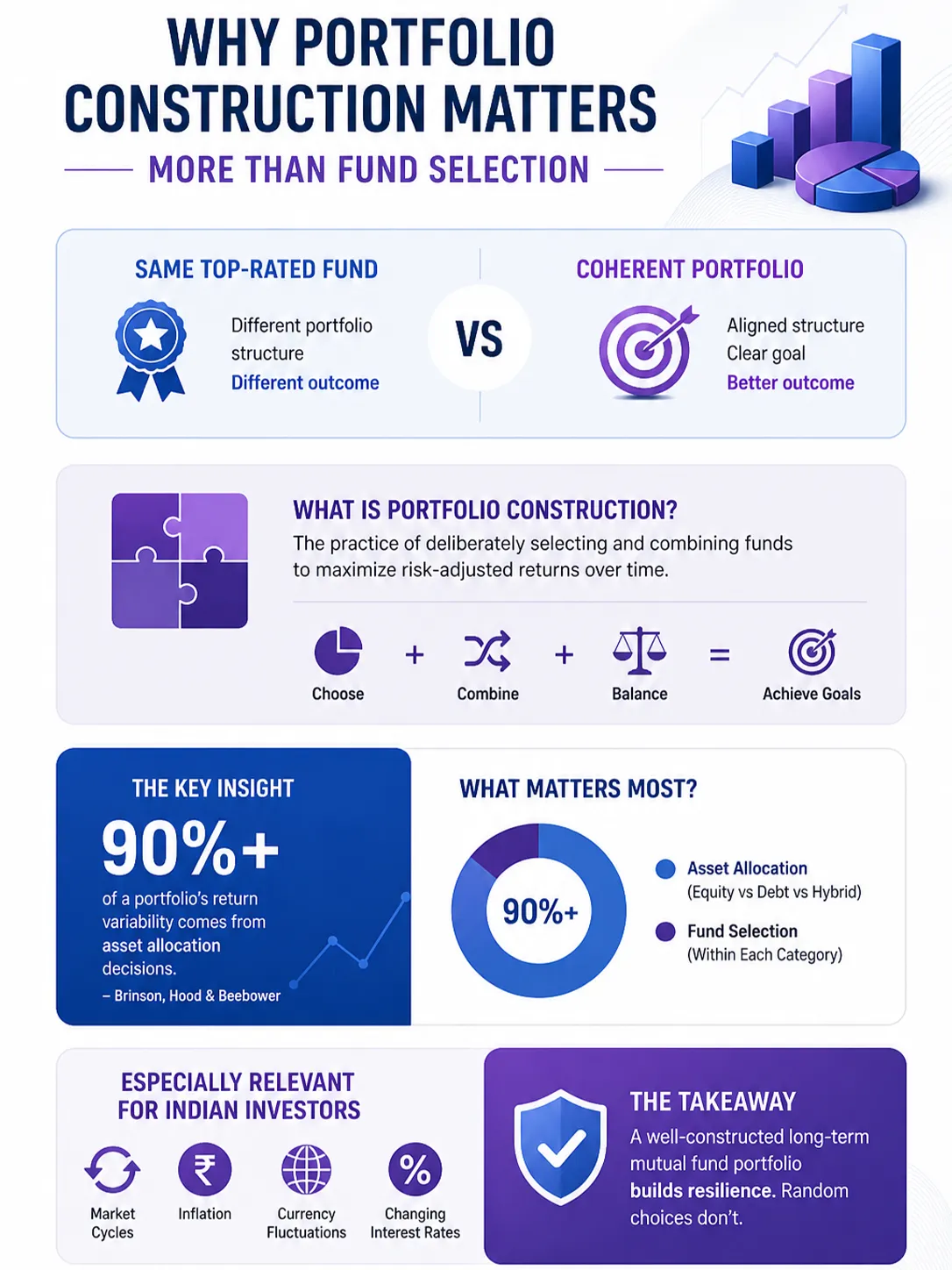
Here's a truth most financial content skips: the fund you choose matters far less than the architecture of your overall mutual funds portfolio. Two investors can hold the same top-rated fund and get completely different outcomes, because one built a coherent, goal-linked structure and the other didn't.
Portfolio construction is the practice of deliberately selecting and combining funds to maximize risk-adjusted returns over time. This means thinking about how each fund in your mutual fund investment portfolio behaves relative to the others. Do they move together, or do they balance each other out?
According to a widely referenced study by Brinson, Hood, and Beebower, asset allocation accounts for over 90% of a portfolio's variability in returns. In simpler terms, the decision of how much to put in equity vs debt vs hybrid matters far more than which specific fund you pick within each category.
For Indian investors, this is especially relevant. Between market cycles, inflation, currency fluctuation, and changing interest rate environments, a well-constructed long-term mutual fund portfolio provides resilience that a randomly assembled set of funds simply cannot.
How Many Mutual Funds Should You Hold? The 3 to 5 Fund Rule Explained
The 3 to 5 Fund Rule Explained
The ideal mutual funds portfolio for most retail investors contains between 3 and 5 funds. This isn't arbitrary. It's the range at which you get genuine diversification without redundancy. Within 3 to 5 well-chosen funds across large cap, flexi cap, mid cap, and debt, you can cover the Indian equity market comprehensively while keeping your portfolio manageable and easy to track.
Wright Research's analysis of investor portfolios consistently shows that investors who hold 3 to 5 focused positions, rebalanced annually, outperform those who dilute their capital across 10+ funds. The discipline of limiting fund count forces better decision-making at the selection stage.
Why More Than 6 Funds Create an Expensive Index
When you hold more than 6 to 7 mutual funds, something predictable happens: your mutual fund investment portfolio starts to behave like a bloated, fee-laden version of the Nifty 500. This is because large-cap and flexi-cap funds tend to hold similar top-40 stocks. Owning three large-cap funds doesn't give you three times the exposure. It gives you three times the overlap, three times the expense ratio, and the same underlying market return you could have gotten from a single index fund.
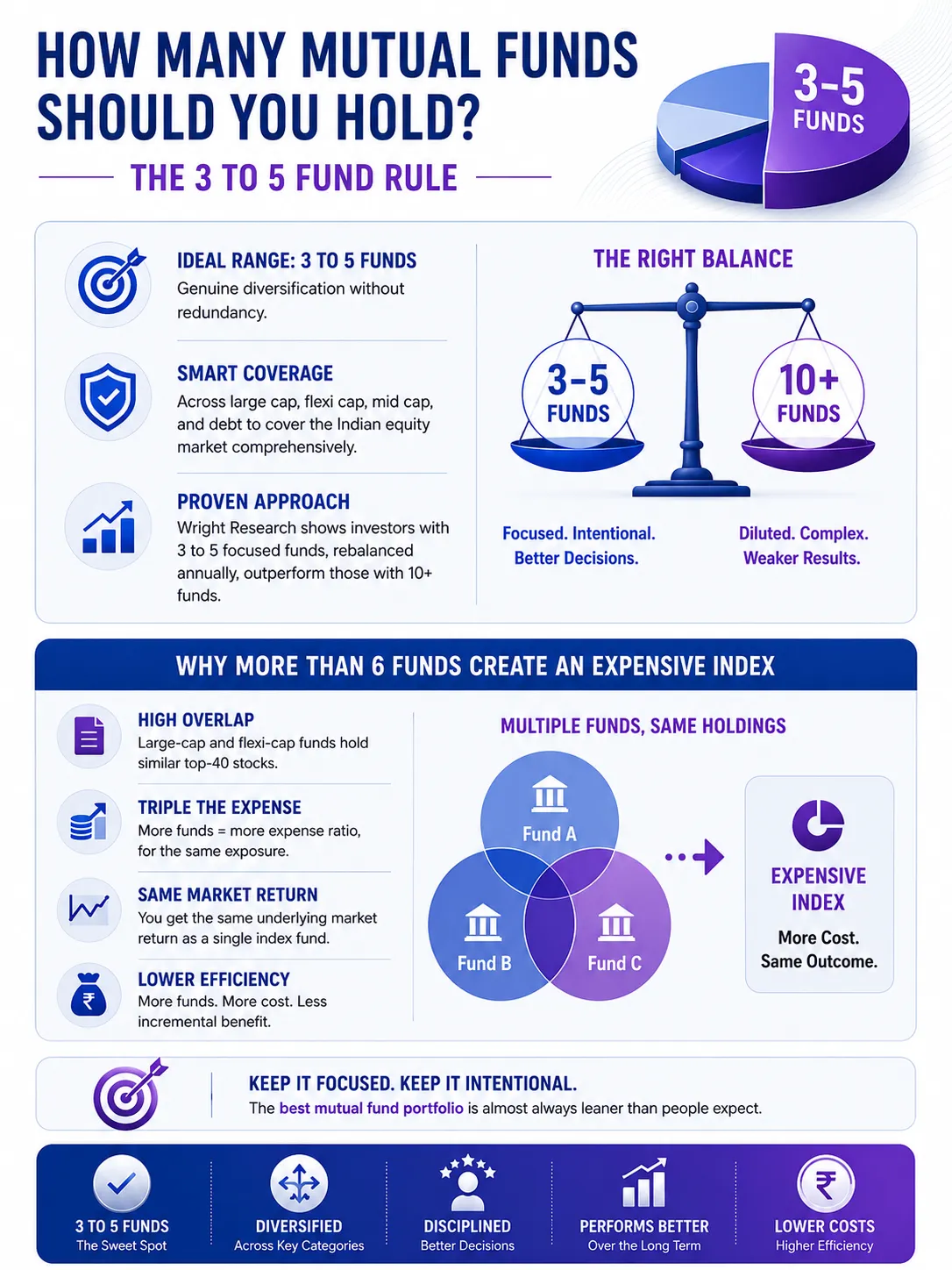
Keep it focused. Keep it intentional. The best mutual fund portfolio is almost always leaner than people expect.
Types of Mutual Fund Portfolios: Conservative, Balanced and Aggressive Explained
Conservative Mutual Fund Portfolio
Conservative mutual funds are designed for investors whose primary goal is capital preservation with modest growth. These portfolios typically allocate 20 to 30% to equity and 70 to 80% to debt instruments, including short-duration funds, corporate bond funds, and liquid funds.
A conservative mutual fund portfolio suits retirees, investors with a 2 to 3 year horizon, or those who experience significant anxiety during market volatility. Returns are lower, typically 7 to 10% CAGR, but the drawdown risk is dramatically reduced. The priority here is not wealth creation but wealth protection.
Balanced Mutual Fund Portfolio
Balanced mutual funds, or more precisely, a balanced mutual fund portfolio, sit in the middle of the risk spectrum. The equity-to-debt split typically ranges from 50:50 to 65:35, giving investors meaningful market participation without the full volatility of a pure equity portfolio.
Hybrid mutual funds and aggressive hybrid funds fall into this category. For investors with a 5 to 7 year horizon who want growth but can't stomach sharp drawdowns, balanced mutual funds are often the most practical and psychologically sustainable choice. According to AMFI data, hybrid funds have seen consistent inflows, suggesting Indian investors are increasingly comfortable with this structure.
Aggressive MF Portfolio
An aggressive MF portfolio allocates 80 to 100% to equity, typically spread across large-cap, mid-cap, and small-cap funds. This portfolio construction is designed for investors with a 7 to 10+ year investment horizon, high risk tolerance, and the emotional discipline to stay invested through significant short-term losses.
Historically, a well-constructed aggressive MF portfolio has the potential to deliver 12 to 15% CAGR over a full market cycle. But the keyword is historically. Past performance does not guarantee future results, and the volatility involved is real. Investors must be prepared for periods where the portfolio drops 30 to 40% before recovering.
How to Build a Diversified Mutual Fund Portfolio Step by Step
Large Cap + Flexi Cap + Mid Cap Combination
The foundation of a strong, diversified mutual fund portfolio for equity-oriented investors is the combination of a large-cap or index fund, a flexi-cap fund, and a mid-cap fund. Each serves a distinct role. The large-cap component provides stability and low-cost market exposure. The flexi cap fund gives the manager flexibility to move across market caps based on opportunities. The mid-cap fund adds growth potential and the possibility of alpha over longer periods.
This three-fund core covers a significant portion of the Indian equity market efficiently and forms the backbone of the best mutual fund portfolio for most growth-oriented investors.
Adding Debt for Stability
Even in a long-term mutual fund portfolio that's equity-heavy, some allocation to debt makes sense, particularly for investors within 3 years of their financial goal. A short-duration or banking-and-PSU debt fund can act as a cushion during equity corrections and can be redeemed strategically when equity markets are down, allowing investors to withdraw without being forced to sell equity at a loss.
The rule of thumb Wright Research recommends: as you approach a financial goal, gradually shift 10 to 15% of equity to debt each year in the final 3 years.
Role of ELSS for Tax Saving
Equity Linked Savings Schemes (ELSS) serve a dual purpose in any mutual fund investment portfolio: tax saving under Section 80C (up to Rs. 1.5 lakh per year) and long-term equity growth. With a mandatory 3-year lock-in period, ELSS funds effectively prevent impulsive redemptions during market corrections, which is actually a behavioural advantage.
For investors under the old tax regime, an ELSS fund can be a natural starting point for the equity portion of their diversified mutual fund portfolio.
Get research like this in your inbox
The week’s research that mattered, in five minutes. Joined by 2L+ investors.
Best Mutual Fund Portfolio: Recommended Allocation by Risk Profile
Conservative Investor Allocation
Fund Category |
Allocation |
Purpose |
Short Duration Debt Fund |
40% |
Capital preservation, low volatility |
Corporate Bond Fund |
30% |
Moderate yield with credit quality |
Large Cap / Index Fund |
20% |
Equity participation |
Liquid Fund |
10% |
Emergency buffer within portfolio |
Moderate Investor Allocation
Fund Category |
Allocation |
Purpose |
Flexi Cap / Large and Mid Cap Fund |
40% |
Core equity growth |
Mid Cap Fund |
20% |
Growth acceleration |
Aggressive Hybrid Fund |
20% |
Built-in equity-debt balance |
Short Duration Debt Fund |
20% |
Portfolio stability |
Aggressive Investor Allocation
Fund Category |
Allocation |
Purpose |
Mid Cap Fund |
30% |
High-growth equity exposure |
Flexi Cap Fund |
30% |
Dynamic allocation across market caps |
Large Cap / Index Fund |
20% |
Stability anchor in equity portfolio |
Small Cap Fund |
20% |
Long-horizon alpha potential |
These allocations are illustrative frameworks, not specific fund recommendations. Consult a SEBI-registered advisor for personalized advice.
Balanced Mutual Funds vs Aggressive MF Portfolio: Which Is Right for You?
This is one of the most common decisions investors face when structuring their mutual funds portfolio, and the answer is rarely one-size-fits-all.
Parameter |
Balanced Mutual Funds |
Aggressive MF Portfolio |
Equity Allocation |
50 to 65% |
80 to 100% |
Ideal Horizon |
5 to 7 years |
7 to 10+ years |
Expected CAGR (historical) |
9 to 12% |
12 to 15%+ |
Max Drawdown Risk |
Moderate (20 to 30%) |
High (30 to 50%) |
Suitable For |
Moderate risk investors, near-goal investors |
High-risk investors, young earners |
Volatility |
Lower |
Higher |
Rebalancing Frequency |
Annual |
Annual or semi-annual |
The most important variable isn't your income or net worth. It's your behaviour during drawdowns. If a 35% portfolio drop would cause you to panic-sell, an aggressive MF portfolio isn't actually suitable for you, regardless of your time horizon. Balanced mutual funds often deliver better real-world returns for investors who cannot emotionally tolerate high volatility, because they stay invested throughout market cycles.
Wright Research recommends that investors who are unsure of their risk tolerance start with a balanced or moderate allocation and move toward aggressive MF portfolio construction only after experiencing at least one full correction cycle.
Common Mistakes to Avoid When Building a Long Term Mutual Fund Portfolio
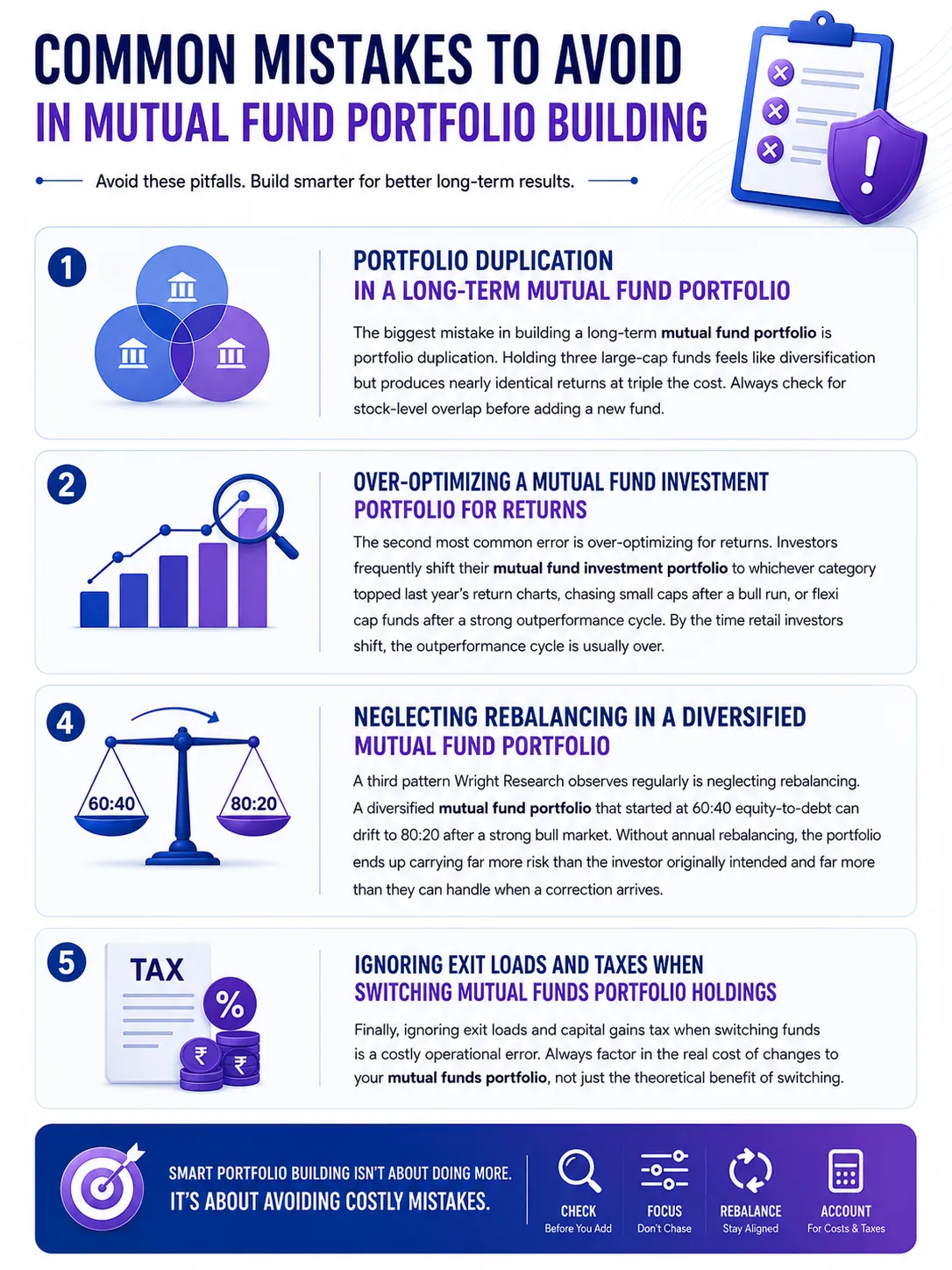
1. Portfolio Duplication in a Long-Term Mutual Fund Portfolio
The biggest mistake in building a long-term mutual fund portfolio is portfolio duplication. Holding three large-cap funds feels like diversification but produces nearly identical returns at triple the cost. Always check for stock-level overlap before adding a new fund.
2. Over-Optimizing a Mutual Fund Investment Portfolio for Returns
The second most common error is over-optimizing for returns. Investors frequently shift their mutual fund investment portfolio to whichever category topped last year's return charts, chasing small caps after a bull run, or flexi cap funds after a strong outperformance cycle. By the time retail investors shift, the outperformance cycle is usually over.
4. Neglecting Rebalancing in a Diversified Mutual Fund Portfolio
A third pattern Wright Research observes regularly is neglecting rebalancing. A diversified mutual fund portfolio that started at 60:40 equity-to-debt can drift to 80:20 after a strong bull market. Without annual rebalancing, the portfolio ends up carrying far more risk than the investor originally intended and far more than they can handle when a correction arrives.
5. Ignoring Exit Loads and Taxes When Switching Mutual Funds Portfolio Holdings
Finally, ignoring exit loads and capital gains tax when switching funds is a costly operational error. Always factor in the real cost of changes to your mutual funds portfolio, not just the theoretical benefit of switching.
Conclusion
Building the best mutual fund portfolio for long-term wealth is not a one-time decision. It is a continuous discipline. The investors who create lasting wealth through mutual funds are not necessarily the ones who discovered the most promising fund early. They are the ones who built a sound structure, resisted the temptation to over-tinker, and stayed invested through market cycles that tested their patience.
Whether you opt for conservative mutual funds that prioritise stability, a balanced mutual funds approach that blends growth with protection, or a full aggressive MF portfolio designed for maximum compounding, the fundamentals remain unchanged. Define your goal, align your allocation, limit your fund count, and review annually.
A diversified mutual fund portfolio that is well-built and consistently maintained will, over a 10 to 15-year horizon, do more for your financial future than chasing top-performing funds every year ever could. Start with a structure that fits your life and let time do the rest.
See what markets are pricing in
Live indices, sector moves and market breadth — the backdrop to every story we publish.
Frequently Asked Questions
How many mutual funds should I have in my portfolio for long-term wealth creation?
A mutual funds portfolio of 3 to 5 funds is ideal for most investors. This provides genuine diversification across market caps and asset classes without creating overlap. Beyond 6 to 7 funds, portfolios tend to mirror a broad index but with higher costs and harder-to-manage complexity. Focus on quality over quantity in your long-term mutual fund portfolio.
What is the difference between a diversified and a concentrated mutual fund portfolio?
A diversified mutual fund portfolio spreads investment across multiple fund categories, including large-cap, mid-cap, debt, and hybrid, to reduce risk from any single market segment. A concentrated portfolio holds fewer funds with high overlap. For long-term wealth, a diversified structure provides more resilience across market cycles without significantly sacrificing return potential.
Should I choose a balanced mutual fund or an aggressive MF portfolio for long-term returns?
If your investment horizon is 7+ years and you can stay invested through 30 to 40% drawdowns without panic-selling, an aggressive MF portfolio may offer higher returns historically. For a 5 to 7 year horizon or lower emotional risk tolerance, balanced mutual funds provide better risk-adjusted outcomes for most investors by combining equity growth with debt stability.
How do conservative mutual funds differ from balanced mutual funds?
Conservative mutual funds prioritise capital safety, typically allocating 70 to 80% to debt instruments with minimal equity exposure. Balanced mutual funds aim for growth with stability, usually maintaining a 50 to 65% equity allocation. Conservative funds suit retirees or near-goal investors, while balanced suits those 5 to 7 years from their financial target.
How can I build the best mutual fund portfolio for long-term wealth in India?
Start by identifying your risk profile and investment horizon. Then, structure your mutual fund investment portfolio using a core equity combination of large-cap, flexi-cap, and mid-cap funds. Add debt for stability and include ELSS for tax efficiency if applicable. Limit yourself to 3 to 5 funds, rebalance annually, and avoid chasing past returns. Consider working with a SEBI-registered advisor like Wright Research for a personalized strategy.