


Tax deducted at source can appear when a mutual fund pays income to an investor, but the rule is often confused with taxation on redemption. For a resident investor, TDS on mutual funds under Section 194K concerns qualifying income in respect of units, such as an income distribution. It does not apply to capital gains.
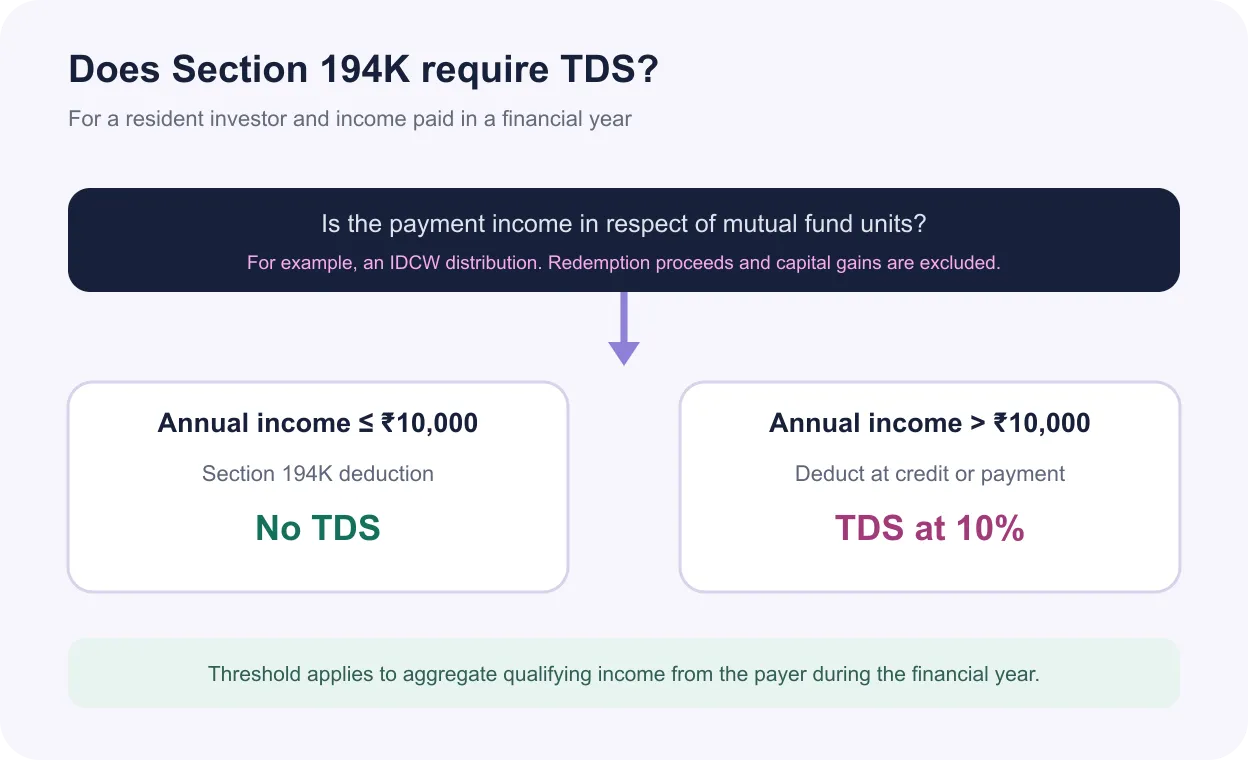
From 1 April 2025, the annual threshold is ₹10,000. Once aggregate qualifying income from the payer exceeds that amount, the statutory deduction rate is 10%. The deduction is a tax credit, not the investor's final tax liability.
What Is Section 194K of the Income Tax Act?
section 194K requires the person responsible for paying qualifying income to a resident in respect of specified mutual fund units to deduct tax. Deduction occurs at the time the income is credited or paid, whichever is earlier.
The rate is 10%. The section covers units of a mutual fund specified under Section 10(23D), units from the Administrator of the specified undertaking and units from the specified company. Its proviso excludes income where the aggregate amount from the payer during the financial year does not exceed ₹10,000.
A crucial statutory exclusion is income in the nature of capital gains. Therefore, the phrase TDS on mutual fund redemption should not be read as a Section 194K charge for resident investors.
See what markets are pricing in
Live indices, sector moves and market breadth — the backdrop to every story we publish.
When Is TDS Deducted on Mutual Funds?
For residents, deduction arises when qualifying income in respect of units crosses the annual threshold. In practical mutual fund language, this usually concerns payouts under the income distribution cum capital withdrawal option, commonly called IDCW.
The payer considers the aggregate qualifying income credited or paid, or likely to be credited or paid, during the financial year. When it exceeds the mutual fund TDS limit , TDS applies at credit or payment, whichever comes first.
TDS on mutual funds should also be separated from withholding for non-residents. Section 194K is written for payments to residents. Non-resident payments can fall under Section 195 and treaty provisions.
TDS on Mutual Fund Dividends
The phrase tds on mutual fund dividend generally refers to an IDCW distribution paid to a resident. If aggregate qualifying income from the payer in the financial year exceeds ₹10,000, the payer deducts 10% under section 194K.
Consider ₹18,000 of qualifying income. Because it exceeds the threshold, 10% of ₹18,000 is deducted, producing TDS of ₹1,800. The threshold is not a slab that shelters the first ₹10,000 once the aggregate exceeds the limit.
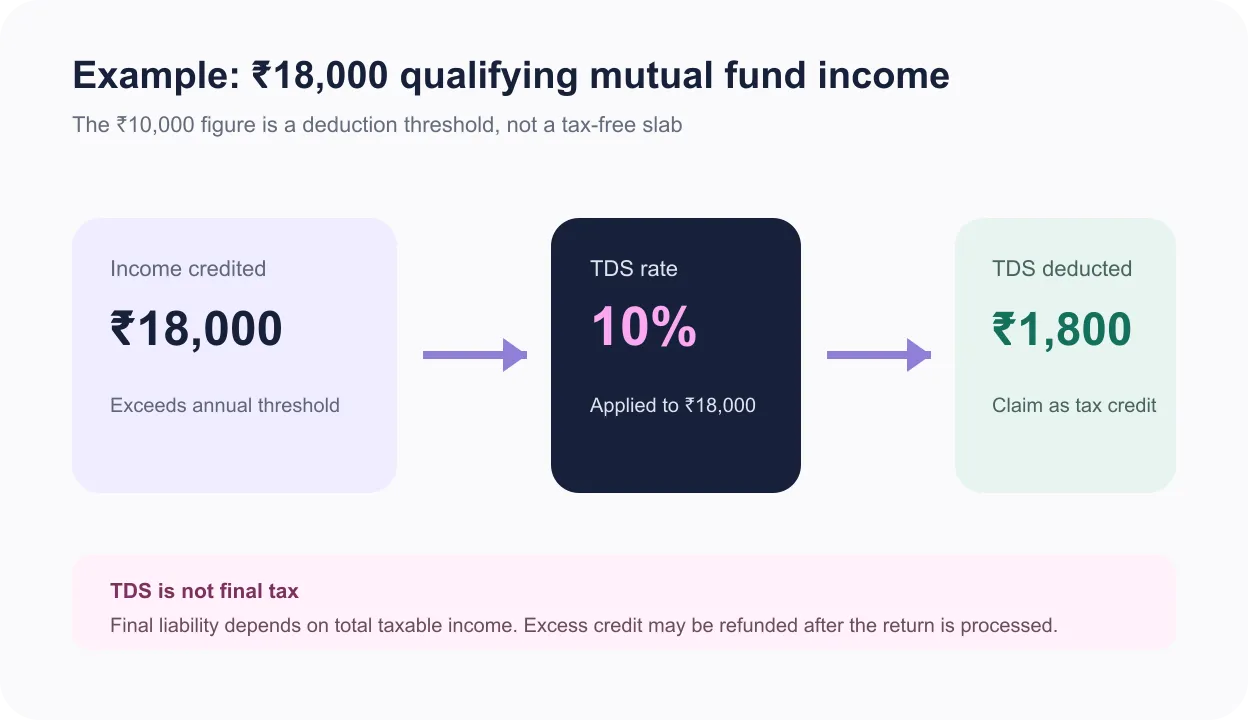
The final tax on the distribution depends on the investor's total income and applicable regime. tds on mutual fund dividend is only a collection mechanism. The investor receives credit for the amount deducted.
TDS on Mutual Fund Redemption: When Does It Apply?
For a resident, TDS on mutual fund redemption does not apply under Section 194K because capital gains are expressly excluded. The AMC does not deduct 10% from the resident's redemption merely because its value exceeds ₹10,000.
The investor must still calculate any tax on mutual fund redemption under the capital-gains provisions. No withholding does not mean no tax. Fund category, acquisition date, holding period and applicable law determine the tax treatment.
TDS on mutual fund withdrawal can arise in a different context for a non-resident investor. Section 195 may require withholding on sums chargeable to tax, subject to the Income-tax Act, valid documentation and treaty relief. This is separate from resident TDS on mutual fund redemption under section 194K.
| Investor | Section 194K treatment | What still needs review |
|---|---|---|
| Resident | No TDS on redemption proceeds or capital gains | Capital-gains tax liability and STT where applicable |
| Non-resident | Section 194K is not the governing redemption rule | Section 195, treaty provisions and AMC documentation |
This distinction answers why TDS on mutual fund redemption and actual tax on mutual fund redemption can have different outcomes.
Get research like this in your inbox
The week’s research that mattered, in five minutes. Joined by 2L+ investors.
Current TDS Rates Under Section 194K
| Situation | TDS treatment |
|---|---|
| Aggregate qualifying income up to ₹10,000 in the financial year | No deduction under Section 194K |
| Aggregate qualifying income above ₹10,000 | 10% deduction at credit or payment, whichever is earlier |
| Capital gains or resident redemption proceeds | Excluded from Section 194K |
| PAN not furnished or invalid | Higher withholding can apply under Section 206AA |
The 10% rate applies to qualifying income, not the redemption corpus. Investors searching for TDS on mutual fund withdrawal should first establish residence status and whether the payment is income or redemption proceeds.
Rates and thresholds can change. TDS on mutual funds should therefore be checked for the financial year in which income is credited or paid.
TDS Exemption Limit on Mutual Fund Income
The current mutual fund TDS limit is ₹10,000 of aggregate qualifying income during the financial year from the person responsible for payment. The threshold increased from ₹5,000 with effect from 1 April 2025.
If qualifying income is ₹9,500, no deduction is required under section 194K. If it reaches ₹18,000, the 10% deduction is calculated on ₹18,000, not only on the ₹8,000 above the threshold.
The threshold determines withholding, not whether the income is taxable. An amount below the limit may still need to be included in the investor's return. Conversely, an eligible taxpayer with no final tax liability may be able to submit Form 15G or Form 15H, subject to the forms' legal conditions and the payer's process.
How to Claim TDS Credit or Refund
First, compare the AMC statement or TDS certificate with Form 26AS and the Annual Information Statement. Confirm PAN, payer details, income and deduction amount. A mismatch can delay credit.
Second, report the underlying income in the correct schedule of the income-tax return and claim the corresponding TDS. tds on mutual fund dividend is not claimed by reducing the income figure. Show the gross income and the available credit as required by the return.
Third, reconcile final tax liability. If total prepaid taxes, including TDS on mutual funds , exceed liability, the processed return can generate a refund. If liability is higher, the investor pays the balance through self-assessment tax.
Keep statements and certificates for reconciliation. A resident who sees apparent TDS on mutual fund redemption should verify whether the entry is actually an IDCW payment, non-resident withholding, exit load, STT or another adjustment. Wright Research's mutual fund platform can help investors review fund choices, while the guide to short-term capital gains explains the separate capital-gains concept.
When records remain unclear, request the transaction breakup from the AMC or registrar. This confirms whether the amount labelled as TDS on mutual fund redemption is a true withholding entry and identifies the legal provision used.
Is your portfolio built for what’s coming?
Get a free AI-powered review of your holdings — risk, overlap and quality in minutes.
FAQ
What is Section 194K of the Income Tax Act?
Section 194K requires a payer to deduct tax at 10% from qualifying income in respect of specified mutual fund units paid to a resident when the annual aggregate from that payer exceeds ₹10,000.
Is TDS deducted on mutual fund redemption?
For a resident investor, Section 194K excludes capital gains and does not require TDS from redemption proceeds. A non-resident redemption can be subject to separate withholding rules, including Section 195.
What is the TDS rate on mutual fund dividends?
For a resident investor, the Section 194K rate is 10% when the qualifying annual income from the payer exceeds ₹10,000. A higher rate can apply where PAN requirements are not met.
Is there any exemption limit for TDS under 194K?
Yes. No deduction is required under Section 194K where aggregate qualifying income from the payer during the financial year does not exceed ₹10,000. This threshold applies from 1 April 2025.
How can I claim a refund of TDS on mutual funds?
Verify the credit in Form 26AS or AIS, report the income and TDS in the income-tax return, and claim the credit. If total TDS exceeds final tax liability, the return can result in a refund after processing.
Is TDS deducted when redeeming mutual funds?
Section 194K does not deduct TDS from a resident investor’s redemption proceeds or capital gains. Non-resident investors should check the separate withholding rules applicable to their redemption.
For residents, TDS on mutual fund redemption under 194K remains nil, but tax on mutual fund redemption may still be payable through the return. tds on mutual fund dividend above the threshold is credited against final liability.