
Blog home
Newsletter
News
Video
Podcast
Reading list
Wright Brief
Sign In

Long Strangle Strategy: Meaning, Payoff and How It Works

A long strangle buys an out-of-the-money call and put to profit from a big move at lower cost than a straddle. Payoff, breakevens, a worked example and risks.

Listen to this article
Audio · ~2 min
Add as a preferred source on Google
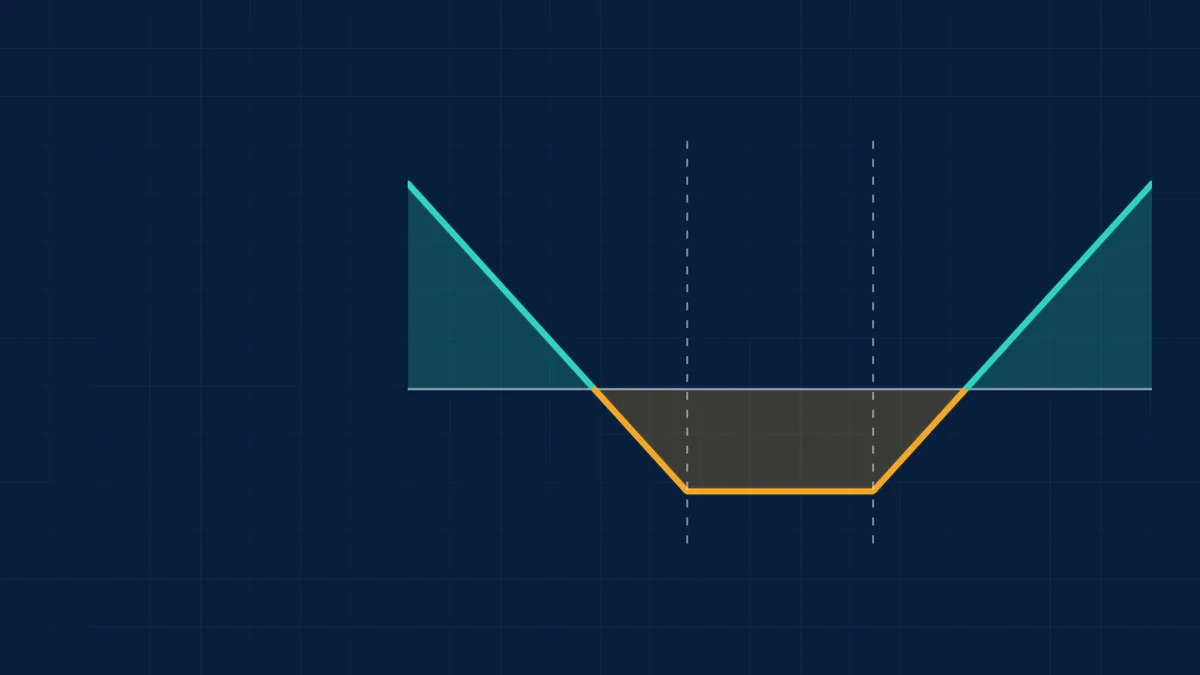
Long strangle payoff diagram with a flat loss zone between two strikes

A long strangle buys an out-of-the-money call and an out-of-the-money put with the same expiry. It is cheaper than a straddle , but price has to move further for it to profit.

How it is built

  • Buy an out-of-the-money call above the current price.
  • Buy an out-of-the-money put below the current price.
  • The total premium paid is the maximum loss.
Free tool

See what markets are pricing in

Live indices, sector moves and market breadth — the backdrop to every story we publish.

Open Market Tracker

A worked example

The Nifty is at 24,000. A trader buys the 24,200 call for 80 and the 23,800 put for 75.

ItemCalculationResult
Total premium (max loss)80 + 75155 points, if the Nifty expires between 23,800 and 24,200
Upper breakeven24,200 + 15524,355
Lower breakeven23,800 - 15523,645
Compare: ATM straddle premium150 + 140290 points, with breakevens at 24,290 and 23,710
The Wright Brief · free weekly

Get research like this in your inbox

The week’s research that mattered, in five minutes. Joined by 2L+ investors.

When traders use it

  • When a large move is expected but the cost of an ATM straddle is too high.
  • Around events, when implied volatility is not already very high.

Risks and costs

  • Both options can expire worthless, which loses the whole premium.
  • A larger move is needed than for a straddle.
  • Selling a strangle collects premium, but has unlimited risk on a large move.

Risk note. Strategies that sell options can lose far more than the premium received, and margin requirements apply. SEBI studies have found that roughly nine in ten individual traders in equity derivatives lost money, mostly after costs. See risk management in options trading and transaction costs. Prices below are per unit of the underlying, so multiply by the lot size for rupee amounts. Examples use illustrative Nifty prices and ignore brokerage, taxes and margin.

Related: long straddle and iron condor. See the full options strategies guide.

Free tool

Is your portfolio built for what’s coming?

Get a free AI-powered review of your holdings — risk, overlap and quality in minutes.

Review my portfolio

Frequently Asked Questions

What is a strangle strategy?

Buying (or selling) an out-of-the-money call and put with the same expiry.

What is the difference between a straddle and a strangle?

A straddle uses the same strike for both options, and a strangle uses different out-of-the-money strikes, which is cheaper but needs a larger move.

What is the maximum loss in a long strangle?

The total premium paid.

How do you calculate strangle breakevens?

Add the total premium to the call strike and subtract it from the put strike.

This article is for education only and is not investment advice. Indicator readings describe past price behaviour and do not predict future returns.

Disclaimer: Investment in securities market are subject to market risks. Read all the related documents carefully before investing. Registration granted by SEBI, membership of a SEBI recognized supervisory body (if any) and certification from NISM in no way guarantee performance of the intermediary or provide any assurance of returns to investors.

The content in these posts/articles is for informational and educational purposes only and should not be construed as professional financial advice and nor to be construed as an offer to buy/sell or the solicitation of an offer to buy/sell any security or financial products. Users must make their own investment decisions based on their specific investment objective and financial position and using such independent advisors as they believe necessary.

Wryght Research & Capital Pvt (Brand name: Wright Research) is a SEBI Registered Portfolio Manager Reg No: INP000007979 (Validity: Apr 03, 2023 – Perpetual) and a SEBI Registered Research Analyst No: INH000017295 (Validity: Jul 03, 2024 – Perpetual), with its registered office at 103, Shagun Vatika Prag Narayan Road, Lucknow, UP, 226001 India and CIN: U67100UP2019PTC123244. Past performance may or may not be sustained in future. Performance provided there in is not verified by SEBI. Investment in securities is subject to market and other risks, and there is no assurance or guarantee that the objectives of any of the strategies of the Portfolio Management Services will be achieved. Registration granted by SEBI, enlistment as RA with Exchange and certification from National Institute of Securities Markets (NISM) in no way guarantee performance of the intermediary or provide any assurance of returns to investors. Please read the Disclosure document carefully before investing. Securities quoted are for illustration only and are not recommendatory. Charts shown are for illustration only. For more information and disclosures, visit our disclosures page here.

Found this useful? Share it.
Explore related topics
Siddharth Singh Bhaisora
About the author
Siddharth Singh Bhaisora
Chief Marketing & Growth Officer | Wright Research, Wright Research

Chief Marketing & Growth Officer

Wright PMS · Portfolio Management Service

Put this research to work

The same 300+ factor research engine behind this article — applied to a professionally managed portfolio, end to end.

300+
Factors tracked
2L+
Investors
₹1,200+ Cr
Invested
SEBI
Registered PMS
