

India runs the busiest equity derivatives market in the world. The National Stock Exchange alone handled about 51% of all equity derivatives contracts traded globally in FY2026. In the same year, India's stock market slipped behind Taiwan and South Korea in value, foreign investors withdrew a record sum, and nearly nine in ten individual derivatives traders lost money.
These facts are connected. A large share of Indian market activity takes place in contracts that settle within days, while the capital that funds companies over years has grown more slowly and, in the case of foreign money, has left. This article looks at who pays for that activity, who collects, and how the costs travel from the trading screen into household savings, the stock market and the wider economy.
How big is India's derivatives market next to the market it is built on?
India's listed companies were worth about US$4.8 trillion in September 2026. Measured by the notional value of contracts, annual derivatives trading runs at several hundred times the cash market, where shares change hands. Measured on the more conservative basis of option premiums, it is still about 2.2 times the cash segment. Most of this activity is in index options that expire every week.
Derivatives were designed so that investors could hedge the risk of owning shares. In India they have drawn in people who own very few shares at all. About a quarter of active derivatives traders do not buy or sell a single stock in the cash market, and trading in the cash market often peaks on expiry days, when the incentive to move prices toward a settlement level is highest.
Regulators have tightened the rules four times in two years
SEBI began restricting the segment in late 2024, cutting the number of weekly expiries, raising contract sizes and collecting option premiums upfront. The Union Budget for 2026-27 then raised the securities transaction tax (STT) on futures from 0.02% to 0.05% and on option premiums from 0.10% to 0.15%, effective 1 April. Options volumes on NSE and BSE fell by about half in FY26.
Activity has a habit of returning. A closing auction session introduced on 3 August led some algorithmic firms to cut expiry-day trading by 35% to 40%, and on 16 October SEBI restored the older settlement method based on the final 30 minutes of trading. Brokers expect volumes to recover. Some traders also moved to commodities: options on MCX's mini crude oil contract became the most traded energy option in the world in the first half of 2026, with volume up about fifteen-fold. Restricting one product tends to move the bet to the next product.
See what markets are pricing in
Live indices, sector moves and market breadth — the backdrop to every story we publish.
Who pays for the trade, and who collects?
SEBI's study for FY26, released on 20 August 2026, found that 87.7% of individual traders in equity derivatives lost money. Their combined net loss was ₹91,685 crore. Fewer people traded than in FY25, so the total loss fell, while the average loss per trader rose to about ₹1.17 lakh.
Table 1: Individual traders in equity derivatives, FY25 and FY26
Measure | FY25 | FY26 |
|---|---|---|
Active individual traders | 98.1 lakh | 78.6 lakh |
Share who lost money | About 91% | 87.7% |
Combined net loss | ₹1.12 lakh crore (revised) | ₹91,685 crore |
Average loss per trader | About ₹1.14 lakh | About ₹1.17 lakh |
The profile of the loss-maker is young and increasingly outside the big cities. Traders under 30 made up 43% of individual traders in FY26. Traders from beyond India's top 30 cities made up 67% of the base and carried 58% of the losses. Options produced 92% of retail losses, and transaction costs alone accounted for 35% of loss-makers' gross losses. Those costs pushed 4.4 lakh traders who had made a gross profit into a net loss.
Experience does not fix the problem. Only about 0.5% of individuals who traded for five years were profitable in every one of them. “There is no strategy to what they’re doing,” says Sonam Srivastava, founder of Wright Research, a Mumbai-based quantitative investment firm. Most retail positions are directional calls on where an index will go, made without research behind them.
The gains go to firms with speed and capital
SEBI data cited in the source article show the other side of the ledger. Proprietary traders, foreign firms, corporates, mutual funds and partnership firms together earned roughly what retail traders lost. Almost all of the larger players' profits came from automated algorithmic strategies. About 15% of retail traders also use algorithms, though most rely on strategies sold by third-party platforms that they may not fully understand.
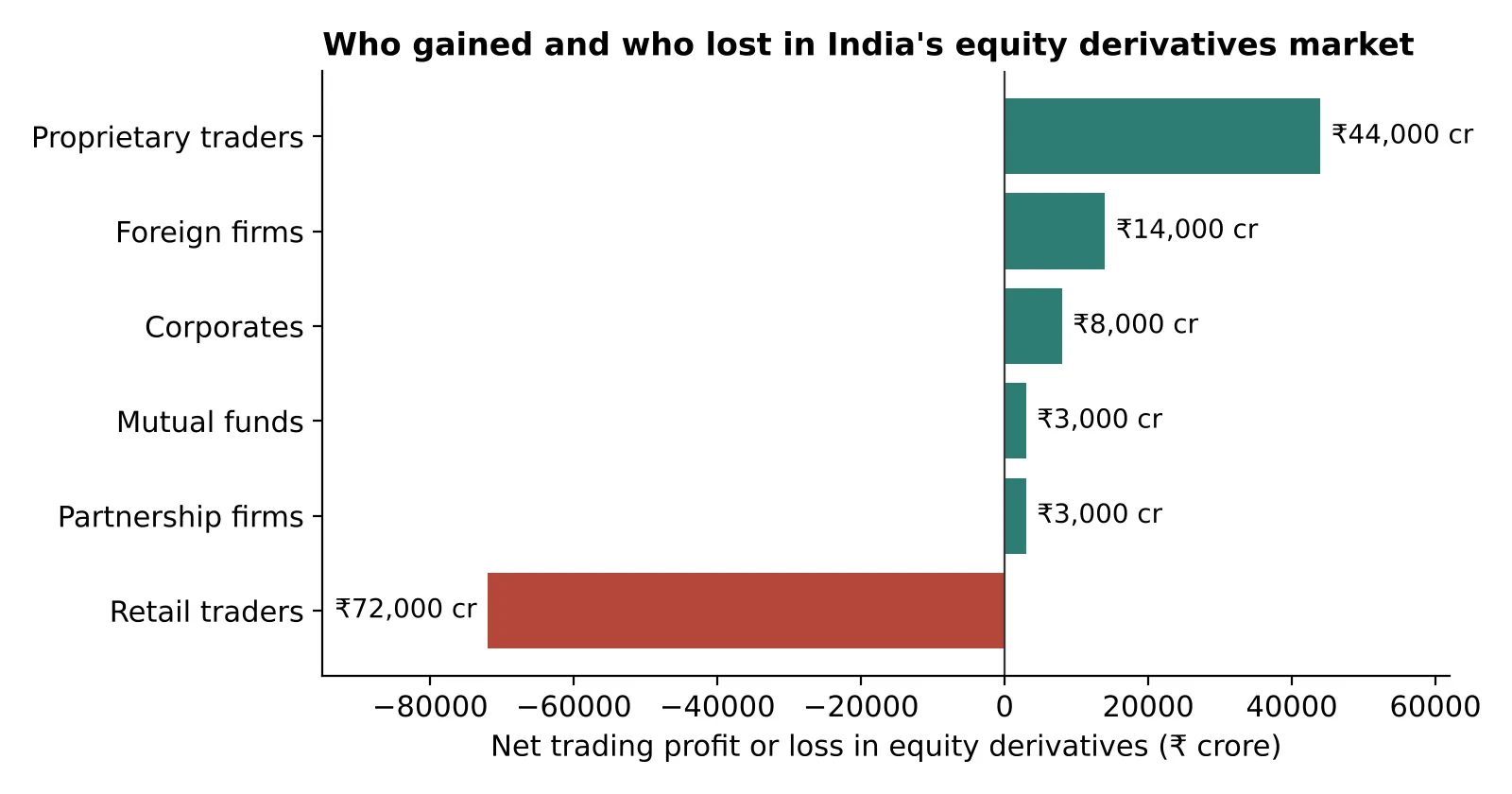
The Jane Street case showed how expiry days can be used against smaller traders. In a July 2025 interim order, SEBI alleged that the US firm bought large quantities of heavyweight bank shares in the morning to lift the Bank Nifty index, built bearish options positions as retail traders followed the rise, and then sold the underlying shares before settlement. SEBI impounded ₹4,843.5 crore, which the firm deposited before resuming trading. Jane Street disputes the findings. The final order is still pending, and the investigation has widened to other indices.
Why do exchanges and brokers depend on the bets?
Market infrastructure in India now earns most of its money from derivatives volumes. NSE's offer document for its September 2026 listing showed that equity options alone produced about 60% of its operating revenue in FY26, and derivatives as a whole about 69%. When SEBI's curbs took effect, NSE's revenue fell from ₹17,141 crore in FY25 to ₹16,601 crore in FY26.
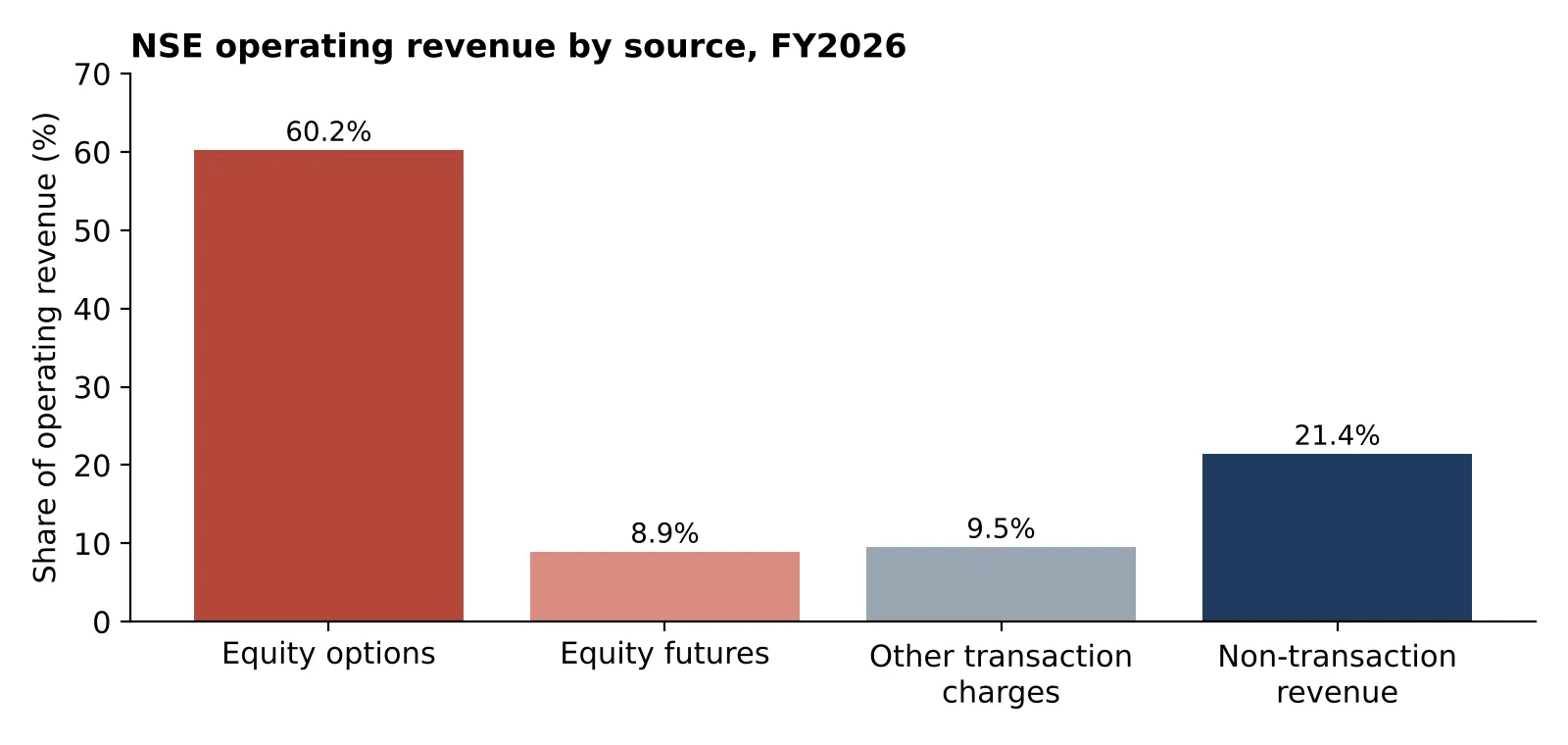
BSE has followed the same route. Its share of the cash market has fallen from about 14% in 2016 to between 5% and 7%, while index derivatives have become central to its business. Its share of the two exchanges' combined transaction-charge revenue rose from 5.5% to 22.5% in two years. Discount brokers such as Zerodha, Groww and Angel One also earn heavily from the segment, and the government collected ₹46,840 crore in STT between April and October of this financial year, whether traders won or lost.
This matters for capital formation. Exchanges also bring companies to the public market. When revenue and management attention follow contract volumes, the incentive to court new issuers and build deeper cash trading weakens. V. Shunmugam of MCQube, a markets consultancy, argues that listing competition grows only when more than one exchange takes the cash market seriously.
Get research like this in your inbox
The week’s research that mattered, in five minutes. Joined by 2L+ investors.
What does the global AI trade have to do with India's options habit?
In 2026, global investors chose to own the companies building artificial intelligence. Those companies sit in a few markets. Taiwan produces about 90% of the world's most advanced logic chips, Samsung and SK hynix make about 80% of high bandwidth memory, and global chip sales are forecast at about US$1.5 trillion this year. Funds that wanted that growth bought South Korea and Taiwan and sold elsewhere.
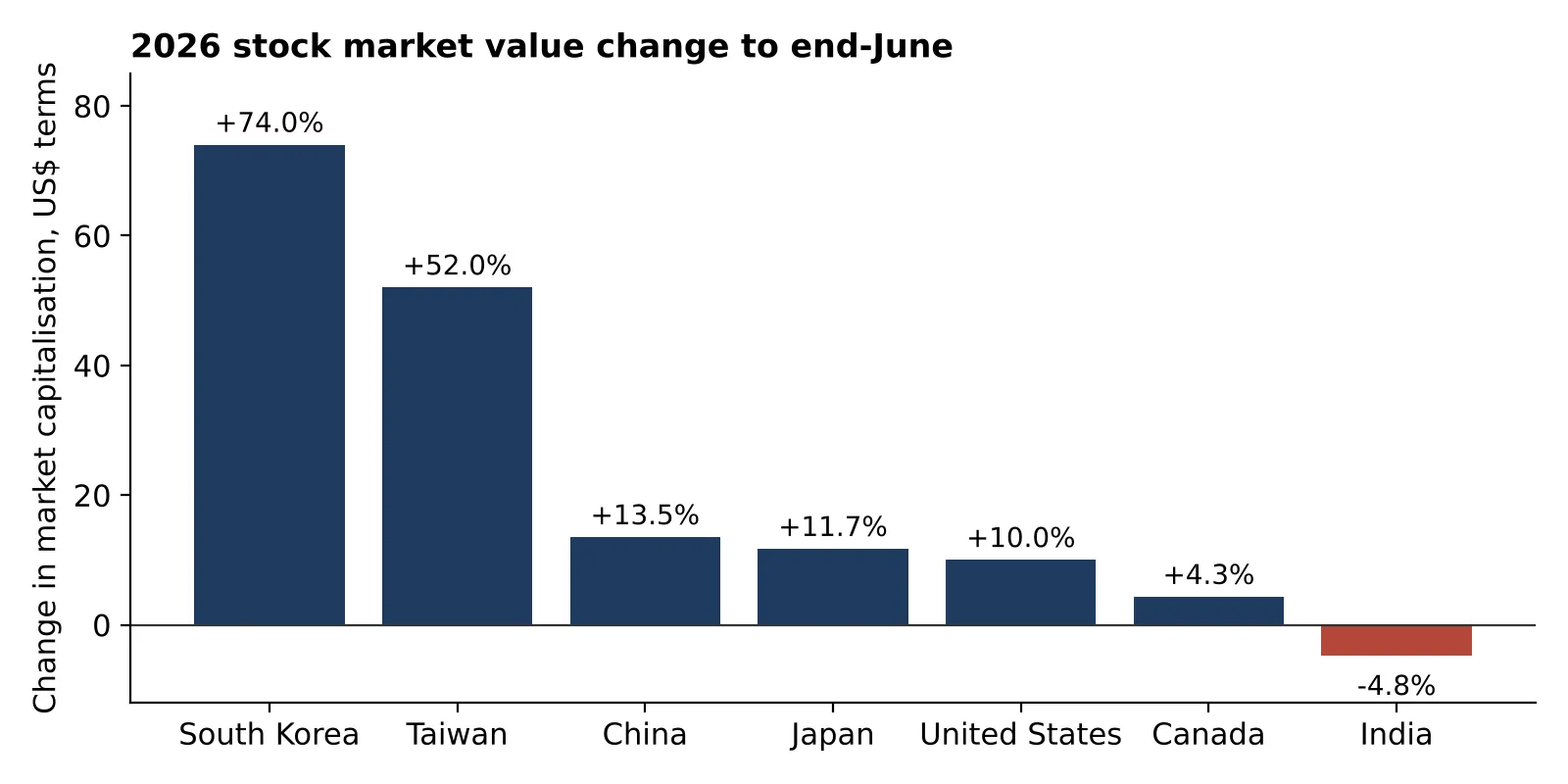
India was a source of funds. Taiwan overtook India's market value on 25 May and South Korea followed on 1 June. Foreign portfolio investors sold ₹3.12 lakh crore of Indian equities in 2026 by mid-October, nearly double the ₹1.66 lakh crore sold in all of 2025. Higher US yields, a strong dollar and expensive crude oil played a part. So did the plain fact that India has few listed companies selling chips, AI hardware or frontier models. Anthropic's planned listing at a valuation of up to US$2 trillion, and OpenAI's US$1.4 trillion private round, will add more AI equity for global funds to buy.
Foreign owners are leaving while foreign traders gain share
Two kinds of foreign capital engage with India. Pension funds and long-term investors buy shares to own a stake in growth. High-frequency trading firms seek short-term price gaps in derivatives. The first group is shrinking its presence, while the second is growing: foreign investors' share of equity futures turnover on NSE reached a record 31.5% in June 2026. Profits made by that second group largely come from Indian retail traders and flow out of the domestic economy.
How do derivative losses reach the wider Indian economy?
Retail losses in FY25 equalled about 6% of household financial savings, according to fund manager Ashish Gupta. Across FY25 and FY26, households lost more than ₹2 lakh crore in equity derivatives at the net level. Household liabilities rose to about 41% of GDP by March 2025, and net financial savings have become volatile from quarter to quarter. When losses are this large and this widespread, they show up in spending, bank deposits and borrowing.
Table 2: How derivatives losses travel through the economy
Channel | What happens | Effect |
|---|---|---|
Household savings | Losses replace money that would have stayed in deposits or long-term funds | Weaker deposit growth and thinner savings buffers |
Consumption | Traders in smaller towns cut spending after losses | Pressure on demand for consumer goods |
Credit | Some traders fund positions with personal loans | Market losses become retail loan stress |
Market integrity | Expiry-day price moves raise concerns about manipulation | Lower confidence among long-term foreign investors |
Tax base | Higher STT pushes trading desks toward Dubai or Singapore | Lost revenue and activity that is harder to supervise |
SEBI's data also show that the losses are rarely balanced by long-term holdings. For 77% of loss-making traders, their remaining cash equity portfolios are worth less than a quarter of what they lost in derivatives. For most of these households, the derivatives account is the main exposure to the stock market.
Domestic savers are carrying the cash market
A second group of Indian households is doing the opposite. Monthly contributions to systematic investment plans (SIPs) reached a record ₹32,490 crore in September 2026 across about 10 crore accounts. In the same month, equity mutual funds took in about ₹38,300 crore while foreign investors sold about ₹35,900 crore. The FY26 derivatives loss equals almost three months of these record SIP contributions. Ananth Narayan, the former SEBI member who led the Jane Street probe, has noted that individual losses had become comparable to total net inflows into equity mutual funds.
Is your portfolio built for what’s coming?
Get a free AI-powered review of your holdings — risk, overlap and quality in minutes.
What would shift Indian money from betting to owning?
Higher taxes and larger contract sizes have reduced participation without changing outcomes for those who stay. Policy now needs to reward ownership and make speculation more difficult for those least able to afford it.
Suitability checks: Linking access to options trading to income, experience or demonstrated understanding, an approach parts of the industry now support.
Expiry-day enforcement: A final Jane Street order and published surveillance findings, so that settlement windows are seen to be policed.
Exchange incentives: Now that NSE is listed, its shareholders will watch derivatives dependence closely. Revenue from listings, data and the cash market deserves equal attention.
Low-cost passive investing: Index funds remain a small part of Indian portfolios and offer a simple route from trading to owning.
Companies worth owning: Listings tied to semiconductors, data centres and power would give foreign and domestic investors an Indian way to own the AI build-out.
India has built the world's largest market for short-dated bets on its own stock indices. The bill has been paid mostly by young, small-town traders, and the winnings collected mostly by firms with faster systems and deeper pockets. The country's economic case rests on the opposite flow: household savings moving into companies that build things. How quickly that flow overtakes the betting will decide whether India's stock market becomes a place to own growth or remains a place to wager on it.