


India changed the way a large part of its equity market reaches the official closing price on 3 August 2026. For stocks eligible for futures and options, the final price is now discovered through a Closing Auction Session, or CAS, rather than the earlier volume-weighted average of trades during the last 30 minutes of continuous trading.
The first sessions showed why this is more than a technical change. Nifty moved sharply as the auction established closing prices for its constituents. Traders then saw unusual-looking closing candles and gaps between spot indices and futures. The following session brought a partial correction. Reports also described disagreement among foreign and domestic institutions, calls for clearer indicative-price displays, and a meeting between SEBI and large brokers after rollout.
The framework itself remains in force. Moneycontrol reported that SEBI had no plan to stop or fundamentally reconsider it, even as the regulator reviewed implementation and investor communication. The important question is therefore how the auction works, why its first prints looked disruptive, and how investors should interpret the new market close.
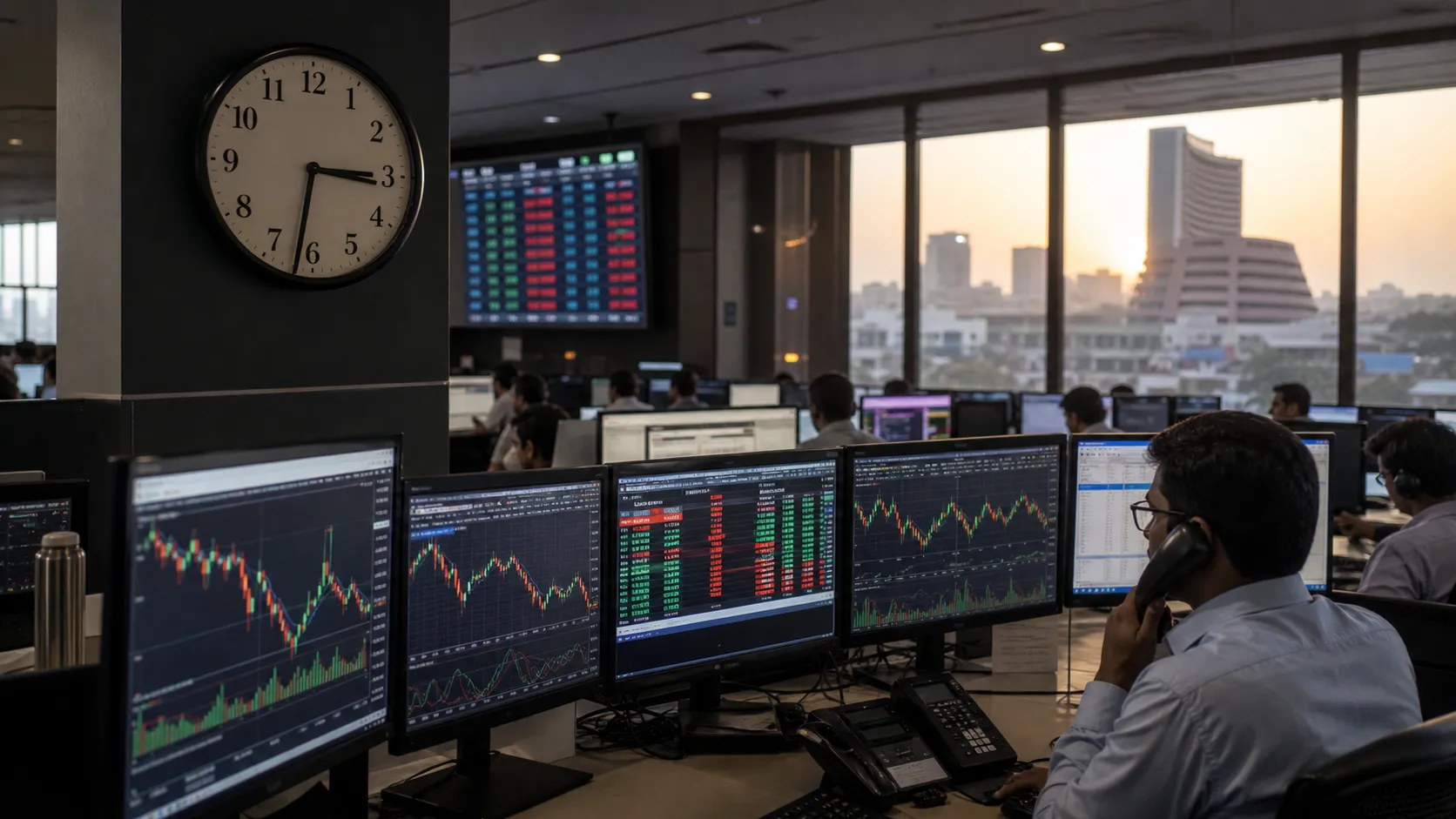
Why did SEBI replace the old closing-price method?
Before CAS, the official closing price of a stock was based on the volume-weighted average price, or VWAP, of trades during the final 30 minutes of the normal session. This method reduced the influence of one small last trade, but it spread closing-price formation over a long window. A passive fund trying to transact close to the benchmark price could not know that price until the window ended.
The official close matters well beyond a chart. Exchanges use stock closing prices to calculate index closes. Mutual funds use closing values in portfolio valuation and net asset value calculations. Derivative settlement can depend on the underlying close. Brokers use it in portfolio statements, collateral values and profit-and-loss displays. Index funds and exchange-traded funds compare their execution with benchmark closing levels.
A closing auction concentrates buy and sell interest into a dedicated end-of-day process. Participants submit orders, the exchange displays indicative information, and all executable orders are matched at a single equilibrium price. The objective is to create a closing price supported by the largest matchable quantity at one point in time.
SEBI’s August 2025 consultation paper said India was unusual among large markets in relying on a last-30-minute VWAP instead of a closing auction. Auctions are established features in markets such as the United States and Europe. Their appeal is strongest for institutions that must execute large benchmark-linked orders while reducing tracking error.
The regulator also wanted to make the close harder to influence through fragmented late trades. Concentrating orders can deepen liquidity at the benchmark event and provide a transparent order imbalance before matching. That does not make the closing price immune to volatility. It changes where liquidity gathers and how the final price is determined.
CAS was introduced in phases. Phase 1 applies to cash-market stocks that are eligible for equity derivatives. Other cash stocks retain the earlier mechanism. This distinction matters because a trader can now see two different end-of-day processes in the same market.
| Feature | Earlier closing mechanism | CAS Phase 1 |
|---|---|---|
| Price method | Last-30-minute VWAP | Single equilibrium auction price |
| Stocks covered | Existing framework across cash stocks | F&O-eligible cash stocks initially |
| End of normal cash trading | 3:30 PM | 3:15 PM for eligible stocks |
| Order information | Continuous-market order book | Indicative price, quantities and imbalance |
| Derivatives close | 3:30 PM under the earlier schedule | 3:40 PM after CAS rollout |
See what markets are pricing in
Live indices, sector moves and market breadth — the backdrop to every story we publish.
How does the Closing Auction Session work each afternoon?
For CAS-eligible stocks, normal continuous cash trading runs until 3:15 PM. The exchange calculates a reference price using the VWAP between 3:00 PM and 3:15 PM. The closing auction then uses a price band of 3% on either side of that reference price.
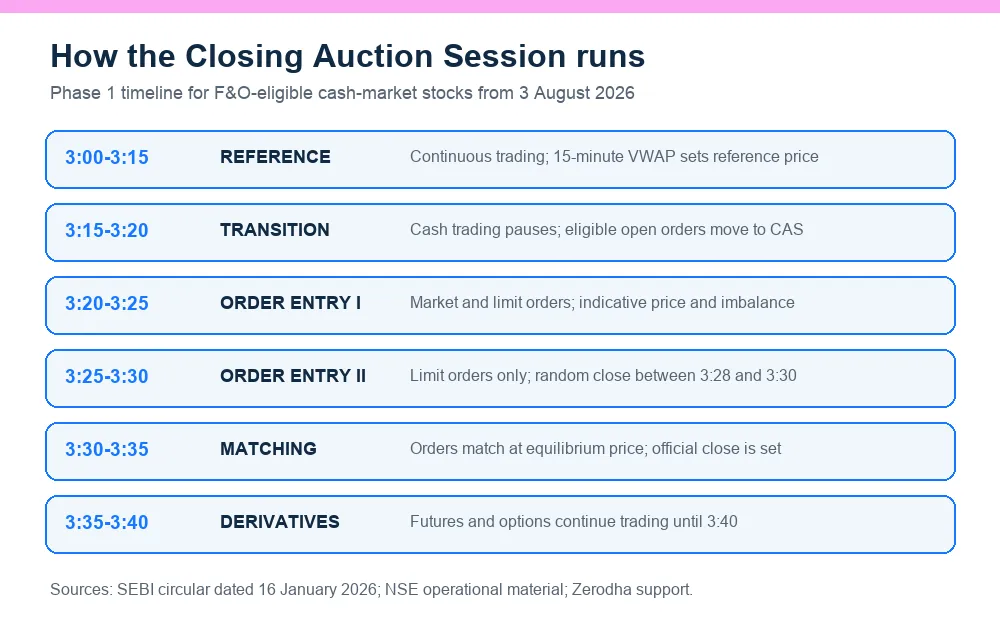
The period from 3:15 PM to 3:20 PM is a transition. Normal cash trading in eligible stocks stops. Existing limit orders can move into the auction if they satisfy the rules and fall within the permitted band. Stop-loss and iceberg orders are excluded. Orders outside the band are not carried forward.
From 3:20 PM to 3:25 PM, participants can enter, modify or cancel market and limit orders. The exchange disseminates the indicative equilibrium price, total buy and sell quantities, the order imbalance and indicative index values. This information lets participants assess where the auction might clear, but it is not a guaranteed final price because orders can still change.
From 3:25 PM, only limit orders can be newly placed or modified. Market orders already present become locked and cannot be modified or cancelled. The order-entry period closes randomly between 3:28 PM and 3:30 PM. Random closure reduces the incentive to flood the book at a precisely known final second.
Matching runs after order entry and is expected to conclude by 3:35 PM. The exchange selects the equilibrium price that maximises executable volume. Market orders receive priority, followed by eligible limit orders according to the prescribed price-time rules.
If more than one candidate price produces the same maximum executable quantity, the framework considers unmatched quantity and proximity to the reference price. If the exchange cannot discover an equilibrium price, the reference price becomes the closing price. These fallback rules are important because an auction requires sufficient overlapping demand and supply.
Equity derivatives continue trading until 3:40 PM. A post-close cash session is scheduled later, with trades executed at the CAS-derived closing price. Brokers may impose earlier intraday square-off cut-offs. Zerodha, for example, says it auto-squares off intraday positions in CAS-eligible cash stocks by 3:10 PM.
The timeline means 3:15 PM is now the practical end of normal cash trading for the affected stocks, while the market’s broader price-discovery process continues through the auction and the derivatives session.
How does the exchange calculate one equilibrium price?
The auction does not simply choose the highest bid, lowest offer or last order. It tests each eligible price level and calculates how much volume can execute there. A buy order with a limit above a candidate price is willing to trade at that lower price. A sell order with a limit below the candidate price is willing to trade at that higher price.
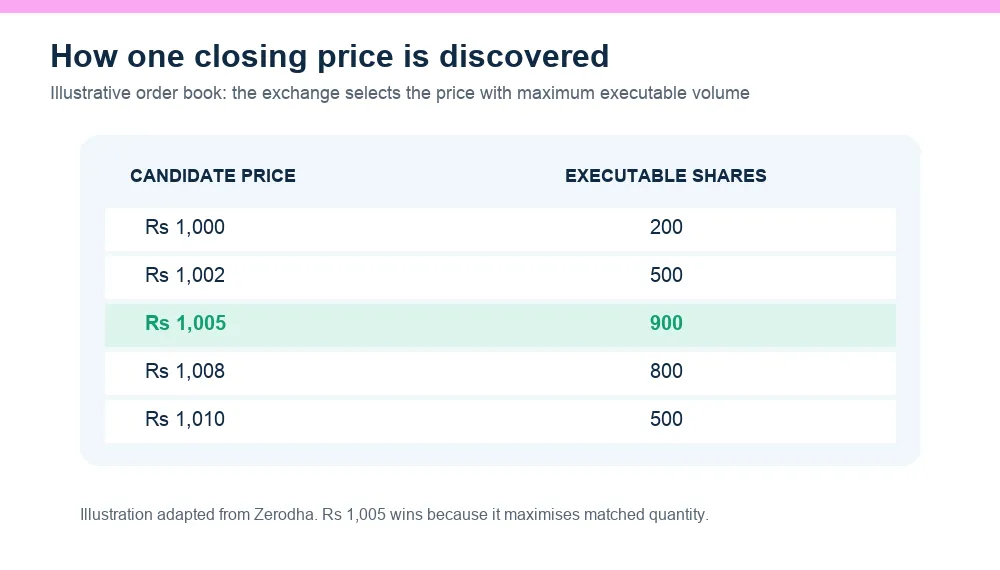
Consider an illustrative book in which 200 shares can execute at Rs 1,000, 500 at Rs 1,002, 900 at Rs 1,005, 800 at Rs 1,008 and 500 at Rs 1,010. The equilibrium price is Rs 1,005 because that price allows the maximum quantity, 900 shares, to trade.
The final price can differ sharply from the last continuous-market trade if the auction attracts a large imbalance. An index-tracking fund may need to buy several constituents at the close after an inflow. Another institution may need to sell to match a benchmark rebalance. Market makers can provide the other side, but their participation depends on risk limits, visibility and expected liquidity.
Indicative prices are therefore central to a well-functioning auction. Participants need timely, stable displays of the likely clearing price and imbalance so they can respond. Moneycontrol reported that SEBI’s meeting with brokers focused partly on the way indicative information was displayed and on investor awareness. Improving the presentation does not alter the equilibrium algorithm, but it can help attract informed orders and reduce surprise.
The reference-price band also constrains the auction. A 3% range limits extreme outcomes relative to the 3:00 PM to 3:15 PM VWAP. The band is wide enough to permit meaningful price discovery, especially on a volatile day, but narrow enough to prevent completely detached auction prints.
Investors should avoid describing every large auction movement as manipulation. A concentrated order imbalance can produce a legitimate change. Surveillance still matters, and SEBI directed exchanges to monitor activity during both reference-price calculation and the auction. Evidence of manipulation requires more than an unusual candle.
Why did Nifty and Bank Nifty show unusual CAS candles?
On the first day of implementation, the Nifty 50 reportedly rose by roughly 200 points around the new closing process. The move attracted attention because the cash index reflected auction prices in constituent stocks while futures did not show the same move at the same time. Traders described the resulting bar as a “CAS candle”.
An index is calculated from its constituent stocks. When CAS establishes closing prices for F&O-eligible constituents, those prices feed into the official index close. A large imbalance in heavily weighted stocks can therefore move the closing index even though there was no equivalent continuous-market index trade at that exact level.
Index futures are separate instruments. They trade on their own order books, reflect financing and dividend expectations, and continue until 3:40 PM. Futures traders can respond to the auction, hedge it or discount it. They are not required to print the same path as the calculated cash index at every moment.
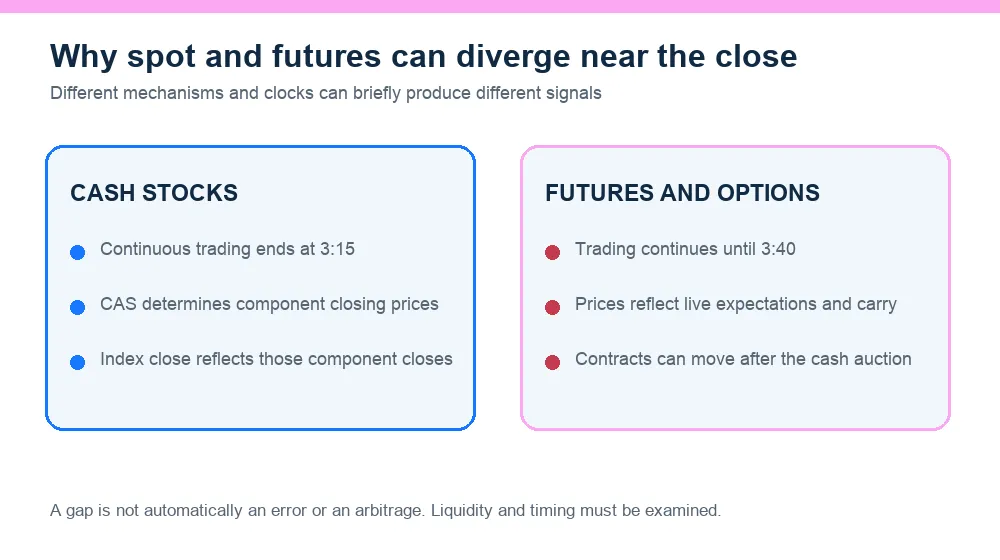
This creates a timing mismatch. Continuous cash trading stops at 3:15 PM. The official component closes emerge from the auction around 3:30 PM to 3:35 PM. Derivatives remain live afterward. A charting platform may display the new cash close as one large candle even though the price was determined through a batch auction rather than a sequence of continuous trades.
Bank Nifty can appear especially sensitive because a few large banks carry substantial index weight. If auction demand is concentrated in those constituents, the calculated index can move more than a diversified set of stocks would suggest. The precise effect depends on component weights, auction prices and the data vendor’s candle construction.
The next morning can then show a correction if the auction close was temporarily above the level supported by overnight information and regular liquidity. BusinessLine described the market opening lower as a CAS correction weighed on sentiment. A reversal does not prove the auction price was invalid. It can show that the dedicated closing demand was different from the next session’s continuous-market balance.
For technical analysis, this is a structural break. Historical indicators built from closes now mix two methodologies: 30-minute VWAP before implementation and auction equilibrium afterward for eligible stocks. Traders should annotate the change and understand how their data vendor records auction prices. Backtests that treat the first CAS candle as an ordinary continuous move may produce misleading signals.
Get research like this in your inbox
The week’s research that mattered, in five minutes. Joined by 2L+ investors.
Why did foreign and domestic institutions disagree about CAS?
The debate reflects different execution needs. Foreign portfolio investors, global index managers and passive funds often operate across markets where closing auctions are standard. Their systems, benchmarks and execution algorithms are designed around a concentrated close. A robust auction can let them trade closer to the official benchmark and reduce tracking error.
Domestic institutions reportedly raised more concerns. Their objections, as described by Moneycontrol, included operational complexity, uncertainty about liquidity and the risk that a concentrated auction could create volatile price moves. Institutions accustomed to spreading orders through the final 30-minute VWAP window had to modify trading systems, risk controls and broker instructions.
Neither position settles the economic question. A closing auction can improve benchmark execution when many buyers and sellers participate. It can perform poorly when the book is thin, indicative information is hard to interpret or one-sided demand dominates. Liquidity is partly a coordination problem: participants join when they expect others to join.
The first sessions should therefore be treated as a transition sample, not a final verdict. Institutions need time to change algorithms and internal procedures. Brokers need to improve displays and client education. Market makers need enough data to price imbalance risk. Exchanges need to refine monitoring and operational messaging.
SEBI pressed ahead because the regulator viewed the global-market structure and potential benefits as stronger than the case for retaining the old method. Reports that it planned broker discussions should be understood as implementation review, not evidence that CAS was being withdrawn. Moneycontrol separately reported that SEBI sources ruled out stopping or changing the core framework.
The appropriate test is measurable market quality over time: auction participation, matched value, closing-price volatility, spreads, order concentration, post-auction futures basis, next-day reversals and tracking error for passive funds. Conclusions based only on one dramatic index candle are premature.
What changes for retail investors, traders and mutual funds?
Long-term investors do not need to trade in the auction merely because it exists. Their holdings still receive an official closing valuation. The change is most relevant when an investor places an end-of-day order, monitors a portfolio around the close or interprets a daily return driven by auction prices.
Retail traders in CAS-eligible cash stocks must recognise that normal trading ends at 3:15 PM. Broker auto-square-off can occur earlier. An intraday trader who previously waited until 3:25 PM may now be closed out before the auction. Broker rules can differ, so the operational cut-off should be checked directly.
Market orders during the first order-entry phase deserve care. Once the second phase begins, existing market orders cannot be changed or cancelled. A limit order provides price control but may remain unexecuted. An indicative price is useful information, not a commitment by the exchange to clear there.
Good Till Triggered orders and alerts may also stop triggering earlier for affected cash stocks. Zerodha states that its GTT orders and price alerts for F&O stocks can trigger only until 3:15 PM. Users of other brokers should check the equivalent policy rather than assume uniform implementation.
Futures and options traders face a different issue. Their instruments remain live after the cash auction starts and until 3:40 PM. Option premiums can respond to futures, expected spot value, volatility and time decay. The official spot index can jump when component auction prices arrive, while the derivative has already incorporated some or all of the expected change.
For mutual funds, the official close affects portfolio valuation. Index funds and ETFs may benefit if the auction lets them execute constituent orders near the same prices used in the benchmark. This can reduce one source of tracking difference. The actual benefit depends on auction liquidity and transaction costs.
Active funds may decide whether to participate based on valuation, liquidity and mandate. CAS does not force a fund to trade at the close. It changes the reference event against which end-of-day execution is judged.
What should market participants monitor during the rollout?
The first metric is participation. A closing auction works best when diverse natural buyers, sellers and liquidity providers submit orders. Exchanges should publish enough aggregate data for the market to assess matched quantity, imbalance and the relationship between auction volume and normal trading volume.
The second is price continuity. Analysts can compare the reference price, indicative prices, equilibrium close, contemporaneous futures price and next-session open. Large differences are not automatically failures, but persistent one-sided deviations may reveal weak participation or design problems.
The third is index construction and data display. Brokers and chart providers should label auction-derived bars clearly. Traders need to know whether a 3:30 PM candle represents continuous trades, a single equilibrium print or a vendor-specific combination. Indicative index values should be visible enough for participants to manage risk.
The fourth is surveillance. Exchanges need to examine order placement and cancellation during the reference window and auction, particularly around index-heavy constituents and expiry events. Random closure and price bands reduce certain strategies, but they do not remove the need for supervision.
The fifth is derivatives behaviour. Cash closes now influence stock and index derivative settlement rules, while derivatives continue trading after the auction. Basis movements, hedging costs and liquidity between 3:15 PM and 3:40 PM should be evaluated over a meaningful sample.
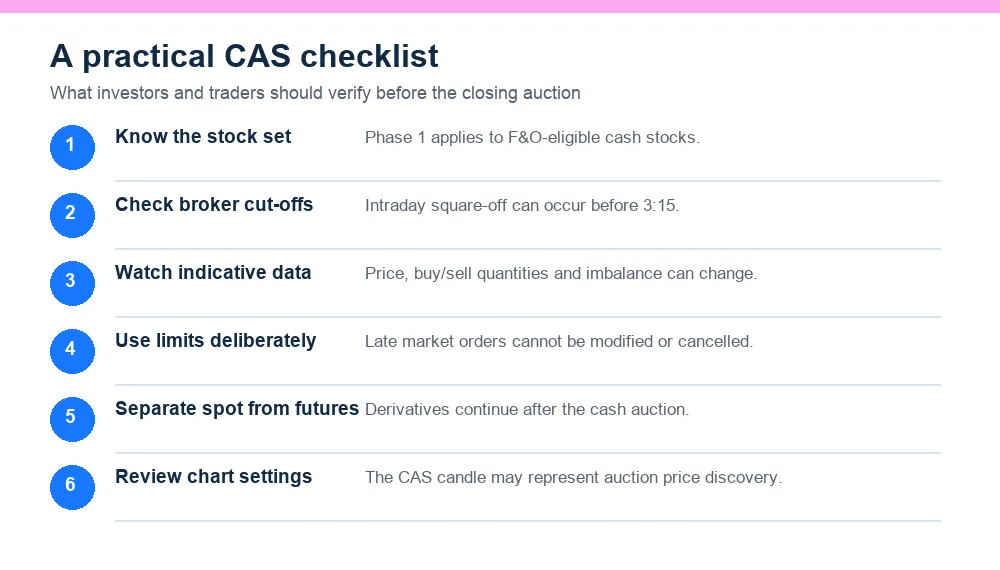
SEBI and exchanges should also distinguish between framework design and interface problems. A confusing indicative-price screen may be fixable without changing the auction algorithm. Investor-awareness gaps can be addressed through broker notices and standard labels. Thin participation may require more time, incentives or changes to order handling.
The rollout should ultimately be judged against the old 30-minute VWAP system. Relevant questions include whether closing prices become more stable, passive tracking improves, large orders face lower impact costs and suspicious late-session activity declines. CAS should not be evaluated against an imaginary frictionless close.
Is your portfolio built for what’s coming?
Get a free AI-powered review of your holdings — risk, overlap and quality in minutes.
What are the key FAQs about SEBI’s Closing Auction Session?
When did the Closing Auction Session start in India?
Phase 1 started on 3 August 2026 for cash-market stocks eligible for futures and options. Other cash stocks continue under the existing closing-price mechanism.
Is CAS the same as the post-closing session?
No. CAS discovers the official closing price through order collection and matching. The later post-close session allows transactions at the closing price already determined through CAS.
Can retail investors place orders during CAS?
Yes, subject to broker support and session rules. Market and limit orders are accepted in the first order-entry phase. The later phase permits limit-order activity, while existing market orders are locked.
Why can Nifty spot and Nifty futures show different prices?
The spot index is calculated from constituent stock prices, including their auction closes. Futures trade on a separate order book until 3:40 PM and reflect expectations, financing, dividends and live demand.
Has SEBI withdrawn or paused the CAS framework?
No. Reports after the first sessions said SEBI was reviewing rollout issues and broker communication but had no plan to stop or reverse the core framework.