


Risk management in options trading involves strategies like protective puts, covered calls, and iron condors to achieve downside protection and capital preservation. Option buying limits risk to premiums paid, while long-short equity strategies use market momentum signals to time entries. Combining options with PMS or moderate risk mutual funds enhances overall portfolio risk management for Indian investors.
Introduction
Most retail traders come to the options market chasing fast profits. A few wins early on build confidence. Then a single bad trade, or worse, a series of them, wipes out months of gains in days. If you have been there, you are not alone. According to a SEBI study, over 89% of individual options traders in India incurred losses in FY22. The problem is rarely bad luck. It is almost always a lack of structured risk management in options trading.
This blog breaks down the strategies, rules, and frameworks that separate disciplined options traders from the crowd and shows how options can actually protect and grow a portfolio when used correctly.
See what markets are pricing in
Live indices, sector moves and market breadth — the backdrop to every story we publish.
What Is Risk Management in Options Trading?
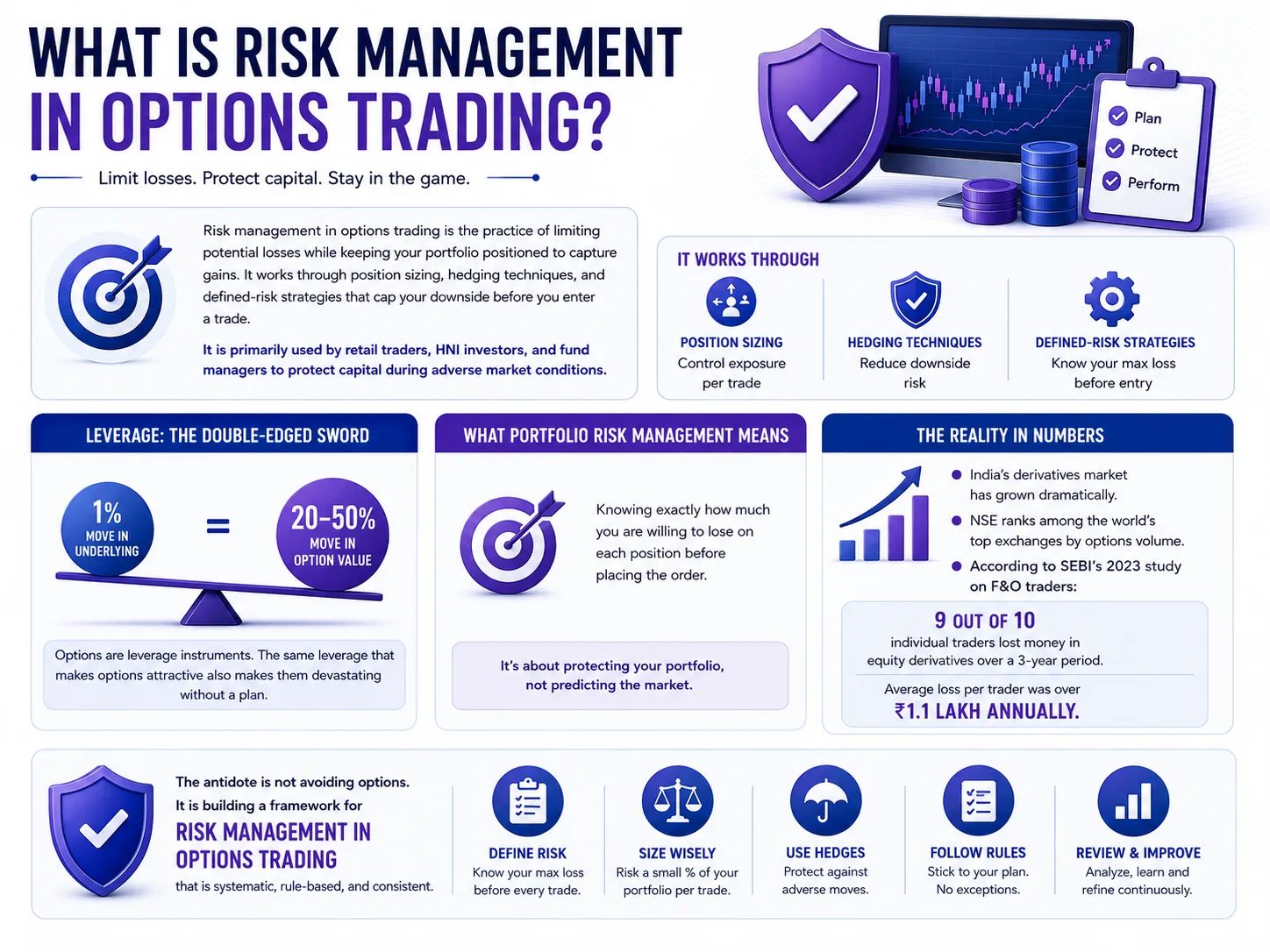
Risk management in options trading is the practice of limiting potential losses while keeping your portfolio positioned to capture gains. It works through position sizing, hedging techniques, and defined-risk strategies that cap your downside before you enter a trade. It is primarily used by retail traders, HNI investors, and fund managers to protect capital during adverse market conditions.
That is the core definition. But the reality is more nuanced and more interesting.
Options are leverage instruments. A 1% move in the underlying can translate to a 20 to 50% move in the option's value, depending on the strike and expiry. That same leverage that makes options attractive also makes them devastating without a plan. Portfolio risk management in the context of options means knowing exactly how much you are willing to lose on each position before placing the order.
India's derivatives market has grown dramatically. The NSE consistently ranks among the world's top exchanges by options volume. More retail participation has come in and so has more uninformed risk-taking. According to SEBI's study on F&O traders published in 2023, 9 out of 10 individual traders lost money in equity derivatives over a three-year period. The average loss per trader was over Rs. 1.1 lakh annually.
The antidote is not avoiding options. It is building a framework for risk management in options trading that is systematic, rule-based, and consistent, not dependent on gut feeling or market tips.
Why Most Retail Options Traders Lose Money
The losses are not random. Three patterns repeat across failing traders: they over-leverage with too large positions, they trade too frequently so that high transaction costs erode gains, and they have no exit plan, so they hold losing positions hoping for a reversal. All three are risk management failures, not market failures.
The 2% Position Sizing Rule
One of the most durable rules in portfolio risk management is the 2% rule: never risk more than 2% of your total trading capital on a single options trade. If your capital is Rs. 10 lakh, the maximum loss on one position should be Rs. 20,000. This rule does not limit your profit. It limits your ruin. A trader who follows this rule can survive 50 consecutive losses and still have capital to trade.
Option Buying vs Option Selling: Risk Profiles and Downside Protection Explained
The debate between option buying and option selling is one of the most misunderstood in derivatives trading. Each has a distinct risk profile, and knowing which one suits your market view and temperament is fundamental to risk management in options trading.
Parameter |
Option Buying |
Option Selling |
Maximum Risk |
Premium paid |
Theoretically unlimited |
Maximum Profit |
Theoretically unlimited |
Premium received |
Probability of Profit |
30 to 40% |
60 to 70% |
Capital Required |
Low |
High (margin) |
Ideal Market Condition |
High volatility |
Low/falling volatility |
Time Decay (Theta) |
Works against the buyer |
Works in favour of the seller |
Best for |
Directional bets |
Income generation |
Buyer: Limited Risk, Unlimited Upside
Option buying means paying a premium for the right, not the obligation, to buy or sell an asset at a predetermined price before expiry. Your maximum loss is the premium you pay. If a Nifty CE (call option) costs Rs. 150 and expires worthless, that is all you lose. But if the market moves sharply in your direction, the same Rs. 150 premium can become Rs. 2,000. This asymmetry is the core appeal of option buying.
The catch is that time decay (theta) works against you every day. Most options expire worthless. Buying options requires being right about direction, magnitude, and timing, three conditions that must align simultaneously.
Seller: Limited Profit, Unlimited Risk: Why Discipline Is Critical
Selling options means collecting premium upfront and hoping the option expires worthless. The win rate is high because sellers win more often than buyers, but losses can be catastrophic without stop-losses. Option sellers need strict risk management in options trading, including defined stop-loss levels, rolling strategies, and adequate margin buffers, to stay solvent when markets move against them.
Best Options Strategies for Downside Protection and Capital Preservation
Downside protection is where options truly shine. Rather than speculative tools, they become insurance policies for your portfolio.
Protective Put Strategy
A protective put is the simplest and most effective downside protection strategy. You own shares (or a basket of stocks through a PMS or Smallcase) and simultaneously buy a put option on the underlying index or stock. If the market falls, the put gains value and offsets your portfolio losses.
Think of it like insuring your car. You pay a premium, and if something goes wrong, the insurance covers the damage. For a portfolio of Rs. 50 lakh in equities, buying monthly Nifty put options at a 3 to 5% out-of-the-money strike can significantly limit downside without exiting the position.
Covered Call for Income Generation
If you hold equity positions and want to generate additional income, the covered call strategy involves selling a call option against stocks you already own. You collect the premium and, in a flat or mildly bullish market, that income enhances your total returns. The trade-off is that your upside is capped at the strike price you have sold. This strategy is particularly useful for HNI investors holding blue-chip portfolios through a Wright Research PMS, as it layers income generation on top of a long equity position.
Iron Condor for Range-Bound Markets
The iron condor involves selling an out-of-the-money call spread and an out-of-the-money put spread simultaneously. It profits when the underlying stays within a defined range. For traders who believe the market will stay calm, such as during a consolidation phase, the iron condor is an efficient downside protection structure. The risk is defined on both sides, making portfolio risk management straightforward.
Long Straddle and Strangle for High-Volatility Events
When a big event looms, such as a Union Budget, RBI policy meeting, or major quarterly earnings, option buying through a long straddle (buying both a call and a put at the same strike) or strangle (buying out-of-the-money calls and puts) can profit from a large move in either direction. The cost is higher premiums, so these strategies require decisive moves to be profitable.
Get research like this in your inbox
The week’s research that mattered, in five minutes. Joined by 2L+ investors.
Capital Preservation Through Options in Volatile Markets
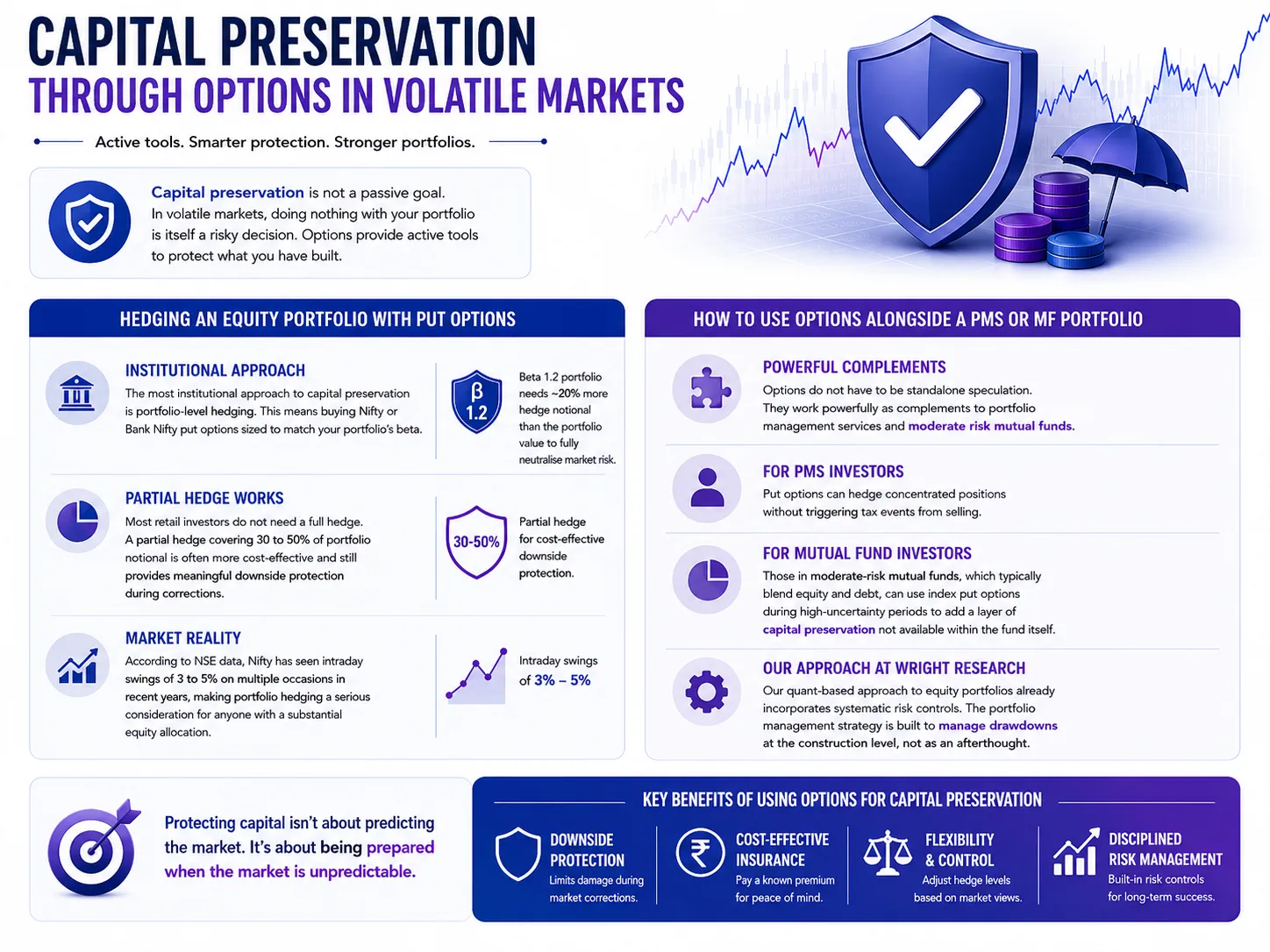
Capital preservation is not a passive goal. In volatile markets, doing nothing with your portfolio is itself a risky decision. Options provide active tools to protect what you have built.
Hedging an Equity Portfolio with Put Options
The most institutional approach to capital preservation is portfolio-level hedging. This means buying Nifty or Bank Nifty put options sized to match your portfolio's beta. A portfolio with a beta of 1.2 relative to Nifty needs 20% more hedge notional than the portfolio value to fully neutralise market risk.
Most retail investors do not need a full hedge. A partial hedge covering 30 to 50% of portfolio notional is often more cost-effective and still provides meaningful downside protection during corrections. According to NSE data, Nifty has seen intraday swings of 3 to 5% on multiple occasions in recent years, making portfolio hedging a serious consideration for anyone with a substantial equity allocation.
How to Use Options Alongside a PMS or MF Portfolio
Options do not have to be standalone speculation. They work powerfully as complements to portfolio management services and moderate risk mutual funds.
For PMS investors, put options can hedge concentrated positions without triggering tax events from selling.
For mutual fund investors, those in moderate-risk mutual funds, which typically blend equity and debt, can use index put options during high-uncertainty periods to add a layer of capital preservation not available within the fund itself.
At Wright Research , our quant-based approach to equity portfolios already incorporates systematic risk controls. The portfolio management strategy is built to manage drawdowns at the construction level, not as an afterthought.
Long-Short Equity Strategies and Market Momentum
Long-short equity strategies represent a more sophisticated approach to portfolio risk management, one that hedge funds and increasingly quant PMS managers in India use to generate returns in both rising and falling markets.
What Long-Short Equity Means
A long-short equity strategy involves going long (buying) stocks expected to outperform and simultaneously shorting (selling) stocks expected to underperform. The net exposure can be market-neutral (equal longs and shorts) or directionally biased with more long than short in a bullish environment. The goal is to profit from the spread between winners and losers, not from the market's overall direction.
In India, short positions in individual stocks are executed through the futures market or through options strategies such as buying puts on underperforming stocks. The long short equity approach reduces overall portfolio correlation to the broad market, which is a significant portfolio risk management advantage.
How Momentum Signals Improve Options Entry Timing
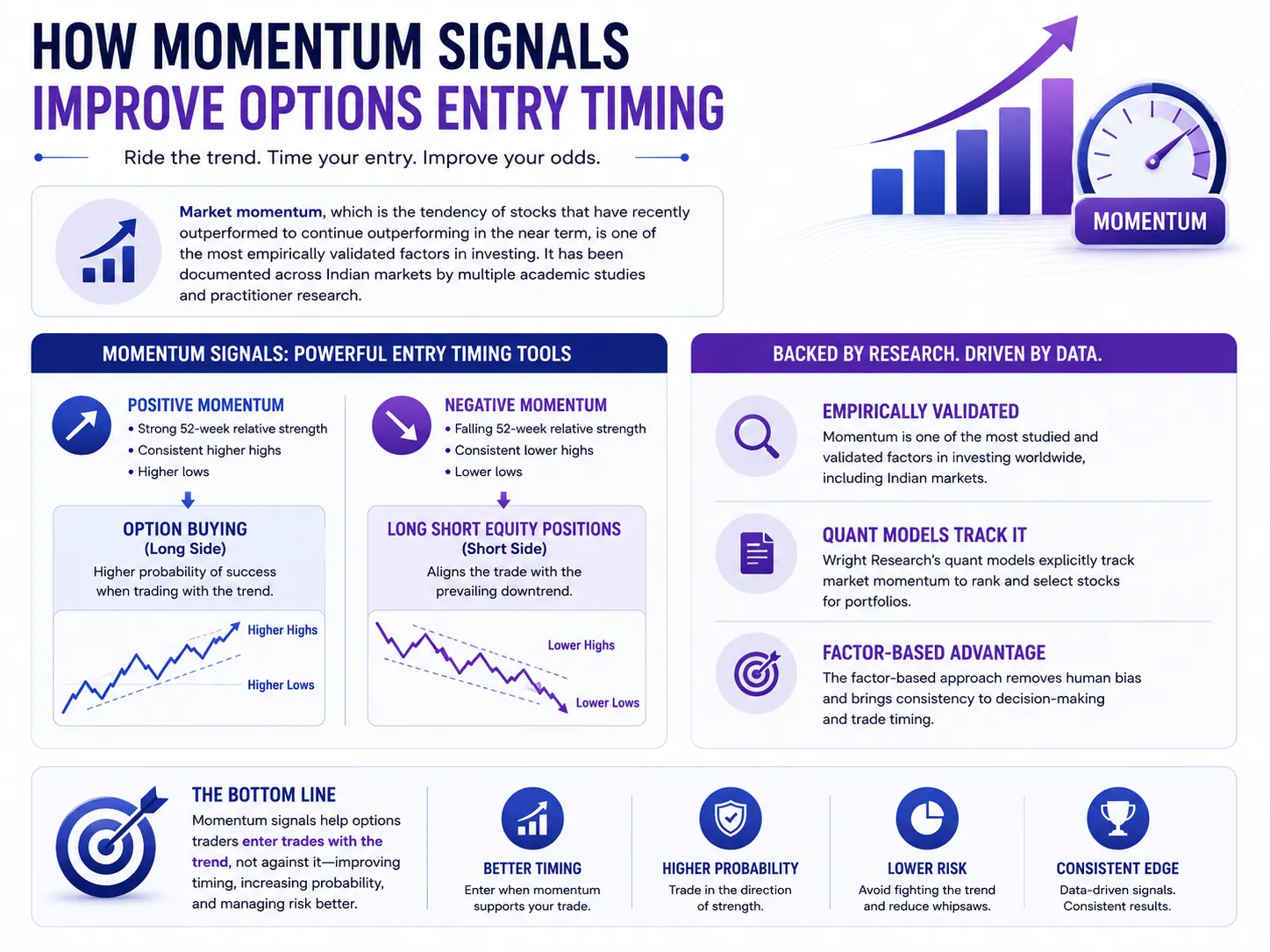
Market momentum, which is the tendency of stocks that have recently outperformed to continue outperforming in the near term, is one of the most empirically validated factors in investing. It has been documented across Indian markets by multiple academic studies and practitioner research.
For options traders, market momentum signals are powerful entry timing tools. When a stock or index shows strong positive momentum with rising 52-week relative strength and consistent higher highs and higher lows, option buying on the long side has a higher probability of success because you are trading with the trend. Conversely, when momentum turns negative, buying puts or entering long short equity positions on the short side aligns the trade with the prevailing trend.
Wright Research's quant models explicitly track market momentum as one of several factors used to rank and select stocks for portfolios. The factor-based approach removes human bias and brings consistency to decision-making.
Risk Management in Options Trading: Rules Every Trader Must Follow
Knowledge of strategies is necessary but not sufficient. Execution discipline means following rules consistently, especially when markets are volatile. That is what separates sustainable traders from those who blow up.
Rule |
Description |
Why It Matters |
2% Position Sizing |
Max loss per trade not more than 2% of capital |
Ensures survival across losing streaks |
Stop-Loss on Entry |
Define exit before placing the trade |
Removes emotion from decision-making |
Avoid 0DTE Traps |
Do not trade options expiring today |
Gamma risk is extreme near expiry |
Hedge High-Conviction Longs |
Buy puts on large positions |
Adds downside protection systematically |
Review Weekly |
Assess open positions every week |
Prevents drift and over-exposure |
Stop-Loss Discipline
A stop-loss for option buying positions is typically set at 30 to 50% of the premium paid. If you bought an option for Rs. 200, exit at Rs. 100 to Rs. 140 if the trade goes wrong. For option sellers, the stop is usually placed when the option's value reaches 2 to 3x the premium received. Discipline here is non-negotiable. Risk management in options trading is only as strong as your willingness to take a small loss before it becomes a large one.
Position Sizing
No single options trade should expose you to a loss that materially impairs your capital preservation goals. The 2% rule is a ceiling, not a target. Many professional traders risk far less, at 0.5 to 1% per trade, to allow for multiple simultaneous positions without undue concentration.
Avoiding 0DTE Traps
Zero-day-to-expiry (0DTE) options have become popular for their large intraday swings. They are also extremely dangerous because gamma (the rate at which delta changes) is at its maximum on expiry day. A small adverse move can wipe out an entire premium in minutes. Unless you are an experienced trader with defined rules, 0DTE options are among the most hostile environments for risk management in options trading.
Conclusion
Options are not inherently risky. The real danger lies in trading them without a plan. When approached with the right framework, options become one of the most powerful tools available to Indian investors for downside protection, capital preservation, and active portfolio risk management.
The strategies covered in this blog, from option buying with capped premium risk to protective puts, iron condors, and long short equity strategies guided by market momentum, are all grounded in one principle: know your risk before you enter, and manage it without emotion while you are in the trade. This is not a set of complex tactics reserved for institutional desks. These are learnable, repeatable rules that any disciplined investor can apply.
What makes the difference over time is not the sophistication of the strategy but the consistency with which you follow it. A trader who applies a simple 2% sizing rule and a defined stop-loss on every trade will outperform someone with a clever system but poor discipline.
The same logic applies when options are used alongside professionally managed portfolios. Products like Wright Research's PMS or moderate risk mutual funds already embed systematic risk controls at the strategy level, giving investors a structured foundation to build on. Markets will always be uncertain. What changes outcomes is not prediction. It is preparation, discipline, and a clear framework that holds even when markets do not cooperate.
Is your portfolio built for what’s coming?
Get a free AI-powered review of your holdings — risk, overlap and quality in minutes.
Frequently Asked Questions
What are the best options trading strategies for risk management in India?
The most effective risk management in options trading strategies for Indian investors include protective puts (buying puts against equity holdings), covered calls (selling calls on held stocks for income), and iron condors (for range-bound markets). These strategies offer built-in downside protection, defined risk, and align well with India's NSE derivatives ecosystem for both retail and HNI investors.
How does option buying differ from option selling in terms of risk?
Option buying limits your risk to the premium paid. You can only lose what you spend. Option selling collects premium upfront, but the risk is theoretically unlimited without stop-losses. Buyers need correct direction, magnitude, and timing. Sellers benefit from time decay but need strict risk management in options trading to avoid catastrophic losses on adverse moves.
What is the best options strategy to protect a portfolio during a market downturn?
The protective put is the most direct downside protection strategy for a falling market. Buying out-of-the-money Nifty put options sized to your portfolio's beta provides a hedge that gains value as the market falls, offsetting portfolio losses. Portfolio-level put hedging is a reliable capital preservation tool during high-uncertainty periods for equity investors.
How does capital preservation work through options strategies in volatile markets?
Capital preservation through options works by buying put options that increase in value during market downturns, capping your portfolio's loss at the cost of the premium. Strategies like protective puts and portfolio-level hedges allow investors in moderate risk mutual funds and equity portfolios to stay invested without converting paper losses into permanent capital erosion, even through sharp corrections.
What is momentum investing and how can it be combined with options strategies?
Market momentum investing is buying assets that have recently outperformed and shorting those that have underperformed, based on the empirical finding that trends persist in the short to medium term. Combined with options, momentum signals help traders time option buying entries more accurately, going long calls on high-momentum stocks and buying puts on low-momentum ones, effectively executing long short equity strategies with defined, limited risk through derivatives.