
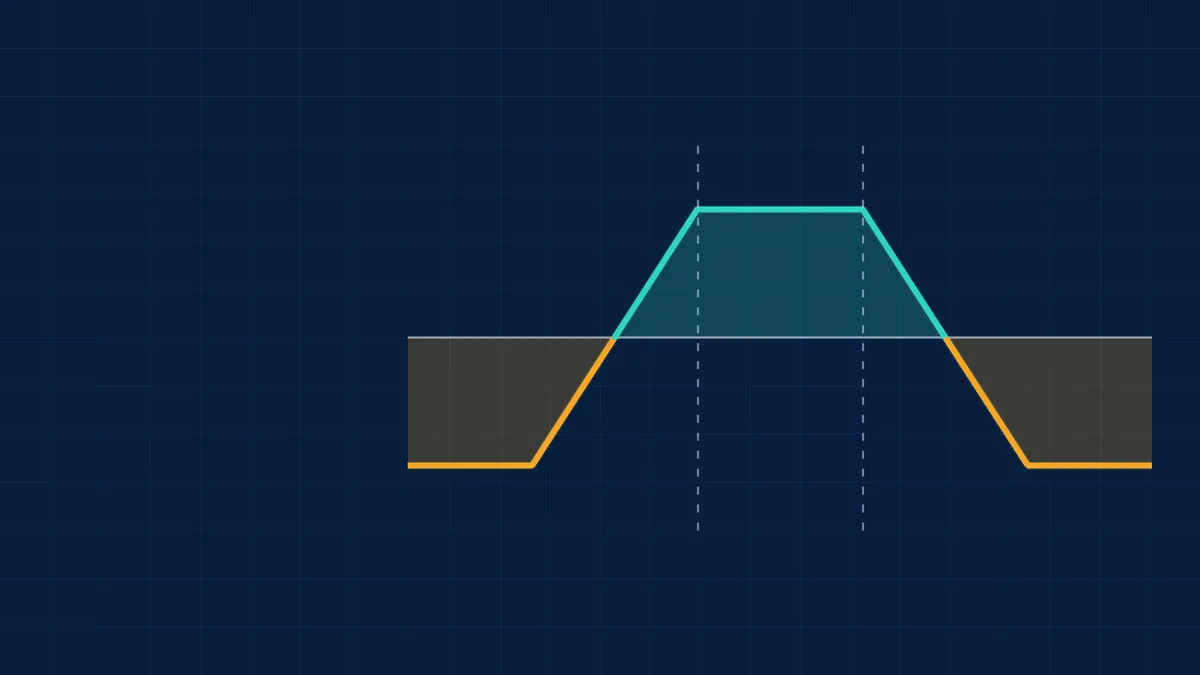
An iron condor combines a short call spread and a short put spread on the same underlying and expiry. It earns a limited profit if price stays within a range, and has a limited loss if price moves beyond either side. It is a neutral strategy for low-volatility conditions.
How it is built
- Sell an out-of-the-money call and buy a further out-of-the-money call (call spread).
- Sell an out-of-the-money put and buy a further out-of-the-money put (put spread).
- The bought options are the 'wings' that cap the loss. The net premium received is the maximum profit.
See what markets are pricing in
Live indices, sector moves and market breadth — the backdrop to every story we publish.
A worked example
The Nifty is at 24,000. Sell the 24,200 call at 80 and buy the 24,400 call at 40. Sell the 23,800 put at 75 and buy the 23,600 put at 35.
| Item | Calculation | Result |
|---|---|---|
| Net credit (max profit) | 80 - 40 + 75 - 35 | 80 points, if the Nifty expires between 23,800 and 24,200 |
| Maximum loss | Wing width 200 - credit 80 | 120 points, beyond 24,400 or below 23,600 |
| Upper breakeven | 24,200 + 80 | 24,280 |
| Lower breakeven | 23,800 - 80 | 23,720 |
Get research like this in your inbox
The week’s research that mattered, in five minutes. Joined by 2L+ investors.
When traders use it
- When the trader expects the price to stay in a range and implied volatility to be high or fall.
- Time decay helps the position, since the options sold lose value as expiry approaches.
Risks and costs
- The maximum loss (120) is larger than the maximum profit (80) in this example, so the strategy needs a high chance of the price staying in range to be worthwhile.
- A sharp move through either short strike causes losses that grow until the wings cap them.
- Four legs mean four sets of costs, and wide bid-ask spreads can erode the credit.
Risk note. Strategies that sell options can lose far more than the premium received, and margin requirements apply. SEBI studies have found that roughly nine in ten individual traders in equity derivatives lost money, mostly after costs. See risk management in options trading and transaction costs. Prices below are per unit of the underlying, so multiply by the lot size for rupee amounts. Examples use illustrative Nifty prices and ignore brokerage, taxes and margin.
Related: butterfly option strategy and strangle. See the full options strategies guide.
Is your portfolio built for what’s coming?
Get a free AI-powered review of your holdings — risk, overlap and quality in minutes.
Frequently Asked Questions
What is an iron condor?
A neutral options strategy that sells an out-of-the-money call spread and put spread to earn the premium if price stays in a range.
What is the maximum profit and loss of an iron condor?
The maximum profit is the net credit. The maximum loss is the width of a spread minus the credit.
When is an iron condor profitable?
When the underlying expires between the two short strikes, or within the breakevens.
How is an iron condor different from a butterfly?
Both are limited-risk neutral strategies. A butterfly profits most at one strike, while an iron condor profits across a range.
This article is for education only and is not investment advice. Indicator readings describe past price behaviour and do not predict future returns.