
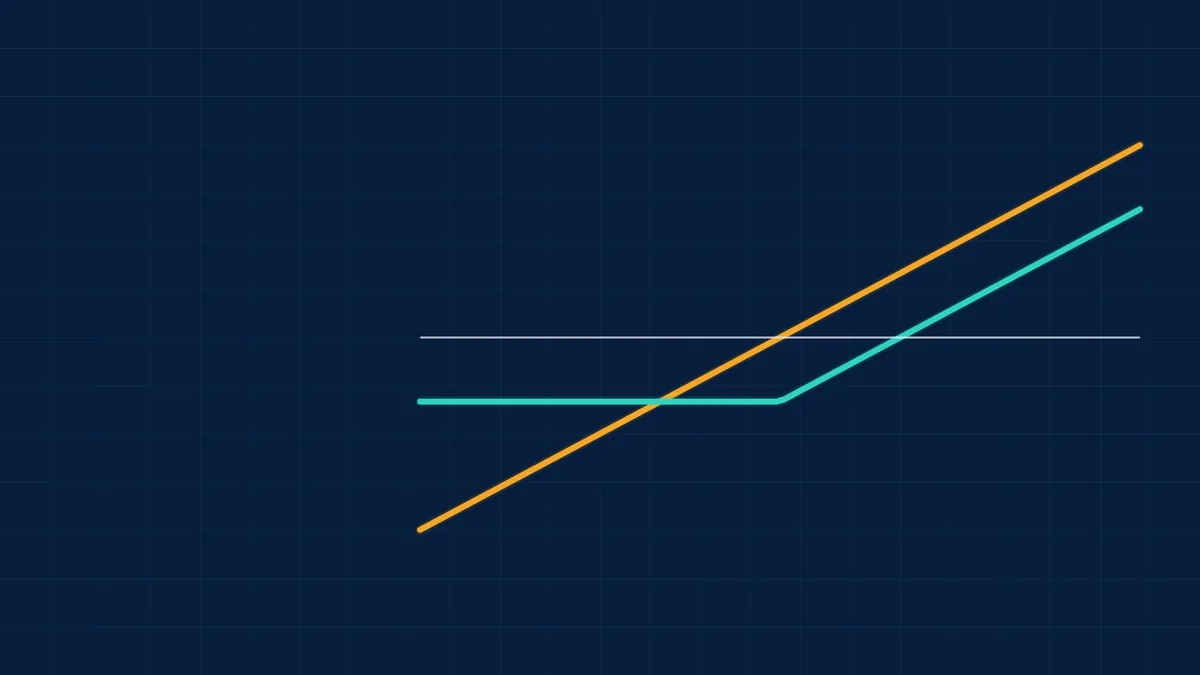
A futures contract is an obligation to buy or sell an asset at a set price on a future date. An option gives the buyer the right, not the obligation, to buy (call) or sell (put) at a set price by an expiry date. This difference shapes the risk, cost and payoff of each.
How it is built
- Futures: both buyer and seller are obliged to settle. Gains and losses are marked to market daily, and both can be unlimited.
- Options buyer: pays a premium up front for the right, and the maximum loss is that premium.
- Options seller: receives the premium but takes on the obligation, with large potential loss and a margin requirement.
See what markets are pricing in
Live indices, sector moves and market breadth — the backdrop to every story we publish.
A worked example
The Nifty is at 24,000 and a trader expects a rise. Compare buying a Nifty futures contract at 24,000 with buying a 24,000 call for 150 (per unit).
| Case | Calculation | Result per unit |
|---|---|---|
| Nifty at 24,500 at expiry | Futures: +500. Call: +500 - 150 | Futures +500, call +350 |
| Nifty at 24,000 | Futures: 0. Call: -150 | Futures 0, call -150 |
| Nifty at 23,500 | Futures: -500. Call: -150 | Futures -500, call -150 (max loss) |
Get research like this in your inbox
The week’s research that mattered, in five minutes. Joined by 2L+ investors.
When traders use it
- Futures: to hedge or to get direct, linear exposure. Futures price is spot plus the cost of carry: for example 24,000 x (1 + 7% x 1/12) is about 24,140 for a month, before dividends. See Nifty futures.
- Options: to define risk in advance, or to trade volatility as well as direction. See option premium and implied volatility.
Risks and costs
- Futures have no time decay in the premium sense but are leveraged, so losses can exceed the margin.
- Options buyers face time decay: they can lose the entire premium even when the view is partly right.
- Options sellers have large possible losses.
- Both involve costs, taxes and margin. See transaction costs.
Risk note. Strategies that sell options can lose far more than the premium received, and margin requirements apply. SEBI studies have found that roughly nine in ten individual traders in equity derivatives lost money, mostly after costs. See risk management in options trading and transaction costs. Prices below are per unit of the underlying, so multiply by the lot size for rupee amounts. Examples use illustrative Nifty prices and ignore brokerage, taxes and margin.
Related: Nifty futures contract and put vs call options. See the full options strategies guide.
Is your portfolio built for what’s coming?
Get a free AI-powered review of your holdings — risk, overlap and quality in minutes.
Frequently Asked Questions
What is the main difference between futures and options?
Futures are an obligation to transact at a set price. Options give the buyer a right but not an obligation.
Which is riskier, futures or options?
Futures and option selling can have large losses. An option buyer's loss is limited to the premium, but the whole premium can be lost.
Do options have a premium and futures do not?
Yes. Option buyers pay a premium up front. Futures need margin, not a premium.
What is cost of carry in futures?
The difference between futures and spot prices, mainly reflecting interest cost, less any dividends.
This article is for education only and is not investment advice. Indicator readings describe past price behaviour and do not predict future returns.