


A put vs call option comparison starts with direction and contractual rights. A call buyer receives the right to buy the underlying at a strike price; a put buyer receives the right to sell.
The difference between put and call is only one layer. A full put option vs call option assessment must identify whether the investor buys or sells, because payoff, margin and maximum loss change sharply.
What Is a Call Option?
The call option meaning is the buyer’s right, but not obligation, to buy an underlying at the strike price by expiry. The seller receives the premium and takes the corresponding obligation. In a put vs call option decision, a long call is generally bullish.
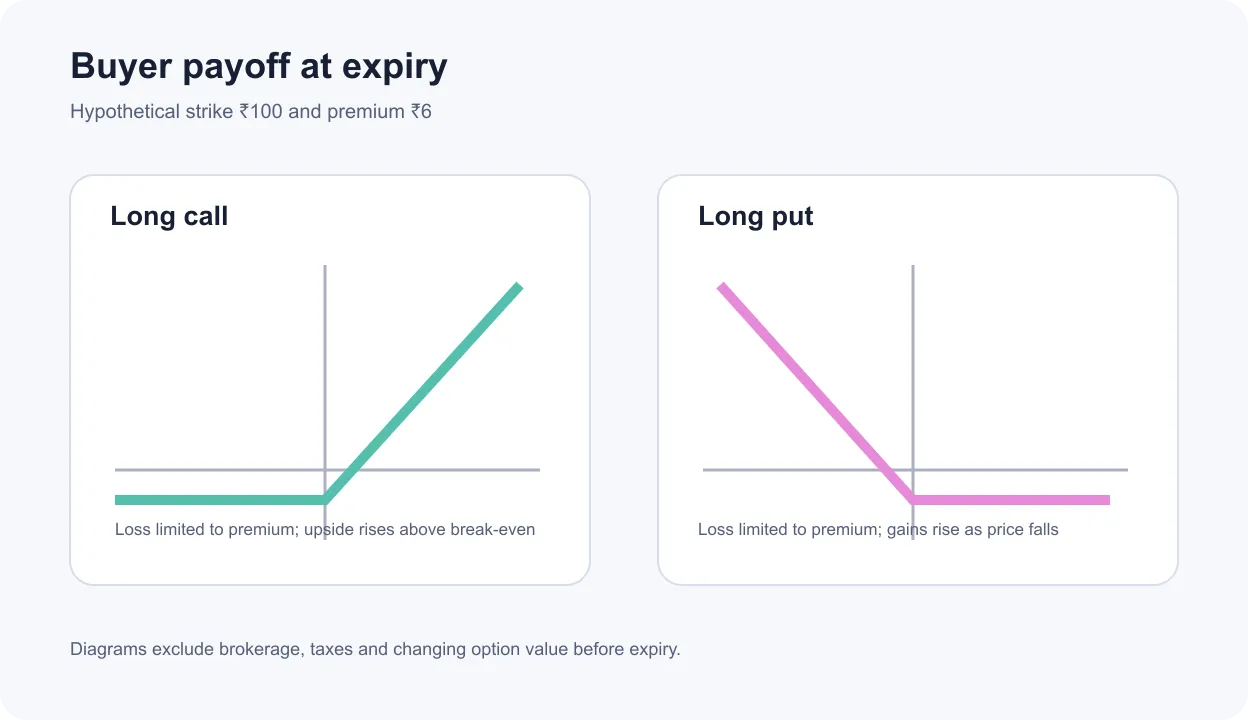
Suppose an index call has a ₹100 strike and costs ₹6. At expiry, its break-even is ₹106 before charges. Below ₹100 it expires without intrinsic value, so the buyer loses the ₹6 premium. This call option meaning distinguishes payoff from profit.
A put option vs call option quote also contains expiry, lot size, implied volatility and liquidity. The difference between put and call does not explain why one premium is expensive. Call option meaning in practice includes time decay: the contract can lose value even if the investor’s directional view is eventually correct.
See what markets are pricing in
Live indices, sector moves and market breadth — the backdrop to every story we publish.
What Is a Put Option?
The put option meaning is the buyer’s right, but not obligation, to sell an underlying at the strike price by expiry. A long put is generally bearish or protective. In a put vs call option comparison, it gains intrinsic value as the underlying falls below the strike.
With a ₹100 strike and ₹6 premium, the long-put break-even at expiry is ₹94 before costs. At ₹80, intrinsic value is ₹20 and the simplified profit is ₹14. This put option meaning shows why premium must be included when measuring returns.
The difference between put and call is directional for buyers, but both suffer time decay when other factors stay constant. Put option meaning also includes the seller’s obligation to buy if assigned. A put option vs call option decision is incomplete without identifying that side.
Put vs Call Option: Key Differences
The central put vs call option distinction is the buyer’s right: buy for a call, sell for a put. The difference between put and call also appears in intrinsic value. A call is in the money when spot exceeds strike; a put is in the money when strike exceeds spot.
| Feature | Long call | Long put |
|---|---|---|
| Buyer’s right | Buy at strike | Sell at strike |
| Typical view | Bullish | Bearish or protective |
| Maximum loss | Premium paid | Premium paid |
| Break-even | Strike + premium | Strike − premium |
| Upside at expiry | Theoretically open-ended | Limited as underlying cannot fall below zero |
A put option vs call option table for sellers would look different. In put option vs call option trading, the seller’s profit is limited to premium, while potential loss may be substantial. The call option meaning and put option meaning must therefore specify “long” or “short.”
The difference between put and call does not make one universally better. Put vs call option suitability depends on market view, hedge objective, volatility, time horizon and loss capacity. Put option vs call option pricing also reacts differently to movements in the underlying through delta.
Which Is Riskier: Put or Call Options?
A put vs call option label alone does not determine risk. Buying either can lose 100% of the premium. Selling either can create losses far beyond premium received, especially with uncovered positions. The difference between put and call matters less than buyer versus seller exposure.
For an uncovered short call, loss can rise as the underlying rises. An uncovered short put can suffer heavily as the underlying falls, with downside bounded only when the underlying reaches zero. This put option vs call option contrast explains why margin and stress testing matter.
Call option meaning also includes volatility and expiry risk. Put option meaning includes gap risk and assignment. In either case, leverage can multiply outcomes. SEBI reported that 93% of individual equity F&O traders incurred losses between FY22 and FY24, with aggregate losses above ₹1.8 lakh crore.
A prudent put vs call option review sets maximum rupee loss before entry. The difference between put and call should be modelled across several expiry prices, while a put option vs call option review should include brokerage, taxes, bid-ask spread and slippage.
Get research like this in your inbox
The week’s research that mattered, in five minutes. Joined by 2L+ investors.
How Put and Call Options Are Used in Trading Strategies
A long call can express limited-loss bullish exposure; a long put can express limited-loss bearish exposure. This call option meaning is different from buying the underlying because the option expires. This put option meaning is different from short-selling because payoff is nonlinear.
Put option vs call option investors also combine contracts. A protective put pairs shares with a long put. A covered call pairs shares with a short call, capping some upside. A vertical spread buys one strike and sells another. Each put vs call option combination trades some potential reward for cost or risk control.
The difference between put and call becomes useful in a straddle, where a trader buys a call and put at the same strike to seek a large move in either direction. Yet the total premium raises break-even levels. A put option vs call option strategy must account for implied volatility falling after an event.
Call option meaning in a spread depends on both legs, not the purchased contract alone. Put option meaning in a hedge depends on portfolio size and correlation. Put vs call option strategies should be evaluated as one net position with a single maximum-loss estimate.
Can Beginners Trade Put and Call Options in India?
Eligible retail clients can access exchange-listed contracts after activating derivatives with their broker and completing applicable requirements. NSE contract details identify the underlying, strike, expiry and option type. The difference between put and call is displayed as CE and PE in common market conventions.
Put option vs call option access is not readiness. A beginner should know call option meaning, put option meaning, intrinsic value, time value, implied volatility, Greeks, lot size, margin, exercise and settlement. Put option vs call option practice should begin with payoff calculations and paper scenarios, not borrowed capital.
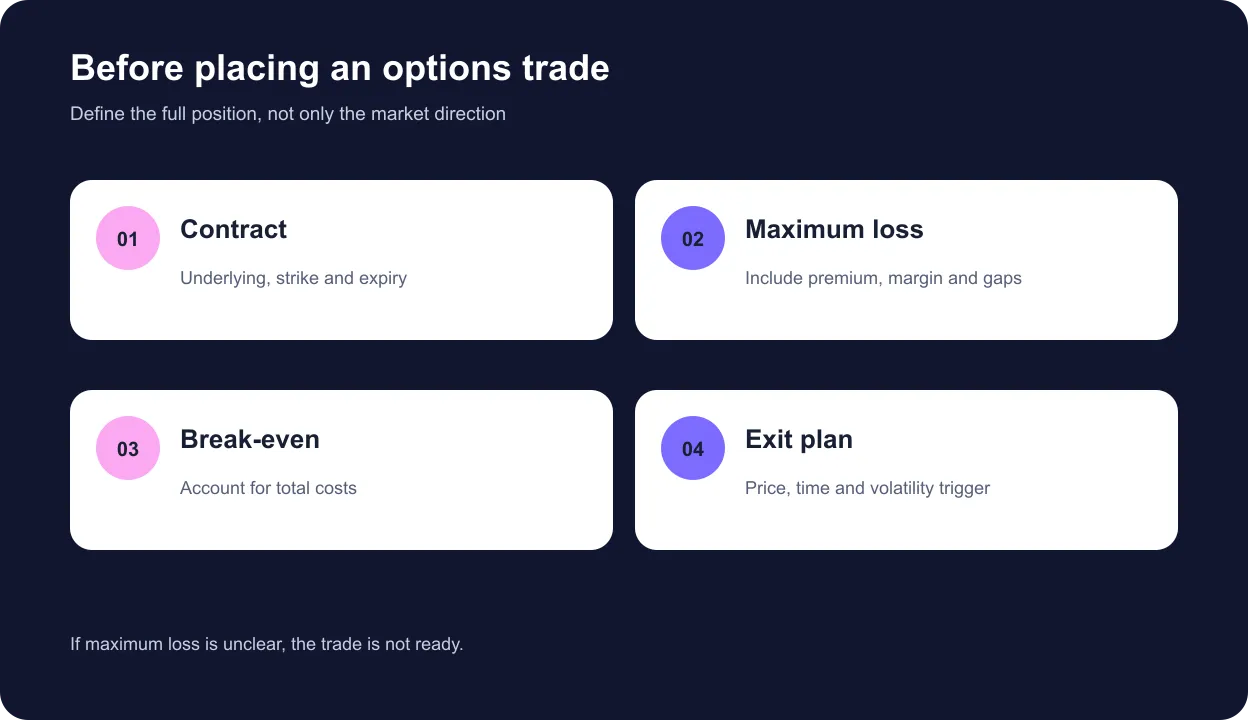
Before any put vs call option trade, define the contract, premium, maximum loss, break-even and exit trigger. The difference between put and call should be checked at expiry and before expiry, when time and volatility affect price. Avoid confusing low premium with low risk.
SEBI warns that derivatives are leveraged and can multiply losses. Call option meaning does not mean easy upside, and put option meaning does not mean automatic protection. A put option vs call option choice should remain small relative to the investor’s capital and experience.
Conclusion
The difference between put and call is the right granted to the buyer: buy through a call and sell through a put. But a useful put vs call option analysis goes further by separating buyers from sellers, modelling premium and identifying expiry, volatility and liquidity risk.
Call option meaning and put option meaning are simple but complex in a portfolio. Use a put option vs call option framework that defines maximum loss, costs and exit rules before market direction. For put vs call option beginners, learning and capital protection should come before strategy complexity.
Is your portfolio built for what’s coming?
Get a free AI-powered review of your holdings — risk, overlap and quality in minutes.
FAQ
What is the difference between put and call options?
A call gives its buyer the right to buy the underlying at the strike price; a put gives its buyer the right to sell. Buyers pay premiums and may let options expire, while sellers accept the corresponding obligation if assigned.
What does call option meaning refer to in trading?
It refers to a contract giving the buyer the right, but not the obligation, to buy an underlying at a specified strike by expiry. A call buyer usually expects a rise or uses the contract to structure exposure.
What is put option meaning in simple terms?
It is the right, but not the obligation, to sell an underlying at a specified strike by expiry. Investors may buy puts for bearish exposure or to hedge a portfolio decline.
Which is riskier, put or call options?
Risk depends more on buying versus selling, strike, expiry, volatility and position size than on the label. Option buyers can lose the premium; uncovered sellers can face much larger losses and margin calls.
Can beginners trade put and call options in India?
Eligible clients may trade exchange-listed options after broker activation and required disclosures. Beginners should first understand contract specifications, payoff, time decay, volatility, settlement, costs and maximum loss, and should avoid borrowed money.