


Miniratna status gives profitable Central Public Sector Enterprises greater authority to invest, modernise, form subsidiaries and pursue acquisitions within prescribed limits. It is designed for capable CPSEs that may be smaller than Navratna and Maharatna enterprises but have demonstrated financial stability.
For investors, miniratna companies in india span mining, defence, shipbuilding, energy, construction, aviation, telecom, healthcare and services. The label indicates eligibility for delegated powers, not a promise of shareholder returns. Many enterprises are also unlisted.
Miniratna status can increase operating freedom, but company fundamentals still determine investment merit.
What Is a Miniratna Company?
A Miniratna is a CPSE recognised by its administrative ministry after meeting DPE conditions. The scheme was introduced to provide stronger boards with faster financial and operational decision-making while preserving public-sector ownership and accountability.
The miniratna companies in india group is not a stock index. It includes listed companies, unlisted enterprises and government-owned subsidiaries. Investors should first confirm whether equity is publicly traded before evaluating a possible purchase.
Delegation can reduce approval friction, but it cannot make a project profitable. Boards still need to select investments carefully, control costs and convert projects into cash. Investors should compare management commitments with later delivery.
See what markets are pricing in
Live indices, sector moves and market breadth — the backdrop to every story we publish.
Miniratna Category I vs Category II
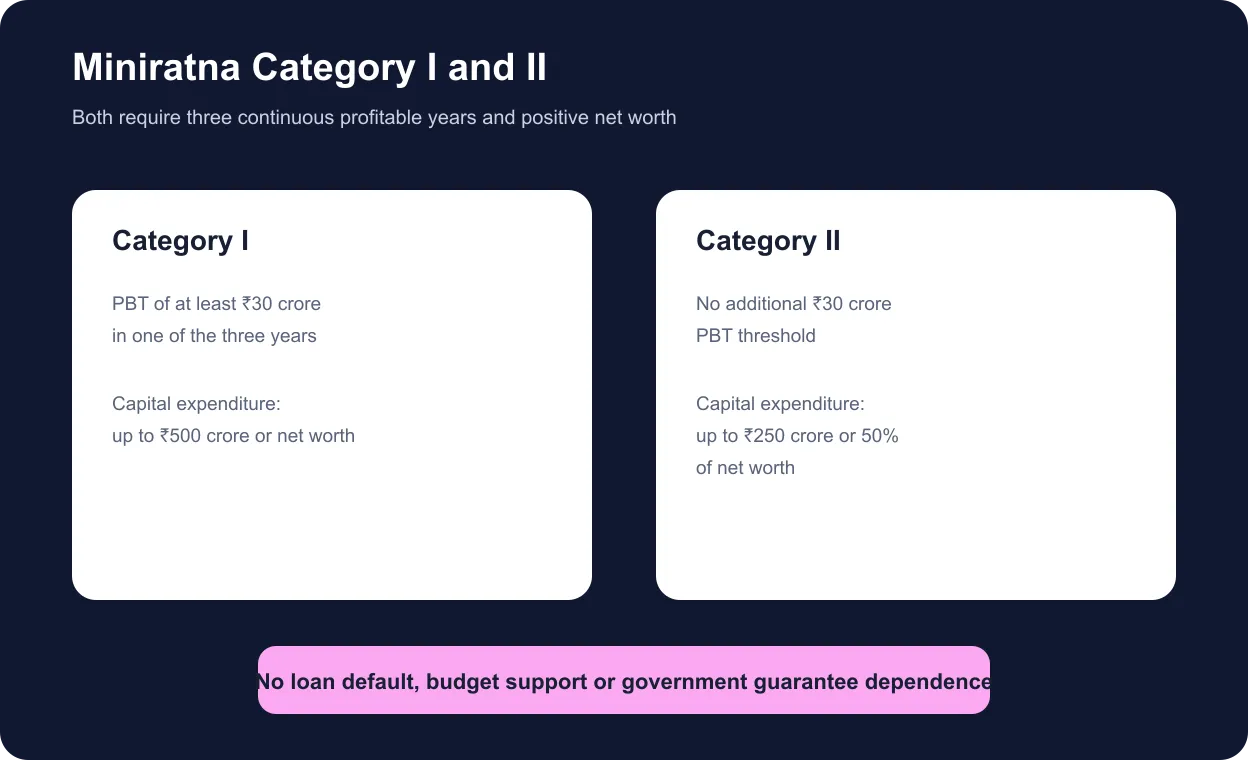
Both categories require profit in each of the previous three years and positive net worth. They must not have defaulted on government loans or interest, depend on budgetary support or government guarantees, and their boards require at least three non-official directors before using enhanced powers.
miniratna category 1 companies must also report pre-tax profit of ₹30 crore or more in at least one of the three years. Their boards can approve capital expenditure up to ₹500 crore or net worth, whichever is lower.
miniratna category 2 companies have no separate ₹30 crore test. Their capital-expenditure authority is lower: up to ₹250 crore or 50% of net worth, whichever is lower. Joint-venture and subsidiary limits follow the same category-specific ceilings.
Complete Miniratna Companies List for 2026
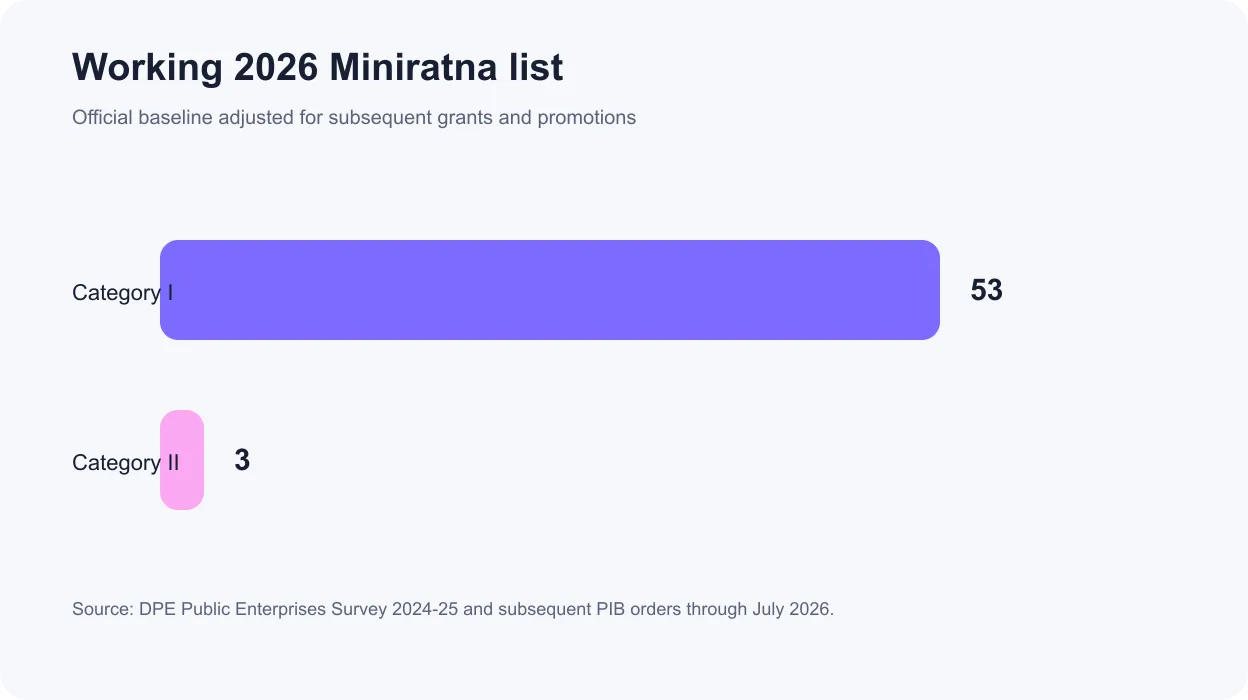
The DPE Public Enterprises Survey 2024-25 provides the latest consolidated baseline. Subsequent orders added Munitions India, Armoured Vehicles Nigam and India Optel in May 2025, Yantra India in February 2026 and MECON in July 2026. GRSE moved to Navratna in June 2026.
The resulting dated working list contains 53 Category I and three Category II enterprises. Because orders can change classification, the miniratna companies in india count should always carry an as-of date.
| No. | Company | Category |
|---|---|---|
| 1 | Airports Authority of India | I |
| 2 | Antrix Corporation Ltd. | I |
| 3 | Balmer Lawrie & Co. Ltd. | I |
| 4 | Bharat Coking Coal Ltd. | I |
| 5 | Bharat Dynamics Ltd. | I |
| 6 | BEML Ltd. | I |
| 7 | Bharat Sanchar Nigam Ltd. | I |
| 8 | Braithwaite & Co. Ltd. | I |
| 9 | Bridge & Roof Co. (India) Ltd. | I |
| 10 | Central Coalfields Ltd. | I |
| 11 | Central Electronics Ltd. | I |
| 12 | Central Mine Planning & Design Institute Ltd. | I |
| 13 | Chennai Petroleum Corporation Ltd. | I |
| 14 | Cochin Shipyard Ltd. | I |
| 15 | Cotton Corporation of India Ltd. | I |
| 16 | EdCIL (India) Ltd. | I |
| 17 | Grid Controller of India Ltd. | I |
| 18 | Goa Shipyard Ltd. | I |
| 19 | Hindustan Copper Ltd. | I |
| 20 | Hindustan Steelworks Construction Ltd. | I |
| 21 | HLL Lifecare Ltd. | I |
| 22 | HSCC (India) Ltd. | I |
| 23 | India Tourism Development Corporation Ltd. | I |
| 24 | India Trade Promotion Organisation | I |
| 25 | IREL (India) Ltd. | I |
| 26 | KIOCL Ltd. | I |
| 27 | Mahanadi Coalfields Ltd. | I |
| 28 | Mangalore Refinery & Petrochemicals Ltd. | I |
| 29 | Mineral Exploration and Consultancy Ltd. | I |
| 30 | Mishra Dhatu Nigam Ltd. | I |
| 31 | MMTC Ltd. | I |
| 32 | MOIL Ltd. | I |
| 33 | MSTC Ltd. | I |
| 34 | National Projects Construction Corporation Ltd. | I |
| 35 | National Seeds Corporation Ltd. | I |
| 36 | National Small Industries Corporation Ltd. | I |
| 37 | North Eastern Electric Power Corporation Ltd. | I |
| 38 | Northern Coalfields Ltd. | I |
| 39 | Numaligarh Refinery Ltd. | I |
| 40 | Pawan Hans Ltd. | I |
| 41 | Projects & Development India Ltd. | I |
| 42 | Security Printing & Minting Corporation India Ltd. | I |
| 43 | South Eastern Coalfields Ltd. | I |
| 44 | Telecommunications Consultants (India) Ltd. | I |
| 45 | THDC India Ltd. | I |
| 46 | WAPCOS Ltd. | I |
| 47 | Western Coalfields Ltd. | I |
| 48 | Munitions India Ltd. | I |
| 49 | Armoured Vehicles Nigam Ltd. | I |
| 50 | India Optel Ltd. | I |
| 51 | Yantra India Ltd. | I |
| 52 | MECON Ltd. | I |
| 53 | National Film Development Corporation Ltd. | I |
| 1 | Artificial Limbs Manufacturing Corporation of India | II |
| 2 | Broadcast Engineering Consultants India Ltd. | II |
| 3 | Engineering Projects (India) Ltd. | II |
Miniratna Companies by Sector
Coal and mining are prominent through subsidiaries and specialist enterprises such as Central Coalfields, Northern Coalfields, Western Coalfields, Hindustan Copper, MOIL and IREL. Defence and industrial production include Bharat Dynamics, BEML, Mishra Dhatu Nigam and the newer corporatised defence enterprises.
Energy exposure includes Chennai Petroleum, Mangalore Refinery, Numaligarh Refinery, NEEPCO and THDC. Infrastructure and services include AAI, WAPCOS, NPCC, HSCC, ITDC and ITPO. The broad mix means miniratna companies in india require sector-specific metrics.
A miner’s realised price and reserve quality cannot be compared directly with a shipyard’s order book or an airport operator’s traffic. Sector concentration also matters because owning multiple coal subsidiaries may create less diversification than the number of holdings suggests.
Get research like this in your inbox
The week’s research that mattered, in five minutes. Joined by 2L+ investors.
Which Miniratna Companies Are Listed Stocks?
Listed examples include BEML, Bharat Dynamics, Cochin Shipyard, Chennai Petroleum, Hindustan Copper, KIOCL, MMTC, MOIL, MSTC and Mishra Dhatu Nigam. Exchange status should be verified using the legal company name and symbol before trading.
Many miniratna companies in india are not directly investible. A subsidiary may contribute to a listed parent without having separately traded equity. Government classification and stock-market availability are distinct questions.
Liquidity, free float and market capitalisation also vary among listed names. A tradeable share can still have wide price swings or limited volumes. Investors should use suitable position sizes and avoid assuming government ownership prevents loss.
Miniratna vs Navratna vs Maharatna
The miniratna vs navratna distinction concerns eligibility and delegated authority. Navratna requires Schedule A and Miniratna-I status, strong MoU ratings and a composite score of at least 60. Maharatna adds large three-year financial thresholds, listing and international operations.
| Category | Main qualification | General capex delegation |
|---|---|---|
| Maharatna | Large listed Navratna meeting added financial and global tests | Highest delegation |
| Navratna | Schedule A Miniratna-I with ratings and score tests | Up to ₹1,000 crore within prescribed limits |
| Miniratna-I | Three profitable years, ₹30 crore PBT test and positive net worth | ₹500 crore or net worth |
| Miniratna-II | Three profitable years and positive net worth | ₹250 crore or 50% of net worth |
Higher status is not automatically a better investment. Classification measures autonomy, while stock selection concerns future cash flow, valuation and risk. A well-run Miniratna can be more attractive than an expensive or weakening company in a higher category.
How to Evaluate Miniratna Stocks
Start with the business model, customers and cycle. Review five years of revenue, margins, cash flow, debt and return on capital. Separate recurring operations from subsidies, asset sales, exceptional orders and commodity peaks.
For project companies, examine order intake, execution, receivables and working capital. For miners and refiners, use mid-cycle prices and costs. For defence manufacturers, assess order diversity, delivery schedules, capacity and customer concentration.
Study how management uses delegated powers. Compare announced investment with commissioning, utilisation and returns. The best miniratna category 1 companies should demonstrate that greater autonomy produces disciplined capital allocation rather than only larger spending.
Valuation must fit the company. Price-to-book may suit some asset-heavy or financial businesses, while enterprise value to EBITDA and normalised earnings can help with industrial and commodity companies. Always build a downside case.
Risks of Investing in PSU Stocks
The government is controlling shareholder and policymaker. It may prioritise employment, strategic capacity, affordability or national projects over near-term minority-shareholder returns. Pricing decisions, subsidy timing and mandated investment can affect cash flow.
Small scale can create customer concentration, execution risk and weaker liquidity. Commodity prices, rates, regulation, technology, environmental liabilities and delayed government payments can also alter outcomes. miniratna category 2 companies may have more limited financial capacity than Category I peers.
Use the miniratna companies in india list as a research universe, not a buy list. Verify current status, listing, financials and valuation independently. Diversify by economic driver, because several names may depend on the same public-spending or commodity cycle.
The miniratna vs navratna label should never replace a written thesis. Define what must happen for value to emerge, what would invalidate the idea, and how much loss the portfolio can tolerate.
Is your portfolio built for what’s coming?
Get a free AI-powered review of your holdings — risk, overlap and quality in minutes.
FAQ
What is a Miniratna company?
A Miniratna is a profitable CPSE granted enhanced financial and operational autonomy after meeting government eligibility and governance conditions.
How many Miniratna companies are there in India in 2026?
The dated working list used here contains 56: 53 Category I and 3 Category II, based on the latest DPE survey plus subsequent official grants and promotions.
What is Miniratna Category I and Category II?
Both require three continuous profitable years and positive net worth. Category I additionally requires pre-tax profit of at least ₹30 crore in one of those years and receives higher delegated limits.
Which Miniratna companies are listed on the stock market?
Listed examples include BEML, Bharat Dynamics, Cochin Shipyard, Hindustan Copper, MOIL, MSTC, Chennai Petroleum, MMTC and several others. Many Miniratnas remain unlisted.
What is the difference between Miniratna, Navratna and Maharatna?
They are progressively higher CPSE autonomy categories with different eligibility and delegated investment limits. Higher status is not an investment rating.
Are Miniratna stocks good investments?
Status alone is insufficient. Investors must assess business quality, cash flow, debt, governance, policy exposure, liquidity and valuation.