


Maharatna status identifies India’s largest and most strategically important Central Public Sector Enterprises, or CPSEs. It gives their boards greater freedom to approve investments, joint ventures, subsidiaries and organisational decisions without seeking case-by-case government approval within prescribed limits.
For investors, maharatna companies in india offer exposure to energy, power, mining, heavy engineering, steel, finance and defence. Yet the label measures scale and eligibility for autonomy, not future share returns. Business quality, valuation and policy risk still require separate analysis.
Maharatna status expands board autonomy, but investors still need company-level research.
What Is a Maharatna Company?
A Maharatna is a Navratna CPSE that has crossed additional financial thresholds, is listed with the required public shareholding and maintains significant global operations. The Department of Public Enterprises processes proposals, while the government grants the status under its CPSE autonomy framework.
The scheme was introduced in 2010 to help large public enterprises expand in domestic and international markets. Greater delegation lets boards respond more quickly to major projects and acquisitions. It does not privatise the company or remove government ownership and oversight.
The 2026 maharatna companies list contains businesses of very different types. ONGC’s economics depend heavily on upstream energy prices, Power Grid operates regulated transmission assets, PFC and REC are lenders, while HAL works in defence aerospace. The common status does not create a common earnings model.
See what markets are pricing in
Live indices, sector moves and market breadth — the backdrop to every story we publish.
Maharatna Status: Eligibility and Benefits
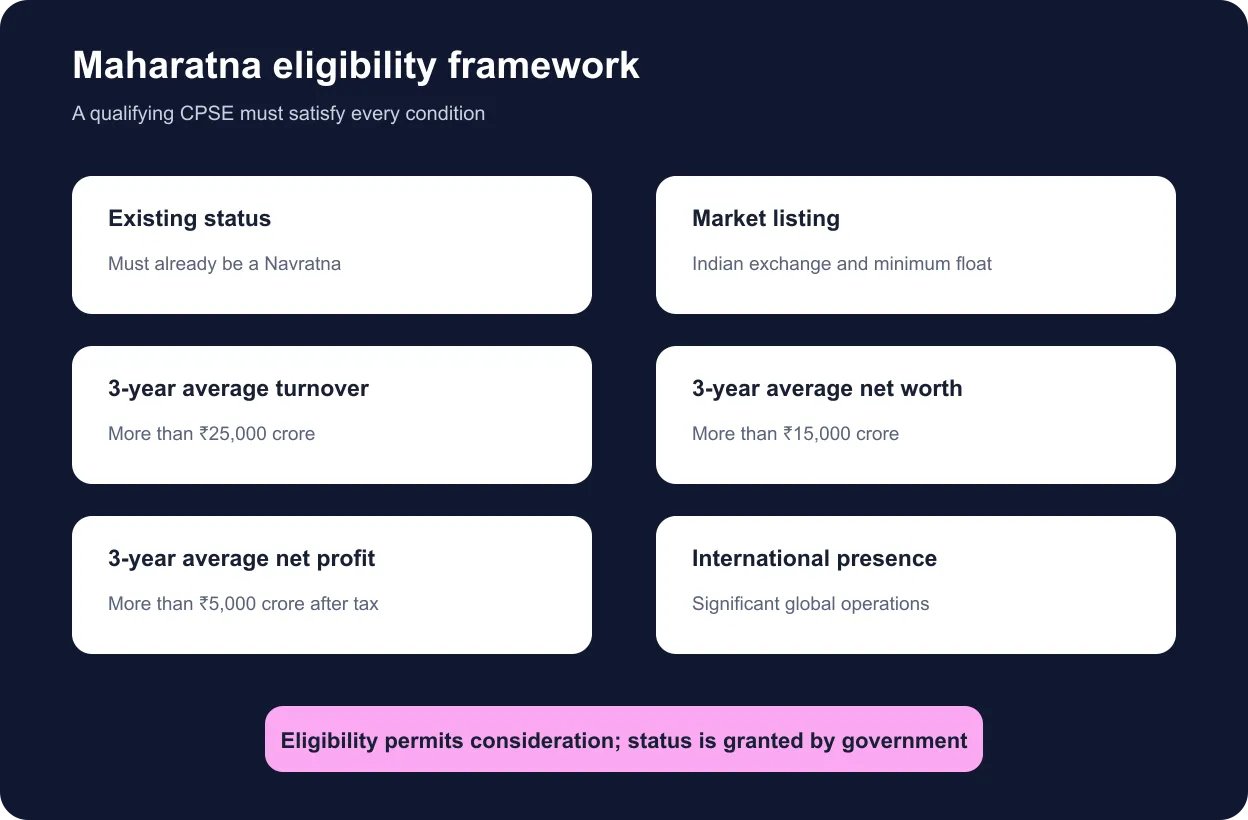
DPE guidelines require an applicant to already hold Navratna status and be listed on an Indian stock exchange with the minimum public shareholding prescribed under SEBI rules. It must also have significant global presence or international operations.
Over the preceding three years, average annual turnover must exceed ₹25,000 crore, average annual net worth must exceed ₹15,000 crore, and average annual profit after tax must exceed ₹5,000 crore. Meeting the numbers makes a CPSE eligible for consideration rather than automatically conferring status.
A Maharatna board can approve equity investments for joint ventures and wholly owned subsidiaries, and undertake mergers and acquisitions in India or abroad, within the delegated ceiling. The general framework permits up to 15% of the enterprise’s net worth in one project, subject to an absolute ₹5,000 crore ceiling. Specific Cabinet approvals can create exceptions, as seen when POWERGRID’s per-subsidiary limit was raised to ₹7,500 crore in February 2026 while retaining the 15% cap.
These powers can shorten decision cycles and support capital-intensive expansion. Investors should still examine whether each approved project earns more than its cost of capital. Autonomy improves capacity to act; it does not ensure that every capital-allocation choice creates value.
The proposal normally begins with the enterprise’s administrative ministry or department after internal approvals. DPE examines it before the inter-ministerial process and final government decision. This matters because financial thresholds are necessary but not the only judgement involved. The framework also considers whether the enterprise has the scale, governance and international orientation expected from the highest autonomy category.
Delegation changes who can approve a decision, not the economic risk carried by shareholders. A faster acquisition can still be overpriced, and a new subsidiary can still underperform. Investors should connect each large approval to management’s stated hurdle rate, funding plan, execution calendar and expected cash flows. Subsequent annual reports should then be used to compare those promises with actual delivery.
Complete List of Maharatna Companies in India in 2026
The latest official DPE annual-report list contains 14 enterprises. HAL is the newest addition, receiving Maharatna status in October 2024. The following maharatna companies list 2026 uses the official names and adds exchange symbols and broad business descriptions for investor reference.
| No. | Company | NSE symbol | Primary exposure |
|---|---|---|---|
| 1 | Bharat Heavy Electricals Ltd. | BHEL | Capital goods and power equipment |
| 2 | Bharat Petroleum Corporation Ltd. | BPCL | Oil refining and marketing |
| 3 | Coal India Ltd. | COALINDIA | Coal mining |
| 4 | GAIL (India) Ltd. | GAIL | Natural-gas infrastructure and marketing |
| 5 | Hindustan Petroleum Corporation Ltd. | HINDPETRO | Oil refining and marketing |
| 6 | Indian Oil Corporation Ltd. | IOC | Oil refining, pipelines and marketing |
| 7 | NTPC Ltd. | NTPC | Power generation |
| 8 | Oil and Natural Gas Corporation Ltd. | ONGC | Oil and gas exploration and production |
| 9 | Power Finance Corporation Ltd. | PFC | Power-sector finance |
| 10 | Power Grid Corporation of India Ltd. | POWERGRID | Electricity transmission |
| 11 | Steel Authority of India Ltd. | SAIL | Steel production |
| 12 | REC Ltd. | RECLTD | Infrastructure and power finance |
| 13 | Oil India Ltd. | OIL | Oil and gas exploration and production |
| 14 | Hindustan Aeronautics Ltd. | HAL | Aerospace and defence |
The maharatna companies list 2026 should be treated as a dated regulatory classification. A company’s place on it can change after a new government order, so investors preparing research or publication should verify the current DPE record rather than copy an older commercial list.
All 14 names are exchange-listed, which allows retail participation. That accessibility does not mean each security suits every portfolio. Market capitalisation, free float, liquidity, volatility and valuation differ widely across this group.
The official maharatna companies list uses legal enterprise names, while exchanges and financial websites may use shortened labels. Investors should match the company name, symbol and security identifier before placing an order. This is especially useful where related subsidiaries or similarly named public enterprises also trade. The parent’s status does not automatically extend to every listed group company.
The government remains the controlling shareholder, but public shareholding lets market investors participate in the equity. Ownership levels and free float affect liquidity and index weights. Changes through offers for sale, exchange-traded funds or other disinvestment routes can influence near-term supply without necessarily changing the enterprise’s operating outlook.
Maharatna Companies by Sector
Energy dominates. BPCL, HPCL and Indian Oil refine and market petroleum products. ONGC and Oil India focus on exploration and production, while GAIL spans gas transmission, marketing and related infrastructure. Their cash flows respond differently to crude prices, refining margins, administered prices and policy decisions.
Power exposure includes NTPC in generation and Power Grid in transmission. PFC and REC finance power and infrastructure assets, so credit costs, funding spreads and borrower health matter alongside the sector’s capital-expenditure cycle. Coal India and SAIL add mining and steel exposure.
BHEL represents heavy electrical equipment, while HAL adds aerospace and defence manufacturing. A search for the top maharatna companies in India should therefore begin with sector fit, not a single ranking. A lender cannot be compared with an oil producer using identical operating metrics.
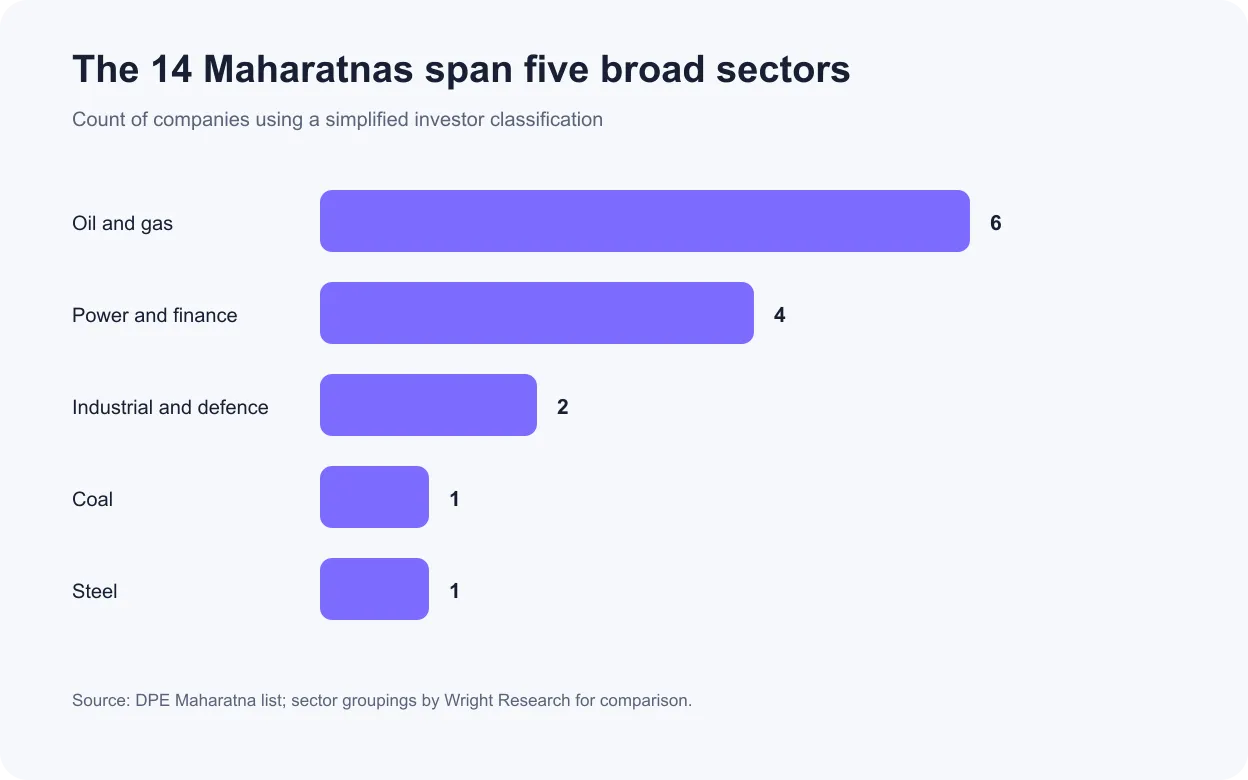
This concentration is important for portfolio construction. Owning several Maharatna stocks may look diversified by company count while leaving an investor heavily exposed to energy policy, commodities, regulated returns and government capital-spending priorities.
Strategic relevance can support long project pipelines, but it may also require investment through weak parts of a cycle. Defence indigenisation, grid expansion, energy transition and infrastructure spending can create opportunities over many years. The timing of orders, regulatory approvals, land, equipment and customer payments determines when those opportunities become revenue and cash.
Get research like this in your inbox
The week’s research that mattered, in five minutes. Joined by 2L+ investors.
Key Financial and Business Characteristics to Compare
Start with the business model. Producers need reserve quality, realisations and lifting costs. Refiners require throughput, marketing margins and inventory management. Utilities need regulated asset growth and plant availability. Lenders require asset quality, capital adequacy, spreads and provisioning discipline.
Then compare revenue growth with profitability and cash conversion. Large accounting profit can coexist with heavy receivables or capital expenditure. Review operating cash flow, free cash flow, return on capital employed, leverage, interest coverage and contingent liabilities across a full cycle.
The maharatna companies list also contains different dividend profiles. A high yield can reflect strong cash generation, a government payout policy or a depressed share price. Check payout sustainability after planned investment, debt service and working-capital needs.
Valuation must match the economics. Price-to-book can be useful for lenders, enterprise value to EBITDA may assist with capital-intensive operators, and price-to-earnings needs normalised profits when commodity cycles are extreme. No single multiple identifies the top maharatna companies in India across every sector.
Balance-sheet comparison deserves equal attention. Net cash may provide room for dividends and expansion, while high borrowing can magnify both returns and stress. For finance companies, debt is an operating input, so investors should focus on capital adequacy, asset-liability matching, borrowing cost and non-performing assets rather than applying an industrial-company leverage rule.
Order books are useful for BHEL and HAL only when read with execution capacity, delivery schedules, margins and customer concentration. For NTPC and Power Grid, commissioned capacity and regulated asset base can matter more than announced pipelines. For producers, physical volumes and realised prices should be reconciled with reported revenue.
Government receivables and subsidies can create a gap between profit and cash. Study debtor ageing, overdue balances and changes in working capital. A business that repeatedly funds customers or waits for policy-linked reimbursements may need more borrowing even while reporting profit. Cash-flow quality helps distinguish a temporary timing issue from a structural weakness.
Maharatna vs Navratna vs Miniratna
The maharatna vs navratna distinction concerns eligibility and delegated authority. Maharatnas must first be Navratnas, then satisfy the larger scale, profit, listing and international-operation tests. Navratna qualification follows its own performance framework and carries a lower delegated investment ceiling.
| Category | General position | Board investment autonomy |
|---|---|---|
| Maharatna | Largest listed Navratna CPSEs meeting additional financial and global criteria | Highest general delegation, including up to ₹5,000 crore per qualifying project within 15% of net worth |
| Navratna | High-performing Schedule A and Miniratna-I CPSEs meeting the prescribed score and ratings | Broad autonomy with a lower project ceiling than Maharatna |
| Miniratna-I | Profitable CPSEs meeting Category-I conditions | Capital expenditure up to the prescribed lower ceiling or net-worth limit |
| Miniratna-II | CPSEs meeting Category-II profitability and net-worth conditions | More limited delegated capital expenditure |
Higher status can help management execute projects faster, but it is not an investment grade. A Navratna with better returns on capital and a cheaper valuation may be more attractive than a Maharatna facing cyclical pressure. Classification and security selection answer different questions.
Miniratna categories provide narrower autonomy to eligible profit-making CPSEs. Navratna status adds a performance-based route for larger Schedule A enterprises, while Maharatna adds the strict scale and listing filters. The progression indicates administrative delegation, not a guaranteed path that every enterprise will follow. A company must receive the relevant government status even when investors believe it qualifies.
How Investors Can Evaluate Maharatna Stocks
First, identify the earnings drivers and build a sector-specific checklist. Read annual reports, investor presentations, exchange filings and government policy documents. Separate recurring operating profit from subsidies, exceptional gains, asset sales and commodity windfalls.
Second, assess management’s use of autonomy. Compare project commitments with completion, utilisation and returns. Review acquisitions, subsidiaries, related-party transactions and capital allocation. The strongest candidates among the maharatna companies list 2026 should demonstrate both strategic importance and financial discipline.
Third, estimate valuation under more than one scenario. Commodity producers deserve mid-cycle assumptions rather than peak margins. Regulated utilities need careful treatment of allowed returns and execution. Lenders require stress tests for credit costs and concentrated exposures.
Finally, check portfolio overlap. Several maharatna companies in india depend on connected power, fuel and infrastructure cycles. Decide whether a new position diversifies the portfolio or simply increases an existing macroeconomic bet. Position size should reflect volatility and downside, not only dividend yield.
Read at least five years of financials where possible. One year can be distorted by crude prices, impairment, subsidy recovery, unusually strong orders or a low credit-cost cycle. Compare management guidance with actual outcomes and note repeated revisions. A history of meeting capacity, leverage and return targets is more informative than one ambitious presentation.
Build an explicit thesis with a disconfirming condition. For example, the thesis may require a project to commission by a certain period, return on equity to remain above a threshold, or debt to decline after a spending phase. If the condition fails, reassess rather than relying on the Maharatna label as reassurance.
Status should inform research, never replace independent stock selection.
Risks of Investing in PSU Stocks
The government is both controlling shareholder and policymaker. It may prioritise energy security, consumer affordability, employment, strategic capacity or national investment over near-term minority-shareholder returns. Pricing interventions, subsidy timing and mandated projects can affect profits and cash flow.
Commodity and rate cycles add volatility. Oil, gas, coal and steel earnings can swing with global prices and domestic regulation. PFC and REC face funding and credit risks, while BHEL and HAL depend on project execution, orders, supply chains and customer concentration.
Large dividends may not persist, and disinvestment can affect supply in the market. Investors comparing the top maharatna companies in India should also examine governance, board independence, audit observations, contingent liabilities, environmental obligations and related-party exposure.
The status can create an aura of safety because these enterprises are large and government-controlled. Equity holders still absorb market losses. Even businesses on the maharatna companies list can face poor cycles, expensive valuations or weak execution. Diversification and a suitable horizon remain essential.
Use the maharatna companies list 2026 as a research universe, not a buy list. The best conclusion may be to wait when expected returns do not compensate for policy, commodity, balance-sheet or valuation risk.
Environmental and transition risks also vary. Coal, oil, gas, refining and thermal-power assets face emissions, remediation, demand-transition and capital-allocation questions. At the same time, grid expansion, renewable integration and cleaner technologies may create investment requirements. Evaluate the cost, funding and return profile of transition plans instead of treating all green expenditure as automatically positive.
Liquidity cannot prevent volatility. Widely traded PSU shares can reprice sharply after government announcements, commodity moves, election expectations, dividend changes or stake sales. Investors using concentrated positions or borrowed money can face losses even when the underlying enterprise remains strategically important. A diversified allocation and realistic holding period provide better protection than status-based confidence.
Is your portfolio built for what’s coming?
Get a free AI-powered review of your holdings — risk, overlap and quality in minutes.
FAQ
What is a Maharatna company?
A Maharatna is a large Navratna Central Public Sector Enterprise granted enhanced financial and operational autonomy by the Government of India after meeting scale, profitability, listing and international-presence conditions.
How many Maharatna companies are there in India in 2026?
The latest official DPE annual-report list contains 14 Maharatna CPSEs. Investors should recheck the DPE list because the government can elevate eligible enterprises or revise classifications.
Which companies are Maharatna PSUs?
The list comprises BHEL, BPCL, Coal India, GAIL, HPCL, Indian Oil, NTPC, ONGC, PFC, Power Grid, SAIL, REC, Oil India and HAL.
Are Maharatna companies good investments?
Status alone does not make a stock attractive. Investors still need to assess earnings, capital allocation, regulation, commodity exposure, debt, valuation, dividends and the possibility that government priorities differ from minority-shareholder priorities.
What is the difference between Maharatna and Navratna?
Maharatna is the higher autonomy category for very large listed Navratna CPSEs that meet additional three-year financial thresholds and have significant international operations. The delegated investment ceiling is also higher.
Can retail investors invest in Maharatna companies?
Retail investors can buy shares of listed Maharatna CPSEs through a registered broker and demat account. Availability does not establish suitability, so investors should evaluate the company and price before buying.