


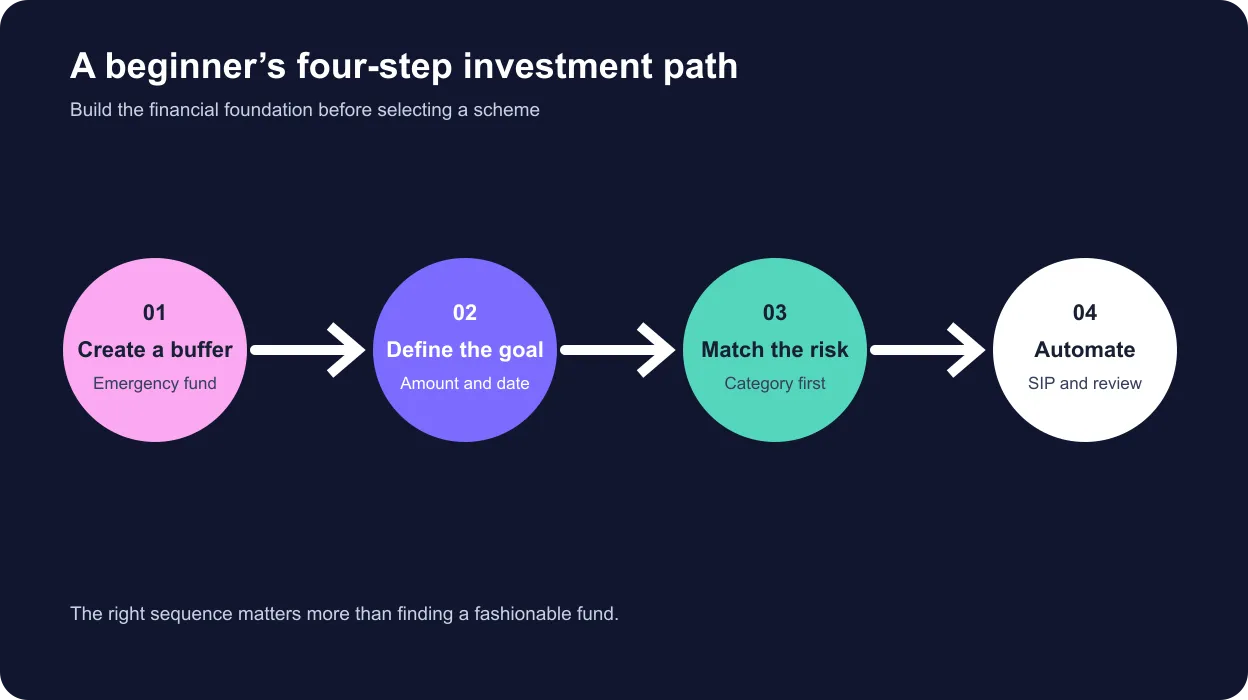
The best mutual funds for beginners are not necessarily the schemes at the top of a recent return chart. A better starting point is a fund category that matches the investor’s goal, time horizon and capacity to withstand a temporary loss.
Good mutual funds investment plans for beginners are deliberately simple. They leave room for emergency savings, use diversified exposure and make costs and risk understandable. This guide explains the decision process without presenting a short-lived fund ranking.
A goal-first plan is a stronger foundation than chasing the latest winner.
Why Mutual Funds Are a Good Starting Point for New Investors
For people investing in mutual funds for beginners , one scheme can provide access to a diversified portfolio managed within a disclosed mandate. Units can usually be purchased in modest amounts, and open-ended schemes offer published NAVs and defined redemption processes.
Mutual funds for first time investors also make comparison easier because SEBI standardises broad scheme categories and disclosures. Yet market-linked returns are not guaranteed. Equity funds can fall sharply, while debt funds carry interest-rate and credit risk. The relevant Riskometer should be checked before investing.
See what markets are pricing in
Live indices, sector moves and market breadth — the backdrop to every story we publish.
Things to Check Before Picking Your First Mutual Fund
Effective mutual funds investment plans for beginners begin with the scheme category, not the brand. Read the investment objective, benchmark and asset-allocation range. Then examine the current Riskometer, direct versus regular plan, expense ratio, exit load, portfolio concentration and the period managed by the current manager.
Compare rolling results and downside behaviour against the benchmark and category, instead of relying on a single trailing return. The best mutual fund to invest for beginners should remain understandable in a weak market. If the investor cannot explain why the scheme belongs in the plan, more research is needed.
Best Mutual Fund Categories for First-Time Investors
The best mutual funds for beginners depend on when the money is needed. SEBI’s 2026 classification broadly groups schemes into equity, debt, hybrid, life-cycle and other schemes such as passive funds and funds of funds. A category indicates the portfolio’s permitted behaviour; it does not promise a return.
| Need | Category to research | Why it may fit | Main caution |
|---|---|---|---|
| Long-term wealth goal | Broad-market index or diversified equity | Simple, diversified equity exposure | Can suffer deep interim falls |
| Moderate-risk long goal | Suitable hybrid fund | Combines asset classes | Equity allocation still creates volatility |
| Short parking need | Liquid or very-short-duration category | Lower duration than long-bond funds | Not equivalent to a bank deposit |
For mutual funds for first time investors, sectoral, thematic, small-cap and concentrated strategies generally demand more tolerance and monitoring than a core diversified holding. The best mutual fund to invest for beginners is therefore usually a category-level decision before it becomes a scheme-level decision.
SIP vs Lump Sum: What Should Beginners Choose?
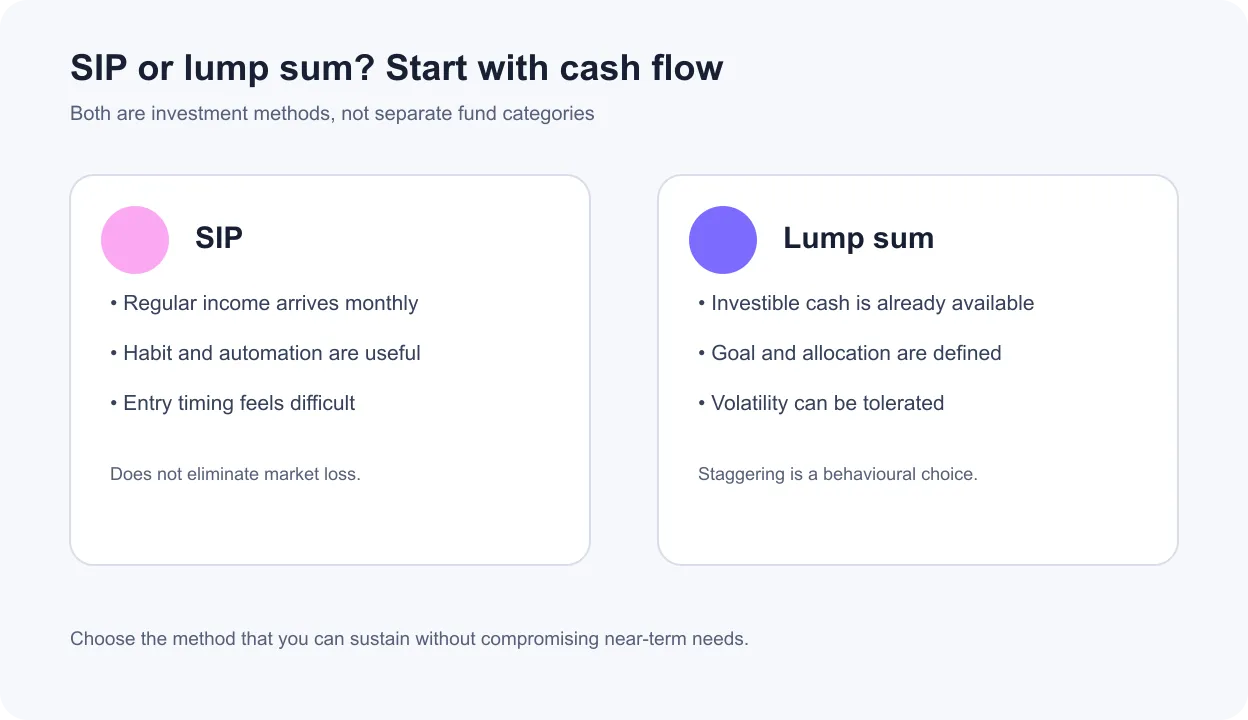
A SIP invests a fixed amount at scheduled intervals; a lump sum invests available capital at once. For regular earners, mutual funds investment plans for beginners often use SIPs because automation supports discipline and spreads purchase dates. Rupee-cost averaging does not prevent losses or ensure superior returns.
A lump sum may suit an investor who already holds surplus cash, has completed the emergency reserve and accepts near-term volatility. When investing in mutual funds for beginners, the chosen method should follow cash flow and allocation, not a prediction about next month’s market.
Get research like this in your inbox
The week’s research that mattered, in five minutes. Joined by 2L+ investors.
How Much Should You Invest as a Beginner?
For mutual funds investment plans for beginners, there is no correct universal amount. Start after setting aside emergency liquidity and addressing expensive debt. Estimate the future goal, time available and a conservative return assumption, then calculate the periodic contribution. Mutual funds investment plans for beginners should remain affordable through ordinary months.
A small SIP can be increased annually as income rises. That is often better than committing an unsustainable figure. The best mutual funds for beginners cannot compensate for missed payments, premature redemptions or an allocation that leaves no cash for foreseeable expenses.
Common Mistakes First-Time Investors Should Avoid
Frequent mistakes include choosing last year’s leader, owning several overlapping funds, ignoring costs, treating debt funds as guaranteed and investing short-term money in volatile equity. Mutual funds for first time investors should also avoid NFO enthusiasm unless the new mandate fills a genuine portfolio need.
When investing in mutual funds for beginners, another error is switching after every weak quarter. When investing in mutual funds for beginners, define review triggers in advance: a material mandate change, persistent process breakdown, unexplained risk increase or goal change. Normal market volatility alone is not a sound exit rule.
How to Start Investing in Mutual Funds
Complete KYC, define the goal and choose a category. Compare a short list using official scheme documents, factsheets and AMFI disclosures. Decide between a direct plan for self-directed investors and a regular plan where distribution support is valued; direct plans have lower expenses because distribution commission is not charged.
Next, select growth or other available options carefully, nominate where appropriate, set the SIP or transfer the lump sum, and retain the confirmation. Good mutual funds investment plans for beginners are reviewed periodically, not watched daily. Rebalance when allocation meaningfully drifts or the goal changes.
Conclusion
The best mutual funds for beginners are the ones that fit a goal and can be held through an uncomfortable market. Start with diversification, check the Riskometer and costs, and compare only within the same category.
Well-designed mutual funds investment plans for beginners make the best mutual fund to invest for beginners easier to identify without pretending one scheme suits everyone. Keep the number of holdings low, automate contributions where useful and review mutual funds investment plans for beginners against the goal rather than market headlines.
Is your portfolio built for what’s coming?
Get a free AI-powered review of your holdings — risk, overlap and quality in minutes.
FAQ
What are the best mutual fund investment plans for beginners?
The suitable choice depends on the goal, horizon and ability to tolerate loss. Many beginners can start their shortlist with a broad-market index, flexi-cap or suitable hybrid category, then compare the Riskometer, costs and consistency.
How much should a beginner invest in mutual funds monthly?
Start with an amount that remains affordable after essential expenses, high-cost debt payments and emergency savings. A modest SIP that increases with income is usually more durable than an aggressive amount that is stopped frequently.
Which mutual fund is best for first-time investors in India?
There is no universal winner. The best fit is a diversified category aligned with the investor’s time horizon and risk capacity, selected after reviewing the scheme document, benchmark, portfolio, expense ratio and exit load.
Is SIP better than lump sum for beginners?
A SIP often suits salaried beginners because it automates regular investing. A lump sum can be reasonable when surplus cash is already available and the investor accepts market timing risk. Neither method guarantees returns.
How do I choose the best mutual fund to invest in as a beginner?
Choose the category before the scheme. Compare like-for-like funds on mandate, Riskometer, rolling outcomes, downside behaviour, costs, portfolio concentration and manager tenure. Avoid choosing from a one-year return table alone.