


Navratna status gives selected Central Public Sector Enterprises greater freedom to invest, form joint ventures, establish subsidiaries and make organisational decisions. The classification recognises sustained performance and aims to help capable public enterprises compete more effectively.
For investors, navratna companies in india form a varied research universe spanning railways, defence, power, mining, construction, finance, logistics, shipping, telecom and fertilisers. The label describes government-granted autonomy. It does not guarantee growth, dividends, governance quality or attractive share returns.
Navratna status is a starting point for research, not a substitute for stock analysis.
What Does Navratna Status Mean?
The Government introduced the scheme in 1997 to identify CPSEs with comparative advantage and potential to become stronger domestic and global competitors. Enhanced delegation allows their boards to act within defined limits without returning to the government for every qualifying decision.
The navratna PSU companies can establish financial joint ventures and wholly owned subsidiaries in India or abroad, undertake mergers and acquisitions, approve capital expenditure and exercise additional human-resource powers under the applicable guidelines. General equity investment in one project is capped at ₹1,000 crore or the relevant net-worth limit.
Status does not remove administrative ownership, public accountability or sector regulation. A railway enterprise, defence shipyard and infrastructure lender remain exposed to different customers, capital cycles and policy constraints. Investors must analyse the actual company rather than assume every Navratna behaves alike.
The practical benefit is speed. A board can approve a qualifying expansion, subsidiary or partnership within its delegated authority instead of sending each decision through a longer government process. That matters when bidding deadlines, technology partnerships or acquisitions move quickly. Faster approval, however, does not make the underlying economics safer.
Shareholders should track how management uses this freedom. Compare promised project cost, completion date, capacity and return with later disclosures. A well-executed investment can strengthen cash flow, while delays or overruns can weaken the balance sheet. Status expands the decision envelope; it does not guarantee disciplined decisions.
See what markets are pricing in
Live indices, sector moves and market breadth — the backdrop to every story we publish.
How Companies Qualify for Navratna Status
Eligibility begins with a Schedule A, Miniratna Category-I CPSE. It must have received an Excellent or Very Good rating under the government’s Memorandum of Understanding performance system in three of the previous five years.
The enterprise also needs a composite score of at least 60 across six prescribed parameters. These assess profitability, productivity and efficiency, including net profit to net worth, manpower cost to total cost, profit before depreciation, interest and tax to capital employed, profit before interest and tax to turnover, earnings per share and inter-sectoral performance.
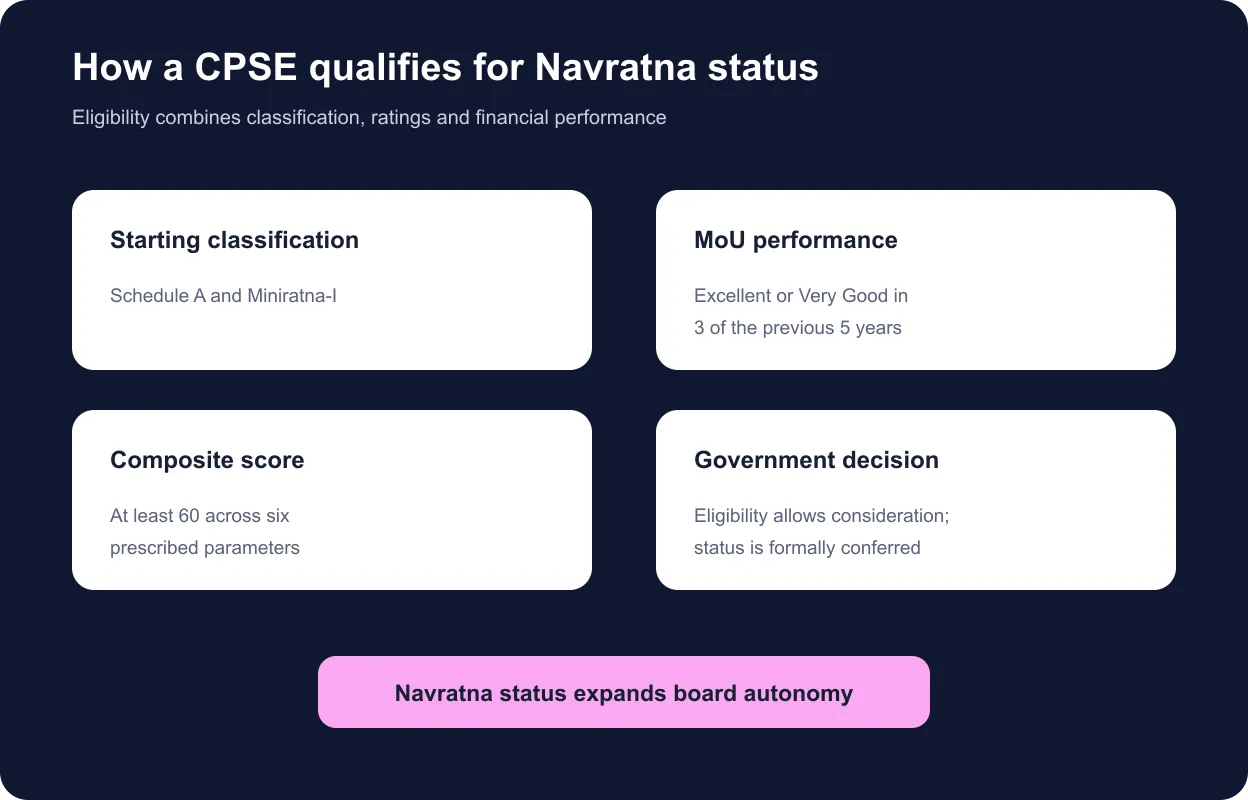
Eligibility is not self-executing. The administrative ministry initiates the proposal, DPE processes it, and an inter-ministerial mechanism considers the case. Investors should rely on a formal government order, not a company’s apparent financial qualification or an unofficial list.
The six-parameter score prevents one large profit number from deciding the outcome. It combines returns, productivity and operating efficiency, then includes inter-sectoral performance. This matters because a utility, trading company and manufacturer have different asset intensity and cost structures. Formal scoring creates a shared framework without pretending every sector is identical.
Classification can also change after restructuring, review or elevation. HAL moved out of this category when it became a Maharatna. Counting an old list without reading later orders can therefore both omit new entrants and retain a company that has moved upward.
Complete Navratna Companies List for 2026
The latest DPE annual report listed 24 names. Official releases then added IRCTC and IRFC in 2025 and GRSE on 19 June 2026, bringing the current total to 27. This navratna companies list 2026 incorporates those subsequent grants.
| No. | Company | Short name | Primary exposure | Market access |
|---|---|---|---|---|
| 1 | Bharat Electronics Ltd. | BEL | Defence electronics | Listed |
| 2 | Container Corporation of India Ltd. | CONCOR | Rail logistics | Listed |
| 3 | Engineers India Ltd. | EIL | Engineering consultancy | Listed |
| 4 | Mahanagar Telephone Nigam Ltd. | MTNL | Telecom | Listed |
| 5 | National Aluminium Company Ltd. | NALCO | Aluminium and mining | Listed |
| 6 | NBCC (India) Ltd. | NBCC | Construction and project management | Listed |
| 7 | NLC India Ltd. | NLCINDIA | Power and mining | Listed |
| 8 | NMDC Ltd. | NMDC | Iron-ore mining | Listed |
| 9 | Rashtriya Ispat Nigam Ltd. | RINL | Steel | Unlisted |
| 10 | Shipping Corporation of India Ltd. | SCI | Shipping | Listed |
| 11 | Rail Vikas Nigam Ltd. | RVNL | Rail infrastructure | Listed |
| 12 | ONGC Videsh Ltd. | OVL | Overseas oil and gas | Unlisted subsidiary |
| 13 | Rashtriya Chemicals & Fertilizers Ltd. | RCF | Fertilisers | Listed |
| 14 | IRCON International Ltd. | IRCON | Transport engineering | Listed |
| 15 | RITES Ltd. | RITES | Transport consultancy | Listed |
| 16 | National Fertilizers Ltd. | NFL | Fertilisers | Listed |
| 17 | Central Warehousing Corporation | CWC | Warehousing | Unlisted |
| 18 | Housing & Urban Development Corporation Ltd. | HUDCO | Infrastructure finance | Listed |
| 19 | Indian Renewable Energy Development Agency Ltd. | IREDA | Renewable-energy finance | Listed |
| 20 | Mazagon Dock Shipbuilders Ltd. | MDL | Defence shipbuilding | Listed |
| 21 | RailTel Corporation of India Ltd. | RAILTEL | Rail telecom and digital | Listed |
| 22 | Solar Energy Corporation of India Ltd. | SECI | Renewable-energy implementation | Unlisted |
| 23 | NHPC Ltd. | NHPC | Hydropower | Listed |
| 24 | SJVN Ltd. | SJVN | Power generation | Listed |
| 25 | Indian Railway Catering and Tourism Corporation Ltd. | IRCTC | Rail services | Listed |
| 26 | Indian Railway Finance Corporation Ltd. | IRFC | Rail finance | Listed |
| 27 | Garden Reach Shipbuilders & Engineers Ltd. | GRSE | Defence shipbuilding | Listed |
The navratna companies list 2026 includes four enterprises that are not directly exchange-listed: RINL, ONGC Videsh, CWC and SECI. A public-sector designation does not itself create a tradeable share. Investors should match the legal name and exchange symbol before acting.
The navratna companies list is time-sensitive. HAL left the category when it became a Maharatna in October 2024, while new grants expanded the group. An older article can therefore contain both missing names and a company that has moved upward.
Anyone using the navratna companies in india universe for screening should record the verification date. Status changes are administrative events and may not coincide with the date a market-data provider updates its classification.
This navratna companies list 2026 also separates classification from direct market access. ONGC Videsh belongs to listed ONGC but is not independently traded. SECI and CWC are unlisted, while RINL has no listed equity. Investors should never substitute a parent or similarly named security without checking the legal issuer.
The additions also change sector weights. IRCTC and IRFC deepen railway representation, while GRSE expands defence shipbuilding. Their elevation recognises operating performance and grants more autonomy, but the market may have anticipated the event. Status news alone is not a reason for immediate purchase.
Navratna Companies by Industry and Sector
Transport and rail form the largest cluster through CONCOR, SCI, RVNL, IRCON, RITES and IRCTC. IRFC finances railway assets, while RailTel provides telecom and digital infrastructure to the rail ecosystem. These companies share policy exposure but have very different revenue models.
Power and transition exposure comes through NLC India, NHPC, SJVN and SECI. IREDA finances renewable projects, while HUDCO funds housing and urban infrastructure. Their analysis requires attention to project commissioning, regulated returns, borrowing costs, counterparty payments and asset quality.
Defence exposure includes BEL, Mazagon Dock and GRSE. Mining and metals include NALCO, NMDC and RINL. EIL and NBCC add engineering and construction; RCF and NFL add fertilisers; MTNL adds telecom; ONGC Videsh adds overseas hydrocarbons.
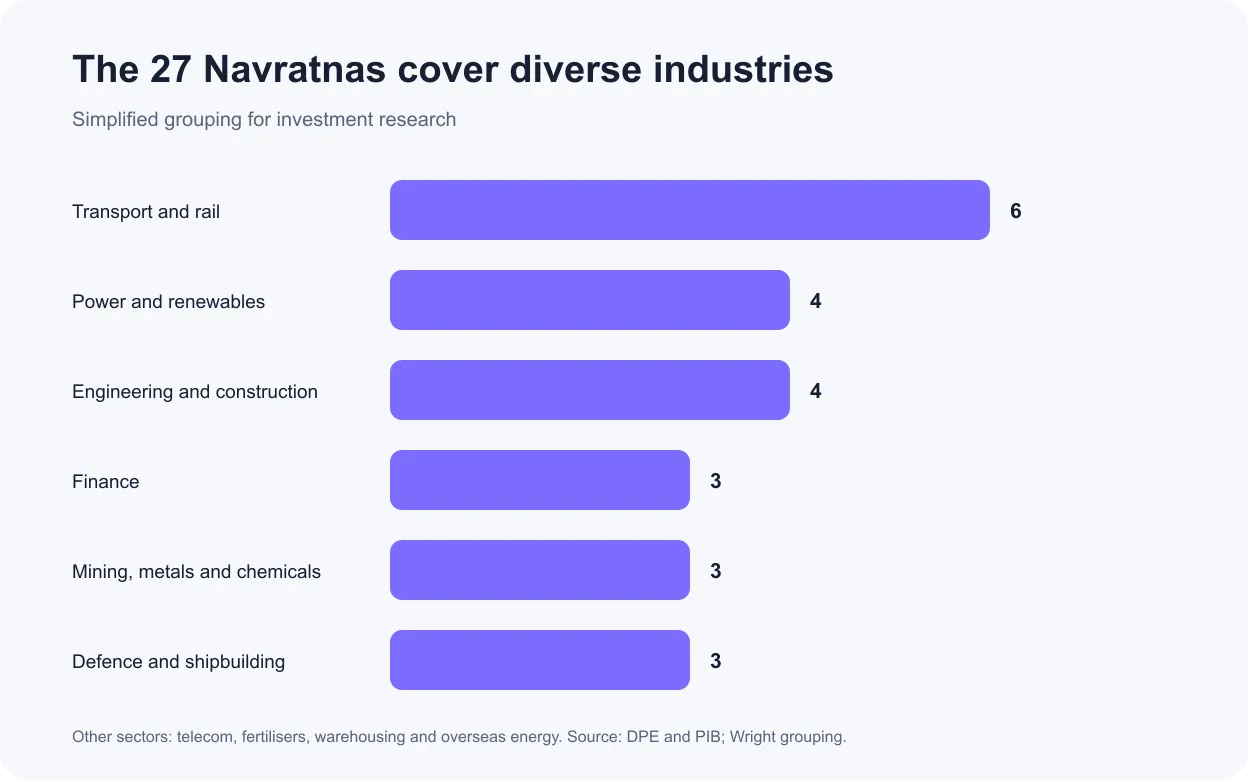
The sector spread means navratna companies in india should not be ranked through one universal multiple. A lender’s book value and credit costs are not comparable with a shipyard’s order book or a miner’s commodity realisations.
Rail-linked exposure is especially varied. CONCOR runs logistics terminals, RVNL and IRCON execute infrastructure, RITES provides consultancy, IRCTC earns from passenger services, RailTel operates communications infrastructure, and IRFC finances railway assets. A shared customer ecosystem does not create identical margins, working capital or risk.
Power exposure also needs separation. NHPC and SJVN develop generation assets, NLC India combines mining and power, SECI implements renewable programmes, and IREDA finances clean-energy projects. Their sensitivity to rates, hydrology, fuel, tariffs, counterparties and construction timelines differs materially.
Get research like this in your inbox
The week’s research that mattered, in five minutes. Joined by 2L+ investors.
Top Metrics to Compare Before Investing
Begin with revenue quality and return on capital. Separate recurring operations from grants, asset sales, one-time orders or commodity windfalls. Compare operating cash flow with reported profit, and review working capital, receivable ageing, capital expenditure and contingent liabilities.
For lenders such as HUDCO, IREDA and IRFC, examine net interest margin, cost of funds, capital adequacy, asset quality and borrower concentration. For project businesses, review order inflow, order book, execution, margins and customer payments. For miners, focus on volume, realisation, cost and reserve life.
The navratna PSU companies often serve strategic objectives. Test whether mandated investment earns an adequate return and whether project delays require extra debt. Review government ownership, free float, related-party transactions, audit observations and board independence.
Dividend yield needs context. A high payout may reflect strong cash generation, government fiscal priorities or a temporary peak in earnings. Compare dividends with free cash flow, maintenance needs, committed projects and leverage before treating the yield as sustainable.
Investors using the navratna companies list should also check valuation against the company’s own cycle. Price-to-book can suit financial firms; enterprise value to EBITDA can help with capital-intensive businesses; price-to-earnings should use normalised profits when earnings are volatile.
Order books require careful reading. Large announced orders can stretch over years, contain variable margins or depend on customer approvals. Compare order intake with execution capacity, revenue conversion, advances and receivables. A rising order book alongside worsening cash conversion may signal funding pressure rather than uncomplicated growth.
For commodity-linked enterprises, use through-cycle prices and costs. A miner can look optically cheap at peak earnings, while a fertiliser producer’s profit may depend on input prices and subsidy timing. Scenario analysis should show how profit, cash flow and leverage change under weaker realisations or delayed payments.
The navratna PSU companies should be compared with private-sector and other public-sector peers where models overlap. Government ownership does not make capital free, and strategic importance does not remove competition. Relative returns on capital, cost structure and execution can reveal whether autonomy is creating an advantage.
Navratna vs Maharatna vs Miniratna
The navratna vs maharatna distinction is mainly scale and delegated autonomy. A Maharatna must already be a Navratna, be listed with prescribed public shareholding, cross three-year turnover, net-worth and profit thresholds, and have significant international operations.
| Category | Qualification emphasis | General board autonomy |
|---|---|---|
| Maharatna | Very large listed Navratna with additional financial and global tests | Highest delegation; general project ceiling up to ₹5,000 crore within 15% of net worth |
| Navratna | Schedule A Miniratna-I with strong MoU ratings and composite score | Broad delegation; general project ceiling up to ₹1,000 crore within 15% of net worth |
| Miniratna-I | Continuous profitability, required profit threshold and positive net worth | Lower prescribed capital-expenditure delegation |
| Miniratna-II | Continuous profitability and positive net worth | More limited delegation |
In investment terms, higher status is not automatically better. A smaller enterprise may have stronger growth, cleaner finances or a cheaper valuation. The classification indicates administrative freedom, while stock selection concerns expected cash flows, price and risk.
These categories are not credit ratings and do not promise government support for equity holders. They define delegation inside the CPSE framework. Investors should not convert administrative hierarchy into a mechanical valuation premium. Evidence of better capital allocation must appear in project returns and cash flow.
Dividend, Growth and Valuation Considerations
Growth can come from government capital expenditure, energy transition, defence indigenisation, railway expansion, urban finance and export orders. Announced opportunity must be translated into funded projects, executable capacity and timely customer collections before it supports valuation.
Many navratna companies in india are mature businesses, yet the group also includes faster-growing defence, rail and renewable-energy companies. Investors should distinguish structural growth from a temporary order surge and compare capacity additions with future demand.
Valuation should incorporate cyclicality and policy. Commodity producers deserve mid-cycle assumptions, finance companies need credit-cost scenarios, and order-book businesses require margin and execution sensitivity. A premium is dangerous when expectations leave no room for delays.
The 2026 navratna companies list 2026 is useful for idea generation, not automatic portfolio inclusion. Establish a required return, downside case and position size. A good enterprise can still be a poor investment when purchased at an excessive price.
Dividend analysis should use both payout ratio and free cash flow. A company can distribute a large share of profit while borrowing for expansion, and a special dividend may not repeat. Review ownership needs, the capital programme and balance-sheet headroom before projecting income.
Growth assumptions need milestones. For a shipyard, monitor deliveries and capacity. For rail contractors, track order conversion and receivables. For renewable lenders, examine disbursement, spreads and asset quality. For miners, compare output guidance with approvals and logistics. Specific milestones make a thesis testable.
A mixed business may need sum-of-the-parts analysis. Mature operations deserve conservative growth, while a new project needs probability-weighted cash flows and execution risk. Combining every announcement into one optimistic forecast can materially overstate intrinsic value.
Risks and Limitations of PSU Investing
The government acts as controlling shareholder and policymaker. It can prioritise affordability, employment, strategic capacity or national infrastructure over near-term minority-shareholder returns. Subsidies, administered pricing, mandated projects and disinvestment can influence earnings or market supply.
Customer concentration is common. Railway companies rely on public projects, defence manufacturers rely heavily on government orders, and infrastructure lenders can share concentrated borrowers. Delayed approvals or payments can create working-capital pressure even when reported demand is strong.
The navratna PSU companies also face sector-specific risks such as commodity prices, interest rates, regulation, technology change, project overruns, environmental obligations and foreign-exchange exposure. Status cannot protect shareholders from operational losses or valuation compression.
Some entries are unlisted, and listed shares vary greatly in liquidity and free float. A diversified set of Navratna names can still concentrate a portfolio in government spending and policy cycles. Investors should examine overlap before adding another PSU position.
Use the navratna companies list 2026 as a documented research universe and update it when DPE issues a new order. The right conclusion may be to wait if expected returns do not compensate for business, policy or valuation risk.
Investors comparing navratna companies in india should measure concentration by economic drivers, not ticker count. Several names depend on government capital expenditure, railway budgets, defence orders or regulated infrastructure. Owning many shares can still leave one underlying policy bet.
Environmental and technology risks also differ. Mining, metals and thermal assets face transition and remediation costs, while telecom and digital businesses face obsolescence and competition. Defence and infrastructure projects can encounter compliance, supply-chain and geopolitical constraints. These risks belong in valuation.
Because the navratna companies list 2026 combines listed and unlisted enterprises, readers should separate policy coverage from investible coverage. The official count answers which CPSEs hold the status; the exchange screen answers which securities can be purchased. That distinction matters when analysing navratna companies in india because an unlisted subsidiary may contribute to a listed parent's results without offering its own equity.
Research on navratna companies in india should end with a thesis, valuation range and conditions that would prove the thesis wrong. Monitor execution, cash conversion, debt, regulatory changes and management guidance after purchase. Review position size when facts change instead of relying on the status label. This discipline helps separate business value from short-term enthusiasm around government orders, dividends or classification news.
Is your portfolio built for what’s coming?
Get a free AI-powered review of your holdings — risk, overlap and quality in minutes.
FAQ
What is a Navratna company?
A Navratna is a qualifying Central Public Sector Enterprise granted enhanced financial and operational autonomy by the Government of India. It must meet prescribed classification, performance-rating and composite-score conditions carefully.
How many Navratna companies are there in India in 2026?
There are 27 based on the latest DPE list plus subsequent official grants to IRCTC, IRFC and GRSE. Because classifications change, investors should check the newest DPE or PIB order.
Which are the Navratna companies?
The current group spans defence, railways, engineering, mining, power, finance, logistics, fertilisers, telecom, shipping and renewable energy. The full 27-company table appears above.
Are Navratna stocks good investments?
Status is not a buy signal. Investors should assess the business model, balance sheet, cash flow, valuation, governance, policy exposure and sector cycle. Some Navratnas are also unlisted.
What is the difference between Navratna and Maharatna?
Maharatna is the higher autonomy category for large listed Navratnas that meet additional turnover, net-worth, profit and international-presence criteria. Navratnas have a lower general investment ceiling.
Can I buy Navratna company shares?
Shares can be bought only where the Navratna CPSE is exchange-listed. Investors need a demat and trading account, but should verify suitability and valuation before purchasing.