


The margin of safety meaning is straightforward: pay meaningfully less than a conservative estimate of what an asset is worth. The margin of safety is not a promise of profit. It is an allowance for imperfect forecasts, changing conditions and human error.
In practice, calculating margin of safety requires more than inserting numbers into a formula. Investors must estimate intrinsic value, test assumptions and decide how much uncertainty they are willing to accept. This article connects stock valuation with portfolio construction.
Purchase discipline begins with a defensible value range.
What Does Margin of Safety Mean in Investing?
The margin of safety in investing is the difference between estimated intrinsic value and market price, usually expressed as a percentage of intrinsic value. The margin of safety meaning is therefore tied to valuation, not price decline alone. A share falling from ₹500 to ₹300 is not automatically cheap.
A defensible estimate studies financial statements, business economics, industry structure and risk. SEBI’s investor education material describes fundamental analysis as examining financial health, the business model and economic factors. Calculating margin of safety then asks whether the quoted price is sufficiently below the resulting value range.
See what markets are pricing in
Live indices, sector moves and market breadth — the backdrop to every story we publish.
The Origins of the Margin of Safety Concept
Benjamin Graham and David Dodd developed the value-investing framework in Security Analysis, first published in 1934. Graham later brought the idea to individual investors in The Intelligent Investor. The historical margin of safety meaning was protection against the unavoidable imprecision of intrinsic value.
CFA Institute research explains that Graham favoured a sufficiently large discount so an investment could remain attractive even when the estimate was somewhat too high. That is why calculating margin of safety should use conservative assumptions. The concept is a decision rule under uncertainty, not proof that the analyst is correct.
How to Calculate Margin of Safety for a Stock
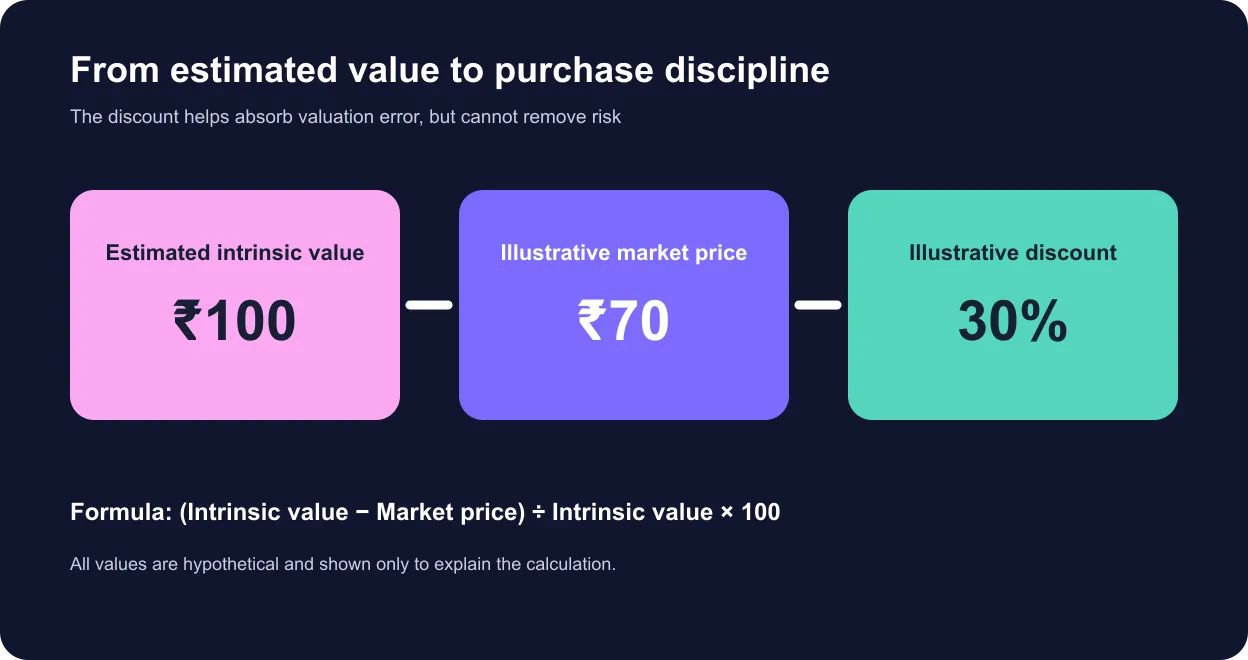
The common formula is: (estimated intrinsic value minus market price) divided by estimated intrinsic value, multiplied by 100. When calculating margin of safety, use the same per-share basis for both inputs. A negative result means price exceeds the estimate.
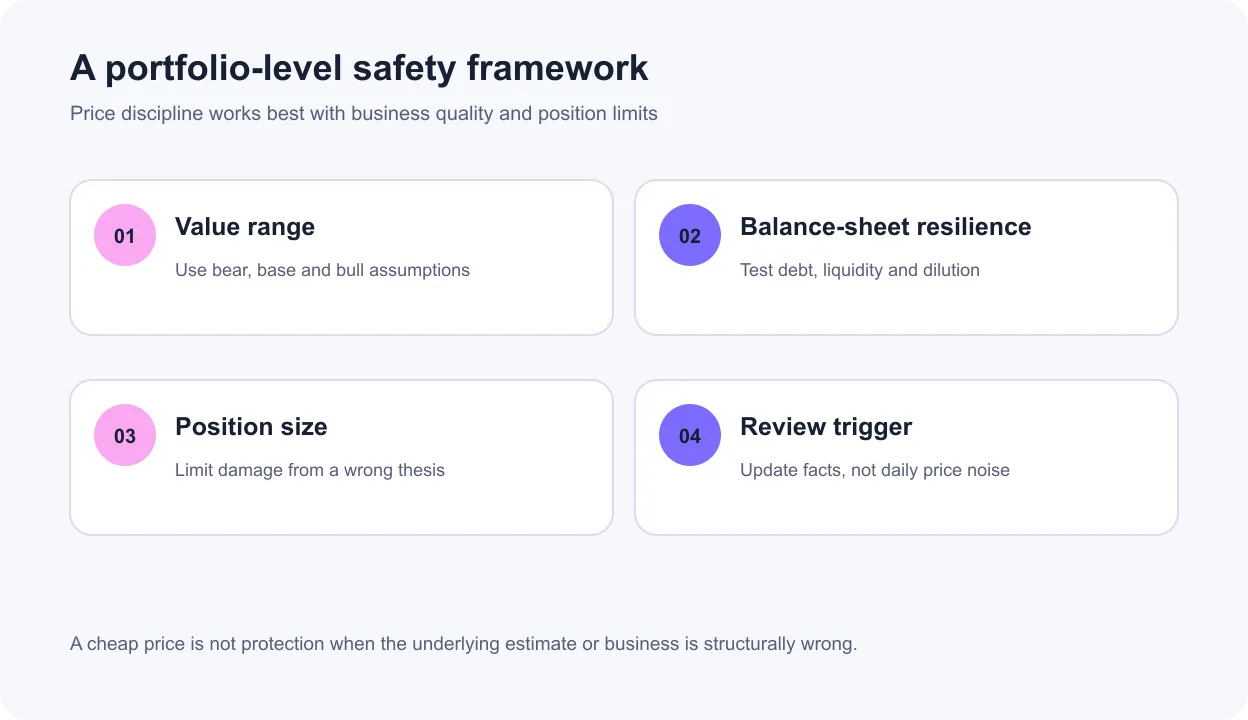
Intrinsic value may come from discounted cash flow, earnings power, asset value or comparable multiples. Calculating margin of safety is more robust when bear, base and optimistic scenarios are tested. The margin of safety meaning weakens if a precise percentage rests on fragile growth or discount-rate assumptions.
Margin of Safety with a Practical Example
Consider a hypothetical company with a conservative intrinsic-value estimate of ₹100 per share and a quoted price of ₹70. Calculating margin of safety gives (₹100 minus ₹70) divided by ₹100, or 30%. This margin of safety example shows the arithmetic, not whether the company is investible.
Now assume weaker demand lowers estimated value to ₹82. The same ₹70 price leaves roughly 14.6%. Calculating margin of safety across scenarios reveals how dependent the apparent bargain is on forecasts. A useful margin of safety example therefore includes sensitivity, debt and cash-flow durability.
| Scenario | Estimated value | Market price | Illustrative discount |
|---|---|---|---|
| Bear | ₹82 | ₹70 | 14.6% |
| Base | ₹100 | ₹70 | 30.0% |
| Optimistic | ₹115 | ₹70 | 39.1% |
Get research like this in your inbox
The week’s research that mattered, in five minutes. Joined by 2L+ investors.
What's a Good Margin of Safety Percentage?
There is no universal good percentage. The margin of safety meaning depends on business predictability, leverage, governance, cyclicality and model uncertainty. Calculating margin of safety for a regulated utility is different from valuing a young company with unproven economics.
A larger discount may be prudent when cash flows are volatile, debt is high or outcomes are binary. A smaller one may sometimes be considered for a resilient company, but quality does not eliminate valuation risk. Calculating margin of safety should be paired with a required-return test.
Applying Margin of Safety to Portfolio Selection
The margin of safety in investing can rank candidates by price relative to conservatively estimated value. It can also inform position size: a wider, more credible discount may justify further research, while an uncertain thesis should remain small regardless of apparent upside.
At portfolio level, calculating margin of safety must include correlation and concentration. Five discounted banks may share one economic risk. The margin of safety meaning expands from stock selection to controlling exposure, maintaining liquidity and avoiding forced selling.
Limitations of the Margin of Safety Approach
Intrinsic value cannot be observed directly. Small changes in growth, margins, reinvestment or discount rates can materially alter results. Calculating margin of safety may create false confidence when inputs are overly precise. A low multiple can also reflect permanent business deterioration rather than mispricing.
The margin of safety approach can miss intangible assets, optionality or structural disruption. It may also keep cash uninvested in expensive markets. A margin of safety example based on one scenario cannot capture fraud, dilution, regulation or technology change. The discipline reduces some errors; it does not remove market risk.
Conclusion
The margin of safety meaning is best understood as humility expressed through price. Estimate value conservatively, test a range and demand a discount that reflects uncertainty. Calculating margin of safety is useful only when the business analysis behind the estimate is sound.
For portfolio decisions, combine valuation with quality, diversification and position limits. The margin of safety in investing is not a shortcut to certainty, but it can create a repeatable rule for refusing unattractive prices.
Is your portfolio built for what’s coming?
Get a free AI-powered review of your holdings — risk, overlap and quality in minutes.
FAQ
What is margin of safety in investing?
It is the discount between a conservative estimate of intrinsic value and the price paid. The gap is intended to absorb some valuation error and adverse developments, but it cannot guarantee against loss.
What is the margin of safety meaning in value investing?
The concept means buying only when price is sufficiently below a defensible value estimate. It combines valuation with purchase discipline rather than treating a good company as attractive at every price.
How do you calculate margin of safety for a stock?
Subtract market price from estimated intrinsic value, divide the difference by intrinsic value and multiply by 100. Because intrinsic value is uncertain, calculate a range under multiple scenarios.
What is a good margin of safety percentage?
No universal percentage is suitable. A stable, understandable company may justify a smaller discount than a leveraged or unpredictable business. The required gap should rise with uncertainty and downside risk.
Why is margin of safety important for portfolio selection?
It creates a consistent price discipline across candidates and can inform position sizing. Portfolio protection still also requires diversification, liquidity awareness and limits on correlated exposures.