


A Nifty 50 futures contract lets a trader take a leveraged view on India’s benchmark equity index without buying all 50 constituent shares. The contract is standardised by the exchange, traded in fixed lots and settled in cash. Both long and short positions carry an obligation, so losses can exceed the margin initially deposited.
For readers asking what is Nifty futures, the shortest answer is a time-bound agreement whose value tracks the Nifty 50 index. The exchange specifies the lot, expiry and settlement rules; the market sets the futures price. That price can trade above or below the spot index because of financing costs, expected dividends and demand.
What Is a Nifty Futures Contract?
The Nifty futures meaning begins with the underlying: the Nifty 50, an index rather than a deliverable share. A futures buyer agrees economically to receive gains when the contract rises and pay losses when it falls. A seller has the opposite exposure. Because an index cannot be physically delivered, NSE index futures are cash-settled.
A Nifty futures contract has a defined symbol, expiry date and market lot. NSE currently lists near-month, mid-month and far-month contracts, so three monthly maturities are normally available. A new far-month contract is introduced after the near-month expiry.
This Nifty futures contract is standardised so that every participant in the same expiry trades the same underlying, lot and settlement terms. Only the market price and position direction differ between buyers and sellers.
Another way to answer what is Nifty futures is to distinguish exposure from ownership. A long future does not give voting rights or dividends from constituent companies. It creates a marked-to-market derivative position linked to index movement.
What’s the market feeling today?
Our India Fear & Greed index tracks sentiment so you don’t trade on headlines.
How Nifty Futures Trading Works
Nifty futures trading begins when a buyer and seller match on the exchange. A long trader benefits from an increase in the futures price; a short trader benefits from a decrease. The clearing corporation becomes the central counterparty and manages settlement and risk.
Instead of paying the full notional contract value, both sides post margin. Positions are marked to market daily. If the futures price moves against the trader, money is debited; favourable movement creates a credit. A large adverse move can therefore require more funds even when the original margin was adequate.
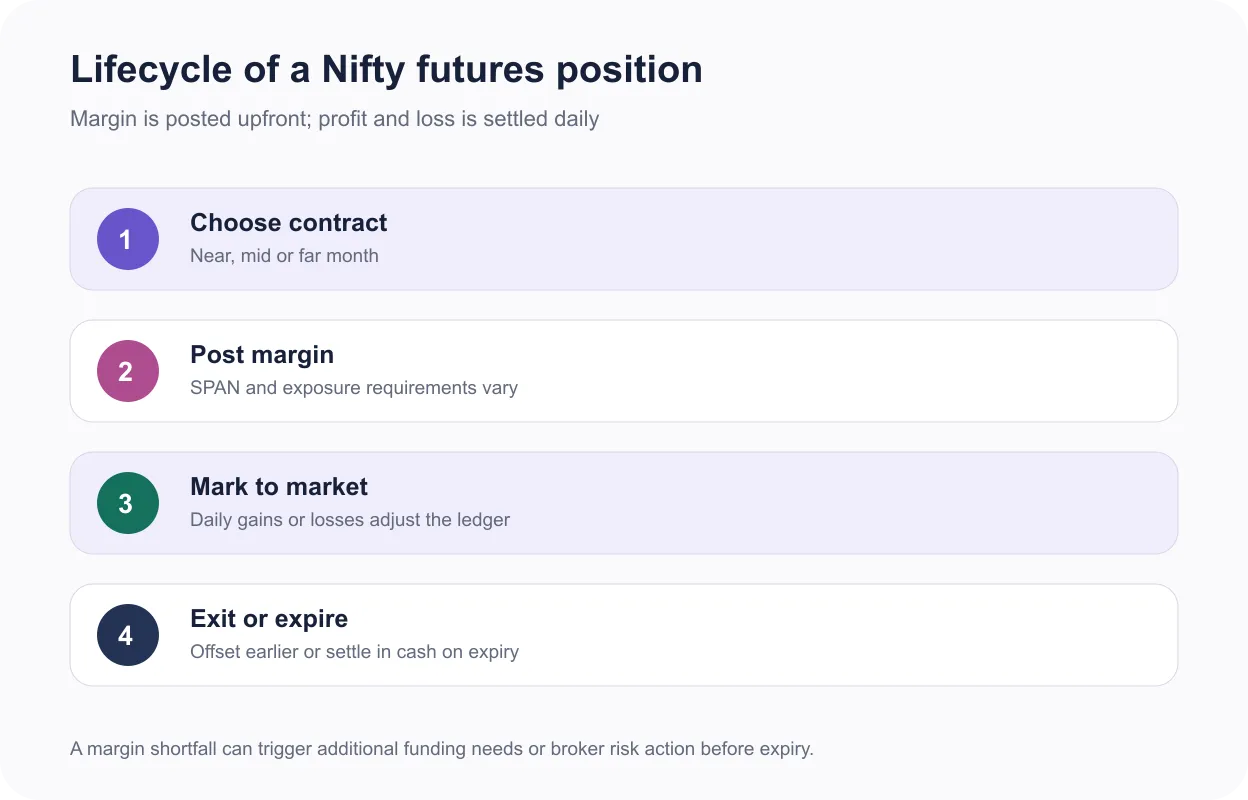
Understanding what is Nifty futures also requires the basis: futures price minus spot index. The basis may be positive or negative and generally converges toward zero at expiry. It can change because of interest rates, dividends, time remaining and positioning.
Nifty Futures Lot Size Explained
The Nifty futures lot size is the number of index units in one contract. NSE revised the market lot from 75 to 65 for the January 2026 monthly expiry onward. As of September 2026, current contracts use 65 units, but traders must verify the live permitted-lot-size file because periodic reviews can change it.
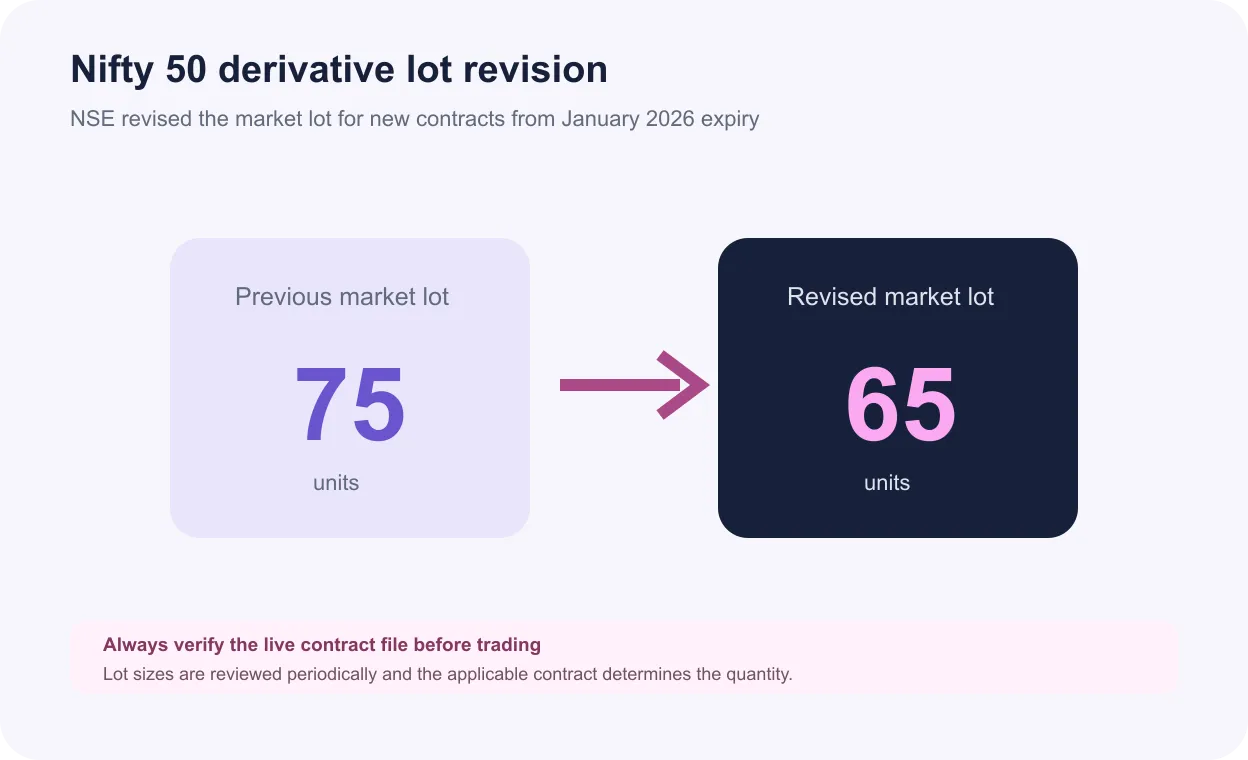
Notional contract value equals the futures price multiplied by the Nifty futures lot size. At an illustrative futures price of 25,000, one 65-unit contract represents ₹16,25,000 of index exposure. This is not the amount paid upfront, but it is the economic exposure on which profit and loss is generated.
A one-point movement changes one lot’s value by ₹65 when the Nifty futures lot size is 65. A 100-point adverse move therefore produces a ₹6,500 loss before charges. The same arithmetic applies to gains, which is why a modest index move can be significant relative to margin capital.
The Nifty futures lot size also determines order quantity: two lots equal 130 units and three equal 195. Traders cannot normally enter a fractional lot, so risk must be sized in those steps.
Nifty Futures Contract Example
Assume a trader buys one near-month future at 25,000 with a 65-unit lot. The notional value is ₹16,25,000. If the trader later sells at 25,150, the gross gain is 150 × 65, or ₹9,750. If the price instead falls to 24,850, the gross loss is ₹9,750.
| Item | Long position | Short position |
|---|---|---|
| Entry futures price | 25,000 | 25,000 |
| Exit futures price | 25,150 | 24,850 |
| Price movement | +150 points | -150 points |
| Gross result at 65 units | ₹9,750 gain | ₹9,750 gain |
The example excludes brokerage, exchange charges, GST, securities transaction tax, stamp duty and slippage. It also assumes the position is closed at the stated price. The Nifty futures meaning becomes practical only when the trader translates points into rupees before entering. The Nifty futures lot size is the multiplier connecting those two measures.
Nifty Futures Expiry and Settlement
Nifty futures expiry currently occurs on the last Tuesday of the expiry month. If that Tuesday is a trading holiday, the contract expires on the previous trading day. This replaced older Thursday-based schedules, so outdated articles and calendar assumptions can create operational mistakes.
A trader can close the position before Nifty futures expiry by taking the opposite position in the same contract. A long sells; a short buys. Traders who want to maintain exposure may roll by closing the expiring contract and opening a later month, accepting the prevailing spread and transaction costs.
Open positions at expiry are cash-settled using the exchange’s final settlement framework. There is no delivery of an index basket. The near, mid and far contracts can have different prices, liquidity and basis, so contract selection matters.
Get research like this in your inbox
The week’s research that mattered, in five minutes. Joined by 2L+ investors.
Nifty Futures vs Nifty Options
Nifty futures vs Nifty options is fundamentally a comparison of obligations and payoff shapes. Futures create linear exposure for both sides. An option buyer pays a premium for a right and has loss limited to that premium, while the seller accepts a contingent obligation with potentially large loss.
| Feature | Nifty futures | Nifty options |
|---|---|---|
| Buyer’s commitment | Obligation until offset or settlement | Right, not obligation |
| Upfront cash | Margin | Premium for buyer; margin for seller |
| Payoff | Linear with futures-price movement | Non-linear and strike-dependent |
| Time decay | No option premium decay, though basis converges | Option value is affected by time decay |
The Nifty futures vs Nifty options decision depends on the desired exposure and risk. Wright Research’s options trading guide for beginners explains premiums, strikes and option rights in more detail. Neither product is automatically safer without sizing and exit discipline.
Margin Requirements for Nifty Futures
There is no universal rupee figure for margin. Clearing requirements are risk-based and can include SPAN and exposure components, with brokers sometimes adding their own buffers. Volatility, contract value, offsets and exchange parameters can all change the requirement.
The margin displayed when an order is entered is not the maximum possible loss. The full position is exposed to market movement, and mark-to-market debits may create a margin shortfall. Brokers can reduce positions under their risk policy if funds are not added promptly.
Before Nifty futures trading, calculate notional exposure, loss per index point, planned stop level and available liquidity. Do not size only from the minimum margin shown on screen.
A margin calculator should be refreshed before the order because a revised Nifty futures lot size or higher volatility can materially change the cash required.
Risks of Trading Nifty Futures
Leverage is the central risk. A relatively small deposit controls a much larger notional position, magnifying both gains and losses. Gaps can cause execution beyond a planned stop, and a fast market can produce additional margin calls.
Basis and rollover risk also matter. A hedge may not move exactly like the portfolio being protected. Rolling from one expiry to the next can occur at an unfavourable spread, and liquidity may concentrate in the near contract.
Operational errors include choosing the wrong expiry, overlooking the Nifty futures lot size, placing market orders in thin conditions and carrying a position into expiry unintentionally. The current lot of 65 still represents large exposure at prevailing index levels.
SEBI’s repeated studies of individual equity F&O traders show that most incurred losses. Those findings cover a broader derivatives segment, not Nifty futures alone, but they underline why leverage should be treated as a risk-management tool rather than easy income.
How to Start Trading Nifty Futures
First activate the equity derivatives segment with a registered broker and complete the required income and risk disclosures. Learn the broker’s margin policy, square-off rules, order types and treatment of expiry-day positions.
Next, define the trade in advance: contract month, entry, invalidation level, maximum rupee loss and exit method. Confirm the live lot and calculate exposure. A written framework for Nifty futures trading , grounded in broader stock market investment strategies, is more useful than responding to an intraday forecast without context.
Beginners should practise with simulated positions and track daily settlement before using capital. Start smaller than the maximum margin allows, keep surplus cash for adverse variation and avoid averaging a leveraged loss without a pre-defined rule.
Finally, verify exchange specifications whenever rules change. The answer to what is Nifty futures is stable at the conceptual level, but the lot, expiry calendar, tick size, margins and risk controls can change.
In practice, the Nifty futures meaning combines index exposure, a fixed expiry, daily settlement and leverage. Leaving out any one of those features gives an incomplete picture of the product.
Know your risk profile in 2 minutes
A short quiz that maps how much drawdown you can actually live with.
FAQ
What is the lot size of Nifty futures?
As of September 2026, the NSE market lot for current Nifty 50 futures contracts is 65 index units. Lot sizes are reviewed periodically, so the live NSE contract file and broker order screen should be checked before every trade.
How does Nifty futures trading work?
A trader takes a long or short position in a standardised index contract, posts the required margin and receives or pays daily mark-to-market differences. The position can be offset before expiry or cash-settled at expiry.
What is the difference between Nifty futures and Nifty options?
A futures buyer and seller both have an obligation and linear profit or loss. An option buyer has a right, not an obligation, and pays a premium; the option seller accepts a contingent obligation and margin requirement.
When does a Nifty futures contract expire?
Nifty 50 monthly futures currently expire on the last Tuesday of the expiry month. If that Tuesday is an exchange holiday, expiry moves to the previous trading day.
How much margin is required for Nifty futures?
There is no permanent fixed rupee amount. Required margin depends on the contract value, volatility, SPAN and exposure parameters, broker policies and portfolio offsets, and can change intraday.
Can beginners trade Nifty futures?
They can access the product through an eligible derivatives account, but the leverage, daily settlement and large contract value make it unsuitable for many beginners. Paper trading and detailed risk controls should come first.