


India’s two best-known stock exchanges often display the same company at nearly identical prices. That can make the choice look cosmetic, but each venue has its own order book, liquidity, product set and flagship index.
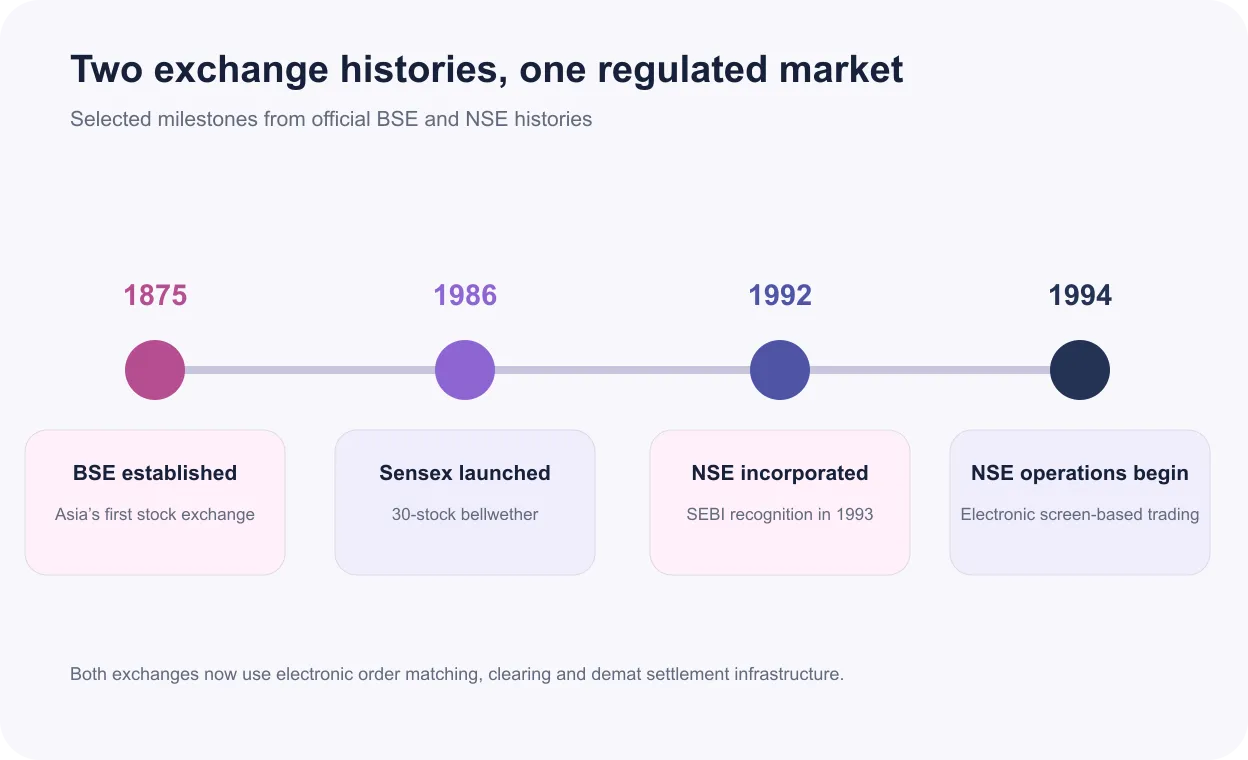
The difference between BSE and NSE begins with history and market depth. BSE dates to 1875 and has the broader listed-company universe. NSE began operations in 1994 as India’s first electronic screen-based exchange and now handles substantially more equity cash trading.
BSE and NSE: A Quick Overview
BSE and NSE are market infrastructure institutions where eligible securities are listed and traded under SEBI oversight. Brokers route investor orders to an exchange, its electronic system matches compatible bids and offers, and a clearing corporation manages settlement obligations.
The practical BSE and NSE difference is not ownership of the shares. A dematerialised share has the same ISIN when the company is admitted on both venues. What changes is the venue’s live price, bid-ask spread, available quantity and execution queue.
Both exchanges support equities, exchange-traded funds, debt products and derivatives, though contracts and liquidity differ. Investors should confirm that a security is listed on the chosen venue and that their broker supports that segment.
Another difference between BSE and NSE is that each exchange maintains its own notices, surveillance actions and trading files. A company announcement is commonly submitted to both venues when the shares are dual-listed, but investors should still consult the relevant exchange record and the company’s official filing before acting.
See what markets are pricing in
Live indices, sector moves and market breadth — the backdrop to every story we publish.
BSE Full Form and History
The BSE full form is commonly expanded as Bombay Stock Exchange, its historic name. The company is now formally BSE Limited. Established in 1875, it describes itself as Asia’s first stock exchange and represents the older institutional lineage of India’s organised securities market.
BSE’s flagship Sensex launched on 2 January 1986. BSE Index Services says it is designed to measure 30 of the largest, most liquid and financially sound companies across important sectors. The index uses float-adjusted market-cap weighting.
One notable BSE and NSE difference is listing breadth. SEBI’s FY 2024–25 table recorded 5,452 companies listed on BSE, including active and suspended companies. A high listing count does not mean every share trades actively, so investors must still check volume and spread.
NSE Full Form and History
The NSE full form is National Stock Exchange of India Limited. It was incorporated in 1992, recognised by SEBI in April 1993 and commenced operations in 1994, first in wholesale debt and then in the cash market.
NSE pioneered nationwide electronic or screen-based trading in India. Its official history says the cash segment began on 3 November 1994 and it became the country’s largest exchange by transacted volume within about a year.
Its flagship Nifty 50 represents 50 companies selected from the Nifty 100 under liquidity, derivatives-availability and free-float market-cap rules. Readers comparing large-cap universes can also review how the Nifty 50 and Nifty Next 50 fit together.
BSE vs NSE: Key Differences
A useful BSE vs NSE comparison separates history, listings, liquidity, indices and products. The exchange with more listed companies is not automatically the exchange with more trading activity.
| Feature | BSE | NSE |
|---|---|---|
| Established or incorporated | Established in 1875 | Incorporated in 1992; operations began in 1994 |
| Common full form | Bombay Stock Exchange; formally BSE Limited | National Stock Exchange of India Limited |
| Flagship index | Sensex, designed around 30 companies | Nifty 50, comprising 50 companies |
| FY25 listed companies | 5,452, including active and suspended companies | 2,720 |
| FY25 equity cash ADT | ₹7,798 crore | ₹1,12,963 crore |
| Investor decision | Check listing availability, live spread, depth, costs and order type | |
The difference between BSE and NSE also appears in symbols, contract specifications and data feeds. A broker interface may default to one exchange, but that default should not replace a live quote check for a large or time-sensitive order.
A further difference between BSE and NSE concerns product-level participation. An exchange may list a contract or security without developing the depth seen on the competing venue. A product’s availability and its practical tradability are separate questions, especially in derivatives and less active shares.
Get research like this in your inbox
The week’s research that mattered, in five minutes. Joined by 2L+ investors.
Trading Volumes and Liquidity Comparison
SEBI’s FY 2024–25 statistics show the clearest broad liquidity difference between BSE and NSE. Average daily equity cash turnover was ₹7,798 crore on BSE and ₹1,12,963 crore on NSE. On that measure, NSE’s activity was about 14.5 times BSE’s.
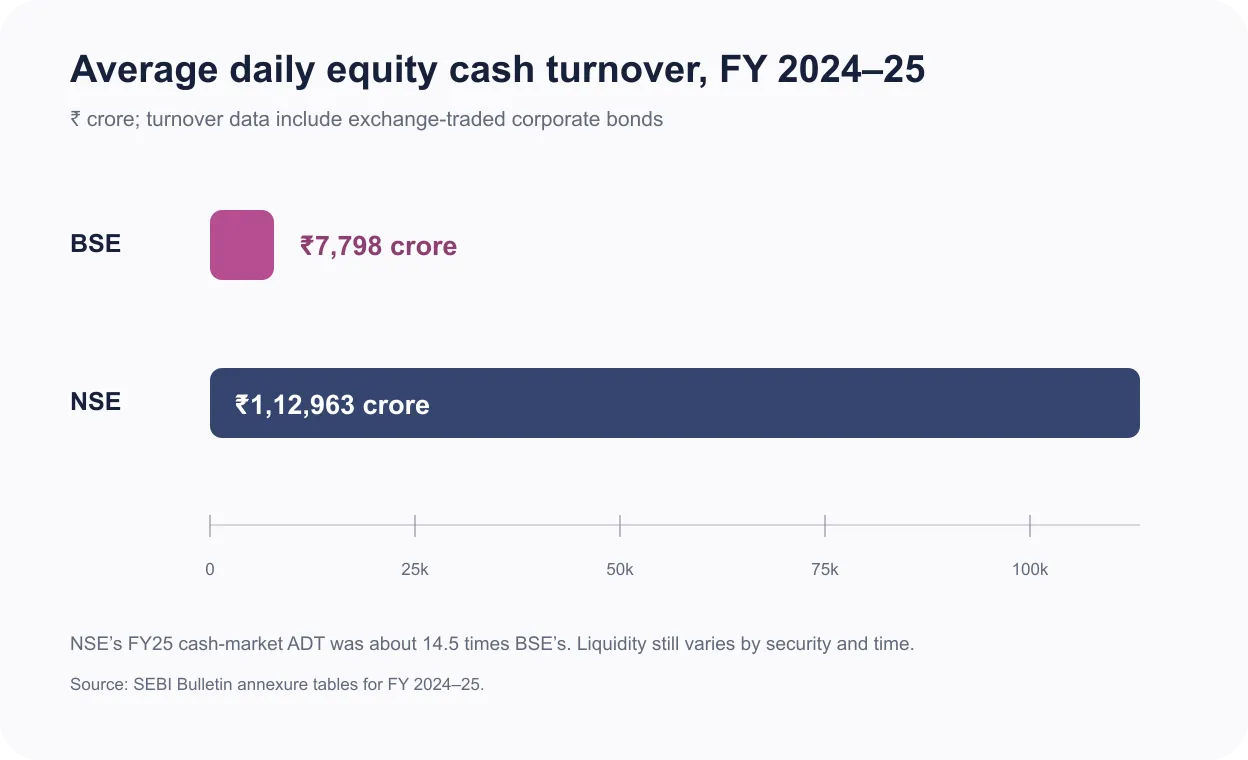
Higher turnover often supports tighter spreads and deeper order books, which can reduce market impact. It does not guarantee that every NSE-listed stock is more liquid than its BSE line. Some securities may be active on one venue and thin on the other.
For BSE vs NSE execution, compare the best bid and ask, quantities available near those prices and recent traded volume. A limit order can control price when the spread is wide. Brokerage and statutory charges are usually not the main venue-specific distinction, but broker policies can vary.
A disciplined BSE vs NSE check takes only a few seconds: compare the two order books, confirm the permitted order type and select the venue offering the better realistic execution for the required quantity. The last traded price alone may be stale or supported by too little volume.
Index Comparison: Sensex vs Nifty
Sensex and Nifty 50 are both free-float market-cap-weighted bellwethers, but they are not interchangeable portfolios. Sensex targets 30 established, liquid BSE-listed companies. Nifty 50 selects 50 companies from the Nifty 100 and requires NSE derivatives eligibility along with liquidity tests.
The broader constituent count means Nifty 50 can distribute weight across more companies, yet both indices remain concentrated in large firms and major sectors. Index levels also use different base dates and base values, so 80,000 on Sensex is not “larger” than 25,000 on Nifty in an economic sense.
Compare percentage or total returns over identical dates rather than index-point changes. Also distinguish price-return indices from total-return indices, which incorporate dividends.
This difference between BSE and NSE indices matters for fund and benchmark comparisons because a 30-stock portfolio and a 50-stock portfolio can carry different sector and company weights even when their daily direction is similar.
How to Choose Between BSE and NSE
Investors asking which is better BSE or NSE should begin with the security. If it trades on only one exchange, the choice is already determined. If it trades on both, inspect the live spread and depth before submitting the order.
For frequently traded large-cap shares, prices are usually close because arbitrage links the venues. Even then, the exact best price and quantity may differ for a few seconds. For less liquid securities, the BSE and NSE difference can be materially larger.
So, which is better BSE or NSE for a long-term investor? Neither is universally better. NSE generally offers greater market-wide liquidity, while BSE offers a wider listed-company universe and may occasionally show the better executable quote. Use a limit order, verify the symbol and exchange, and avoid treating the last traded price as guaranteed.
Is your portfolio built for what’s coming?
Get a free AI-powered review of your holdings — risk, overlap and quality in minutes.
FAQ
What is the full form of BSE and NSE?
BSE stands for BSE Limited, historically known as the Bombay Stock Exchange. NSE stands for the National Stock Exchange of India Limited. Both are recognised stock exchanges regulated within India’s securities-market framework.
Can investors trade the same stock on both BSE and NSE?
Yes, when the company’s shares are listed on both exchanges. The investor chooses the exchange on the order screen, while the shares ultimately settle into the same demat account.
What is the main difference between BSE and NSE?
BSE is the older exchange and has more listed companies, while NSE generally has much higher equity cash-market turnover and dominates several derivatives products. The available stocks, live liquidity and price can differ by venue.
Can I buy shares on both BSE and NSE?
Yes. A broker may provide access to both venues. You can buy on either exchange where the security is listed and, subject to broker and market rules, sell dematerialised shares on the other exchange when the same ISIN is admitted there.
Which has more trading volume, BSE or NSE?
NSE had substantially higher equity cash-market turnover in FY 2024–25. SEBI data show average daily turnover of ₹1,12,963 crore on NSE versus ₹7,798 crore on BSE, although liquidity should still be checked stock by stock.
Is Sensex from BSE or NSE?
Sensex is BSE’s flagship index. Nifty 50 is NSE’s flagship broad-market index. Sensex is designed around 30 large, liquid and financially sound BSE-listed companies, while Nifty 50 contains 50 eligible companies from the Nifty 100 universe.