


If you are asking what is basis point , it is one-hundredth of one percentage point. One basis point equals 0.01%, while 100 basis points equal 1 percentage point. The bps meaning is designed for precision when financial rates move by small amounts.
A basis point in finance appears in RBI policy communication, bank rates, bond yields and investment costs. The basis points formula is simple, but using it correctly prevents confusion between percentage-point and relative percentage changes.
What Is a Basis Point?
The answer to what is basis point is 0.01 percentage point. The term is abbreviated as bp for one and bps for multiple units. SEBI’s investor glossary defines a basis point as one-hundredth of a percentage point.
The bps meaning becomes clearer with a rate example. If a yield rises from 7.25% to 7.40%, it increases by 15 basis points. It does not increase by 15%. A basis point in finance measures the absolute gap between two percentage rates.
When someone asks what is basis point in market commentary, identify the starting and ending rate. A 50-bps increase from 5% reaches 5.50%. The relative increase in the rate itself is 10%, which is a different calculation.
See what markets are pricing in
Live indices, sector moves and market breadth — the backdrop to every story we publish.
The Basis Points Formula Explained
The basis points formula is: basis points = percentage-point change × 100. The reverse conversion is: percentage-point change = basis points ÷ 100. This bps meaning applies consistently across rates and yields.
For example, a move from 6.20% to 6.45% is 0.25 percentage point. The calculation gives 25 bps. A fall from 8.10% to 7.90% is negative 20 bps. The bps percentage conversion is 0.20 percentage point.
| Basis points | Percentage points | Illustrative move |
|---|---|---|
| 1 bp | 0.01% | 7.00% to 7.01% |
| 10 bps | 0.10% | 7.00% to 7.10% |
| 25 bps | 0.25% | 7.00% to 7.25% |
| 50 bps | 0.50% | 7.00% to 7.50% |
| 100 bps | 1.00% | 7.00% to 8.00% |
The bps percentage should always be described as a percentage-point change. Applying the basis points formula to a relative return without clarifying the denominator can mislead readers.
How Many Basis Points Make 1%?
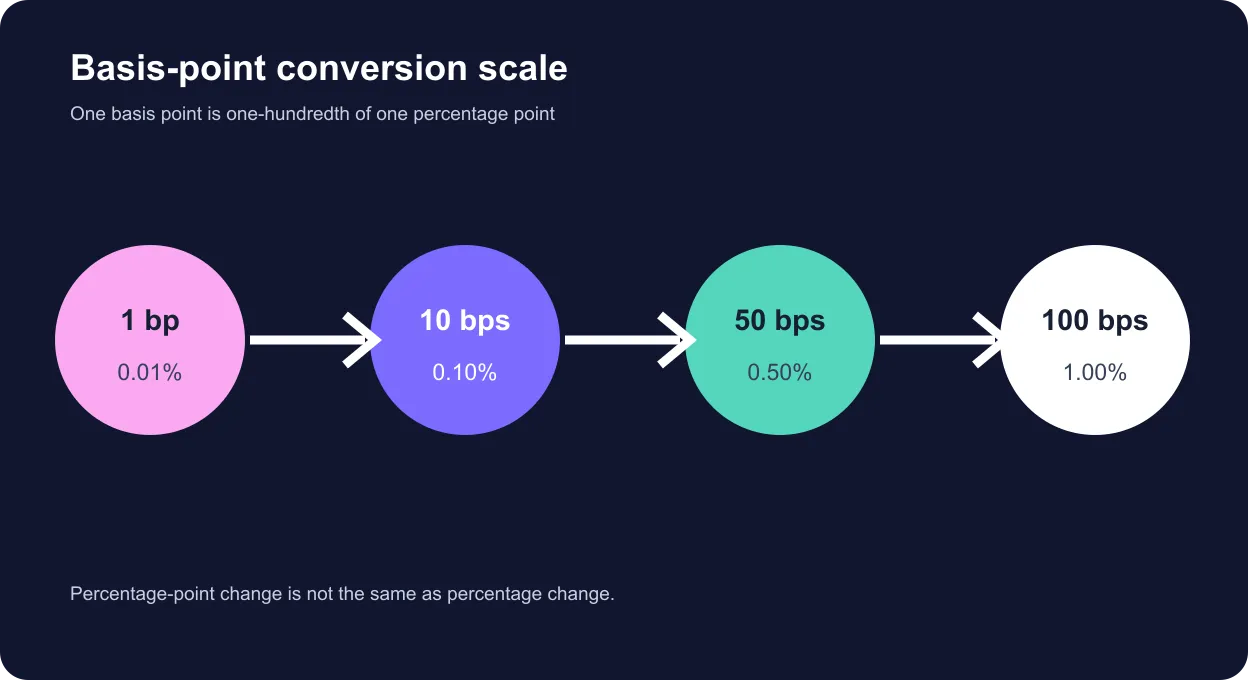
One hundred basis points make 1 percentage point. That is the core bps meaning: 1 bp equals 0.01%. If you remember this bps meaning relationship, the basis points formula can be applied mentally.
To understand what is basis point at different scales, 5 bps equals 0.05%, 75 bps equals 0.75%, and 150 bps equals 1.50 percentage points. The bps percentage is found by dividing the basis-point figure by 100.
Get research like this in your inbox
The week’s research that mattered, in five minutes. Joined by 2L+ investors.
Why Do Banks and RBI Use bps Instead of Percentages?
Banks and RBI use bps because the wording is unambiguous. Saying a rate rose “by 10%” could mean a relative increase. Saying it rose by 10 basis points clearly means an absolute increase of 0.10 percentage point.
A basis point in finance also supports concise comparison across policy rates, lending spreads and yields. RBI publications regularly use bps, and RBI explains that 1%=100 bps. This shared bps meaning helps markets interpret decisions consistently.
The convention also makes small differences visible. A change from 6.50% to 6.55% is only 0.05 percentage point, but describing it as 5 bps is cleaner. The resulting bps percentage remains 0.05 percentage point.
Basis Points in Everyday Investing
Investors see basis points in loan and deposit rates, bond yields, mutual-fund expenses and portfolio performance. When bond yields rise, existing fixed-rate bond prices generally fall, although the size of the move depends on duration and other risks. This is why a basis point in finance can have a meaningful price effect.
Costs also compound. If two funds differ by 30 bps in annual expense ratio, the basis points formula converts that difference to 0.30 percentage point per year. The bps meaning is small in one year but potentially material over a long holding period.
For loans, a 25-bps rate change alters interest cost, but the rupee impact depends on principal, tenure and repayment structure. The bps percentage alone is not the monetary answer. Investors should apply the rate change to the relevant cash flows.
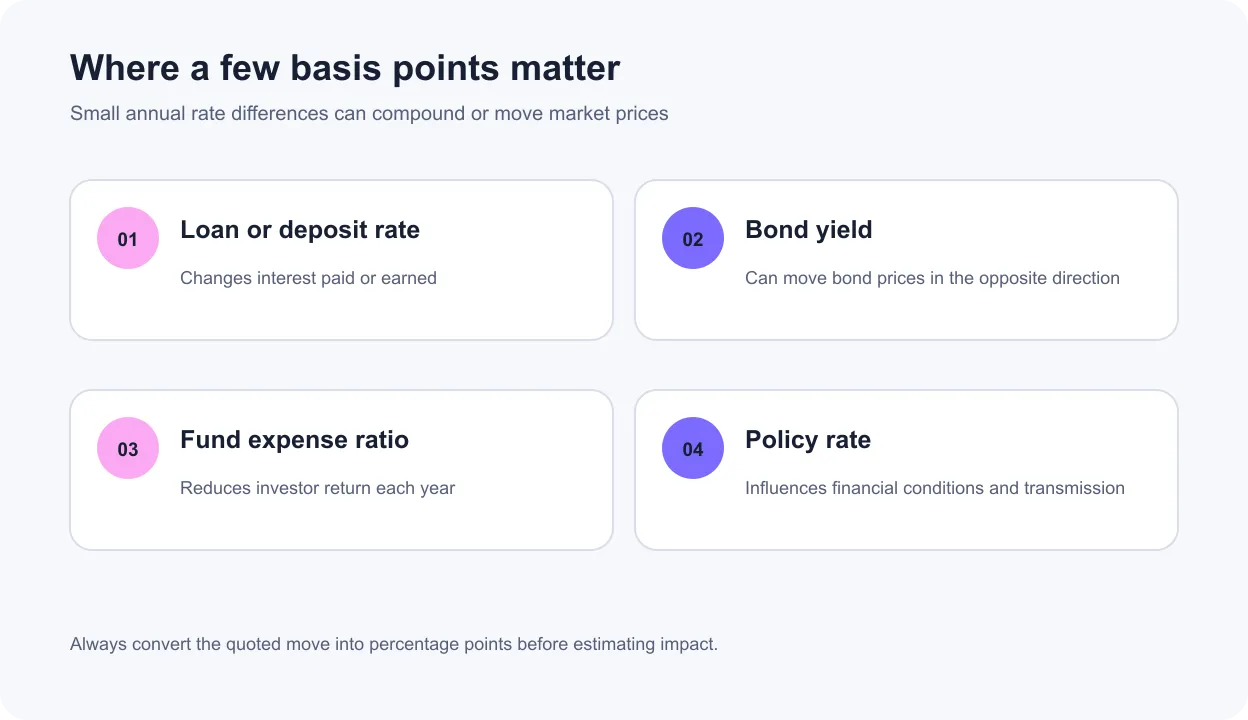
When reading what is basis point in a report, note whether the figure describes a yield change, fee, spread or performance gap. Then use the basis points formula and, if needed, a financial calculator to estimate the rupee effect.
Conclusion
The bps meaning is one-hundredth of one percentage point. Knowing what is basis point makes RBI decisions, bond movements and investment fees easier to interpret. The bps percentage conversion is basis points divided by 100.
A basis point in finance may look tiny, but scale and compounding matter. Use the basis points formula carefully, distinguish percentage points from relative percentages, and translate the rate difference into money before making a decision.
Is your portfolio built for what’s coming?
Get a free AI-powered review of your holdings — risk, overlap and quality in minutes.
FAQ
What is the bps meaning in finance?
Bps means basis points. One basis point equals 0.01 percentage point, so 100 basis points equal 1 percentage point.
What is a basis point used for?
It communicates small changes in interest rates, bond yields, loan spreads, expense ratios and other financial percentages without ambiguity.
What is the basis points formula?
Basis points equal the percentage-point change multiplied by 100. To convert basis points into percentage points, divide by 100.
How many basis points make 1%?
One hundred basis points equal 1 percentage point. Therefore, 25 basis points equal 0.25 percentage point and 50 basis points equal 0.50 percentage point.
Why do banks and RBI use bps instead of percentages?
Basis points distinguish an absolute percentage-point movement from a relative percentage change. This makes rate decisions and market communication more precise.