


India's technology sector crossed $315 billion in revenue in FY26, growing 6.1% over the previous year. Its headcount grew 2.3%. That gap is the most important fact about the industry right now.
For three decades, revenue and employment at Indian IT firms moved together. Work arrived as a volume of effort, effort was priced per person per hour, and growth meant hiring. The June 2026 quarter shows that link weakening. Revenue is holding up and order books are full, while the companies are adding far fewer people to service them. Underneath both trends, the price of a unit of work is falling.
What did the June quarter actually show?
Three large companies with different strategies landed within 0.2 percentage points of each other on growth.
Company | Q1 FY27 revenue | YoY growth | Operating margin | Headcount direction |
|---|---|---|---|---|
TCS | $7.62 bn | +2.7% | 24.0% | Added; total near 594,000 |
Infosys | $5.08 bn | +2.8% | 21.1% | Broadly flat; total near 328,000 |
HCLTech | $3.65 bn | +2.6% | 16.9% | Down by about 3,300 |
Source: TCS, Infosys and HCLTech Q1 FY27 disclosures. HCLTech margin is 17.5% after adjusting for one-time restructuring costs.
TCS booked $9.5 billion in total contract value for the quarter, including an $800 million AI-led transformation deal with the Swedish engineering firm SKF, its sixth mega deal in five quarters. Its margin fell 1.3 percentage points sequentially after a company-wide pay raise.
Infosys signed $3.6 billion in large deals, 61% of it net-new business, then cut its full-year revenue guidance to a range of 1.5% to 3%. It cited softer volumes, one contract termination and harder client pushback on price. Roughly 1.7 percentage points of its reported annual growth comes from two small acquisitions rather than from the existing business.
HCLTech's own operations were close to flat, and it kept its 1% to 4% growth guidance unchanged because that range excludes its acquisitions entirely.
The convergence matters more than any individual figure. When companies with different client mixes, verticals and delivery models all arrive at roughly 3% growth, the binding constraint is sitting outside any one of them.
Check the macro backdrop
GDP, inflation, rates and more — India’s key economic indicators in one dashboard.
Why does the same work now earn less?
Because AI compresses the effort a project requires, and clients expect to be handed the saving.
HCLTech chief executive C Vijayakumar has put a number on it: his teams now need roughly 25% to 30% more effort to earn the revenue they used to earn. TCS frames the same pressure from the pricing side. Chief executive K Krithivasan said the company typically passes 10% to 15% of the productivity saving to the client at signing, and usually recovers it by taking additional scope in the same negotiation. Infosys tracks what it calls AI-led deflation internally and has declined to publish the figure. Analysts covering the sector model 2% to 3% annual deflation across the application services base.
The mechanics are straightforward. A task that once took a hundred hours now takes seventy. The client sees the same outcome delivered faster and negotiates on that basis. To book last year's revenue, a firm has to close more deals, or bigger ones, in the same period.
Decision cycles have lengthened at the same time.
Tech Mahindra and Wipro have both flagged client caution around token costs, the running expense of enterprise-scale AI use, which buyers are now weighing against the promised productivity gain. Some clients are waiting for the next model release rather than committing to an architecture they may want to change within a year. Separately, discretionary technology budgets have tightened in retail, manufacturing and European automotive, where competition from Chinese electric vehicles has squeezed spending.
How much of the industry's AI revenue can be counted on?
Nasscom estimates AI revenue across the Indian technology sector at $10 billion to $12 billion in FY26, against a total base of $315 billion. It is growing quickly from a small starting point.
Each company reports it differently. TCS discloses an annualised AI services run rate, which reached $2.6 billion in the June quarter, up 13.6% sequentially. Infosys reports AI as a share of revenue, which reached 8.2%, up from 5.5% two quarters earlier. HCLTech reports an Advanced AI segment, which brought in $171 million in the quarter, up 62.1% year on year.
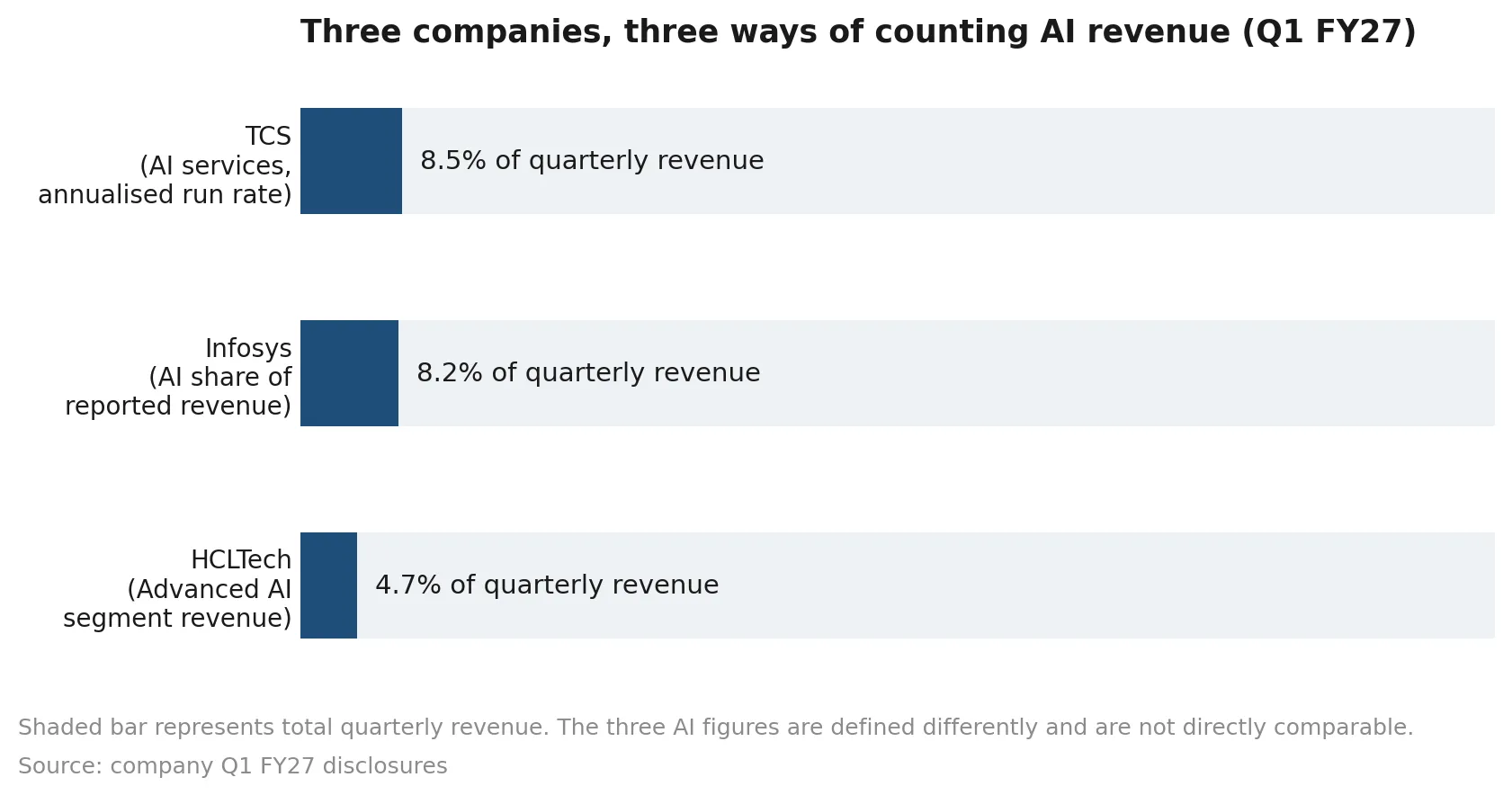
The three figures are constructed on different bases and cannot be compared directly. Source: company Q1 FY27 disclosures.
The numbers are real. The base underneath them is unstable.
Two problems sit behind these disclosures. The first is definitional: there is no shared standard for what counts as AI revenue, so a run rate, a revenue share and a segment total describe three different things. The second is duration. A large share of AI engagements run for one or two quarters, which means the revenue base has to be rebuilt each period.
This is the part that should concern investors. Application maintenance, the work AI is displacing fastest, ran for years and renewed itself with very little sales cost. That annuity is where the sector's margins came from. AI work so far behaves like project revenue, which carries a sales cost every time and offers no visibility beyond the current engagement.
Who else is now selling the work Indian IT used to sell?
The cloud platforms, and in some cases at no additional charge.
Amazon's AWS Transform runs agents that handle code discovery, dependency mapping, refactoring and test generation across .NET, mainframe and VMware estates. Amazon reports that customers have pushed more than 1.1 billion lines of code through the service and saved over 810,000 hours of manual effort. Amazon can give the core capability away because it monetises the destination, the cloud infrastructure the modernised workload eventually runs on. Microsoft and Google Cloud are building comparable agentic modernisation tools, which makes this a direction for the platform layer rather than one company's bet.
This is the same discovery, analysis and refactoring work Indian firms have billed by the hour for two decades. The majors have their own platforms, including TCS MasterCraft, Infosys Topaz and Wipro Intelligence, and these hold their value where domain knowledge, regulatory context and client-specific architecture decide the outcome. The structural difference is in monetisation: the hyperscalers charge for where the workload lands, while the integrators charge for the journey of getting it there.
The vendors are publishing the new price themselves.
Infosys told investors it moved three million lines of Hertz COBOL into a microservices environment using AI foundation models at 60% lower cost and on a 60% shorter timeline than a conventional migration. Disclosures like this are good marketing and they also set a reference price. Once a buyer knows a modernisation programme can be delivered for 60% less, that becomes the opening position in the next negotiation, with every vendor in the room.
Get research like this in your inbox
The week’s research that mattered, in five minutes. Joined by 2L+ investors.
Why has revenue growth stopped producing jobs?
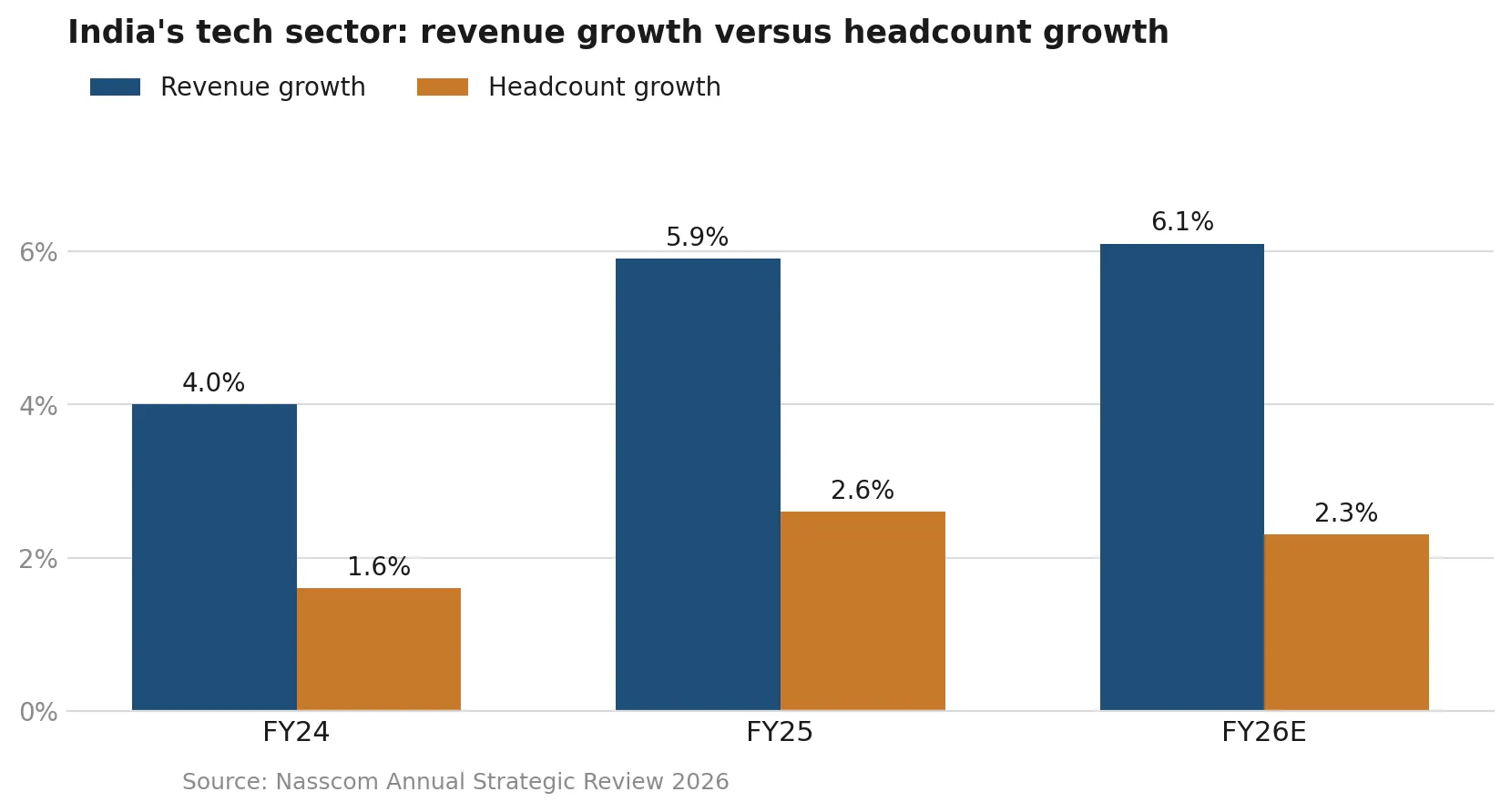
Source: Nasscom Annual Strategic Review 2026. FY26 figures are estimates.
Nasscom puts FY26 sector revenue growth at 6.1% and headcount growth at 2.3%, a net addition of about 135,000 people on a base approaching six million. Revenue growth of that size would once have required two to three times the intake.
Three companies, three different bets.
TCS added people in the June quarter, taking its workforce to around 594,000, and onboarded 14,000 campus graduates. Krithivasan has said he does not expect white-collar software employment to shrink, arguing that people move into supervising, training and testing models. Infosys was roughly flat once the 2,000 people it gained through acquisitions are stripped out, leaving headcount near 328,000, and it is holding to a target of 20,000 campus hires this year. HCLTech reduced its headcount by about 3,300 while its revenue per employee rose.
The entry level is carrying most of the adjustment.
Fresher hiring across Indian IT has fallen from a peak of roughly 600,000 in FY22 to about 120,000 in FY25, according to staffing analytics firm Xpheno. Deferred onboarding has become routine: candidates receive offer letters and then wait months, sometimes longer, for a joining date. Wipro trimmed its fresher guidance to 7,500 to 8,000 from an earlier 10,000, and Tech Mahindra has said it will hire fewer freshers while redeploying people freed up from completed projects.
The pyramid model, which meant hiring juniors in bulk and deploying them across projects, depended on a large volume of routine work being available to absorb them. That volume is exactly what AI removes first.
Visa policy compounds the pressure. H-1B approvals for the six largest Indian firms fell about 40% year on year in FY26, which raises the cost of placing engineers in front of US clients at the same moment automation is reducing how many are needed.
Where is the growth coming from instead?
Four places, and none of them resembles the old model.
Vendor consolidation and Europe
Clients cutting costs are dropping smaller suppliers and handing the work to a single large vendor. About a fifth of Infosys's large deal value in the quarter came from this. All three majors also won European deals: Infosys restructured its Mercedes-Benz hybrid cloud engagement around an AI-led model and added a Nokia network engineering partnership, TCS signed SKF, and HCLTech won an unnamed Fortune Global 50 client. This follows a deliberate move to reduce dependence on the US market.
Data centres and the domestic market
HCLTech is investing roughly Rs 3,500 crore in a planned 50 megawatt data centre in Odisha, funded through a mix of partner commitments, equity and debt. TCS announced its own data centre programme last year and has OpenAI as its first customer. In both cases the value being chased is the managed services layer wrapped around the capacity rather than the capacity itself. Domestically, TCS's India revenue grew 22.9% year on year and HCLTech's grew 16.9%, both from small bases, at a time when their North American businesses were close to flat.
Two shifts happening alongside
Global capability centres, the in-house India offices of multinationals, now number above 2,000 and employ around two million people. They compete with the services firms for the same work and the same engineers. Separately, mid-tier firms including Coforge, Persistent Systems and Mphasis have been growing faster than the majors for several quarters, helped by smaller bases, quicker deal ramp-ups and fewer legacy contracts to protect.
What should you watch over the next few quarters?
Margins
TCS and HCLTech both expect margins to recover as this quarter's wage hike and restructuring costs wash through. Whether they do will indicate how much of the current pressure is timing and how much is pricing.
Guidance
Infosys has already cut its full-year range. If the others follow, the deflation effect is sector-wide rather than company-specific.
The shape of AI revenue
Watch whether AI engagements start renewing and extending. Recurring AI revenue would replace part of the maintenance annuity. Project-shaped AI revenue leaves the gap open.
Deal cycles and campus hiring
Shorter decision cycles would signal that buyers have resolved their questions about cost and model choice. Campus intake is the clearest leading indicator of what these companies expect to need, and it usually says more about their internal forecasts than their published guidance does.
See what markets are pricing in
Live indices, sector moves and market breadth — the backdrop to every story we publish.
So where does this leave the sector?
The revenue base is intact, the order books are full, and the companies are still profitable at margins most global peers would accept. The open question is about price. A unit of work is worth less than it was two years ago, and it will be worth less again next year.
The defensible ground sits in the layers a cloud platform cannot easily supply: regulated industry context, governance of AI systems running in production, domain-specific agents, and workflows built on client data these firms already hold and understand. Building that position is slower work than losing the annuity it has to replace. FY27 will show how the two are tracking against each other.