

The full form of NAV in mutual fund terminology is Net Asset Value. NAV is a critical measure that indicates the per-unit value of the mutual fund, derived from the total value of the fund's assets minus its liabilities, divided by the number of outstanding units. Knowing the full form of NAV in mutual fund context is important for investors as it represents the price at which they can buy or sell fund units. The full form of NAV in mutual fund investments reflects the market value of each unit, updated daily to account for changes in the fund's portfolio.
Essentially, the NAV represents the total asset value per unit of the fund after subtracting the liabilities; it is the price at which investors buy and sell fund shares from the fund company. The calculation of NAV is straightforward: it involves dividing the total value of all the securities in a portfolio, minus any liabilities, by the number of fund shares outstanding at the end of each trading day.
Understanding what is NAV in mutual funds is crucial as it reflects the fund's performance and is a direct indicator of how well the mutual fund's assets are being managed, in relation to the market value of its investments. NAV fluctuates daily due to changes in the market value of the fund’s holdings and is published at the end of each trading day.
Investors who opt for Systematic Investment Plans (SIPs) should also grasp the importance of NAV in SIP transactions. Each SIP installment is used to purchase additional units of the fund at the current NAV, thus the number of units acquired each month varies depending on the NAV and the amount invested. This aspect is crucial because it impacts the cost averaging strategy and ultimately, the overall returns from the SIP.
For those looking to invest or currently investing in mutual funds, you may be wondering about What Does NAV Stand for in the Context of Mutual Funds? A thorough understanding of NAV helps in making informed decisions about when to enter or exit a fund, illustrating the performance of the investment over time relative to the market conditions.
Run the numbers on your next investment
Project returns on a lumpsum or SIP with our free calculators.
What Does NAV Mean in Mutual Funds?
So what does NAV stand for in the context of mutual funds? Understanding the Net Asset Value (NAV) is crucial for any investor involved with mutual funds. NAV, the full form in mutual fund terminology being "Net Asset Value," indicates the price at which units of the fund can be bought or sold. Essentially, the NAV represents the total asset value per unit of the fund after subtracting the liabilities; it is the price at which investors buy and sell fund shares from the fund company. The calculation of NAV is straightforward: it involves dividing the total value of all the securities in a portfolio, minus any liabilities, by the number of fund shares outstanding at the end of each trading day. Understanding what NAV stands for in the context of mutual funds is crucial, as it reflects the fund's performance and is a direct indicator of how well the mutual fund's assets are being managed in relation to the market value of its investments.
Here's a deeper look into what does NAV stand for in the context of mutual funds?
Definition and Calculation: NAV in mutual funds is calculated by dividing the total value of all the securities in the fund's portfolio, minus any liabilities, by the number of units outstanding. This calculation is typically done at the end of each trading day by the fund house.
Importance in SIPs: When considering NAV in SIP (Systematic Investment Plan), it's important to understand that each installment of a SIP buys fund units at the prevailing NAV. This purchasing method leverages the benefit of rupee cost averaging, where the fluctuating NAV can lead to buying more units when prices are low and fewer when prices are high, potentially lowering the average cost per unit over time.
Assessing a Good NAV: The question of what is a good NAV for a mutual fund often arises, but it's important to note that a higher or lower NAV doesn't inherently make a mutual fund better or worse for investment. Performance relative to the market and similar funds should be the focus, rather than the NAV itself.
NAV and Fund Performance: Investors sometimes misconstrue NAV as a scorecard of fund performance, but it should be viewed in context. NAV reflects current market values and the fund's liabilities, and while it provides a snapshot of fund value, the historical performance and future potential are more crucial for making investment decisions.
Timing and NAV: While some might try to time their investments based on NAV, such practices are less effective in mutual funds compared to direct stock investments. In mutual funds, a consistent investment approach, like SIPs, tends to yield better long-term results irrespective of the daily NAV fluctuations.
By fully grasping what does NAV stand for in the context of mutual funds? And how it affects investments like SIPs, investors can make more informed decisions, focusing less on the NAV itself and more on the overall performance and management of the fund.
How Is NAV Calculated?
The basic NAV calculation is:
NAV per unit = (investment value + other assets − liabilities) ÷ outstanding units.
Other assets can include cash, receivables and accrued income. Liabilities include accrued expenses and amounts payable. The valuation of investments follows the scheme's applicable valuation policies; it is not simply the sum originally paid for the securities.
For a hypothetical NAV calculation, assume investments worth ₹105 crore, cash and receivables of ₹5 crore, and liabilities of ₹2 crore. Net assets are ₹108 crore. With 6 crore outstanding units, net asset value is ₹18 per unit. This is an arithmetic illustration, not a live scheme valuation.

NAV in mutual funds also connects directly to your account. Ignoring transaction deductions for illustration, ₹9,000 invested at ₹18 buys 500 units. If their value later becomes ₹19.80 each, the holding is worth ₹9,900. The gain is 10%, assuming no distributions or other cash flows.
Accurate NAV calculation uses assets, liabilities and units for the same valuation date. For actual allotments, use the fund's official transaction confirmation rather than rounding a displayed figure yourself.
How a SIP changes the unit count
Suppose two hypothetical ₹5,000 instalments are invested at ₹20 and ₹25. They buy 250 and 200 units, respectively, before any deductions. Total investment is ₹10,000 and total units are 450, giving an average acquisition cost of about ₹22.22 per unit.
This demonstrates how NAV in mutual funds affects unit allocation. At ₹21, those 450 units would be worth ₹9,450. Regular investing spreads purchase dates but cannot guarantee profit or eliminate market risk. Wright's SIP guide explains the broader process.
Does a Lower NAV Mean a Cheaper or Better Fund?
No. Comparing NAV in mutual funds by the rupee amount alone confuses unit size with investment value. A lower figure gives you more units for the same money, but each unit represents a correspondingly smaller amount of net assets.
Consider two hypothetical investments of ₹10,000. Fund A starts at ₹10 and Fund B at ₹100. You receive 1,000 and 100 units. If both portfolios generate the same 10% return after expenses, their unit values become ₹11 and ₹110. Both investments finish at ₹11,000.
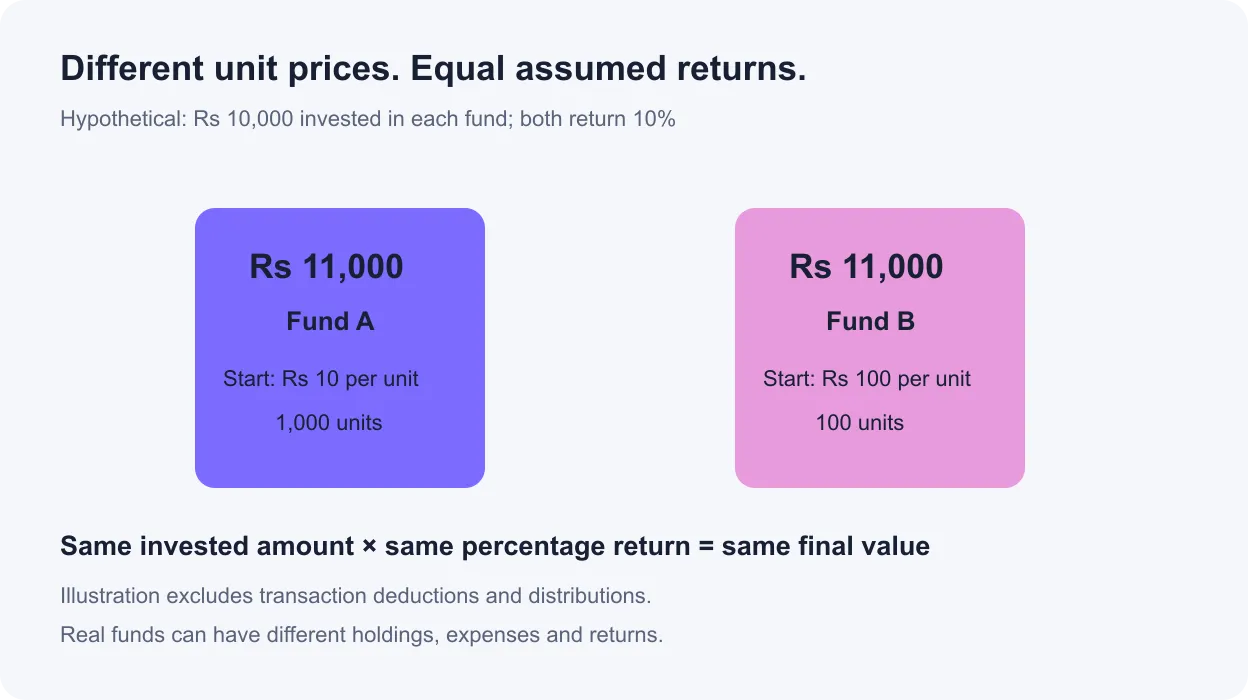
The NAV calculation has not favoured either investor. Equal percentage returns on equal invested amounts produce equal gains under these assumptions. Real funds will have different portfolios, risks and expenses, so the example explains the arithmetic rather than predicting matching performance.
A new fund offer at ₹10 is therefore not inherently cheaper than an established scheme. NAV in mutual funds is also different from a company's valuation multiple: a stock's price-to-earnings ratio compares price with earnings, whereas an isolated fund-unit price says nothing about whether its holdings are expensive.
Things You Need to Know About Mutual Fund NAV
Navigating through the intricacies of mutual fund NAV (Net Asset Value) can significantly enhance an investor's understanding and decision-making process when it comes to mutual fund investments. Here are some essential aspects you should know about NAV:
NAV Full Form in Mutual Fund: NAV stands for Net Asset Value. It represents the per-unit price of the mutual fund at the end of the trading day, based on the current market value of the fund's holdings minus its liabilities.
Calculation Frequency: NAV in mutual funds is calculated at the close of every trading day. This reflects any daily changes in the market value of the fund’s investments.
Impact on SIPs: Understanding NAV in SIP (Systematic Investment Plan) setups is vital. Each SIP payment purchases units at the prevailing NAV, so the timing of the investment can affect the number of units you get. However, over time, SIP helps in mitigating the impact of NAV fluctuations through rupee-cost averaging.
Misconceptions About High and Low NAV: Often, investors ponder what is a good NAV for a mutual fund, believing that a lower NAV is cheaper and thus better. However, the absolute value of NAV is irrelevant in assessing a fund's quality. The performance should instead be compared based on the percentage return over a period.
Relevance to Fund Performance: While NAV provides a measure of current value, it does not necessarily indicate the health or performance of the fund. Investors should look beyond NAV to factors like the fund's historical return, expense ratio, fund manager’s performance, and investment strategy.
Importance for Buying and Selling: NAV is crucial as it determines the buy and sell price of mutual fund units. When you invest, you buy at the NAV, and when you redeem, you sell at the NAV minus any applicable exit fees.
Understanding these key points about what is NAV in mutual fund, how it impacts investments like SIPs, and dispelling common myths can lead to more strategic investment choices. These insights equip investors with the knowledge to focus on the more critical elements that affect mutual fund performance, rather than merely the NAV itself.
NAV vs. Market Price: Differences and Significance
NAV in mutual funds is an accounting valuation, while an exchange price reflects the level at which buyers and sellers transact. Traditional open-ended mutual fund purchases generally use the applicable NAV determined by transaction rules. ETF units trade on exchanges and can change price throughout the session.
| Feature | Traditional open-ended fund | Exchange-traded fund |
|---|---|---|
| Investor transaction basis | Applicable scheme NAV, subject to transaction rules | Executable exchange price |
| Price observation | Published valuation for the relevant date | Quotes and trades during market hours |
| Difference from portfolio value | Transactions generally reference applicable NAV | Price can trade above or below NAV |
| Additional considerations | Cut-off, funds availability and exit load | Bid-ask spread, liquidity and brokerage |
The distinction matters because net asset value and an ETF's market price are related but need not be identical. A premium means the trading price is above NAV; a discount means it is below. Compare values from compatible times before interpreting a gap, especially when underlying markets are closed.
An intraday indicative value is an estimate, not necessarily the final published valuation or an executable quote. Learning NAV in mutual funds should therefore include identifying the product type before deciding which displayed number governs your purchase.
Understanding the differences between NAV (Net Asset Value) and market price is crucial for investors in mutual fund and other securities.Here’s a detailed comparison presented in a tabular format:
Aspect | NAV (Net Asset Value) | Market Price |
Definition | NAV is the per-share value of the mutual fund's assets minus its liabilities, calculated at the end of each trading day. | Market price is the current price at which a security, such as a stock or ETF, can be bought or sold in the market. |
Calculation | Calculated by dividing the total value of all the assets in the portfolio, minus liabilities, by the number of shares outstanding. | Determined by supply and demand dynamics in the stock market and can fluctuate considerably throughout the trading day. |
Usage | Used to determine the buy and sell price of mutual fund units. Buyers pay the NAV per unit, and sellers receive the NAV per unit, adjusted for any load or fees. | Used for buying and selling stocks and ETFs. The market price is what investors pay or receive on the open market. |
Fluctuation | Updated at the end of each trading day to reflect the changes in the value of the fund's holdings. | Fluctuates in real-time during trading hours based on buying and selling activity in the market. |
Significance in SIPs | In SIP (Systematic Investment Plan) , each installment buys mutual fund units at the prevailing NAV, allowing for rupee-cost averaging. | Not directly applicable to SIPs as they specifically relate to mutual funds, which use NAV, not market price. |
Impact on Investors | Directly affects mutual fund investors as it determines the exact amount of money they will need to pay or receive upon transactions. | Affects investors in stocks and ETFs as it reflects real-time valuation and investor sentiment in the market. |
Importance of NAV in Mutual Fund Investing
The Net Asset Value (NAV) plays a pivotal role in mutual fund investing, serving as a critical metric for both valuation and transaction purposes. Understanding the significance of NAV can help investors make more informed decisions regarding their mutual fund investments. Here are some key aspects of the importance of NAV in mutual fund investing:
Benchmark for Performance: NAV is essential as it provides a daily valuation of a mutual fund's assets minus its liabilities, offering a clear indicator of the fund's performance. Investors can track changes in the NAV over time to gauge the effectiveness of the fund manager's investment strategy.
Investment Decisions: When investing in mutual funds, the purchase and redemption of fund units are based on the fund’s NAV. Therefore, knowing the "NAV in mutual funds" allows investors to understand how much they are paying for units of a mutual fund or receiving when they sell.
Impact on SIPs: The concept of "NAV in SIP" is particularly important for systematic investors. Since each SIP installment buys units at the current NAV, understanding how NAV works helps investors appreciate the benefit of rupee-cost averaging, which can smooth out the purchasing price over time in volatile markets.
Transparency and Fairness: The "nav full form in mutual fund" (Net Asset Value) system ensures that all transactions in the fund's shares are done fairly, at a price that reflects the fund's current value per share. This transparency is crucial for investor confidence and fairness.
Evaluating Fund Health: While "what is a good nav for a mutual fund" doesn't necessarily relate to the fund's affordability, tracking the NAV trends can help investors evaluate the overall health and performance of the fund compared to its peers and the broader market.
NAV is not just a number—it is a fundamental component that reflects the intrinsic value of mutual fund investments and influences every buy and sell decision in the fund's lifecycle.
Read this article to get started with SIP Investment Guide: What is SIP, How to Start, Benefits, & Is It Worth It
Understanding NAV and AUM (Assets Under Management)
Understanding the relationship between Net Asset Value (NAV) and Assets Under Management (AUM) is crucial for any mutual fund investor. NAV, as previously defined, is the per unit value of the fund's assets minus liabilities, calculated daily. The NAV full form in mutual fund context, "Net Asset Value," provides a clear snapshot of what each unit of the fund is worth on any given day. On the other hand, AUM represents the total market value of all the assets managed by the mutual fund, indicating the scale or size of the fund.
The NAV is instrumental for practical investment decisions, as it dictates the buying and selling price of mutual fund units. When discussing "what is NAV in mutual fund," it's essential to understand that while NAV gives an idea of the unit cost, AUM provides insight into the fund’s overall performance and management effectiveness. Larger AUM can indicate trust and success, drawing more investors, although it's not always a marker of fund quality.
In the context of SIPs, or Systematic Investment Plans, the term "NAV in SIP" highlights how each investment installment is used to purchase fund units at the prevailing NAV. This impacts how many units an investor can purchase with each installment, which can vary with the NAV at each buying point. Hence, understanding the dynamics of NAV helps investors strategize their entries and exits from the fund, optimizing their investment according to market conditions.
Furthermore, when investors inquire, "what is a good NAV for a mutual fund," they are often trying to assess the fund's potential for growth. However, a high or low NAV in itself doesn’t necessarily indicate a good or bad investment; instead, changes in NAV should be viewed in conjunction with AUM growth over time. A fund with a growing AUM and stable or increasing NAV typically suggests effective management and healthy fund performance.
Both NAV and AUM are fundamental concepts when we talk about mutual funds, each serving different purposes. NAV provides the value at which shares are transacted, directly affecting investors’ costs and returns, while AUM offers a broader view of the fund’s scale, stability, and the confidence it commands in the marketplace. Understanding these metrics in relation to each other enhances an investor’s ability to make informed decisions, ensuring alignment with their financial goals and risk tolerance .
NAV vs AUM
When comparing NAV vs AUM, it's important to understand that NAV, or Net Asset Value, represents the per-unit price of a mutual fund, while AUM, or Assets Under Management, indicates the total market value of all the assets managed by the mutual fund. NAV vs AUM serves different purposes: NAV helps investors determine the price at which they can buy or sell fund units, whereas AUM reflects the overall size and scale of the fund. Analyzing NAV vs AUM can provide insights into the fund's performance and investor interest, with NAV showing daily fluctuations and AUM indicating long-term growth.
Get research like this in your inbox
The week’s research that mattered, in five minutes. Joined by 2L+ investors.
How Often Is NAV Updated?
NAV in mutual funds is generally calculated for each business day using the relevant valuation inputs and disclosed through the AMC and AMFI. Publication timing can vary with scheme category and underlying assets, particularly overseas holdings. Check the valuation date rather than assuming the newest screen update represents today's portfolio.
Daily NAV calculation and transaction eligibility are separate issues. Submitting an instruction is not the same as having money available to the fund. For most schemes other than liquid and overnight funds, purchase eligibility for the same day's NAV requires a valid application and funds available for utilisation before the applicable cut-off, generally 3 p.m.
For example, a valid request submitted at 2 p.m. with money available only after the cut-off does not qualify merely because the button was clicked early. An evening order is normally considered on a later eligible business day, but delayed fund availability can move eligibility further. Holidays also matter.
These rules apply to SIP purchases as well as lump sums. Liquid and overnight schemes have distinct provisions, and platforms may set earlier processing deadlines. Use current scheme documents and transaction confirmations to verify NAV in mutual funds for your particular allotment. Do not apply purchase-funding conditions mechanically to redemption instructions.
Factors That Influence a Fund's NAV
The principal drivers of NAV in mutual funds are movements in portfolio values, income earned and expenses accrued. Equity prices affect equity portfolios. Bond prices respond to interest rates, credit conditions and other factors. Foreign holdings can also change in rupee value when exchange rates move.
Expenses reduce the assets attributable to investors and are already reflected in the published net asset value. A direct plan and a regular plan can follow the same portfolio but have different expense structures. Comparing their absolute unit values is less informative than comparing consistent return periods and costs.
Distributions also matter. Under an income distribution cum capital withdrawal option, an amount paid out reduces scheme assets and correspondingly lowers the ex-distribution NAV, other things equal. A distribution is not free additional wealth. Assess the unit value together with cash received, rather than viewing the fall alone as an investment loss.
Inflows do not automatically increase NAV in mutual funds. A simplified NAV calculation shows why: ₹100 of net assets and 10 units imply ₹10 per unit. A ₹20 subscription at that value creates 2 units, leaving ₹120 divided by 12, still ₹10. Trading costs and portfolio adjustments associated with flows can have separate effects.
NAV in Systematic Investment Plans (SIPs)
The role of Net Asset Value (NAV) in Systematic Investment Plans (SIPs) is vital for understanding how these regular investments grow over time. NAV, or the price per mutual fund unit, directly influences the purchasing power of each SIP installment. When discussing "what is NAV in mutual fund ," it's essential to recognize that in the context of SIPs, the NAV determines how many units an investor can buy with their fixed SIP installment.
Since the NAV fluctuates daily based on market conditions, each SIP payment buys units at different NAVs. This variability in "NAV in SIP" plays a crucial role in the cost averaging strategy, where the risk of market timing is minimized as investments are spread over various market phases. Thus, the changing NAV allows investors to purchase more units when prices are low and fewer when prices are high, which can lead to potentially higher returns over the investment period without the need for active market monitoring. This makes understanding NAV crucial for anyone engaged in SIPs, providing a clear perspective on how their contributions are being utilized and the value they are accumulating.
Read this article on SIP vs STP: Understanding Key Differences and Strategies
Which NAV Value Is Considered When Making a Mutual Fund Purchase in the Evening?
When you make a mutual fund purchase in the evening, the NAV that is considered for buying the units is not the NAV of the day you place the order, but rather the NAV of the next trading day. Mutual funds in India process buy and sell orders based on the NAV of the day the funds are actually received by the fund house, provided the order is placed within the cutoff time.
For most equity and debt mutual funds, the cutoff time is typically 3 PM. This means that if you place your order and the money reaches the mutual fund house before 3 PM on a trading day, the NAV of that day is applied. If the order and funds are received after 3 PM, the NAV applied will be of the next trading day.
This rule ensures that all investors are treated fairly, with the NAV applied only after the fund has received the money, reflecting the actual market conditions at the time the investment is made.
What is TREPS in Mutual Funds? And connection to Mutual Fund NAV
TREPS (Tri-party Repo) is a short-term borrowing mechanism where mutual funds invest surplus cash overnight to earn returns. It is highly secure and liquid, as transactions are collateralized by government securities. TREPS is often used by liquid funds, overnight funds, and debt funds to park idle cash for a short duration, ensuring returns while maintaining liquidity.
The NAV of a mutual fund represents the value of a fund's assets minus its liabilities per unit. Here's how TREPS connects:
Daily NAV Calculation:TREPS investments generate overnight interest, contributing to the fund's daily returns. For funds heavily invested in TREPS, even small changes in returns from TREPS can slightly impact the NAV.
Liquidity Management:Mutual funds, especially liquid and overnight funds, use TREPS to ensure cash availability for redemptions while earning a nominal return. This ensures the NAV stays stable and predictable, critical for short-term investors.
Risk-Free Returns:TREPS provides risk-free returns, as they are backed by government securities. This minimizes risk in NAV fluctuations for funds relying on overnight instruments.
NAV Volatility and Risk Management
NAV (Net Asset Value) volatility is a crucial factor in mutual fund investing, directly impacting the risk and return profile of an investment. Volatility in NAV arises primarily from fluctuations in the market values of the securities held by the mutual fund. As these asset values increase or decrease based on market conditions, the NAV of the fund correspondingly adjusts, reflecting the current value of a unit of the fund.
Effective risk management strategies are essential to mitigate the effects of NAV volatility. Fund managers often diversify the fund’s portfolio across various asset classes, sectors, and geographies to spread out risk. Diversification helps ensure that a decline in one sector or market does not disproportionately affect the overall fund performance, thereby stabilizing the NAV.
Moreover, for individual investors, understanding the implications of NAV volatility can aid in better portfolio management. By assessing their risk tolerance and investment horizon, investors can choose funds whose NAV volatility aligns with their financial goals and risk appetite. For example, equity funds typically exhibit higher NAV volatility compared to debt funds, reflecting the generally more volatile nature of stock markets compared to bond markets.
Investors can also use systematic investment plans (SIPs) as a tool to manage NAV volatility. By investing a fixed amount regularly, investors benefit from rupee-cost averaging, which can reduce the risk of investing a large amount at an inopportune time when NAV might be high. Over time, this strategy can help in reducing the average cost per unit of investment, despite fluctuations in the NAV.
Overall, while NAV volatility is an inherent aspect of mutual fund investing, through strategic planning, portfolio diversification, and regular investing, both fund managers and investors can effectively manage risks associated with NAV fluctuations. This careful approach ensures that the investments are better positioned to achieve growth over the long term while managing the bumps along the way.
Common Myths About NAV
“More units mean a better investment.” Your wealth depends on units multiplied by their value, with distributions and costs accounted for. Buying twice as many units at half the price does not create an immediate gain.
“Rising AUM proves superior management.” Assets can grow because investors contribute more money. That is not the same as earning a strong return. NAV in mutual funds and AUM answer different questions, and neither alone establishes a manager's skill.
“A falling figure always means poor performance.” Check distributions, valuation dates and the exact plan before drawing a conclusion. Net asset value movements need context. For a growth option without cash distributions, a decline does reflect a lower unit valuation, but its cause still requires investigation.
“The latest published figure is guaranteed for my order.” Applicable-NAV rules determine allotment; the number displayed when you submit may belong to an earlier valuation date. NAV calculation determines the unit valuation, not whether your transaction qualifies for that date.
Why NAV Alone Shouldn't Drive Your Investment Decision
Use NAV in mutual funds to understand transactions and track a holding, then assess the investment behind the number. Start with your time horizon, required liquidity and ability to tolerate losses. Compare funds within an appropriate category and against a relevant benchmark over consistent periods.
Read the scheme's objective, portfolio disclosures, Riskometer, expense information and exit-load conditions. Equity concentration, debt credit quality and interest-rate sensitivity can reveal risks that a unit price cannot. Past returns should be considered with drawdowns and consistency, not treated as a promise.
For a simple growth investment without intermediate cash flows, percentage return is ending value divided by starting value, minus one. For multiple dated purchases or withdrawals, a money-weighted calculation such as XIRR better reflects your own cash-flow experience. Distributions require inclusion in the return analysis.
This is where understanding NAV in mutual funds becomes practical: reconcile units and transaction dates, check that expenses are not deducted twice from reported returns, and distinguish scheme performance from your personal investment outcome. Review your allocation when goals change, rather than reacting to every daily movement.
See what markets are pricing in
Live indices, sector moves and market breadth — the backdrop to every story we publish.
Frequently Asked Questions
How does NAV affect my investment returns?
NAV affects your investment returns as it determines the price at which you buy and sell mutual fund units. A higher NAV at the time of selling than at buying results in a profit, whereas a lower NAV leads to a loss.
Is NAV the same for all mutual funds?
No, NAV is not the same for all mutual funds. Each fund has its own NAV that reflects the current market value of the fund's holdings divided by the number of outstanding shares.
How often is NAV updated for mutual funds in India?
NAV is typically updated at the end of each trading day after the market closes. The precise timing can vary, but it generally reflects the value of the fund's assets at the close of the market.
Can NAV change throughout the day?
No, NAV does not change throughout the day. It is calculated once at the end of the trading day based on the closing prices of the securities that the fund holds.
What factors contribute to NAV fluctuations?
NAV fluctuations are influenced by changes in the market value of the fund’s investments, investor inflows and outflows from the fund, and fund expenses. Market performance, economic indicators, and changes in interest rates can all impact the NAV.
How often should I monitor NAV?
The frequency of monitoring NAV should align with your investment strategy and horizon. For long-term investments, occasional monitoring (e.g., monthly or quarterly) is typically sufficient. More frequent monitoring might be necessary for tactical adjustments in a more active investment approach.
What Does NAV Stand for in the Context of Mutual Funds
In the context of mutual funds, NAV stands for Net Asset Value. NAV is a crucial metric used to determine the per-unit value of a mutual fund, calculated by subtracting the fund's liabilities from its total assets and dividing the result by the number of outstanding units. Understanding what does NAV stand for in the context of mutual funds is essential for investors, as it helps them gauge the current market value of their investments. NAV is typically calculated at the end of each trading day, providing a snapshot of the fund's value and performance.
8. What is the NAV full form?
The expansion is net asset value. In mutual fund statements, NAV normally refers to the value per unit after deducting scheme liabilities from assets and dividing by the outstanding units.
9. How is NAV calculated in mutual funds?
NAV calculation adds the value of investments and other assets, subtracts liabilities and divides the result by units outstanding. Use consistent valuation dates and the correct scheme, plan and option.
10. Does a lower NAV mean a cheaper or better mutual fund?
No. It buys more units for the same amount but does not create a return advantage. Compare investment strategy, risk, expenses and percentage performance instead of absolute unit prices.
11. What is the difference between NAV and net asset value?
They refer to the same term: NAV is the abbreviation. In mutual fund usage, the quoted figure is normally expressed per unit, while total net assets describe the entire scheme or plan.
Read these articles to understand all about mutual funds, SIPs and how you can invest in mutual funds with Wright Research:
The Crucial Role of Risk Profiling in Mutual Fund Investments
How many funds should you have in your Mutual Fund Portfolio?
What is Standard Deviation in Mutual Fund and How Does it Help in Portfolio Management?
- Smallcase vs Mutual Fund: Understand Difference and Similarities
- SIP Investment Guide: What is SIP, How to Start, Benefits, & Is It Worth It
- Which One is the Better Option: Liquid Funds or Arbitrage Mutual Funds Instead of Fixed Deposits?
- Understanding Mutual Fund Risks: A Comprehensive Guide for Investors in India
- How To Invest In Mutual Funds in India?
- SIP Investment Guide: What is SIP, How to Start, Benefits, & Is It Worth It
- What is SIP in Mutual Funds? An Experts Guide
- Navigating the Challenge: How to Deal with Loss-Making SIPs
Maximizing Portfolio Potential: The Role of an Investment Advisor
- SIP vs STP: Understanding Key Differences and Strategies
- Comprehensive Guide on Starting & Stopping SIPs: What are Perpetual SIPs in India?
- SIP vs. Lumpsum Investment Strategies: Comprehensive Guide for Best Returns