


Running out of money late in life is not only a question of starting wealth. It is the interaction of lifespan, spending, inflation, taxes, healthcare, portfolio returns and the timing of market losses. High-net-worth families have more assets, but they often support several homes, dependants, philanthropy and large legacy goals.
Effective retirement corpus planning treats retirement as a multi-decade cash-flow problem. The objective is to keep essential spending resilient while preserving enough growth to defend purchasing power and enough flexibility to respond when reality differs from the plan.
A durable plan connects lifestyle spending, family commitments, risk and dependable income.
What Does It Mean to Outlive Your Retirement Corpus?
A retirement corpus is the pool of financial assets intended to support spending after earned income declines. Outliving it means liquid investments are exhausted before the retiree’s lifetime needs end. A household can also face a practical shortfall when assets remain but are illiquid, concentrated or reserved for other purposes.
The warning signs usually appear earlier: withdrawals rise faster than expected, recurring income covers less of essential spending, or portfolio sales become necessary during weak markets. outliving retirement savings is therefore a process, not a single date on which an account reaches zero.
For an HNI, the balance sheet may include business interests, property, private investments and trusts. These can increase net worth without providing reliable monthly cash flow. Planning should separate spendable assets from operating businesses, personal-use property, pledged assets and intended bequests.
See what markets are pricing in
Live indices, sector moves and market breadth — the backdrop to every story we publish.
Why Longevity Risk Is Increasing for HNIs
India’s SRS Abridged Life Tables 2019–23 estimate remaining life expectancy at age 60 at 18.4 years overall, 17.3 for men and 19.6 for women. These are population averages, not expiry dates. A plan must allow for the possibility that one spouse lives well beyond the average.
The official life tables also show meaningful differences by sex, residence and state. Better healthcare access and personal health can make population averages a weak ceiling for affluent households. A couple’s planning horizon should reflect the longer-lived spouse and include a margin for uncertainty.
A robust longevity risk retirement analysis may test age 90, 95 or later rather than using life expectancy alone. The aim is not to predict death. It is to understand what spending and asset decisions remain viable across longer horizons.
Longer retirements also increase exposure to inflation, medical events, family support and cognitive decline. Decision-making protocols, powers of attorney, nominations and consolidated records become part of financial resilience, not merely estate administration.
How Retirement Corpus Can Run Out
The most direct cause is a spending level that the investable portfolio cannot support. The gap may be hidden initially by strong markets or irregular income. Once withdrawals exceed sustainable portfolio earnings for long enough, the base shrinks and future withdrawals consume a larger percentage.
Inflation compounds the pressure. At 5% inflation, an annual lifestyle costing ₹40 lakh today would cost about ₹65 lakh after ten years and roughly ₹1.06 crore after twenty years. Healthcare and care-related costs may follow a different path from general household inflation.
Concentration is another risk. A family may depend on one company, one property market or one promoter-linked asset for both wealth and income. A business setback can then reduce portfolio value and cash flow together. Diversification should consider economic exposure, not just the number of holdings.
Taxes, investment costs, gifts, second homes and large one-time commitments can widen the gap. Good retirement corpus planning maintains separate budgets for core lifestyle, discretionary spending, known capital expenses and legacy transfers so that each promise has visible funding.
Sequence of Returns, Inflation and Spending Risk
Average return does not describe the retiree’s experience. When money is being withdrawn, losses early in retirement force more units to be sold at depressed prices. Less capital remains to participate in the recovery. This is sequence of returns risk.
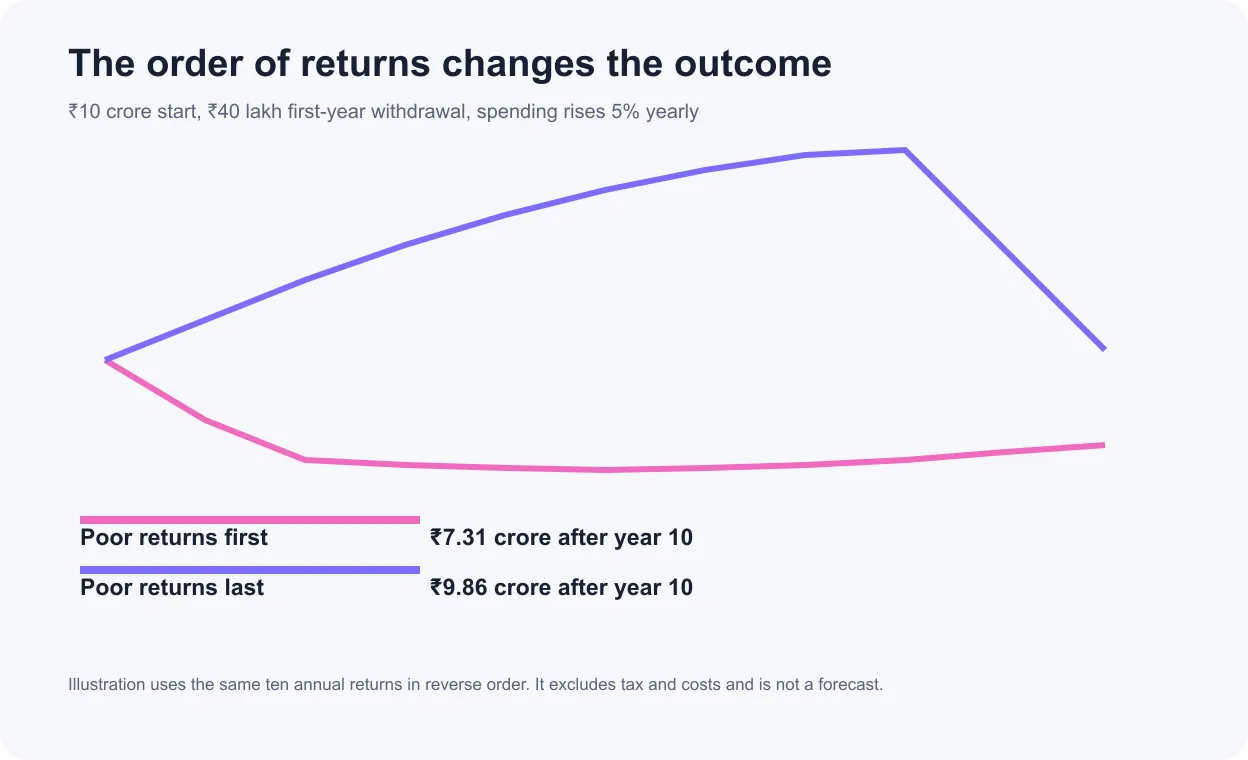
In the illustration, both ₹10 crore portfolios experience the same ten returns and the same inflation-linked withdrawals. Poor returns at the start leave about ₹7.31 crore after year ten, compared with ₹9.86 crore when those losses arrive last. The result is illustrative, but the mechanism is real.
Spending risk can amplify the effect. If lifestyle costs are treated as fixed while markets fall, the withdrawal percentage rises precisely when the portfolio is least able to absorb it. A flexible spending rule can reduce this pressure without making essential expenses unpredictable.
How Much Corpus Do You Actually Need?
Begin with annual cash flow, not a round-number target. Estimate essential living costs, discretionary lifestyle, insurance premiums, healthcare, dependants, taxes and periodic capital expenses. Subtract reliable post-retirement income such as rent, pension or annuity payments after allowing for vacancies, escalation limits and tax.
Next, select a planning horizon and return assumptions. Use nominal returns with nominal cash flows or real returns with today’s purchasing power. Mixing the two produces a false answer. Stress-test lower returns, higher inflation and a longer life rather than relying on one base case.
| First-year withdrawal | Initial rate | Approximate duration | Interpretation |
|---|---|---|---|
| ₹30 lakh | 3% | 56 years | More longevity room, before tax and costs |
| ₹40 lakh | 4% | 36 years | Less margin for adverse outcomes |
| ₹50 lakh | 5% | 26 years | Higher depletion risk |
This table assumes steady returns and inflation-adjusted withdrawals. Markets do not arrive smoothly, so it does not establish a safe withdrawal rate India rule. Tax, fees, lumpy expenses and asset allocation can shorten the duration.
Use scenario ranges instead of one answer. A useful retirement corpus planning model shows which assumptions cause failure, how early the warning appears and what corrective action would restore resilience.
Get research like this in your inbox
The week’s research that mattered, in five minutes. Joined by 2L+ investors.
Withdrawal Strategies for Different Market Conditions
A fixed inflation-linked withdrawal is simple but can become demanding after poor returns. A percentage-of-portfolio rule avoids complete mathematical depletion but makes annual income volatile. Guardrail approaches allow inflation increases in normal conditions and reduce discretionary withdrawals when the portfolio crosses preset limits.
The right method depends on the spending floor. Essential expenses should not depend on selling equity after a crash. Discretionary travel, gifts or luxury upgrades can absorb more variation. Separating these layers makes a flexible rule practical.
Any safe withdrawal rate India estimate should be personalised for taxes, domestic inflation, asset mix and retirement length. Rules derived from another country or historical period are useful research inputs, not automatic prescriptions for an Indian household.
Annuities can transfer some longevity risk to an insurer and create lifetime income. Product choice affects payout, spouse protection, liquidity and legacy. PFRDA lists variants including life annuities, joint-life options and return-of-purchase-price structures. Quotes and terms should be compared at the time of purchase.
Bucket Strategy and Asset Allocation After Retirement
A retirement bucket strategy divides assets by when they may be needed. A liquidity bucket funds near-term withdrawals. A stability bucket holds high-quality assets for the following years. A growth bucket targets longer-horizon inflation protection.
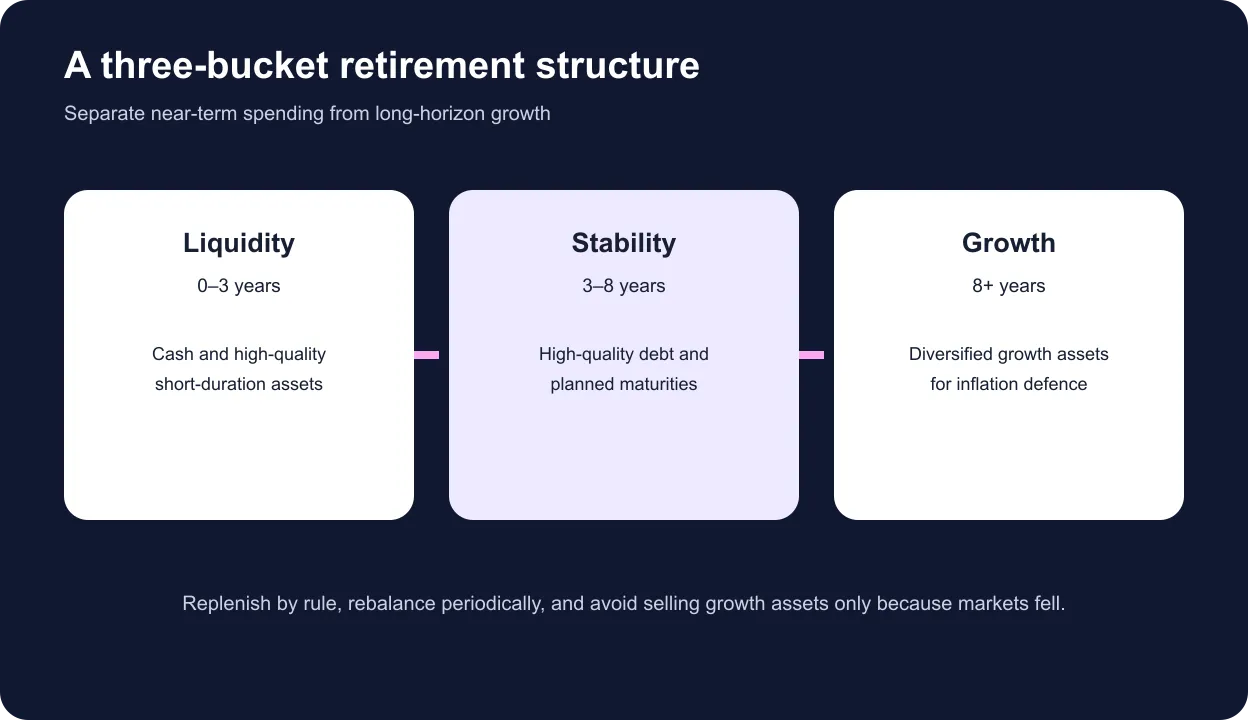
Buckets are an implementation method, not extra diversification by themselves. The total portfolio still needs an intentional asset allocation. Cash reduces short-term selling risk but too much cash can weaken long-term purchasing power. Growth assets add volatility but may be necessary for a retirement lasting several decades.
Rebalancing rules should specify when gains move from growth to stability and when near-term cash is replenished. This helps address sequence of returns risk without trying to forecast the next market cycle.
HNIs should also map currency, geography, credit, liquidity and manager concentration. A consolidated view across family members, entities and custodians prevents hidden duplication and makes the retirement bucket strategy operational.
Contingency Planning for Healthcare and Dependants
Healthcare deserves its own reserve because the timing and scale are uncertain. Review insurance limits, exclusions, waiting periods, co-payments and claims procedures. Set aside liquid capital for expenses that insurance may not cover, including home modifications, rehabilitation and long-term assistance.
Support for parents, adult children or other dependants should be quantified rather than left as an unlimited promise. Define the amount, duration and conditions, then decide whether it belongs in retirement spending, a separate trust or an estate plan.
Maintain an emergency file containing accounts, insurance, nominations, liabilities, advisers and access instructions. Estate documents should align with ownership and beneficiary records. These controls reduce the risk that wealth becomes inaccessible during incapacity.
For longevity risk retirement planning, consider the surviving spouse’s cash flow after one pension, rental stream or annuity stops. Test whether the portfolio remains manageable if the more financially experienced partner dies first.
When to Rebuild or Delay Withdrawals
Review the plan at least annually and after major events. Useful triggers include a sustained rise in the withdrawal rate, a large market drawdown, a change in health, loss of recurring income, a business sale, a major gift or a change in family responsibility.
Corrective action is most effective early. Options include pausing inflation increases, reducing discretionary spending, postponing gifts, extending work, monetising an underused asset, changing portfolio risk carefully or purchasing suitable lifetime income. The choice should reflect taxes and liquidity rather than chasing a higher return target.
If a drawdown occurs early, temporarily funding expenses from the liquidity bucket can avoid forced equity sales. That does not mean ignoring the allocation. A written refill and rebalancing rule is required so that cash does not quietly run down.
Families already close to outliving retirement savings need a cash-flow triage: protect housing, healthcare and core living expenses first; list dependable income; rank assets by liquidity and tax cost; and suspend unfunded discretionary commitments.
Effective retirement corpus planning is a decision system. It connects spending limits, portfolio ranges, insurance, income sources and estate choices. The plan should state who acts, what data they review and which thresholds trigger change.
The question behind safe withdrawal rate India research is not whether one percentage works forever. It is whether the household can adapt withdrawals while preserving dignity and essential spending across plausible market and lifespan outcomes.
Professional review can help HNI families coordinate these moving parts. Explore Wright Research’s investment advisory services when building a documented plan for outliving retirement savings and long-horizon family goals.
Is your portfolio built for what’s coming?
Get a free AI-powered review of your holdings — risk, overlap and quality in minutes.
FAQ
What happens if I outlive my retirement corpus?
Essential spending must then rely on guaranteed or recurring income, family support, asset sales, reduced expenditure or continued work. Early review can preserve more options. Start by protecting housing, food, healthcare and insurance. List all dependable income and assets that can be sold without disrupting daily life. Pause discretionary gifts and large purchases while a regulated adviser or financial planner helps rebuild the cash-flow plan. Avoid emergency sales of complex or illiquid assets where possible. Review pension rights, annuity contracts, insurance benefits and the suitability of property monetisation before relying on family support. Any restructuring should consider tax, ownership and estate consequences.
How much retirement corpus is enough?
There is no universal multiple. Required capital depends on spending, retirement age, planning horizon, inflation, taxes, portfolio return, healthcare, dependants, bequests and reliable income. Retirement corpus planning should model essential and discretionary expenses separately, subtract dependable income, and test several lifespan and market scenarios. A target is useful only when its assumptions are visible and reviewed after major changes.
How can HNIs protect against longevity risk?
Use conservative life-span assumptions, diversify return sources, hold liquidity, insure major risks, consider suitable lifetime income and adopt flexible withdrawals. A longevity risk retirement review should also test the surviving spouse’s income, future care costs, illiquid holdings and family commitments. Written decision rules help the family respond before a shortfall becomes urgent.
What is sequence of returns risk?
It is the risk that weak returns early in retirement, combined with withdrawals, permanently reduce the capital available to benefit from a later recovery. Sequence of returns risk matters because selling assets after a fall locks in losses and leaves fewer units invested. Liquidity reserves, sensible rebalancing and temporary reductions in discretionary spending can limit forced selling.
What withdrawal rate is sustainable in retirement?
No rate is universally safe. A starting rate must be tested against horizon, asset mix, inflation, taxes, fees and adverse return sequences, then reviewed regularly. A retiree with dependable pension or rental income may draw differently from someone relying entirely on investments. The practical rate is a range linked to guardrails, not a promise that spending can rise every year regardless of markets. Test the rate after tax and investment costs. Include irregular expenses instead of hiding them outside the model. Review actual spending and portfolio value annually, but avoid changing a long-term plan only because of one ordinary month of market volatility.
How should retirees structure income after retirement?
Match essential costs with dependable income where possible, maintain near-term liquidity, use high-quality assets for medium-term needs and retain diversified growth assets for long horizons. A retirement bucket strategy can organise these roles, but the total allocation still determines risk. Define how each bucket is replenished and review taxes, credit quality, liquidity and inflation exposure across the whole household portfolio.