


An exchange-traded fund may look like a share in a demat account, but its tax treatment follows the assets inside the fund. A Nifty 50 ETF, gold ETF and debt ETF can therefore produce three different tax outcomes from transactions that appear identical on a broker statement.
This guide explains etf taxation india rules for resident individual investors under the law applicable in 2026. Tax depends on classification, acquisition date, sale date, holding period and Securities Transaction Tax conditions. Surcharge and 4% health and education cess can increase the final liability.
Classify the ETF before calculating the gain or applying a tax rate.
ETF Taxation in India: What Investors Need to Know
Capital gain is broadly the sale consideration minus acquisition cost and eligible transfer expenses. Brokerage records are a useful starting point, but the investor must classify each ETF correctly and aggregate transactions for the financial year.
The current ETF tax in India framework distinguishes equity-oriented funds, specified debt mutual funds and other mutual funds. The post-23 July 2024 capital-gains changes set a 20% short-term rate for qualifying equity-oriented fund gains under Section 111A and a 12.5% long-term rate under Section 112A above the annual threshold.
Non-equity products do not automatically share one treatment. Gold, silver and international ETFs can fall under the “other mutual funds” route, while debt-heavy products may be covered by Section 50AA. This is why a generic ETF capital gains tax calculator can be misleading without the scheme classification.
Run the numbers on your next investment
Project returns on a lumpsum or SIP with our free calculators.
How ETF Taxation Depends on the Underlying Asset
Begin with the scheme portfolio and legal category, not the ETF label. An equity-oriented fund generally needs the statutory domestic-equity exposure. An overseas equity ETF does not become an equity-oriented fund merely because it holds shares abroad.
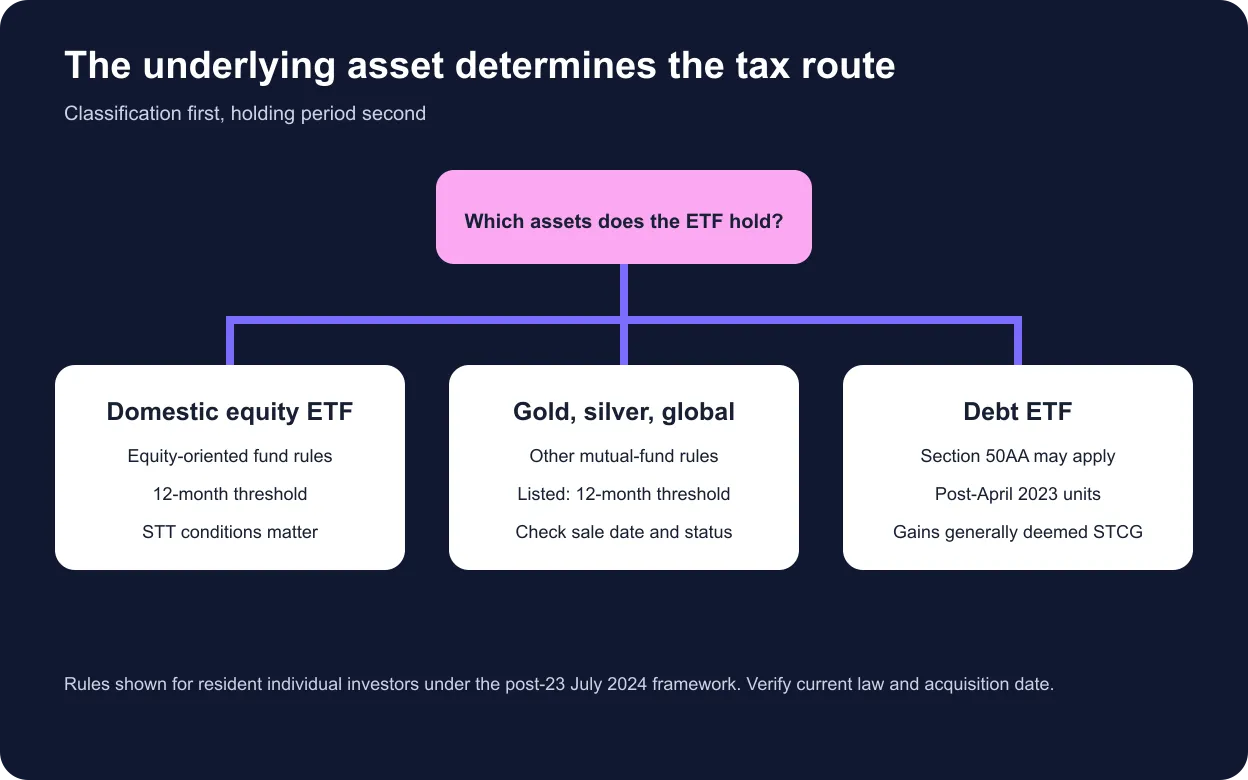
The amended Section 50AA definition, effective from FY 2025-26, focuses on mutual funds investing more than 65% of proceeds in debt and money-market instruments and funds investing at least 65% in those funds. The revised etf taxation india regime generally removes gold, commodity and overseas funds from that specified-fund definition.
Check the scheme’s tax disclosure for the relevant financial year because portfolios and law can change. Do not infer classification from a broker category alone.
Equity ETF Taxation
For a qualifying domestic equity-oriented ETF, units held for not more than 12 months are short-term. When the transfer occurs on or after 23 July 2024 and the Section 111A conditions are met, the short-term gain is taxed at 20%, plus applicable surcharge and cess.
Units held for more than 12 months are long-term. Under Section 112A, the aggregate long-term gains from qualifying equity shares, equity-oriented fund units and business-trust units receive a ₹1.25 lakh annual threshold. The excess is generally taxed at 12.5%, plus applicable surcharge and cess.
This equity ETF taxation treatment is attached to qualifying equity-oriented funds and STT conditions. The ₹1.25 lakh amount is an aggregate yearly threshold, not a separate allowance for each ETF or each sale.
Losses follow capital-loss rules. A short-term capital loss can generally be set off against short-term or long-term capital gains, while a long-term capital loss can generally be set off only against long-term gains. Timely return filing is important for carrying eligible losses forward.
Gold and Silver ETF Taxation
From FY 2025-26, listed gold and silver ETFs generally sit outside the narrowed specified-mutual-fund definition. If held for more than 12 months, they are generally treated as long-term listed units and the gain is taxed at 12.5% without indexation. A shorter holding normally produces gain taxed at the investor’s applicable slab rate.
The current gold ETF tax treatment differs from the rule applied to many units acquired on or after 1 April 2023 and sold before the revised definition took effect. Investors with transactions spanning rule changes should check acquisition and sale dates rather than applying the latest table retrospectively.
The same principle generally applies to silver ETF tax : more than 12 months for long-term classification when listed, 12.5% tax on long-term gains without indexation, and slab-rate taxation for short-term gains. Product documents should confirm the scheme’s status.
Neither commodity price movement nor the exchange listing converts these funds into domestic equity-oriented funds. Their long-term gains do not use the Section 112A ₹1.25 lakh threshold.
Debt ETF Taxation
Section 50AA is central to debt ETF taxation. For units of a qualifying specified mutual fund acquired on or after 1 April 2023, the gain is generally deemed short-term regardless of how long the units are held. The gain is then taxed at the investor’s applicable slab rate.
This treatment can cover debt and money-market ETFs whose portfolio crosses the statutory threshold. Holding such units for several years does not by itself create long-term status. The acquisition-date condition matters, so older holdings require separate examination under the transitional rules.
A bond ETF and a target-maturity ETF should not be assumed to receive the 12.5% listed-asset treatment merely because their units trade on an exchange. For accurate ETF tax in India reporting, review the scheme’s asset mix, tax note and purchase date.
Get research like this in your inbox
The week’s research that mattered, in five minutes. Joined by 2L+ investors.
STCG vs LTCG: Holding Period Rules
| ETF category | Long-term threshold | Short-term rate | Long-term rate |
|---|---|---|---|
| Qualifying domestic equity ETF | More than 12 months | 20% under Section 111A | 12.5% above aggregate ₹1.25 lakh under Section 112A |
| Listed gold, silver or international ETF | More than 12 months | Applicable slab rate | 12.5% without indexation |
| Qualifying specified debt ETF acquired on or after 1 April 2023 | Deemed short-term | Applicable slab rate | Not available under Section 50AA |
The ETF holding period is counted using tax rules from acquisition to transfer. “More than 12 months” is different from “12 months or more”, so the exact dates can change classification.
The table summarises common cases, not every investor situation. Non-residents, business-income treatment, inherited units, corporate actions and units bought before transition dates can require a different analysis. The relevant ETF capital gains tax rate also attracts surcharge and cess where applicable.
ETF Taxation Example
Assume a resident individual bought a qualifying equity ETF for ₹5,00,000 and sold it after more than 12 months for ₹6,40,000 after eligible transfer costs. The long-term gain is ₹1,40,000.
If the investor has no other Section 112A long-term gain in the year and the full ₹1.25 lakh threshold is available, ₹15,000 remains taxable. At 12.5%, the base tax is ₹1,875. Health and education cess at 4% would add ₹75, producing ₹1,950 before any applicable surcharge or other adjustment.
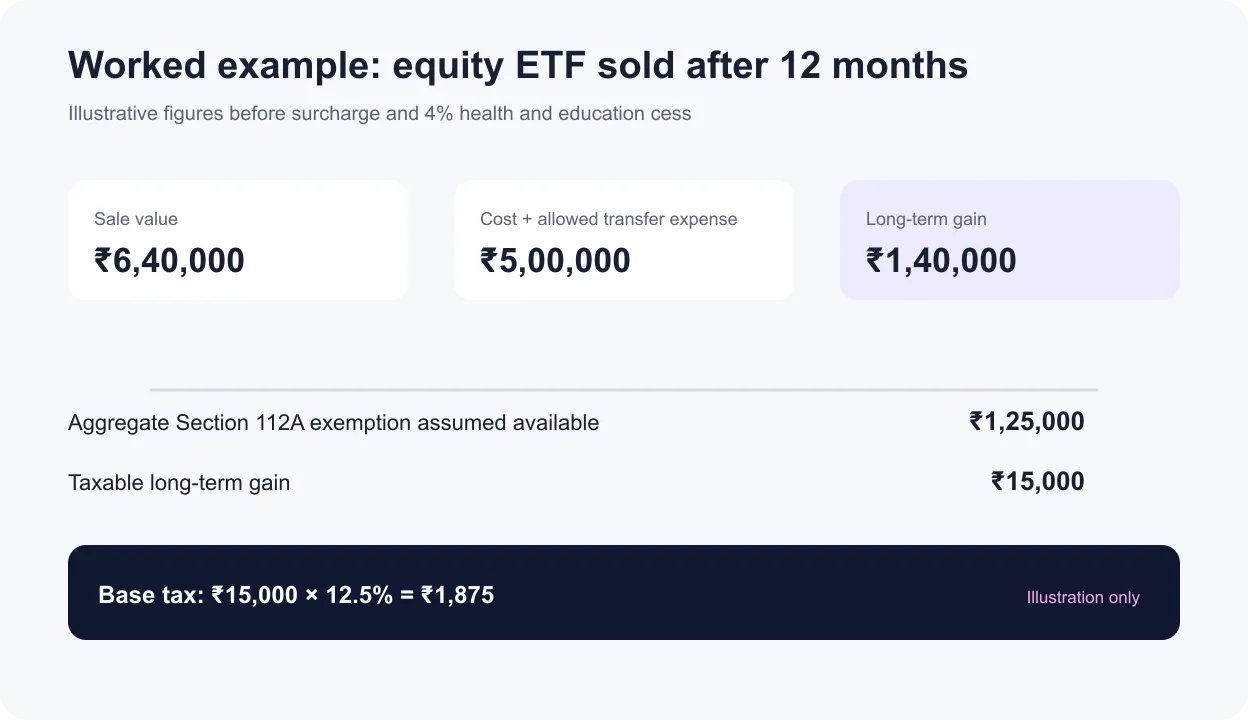
If the same qualifying equity ETF were sold within 12 months, a ₹1,40,000 short-term gain would generally face 20% base tax under Section 111A, subject to the stated conditions. The example shows why etf taxation india cannot be calculated from profit alone.
Other Costs: STT, Brokerage and Transaction Charges
Tax is only one part of the realised return. An ETF trade can include brokerage, exchange transaction charges, GST, SEBI turnover fees, stamp duty and demat-related charges. The contract note shows the amounts actually collected.
STT treatment depends on the security and transaction. Equity-oriented ETF sales on a recognised exchange generally attract STT, and the payment condition is relevant to Sections 111A and 112A. Do not assume that every non-equity ETF has the same STT treatment.
Expense ratio and tracking difference reduce investment performance inside the scheme, although they do not appear as a separate capital-gains deduction on the contract note. Bid-ask spread can also raise the effective trading cost, especially in a thinly traded ETF.
For dependable ETF capital gains tax records, retain broker contract notes, the capital-gains statement, scheme tax disclosures and evidence of acquisition cost. Reconcile corporate actions and transferred holdings before filing.
Common ETF Tax Mistakes
The first mistake is treating every ETF as an equity ETF. Domestic equity exposure, not the trading format, determines equity ETF taxation. Gold, overseas equity and debt products can follow other provisions.
The second is using one holding-period rule for all schemes. The ETF holding period for listed gold and silver products can create long-term status after more than 12 months, while qualifying post-April 2023 debt funds can remain deemed short-term.
The third is applying the ₹1.25 lakh Section 112A threshold to gold or debt gains. That threshold is for aggregate qualifying long-term gains under Section 112A. It is not a universal capital-gains exemption.
The fourth is overlooking dates around legal changes. The applicable gold ETF tax or silver ETF tax result may depend on when units were bought and sold. Use the law for the relevant transaction year, not an old article or a current table without transition notes.
The fifth is ignoring set-off and reporting. Gains and losses must be classified correctly, and carried-forward losses generally require timely filing. Multiple broker statements should be consolidated before calculating ETF tax in India.
Finally, do not let tax alone drive the investment. Select an ETF for exposure, liquidity, tracking quality, cost and portfolio role, then manage tax efficiently. A low tax rate cannot repair an unsuitable or poorly traded product.
Investors comparing funds can explore Wright Research mutual-fund portfolios. For a material transaction, confirm the applicable etf taxation india treatment with a qualified tax professional using the scheme documents and complete transaction history.
See what markets are pricing in
Live indices, sector moves and market breadth — the backdrop to every story we publish.
FAQ
How are ETFs taxed in India?
Tax treatment depends on the ETF’s underlying assets, whether it qualifies as an equity-oriented fund, the acquisition and sale dates, and the investor’s holding period. A sound etf taxation india review starts by matching each ISIN and transaction date with the scheme’s legal category.
What is the tax on equity ETFs?
For qualifying equity-oriented ETFs sold on or after 23 July 2024, short-term gains are generally taxed at 20%. Long-term gains above the aggregate ₹1.25 lakh Section 112A threshold are generally taxed at 12.5%, subject to STT conditions. In an etf taxation india return, this threshold is shared across all qualifying Section 112A gains for the year.
How are gold and silver ETFs taxed?
Under the rules applicable from FY 2025-26, listed gold and silver ETFs generally become long-term after more than 12 months. Long-term gains are generally taxed at 12.5% without indexation, while short-term gains are taxed at the applicable slab rate. The gold ETF tax calculation uses the investor’s actual cost and sale proceeds, not the metal’s headline return.
How are debt ETFs taxed?
Units of qualifying debt-oriented specified mutual funds acquired on or after 1 April 2023 are generally deemed short-term under Section 50AA, irrespective of holding period, and gains are taxed at the applicable slab rate. Correct debt ETF taxation requires investors to separate purchase lots around the statutory acquisition-date cut-off.
What is the holding period for ETF taxation?
It is generally more than 12 months for equity-oriented ETFs and listed non-equity ETFs such as gold, silver and international ETFs. Qualifying specified debt funds acquired from 1 April 2023 are deemed short-term.
What is the difference between STCG and LTCG on ETFs?
STCG applies when the relevant long-term threshold is not met, or when Section 50AA deems the gain short-term. LTCG applies after the qualifying holding period and may receive a separate tax rate. An etf taxation india computation should reconcile both categories across every broker before the return is filed. The final ETF capital gains tax result also includes applicable surcharge and cess.