


Debt funds can appear calm because their portfolios are built from bonds, but bond prices move whenever market yields change. Duration is the bridge between those rate movements and a fund’s net asset value. It tells investors far more than a bond’s final maturity date alone.
The Macaulay duration meaning is best understood as the portfolio’s cash-flow clock: it estimates when, on a present-value-weighted basis, investors receive the value embedded in coupons and principal. Used carefully, the measure helps compare debt funds without pretending that interest-rate risk is their only risk.
What Is Macaulay Duration?
Macaulay duration is the weighted average time required to receive a bond’s promised cash flows. “Weighted” matters: a rupee received sooner has a larger present value than the same rupee received later, while the principal payment at maturity often carries the largest weight.
The measure is expressed in years. It is normally shorter than final maturity for a coupon-paying bond because some value arrives before maturity. For a zero-coupon bond, all value arrives at the end, so duration equals maturity. The Reserve Bank of India also notes that, with maturity held constant, a higher coupon generally shortens duration.
At fund level, the published number reflects the securities held, their market values and portfolio construction. It changes as time passes, yields move, securities pay coupons or mature, and the manager trades. It should therefore be read as a current portfolio characteristic, not a permanent label.
Run the numbers on your next investment
Project returns on a lumpsum or SIP with our free calculators.
Why Duration Matters in Debt Funds
Bond prices and yields generally move in opposite directions. When prevailing yields rise, older bonds with lower coupons become less attractive and their prices tend to fall. When yields decline, existing higher-coupon cash flows become more valuable. Duration helps describe the scale of that price response.
A longer macaulay duration usually signals greater sensitivity to interest-rate changes, although modified duration is the more direct price-sensitivity measure. This distinction is important because a debt fund return includes coupon accrual, mark-to-market movement, expenses and realised gains or losses.
SEBI’s scheme categorisation uses Macaulay bands for several debt-fund categories. Under the February 2026 framework, short-duration funds operate around one to three years, medium-duration funds around three to four years, medium-to-long-duration funds around four to seven years, and long-duration funds above seven years, subject to specified flexibility in adverse situations for some categories. In that setting, Macaulay duration helps define how several schemes are expected to position their portfolios.
Macaulay Duration vs Average Maturity
The average maturity vs duration comparison starts with what each calculation weights. Average maturity looks at the remaining time to each security’s final maturity, usually weighted by portfolio exposure. It does not recognise that coupon cash flows arrive before principal.
Duration incorporates both timing and present value. Two bonds can mature on the same date yet have different durations because the higher-coupon bond returns more value earlier. Conversely, a portfolio can alter coupon structure and cash-flow distribution without a comparable change in its stated average maturity.
| Measure | What it captures | How investors use it | Main limitation |
|---|---|---|---|
| Average maturity | Weighted time to final maturity | Broad sense of portfolio tenor | Ignores coupon timing and present value |
| Macaulay duration | PV-weighted time to all cash flows | Cash-flow timing and duration positioning | Not itself a percentage price estimate |
| Modified duration | Approximate price sensitivity to yield | Estimate impact of a small rate move | Linear approximation; does not capture every risk |
A disciplined average maturity vs duration review can reveal why apparently similar funds behave differently. Neither number identifies defaults, downgrades, liquidity pressure or concentration, so both must be read with the complete portfolio.
Macaulay vs Modified Duration
The modified duration vs Macaulay distinction is simple but consequential. Macaulay is a time measure. Modified duration estimates the percentage change in price for a one-percentage-point change in yield, assuming other variables remain unchanged.
For a bond paying coupons once a year, modified duration equals Macaulay duration divided by one plus yield to maturity. With more frequent coupons, the yield is adjusted for payment frequency. The approximation is: percentage price change ≈ minus modified duration × change in yield.
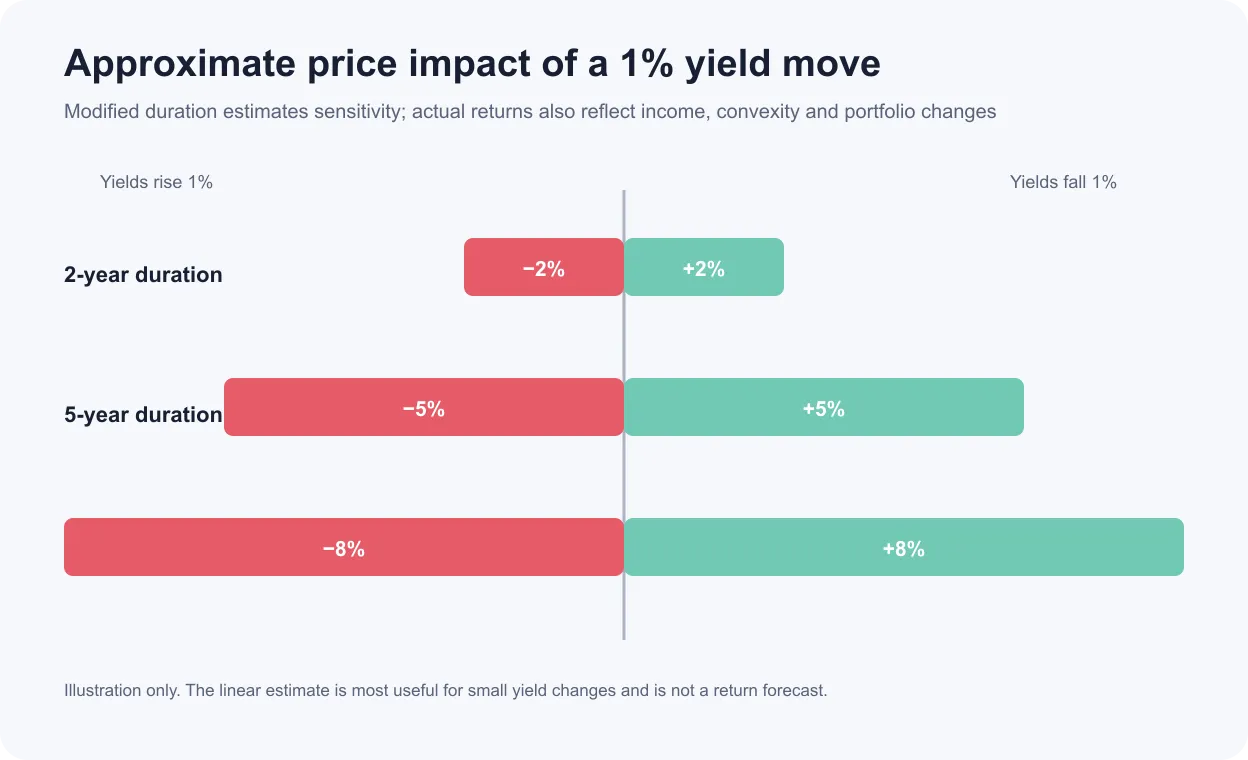
If a portfolio has modified duration of 4, a 1 percentage point rise in yield implies an approximate 4% price fall; a 1 point decline implies an approximate 4% rise. The relationship is curved, not perfectly linear, so convexity creates a difference between the estimate and the actual move, especially when yield changes are large.
How Macaulay Duration Is Calculated
The Macaulay duration formula discounts every expected coupon and principal payment using the bond’s yield. Each present value is multiplied by the number of years until it is received. The sum of those time-weighted values is then divided by the bond’s current price.
Written compactly: DM = Σ[t × PV(CFt)] ÷ price. Here, t is time, CF is the cash flow and PV is its present value. The price in the denominator equals the sum of discounted cash flows under the same assumptions.
The Macaulay duration formula assumes promised cash flows and a yield used for discounting. In a fund, callable bonds, floating-rate instruments, securitised assets and derivatives can require more careful modelling. Factsheets provide a portfolio-level figure, while the scheme information document explains the mandate.
Get research like this in your inbox
The week’s research that mattered, in five minutes. Joined by 2L+ investors.
Worked Example for Investors
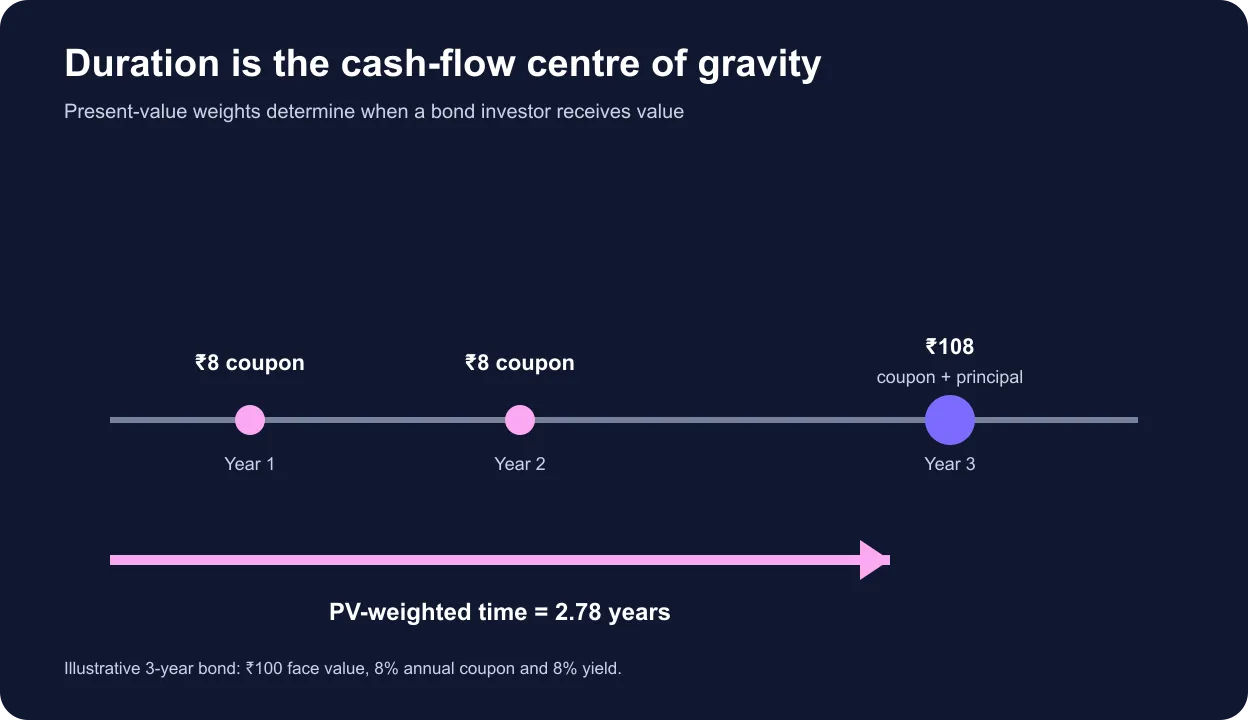
Consider a three-year bond with ₹100 face value, an 8% annual coupon and an 8% yield. It pays ₹8 after year one, ₹8 after year two and ₹108 after year three. Because coupon and yield match, the price is ₹100.
| Year | Cash flow | Present value at 8% | Time × present value |
|---|---|---|---|
| 1 | ₹8.00 | ₹7.41 | ₹7.41 |
| 2 | ₹8.00 | ₹6.86 | ₹13.72 |
| 3 | ₹108.00 | ₹85.73 | ₹257.20 |
| Total | ₹124.00 | ₹100.00 | ₹278.33 |
This Macaulay duration example produces 278.33 ÷ 100, or 2.78 years. The value is below the three-year maturity because two coupons arrive earlier. Modified duration is about 2.78 ÷ 1.08 = 2.58.
Using that modified measure, a 1 percentage point rise in yield suggests an approximate 2.58% price decline, before coupon income and convexity. The worked Macaulay duration example is deliberately simple; a diversified fund contains securities with different coupons, yields, maturities and embedded features.
How Interest Rates Affect Longer-Duration Funds
Longer-duration debt funds tend to gain more when yields fall and lose more when yields rise. That does not mean they are inherently better or worse. It means their NAV path is more responsive to changes in the discount rate applied to distant cash flows.
Yield curves can also change shape. Short-term yields may rise while long-term yields fall, or one maturity segment may move more than another. A single duration number compresses those exposures, so serious comparisons should include portfolio maturity buckets and the manager’s positioning.
There is also a trade-off between price risk and reinvestment risk. Short-duration portfolios usually have smaller price moves, but cash flows may need to be reinvested sooner at lower yields. Longer-duration holdings lock in cash flows for longer but fluctuate more before maturity.
Using Duration to Compare Debt Funds
First compare funds within the same category and on the same reporting date. A duration gap can explain differences in rate sensitivity, but a higher portfolio yield might instead reflect lower credit quality, illiquidity or concentration. Yield and duration should never be treated as interchangeable.
Second, relate duration to your horizon and ability to tolerate interim losses. Investors with near-term liabilities generally need more stability than investors with flexible, longer horizons. Matching is not exact in an open-ended fund because portfolio holdings and duration change over time.
Third, examine consistency. Compare several monthly factsheets, the scheme mandate and actual positioning through rate cycles. The Macaulay duration meaning becomes more useful when seen as a range and a management choice, rather than as one isolated decimal.
Finally, assess expense ratio, credit quality, issuer concentration, liquidity and exit-load terms. Investors can review curated debt mutual fund options while treating duration as one input within a broader suitability process, not as a buy signal.
Common Duration Misconceptions
Duration is not the time an investor must hold a debt fund. It describes the portfolio’s cash-flow timing and rate exposure. An open-ended scheme can be redeemed according to its terms, although exit loads, taxes and market prices can affect the outcome.
It is also not maturity. A five-year coupon bond usually has a duration below five years. Nor is it an expected return: a fund with a longer number can underperform if yields rise, credit spreads widen or expenses offset income.
The modified duration vs Macaulay comparison does not eliminate uncertainty. Modified duration assumes a parallel, small yield move and stable cash flows. Credit spreads can move independently of government yields, and embedded options can alter cash flows when rates change.
Lastly, low duration does not equal low risk. A short portfolio can still hold weak issuers or illiquid paper. SEBI’s Riskometer considers factors including credit risk and interest-rate sensitivity, reinforcing the need to evaluate multiple dimensions together.
A sound reading sequence prevents these errors. Start with Macaulay duration to understand weighted cash-flow timing, then use Macaulay duration alongside modified duration to estimate rate sensitivity. Check whether the latest Macaulay duration is consistent with the scheme category and recent factsheets. The practical Macaulay duration meaning remains narrow but valuable: it organises timing and rate exposure while leaving credit, liquidity and operational questions to other evidence.
Finally, remember that the number is calculated, not promised. The Macaulay duration formula responds to yields, portfolio trades and the passage of time. A current Macaulay duration can therefore differ from the figure observed when an investment was made. Recheck Macaulay duration after material portfolio changes instead of relying on an old snapshot. Investors should revisit the measure as their goal approaches and consider whether the fund’s evolving exposure still matches their capacity for interim NAV movements.
See what markets are pricing in
Live indices, sector moves and market breadth — the backdrop to every story we publish.
FAQ
What is Macaulay duration in debt funds?
It is the present-value-weighted average time, expressed in years, in which the portfolio is expected to receive its bond cash flows. It summarises cash-flow timing rather than forecasting a fund return.
How is Macaulay duration calculated?
Each cash flow is discounted to present value, multiplied by the time until receipt, and divided by the bond price. A fund aggregates the durations and exposures of its holdings.
What is the difference between Macaulay and modified duration?
The first measures weighted time to cash flows. Modified duration converts that measure into an estimate of the percentage price change for a one-percentage-point change in yield.
Why does duration matter in debt funds?
It helps investors compare interest-rate exposure. Longer-duration portfolios usually move more when market yields change, all else equal.
Does higher duration mean higher interest-rate risk?
Usually yes for comparable portfolios, but credit quality, yield-curve exposure, derivatives and convexity also influence the actual outcome.
How can investors use duration when choosing debt funds?
Compare it with the investment horizon and tolerance for interim NAV changes, then assess credit, liquidity, expenses and portfolio concentration separately.