


SEBI created a proportionate regulatory route for specified passively managed mutual-fund schemes. The idea is that a portfolio designed to replicate an index does not require every institutional process built for active security selection, although it still needs robust operations, disclosures and investor safeguards.
The MF Lite framework SEBI introduced through its 31 December 2024 circular was later incorporated into the 2026 mutual-fund regulations and the March 2026 Master Circular. It aims to ease entry and compliance for passive-only businesses while applying defined relaxations to eligible schemes of conventional fund houses.
A lighter institutional framework does not remove the need to examine the underlying benchmark and tracking quality.
What Is the MF Lite Framework?
It is a light-touch regime limited to qualifying passive products. Passive portfolios follow an index or reference asset under disclosed rules, so the manager generally does not make the same security-selection decisions as an active fund manager. SEBI therefore calibrated selected entry, governance and reporting requirements to that operating model.
The framework has two practical routes. A new sponsor can establish a passive-only fund under the lighter entry architecture. An existing conventional AMC can continue managing active and passive schemes while applying specified relaxations to eligible passive products. Active schemes remain under the regular framework.
The phrase MF Lite framework SEBI should not be interpreted as deregulation. Eligible schemes still require fair valuation, accurate NAVs, compliant portfolios, disclosures, service standards and complaint handling. “Lite” describes proportionality in selected institutional requirements, not the absence of supervision.
Run the numbers on your next investment
Project returns on a lumpsum or SIP with our free calculators.
Why SEBI Introduced MF Lite
The original mutual-fund architecture covered active and passive products together. Active management requires research, security selection, portfolio construction and monitoring of issuer-level decisions. A passive scheme instead seeks to reproduce a published benchmark, making some active-fund processes less relevant.
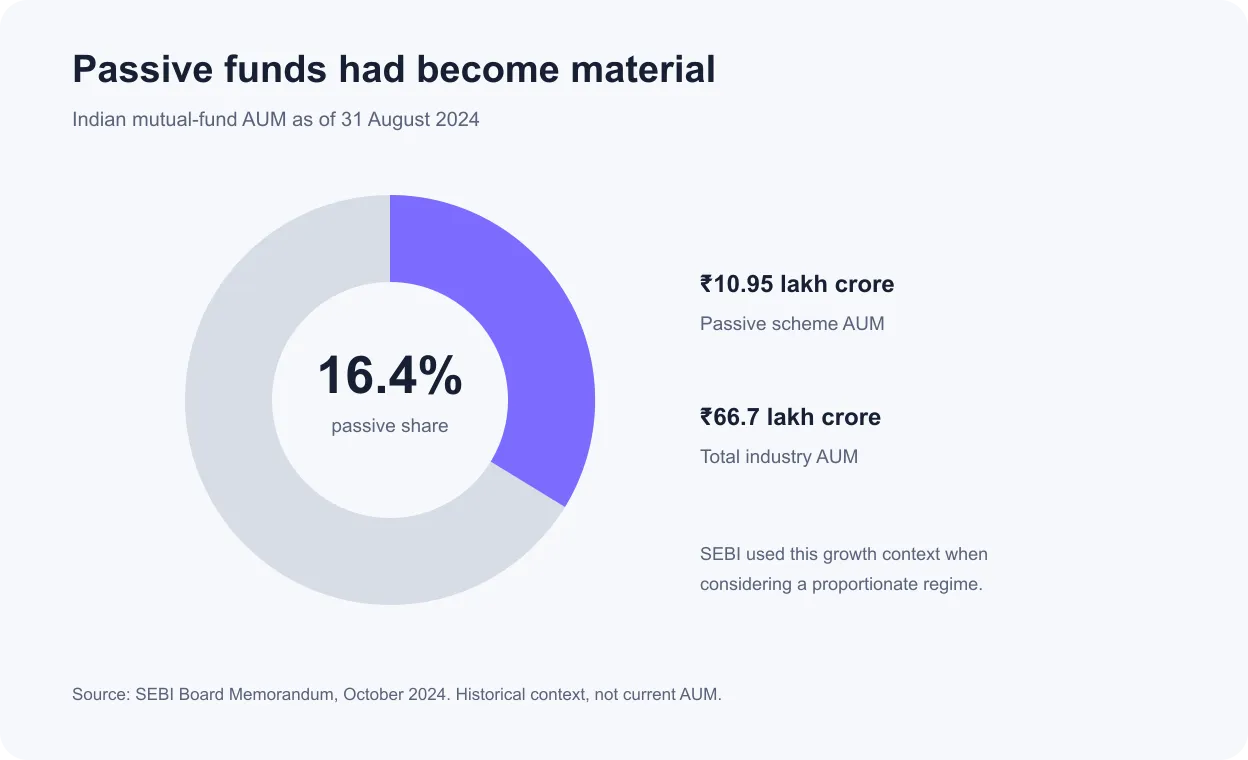
Scale also mattered. SEBI’s 2024 Board Memorandum reported passive AUM of ₹10.95 lakh crore as of 31 August 2024, equal to 16.4% of total industry AUM of ₹66.7 lakh crore. That created a case for a dedicated route rather than treating passive management as a small exception.
SEBI listed several objectives: easier entry, more competition, lower compliance burden, greater penetration, diversification, market liquidity and innovation. The passive mutual funds India market may benefit if more capable providers enter, but the regulation does not guarantee that every new product will be cheap, liquid or well tracked.
Which Schemes and AMCs Can Use MF Lite?
Phase 1 covers only specified categories. Domestic equity products must track broad indices that meet the collective ₹5,000 crore AUM threshold measured on 31 December, with AMFI prescribing the list in consultation with SEBI. Eligibility is therefore attached to recognised benchmark categories, not simply to any index label.
Domestic debt coverage includes specified government-security, treasury-bill and state-development-loan target-maturity products, plus eligible constant-duration passive products where the underlying category crosses the prescribed threshold. Gold ETFs, silver ETFs and FoFs investing only in those ETFs are also included.
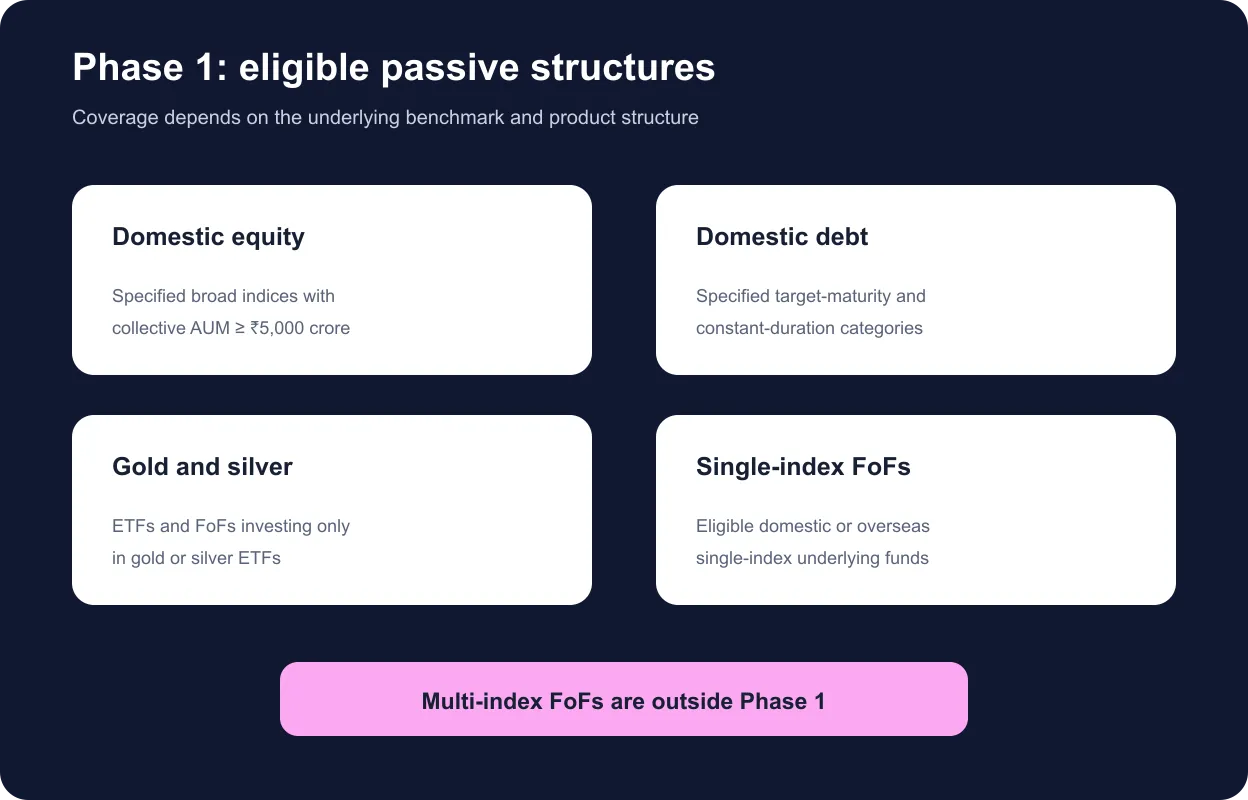
Specified overseas ETFs and FoFs with a single overseas passive underlying may qualify, subject to standardised broad-based benchmarks and quantitative thresholds. FoFs investing in one eligible domestic or overseas index can qualify, but FoFs investing across more than one index are excluded from Phase 1.
That boundary is important for understanding passive mutual funds India. A product can be passive yet fall outside this regime. Investors should check the scheme document rather than infer status from words such as index, ETF or rules-based.
How MF Lite Differs From the Existing Framework
| Area | Passive-only route | Conventional mutual fund |
|---|---|---|
| Permitted business | Only eligible passive schemes | Active and passive schemes under the broader framework |
| Entry | Calibrated sponsor and AMC eligibility | Full sponsor and AMC requirements |
| Governance | Defined lighter roles suited to replication | Broader oversight for varied strategies |
| Scheme coverage | Phase-1 list and benchmark rules | All permitted categories |
| Core investor duties | Continue for valuation, NAV, disclosure and service | Continue across all schemes |
The lighter route calibrates net-worth deployment, sponsor eligibility, trustee oversight, AMC board responsibilities and reporting. It recognises that index replication involves fewer discretionary portfolio decisions. However, operational risk remains: tracking, corporate actions, subscriptions, redemptions, custody and technology still require controls.
The MF Lite framework SEBI also creates a level-playing mechanism for conventional AMCs. If an existing AMC keeps active schemes under regular registration, specified reduced trustee roles can apply only to qualifying passive schemes. The relaxations do not spill into the active business.
This structure avoids forcing an established AMC to create a second fund merely to receive proportional treatment. It also prevents a passive-only registration from being used as an indirect route into active management without meeting the broader requirements.
The registration route separates business ambition from product permission. A passive-only entrant cannot use MF Lite approval to launch an active equity, debt or hybrid scheme. If its strategy changes, it must satisfy broader registration requirements before expanding. That boundary protects the proportional logic: lower complexity supports calibrated obligations, while higher discretion brings the full framework. Investors can verify registration, sponsor, AMC and trustee details in disclosures rather than relying on marketing language.
Get research like this in your inbox
The week’s research that mattered, in five minutes. Joined by 2L+ investors.
Entry, Compliance and Disclosure Changes
A new passive-only sponsor follows streamlined eligibility and liquid-net-worth requirements under the applicable regulations. Trustees and AMC boards receive focused responsibilities, with the board retaining responsibility for overall risk management, operations, investor service and regulatory compliance.
Reporting is reduced where the full active-fund checklist is unnecessary, but core controls remain. The Master Circular preserves requirements relating to scheme documents, valuation, NAV publication, TER disclosure, portfolio compliance and investor complaints. Applicable passive products must also follow benchmark-specific and overseas-index conditions.
The MF Lite framework SEBI requires overseas equity index portfolios to contain at least ten securities, while the permitted indices must be standardised and broad based. This helps prevent a narrowly concentrated basket from obtaining lighter treatment merely by being labelled an index.
Existing schemes can be transferred only through the prescribed process and conditions. Investors should rely on formal AMC communications for any transfer, merger or material change. The regime does not authorise silent alteration of a scheme’s objective, benchmark or investor rights.
What It Means for Passive Fund Investors
More providers may increase choice and competitive pressure. A specialised passive-only AMC can design systems around index replication instead of supporting a broad active platform. That may improve focus, but a lower compliance load does not automatically produce a lower TER.
For investors in passive mutual funds India , the main decision remains the benchmark. Two index funds can track different universes, weighting rules or rebalancing schedules. Even funds following the same index can differ in expenses, cash levels, execution and tracking difference.
ETF investors must also assess exchange liquidity, bid-ask spreads, premium or discount to NAV and creation-unit activity. An index fund avoids exchange execution but may have different cut-offs and cash-flow effects. Product wrapper and benchmark both influence the realised experience.
The word “Lite” should not affect risk perception. Equity indices can fall sharply, long-duration debt indices respond to interest rates, gold and silver are volatile, and overseas products add currency and market-access considerations. The investment remains exposed to its underlying assets.
Potential Benefits and Trade-Offs
Potential benefits include lower barriers for focused entrants, less duplicated reporting and rules better aligned with mechanical portfolios. Competition may encourage sharper execution, narrower costs or new benchmark choices. Standardisation can also make comparable products easier to assess.
The trade-off is that proportional governance places more importance on well-designed systems and transparent benchmarks. A passive fund does not need security-selection judgement, but it needs reliable index data, corporate-action handling, rebalancing execution, collateral processes and investor servicing.
Product proliferation can create confusion. A new thematic or factor index may appear diversified while depending heavily on a few sectors or rules. Phase-1 eligibility reduces this issue by focusing on defined structures, yet inclusion in the framework is not an endorsement of expected returns.
Competition could fragment ETF liquidity across similar products. Small funds may face higher fixed-cost pressure or wider spreads. Investors should therefore measure outcomes instead of assuming that a newer regulatory route is inherently superior to an established fund.
There is another trade-off. The regime may reduce compliance friction, but replication quality still depends on scale and market structure. A fund tracking a liquid broad-market index can transact efficiently, while a less liquid basket may face higher impact costs during rebalancing. Gold and silver products depend on custody, pricing and creation mechanisms. Overseas structures depend on access limits, currency movement and the underlying fund. MF Lite changes the regulatory route, not these sources of tracking difference.
How Investors Should Evaluate MF Lite Schemes
Confirm that the scheme is covered under the official framework and identify the exact benchmark. Read the index methodology: eligible universe, weighting, rebalance frequency, concentration limits and treatment of corporate actions. Check whether the exposure fits the goal and time horizon.
Compare TER and tracking difference over consistent periods. Tracking error measures variability around benchmark returns, while tracking difference shows the actual return gap. Review AUM, portfolio disclosure, cash position and, for ETFs, traded volumes and bid-ask spreads.
Evaluate the AMC’s operational capability. Look for timely NAVs, accurate disclosures, clear complaint channels and consistent replication. The fourth passive mutual funds India test is product simplicity: if the benchmark cannot be explained, the fund may not suit a beginner.
Finally, compare the scheme with conventional alternatives tracking the same exposure. Regulation type is one input, not the investment thesis. Choose on benchmark quality, cost, tracking, liquidity, tax treatment and suitability, and seek regulated advice when the decision requires it.
A sensible review should separate three layers: benchmark, wrapper and manager. First assess what the index owns and how it is built. Then choose between ETF, index fund or FoF based on access and liquidity. Finally compare overall cost, execution, controls and service record.
See what markets are pricing in
Live indices, sector moves and market breadth — the backdrop to every story we publish.
FAQ
What is the MF Lite framework?
It is a proportionate regulatory regime for specified passively managed mutual-fund schemes. It simplifies selected entry, governance and compliance requirements while retaining scheme, disclosure and investor-protection obligations.
Why did SEBI introduce MF Lite?
SEBI said some rules designed for active management were unnecessary for index-replicating products. The regime aims to reduce compliance, encourage entry and competition, improve penetration and support innovation and liquidity.
Which mutual funds can fall under MF Lite?
Phase 1 includes eligible domestic equity and debt passive benchmarks, gold and silver ETFs and related FoFs, and specified single-index domestic or overseas structures. The official AMFI and SEBI lists determine eligibility.
How is MF Lite different from the regular mutual-fund framework?
It offers proportionate sponsor, AMC, trustee, reporting and disclosure requirements for eligible passive-only operations. Conventional AMCs may also use specified relaxations for qualifying passive schemes while keeping active products under the regular regime.
Does MF Lite reduce investor protection?
The framework is lighter in selected institutional requirements, but eligible schemes still follow portfolio, valuation, NAV, disclosure, service and complaint-handling rules. Investors must still assess benchmark and product risks.
What could MF Lite mean for passive-fund investors?
It may support competition and product availability, but it does not guarantee lower expenses or better tracking. Investors should compare benchmark quality, TER, tracking difference, liquidity and AMC execution.