


Infrastructure assets such as toll roads, power lines, renewable-energy networks, warehouses and pipelines require large amounts of long-term capital. An InvIT allows investors to own units in a regulated trust that holds these assets directly or through project companies.
A listed infrastructure investment trust can turn operational infrastructure cash flows into tradeable units and periodic distributions. That does not make it a fixed deposit or a guaranteed-yield product. Revenue, costs, debt, regulation and asset life still determine what unitholders receive.
InvITs provide market access to infrastructure cash flows without direct project ownership.
What Is an InvIT?
An Infrastructure Investment Trust is a trust registered with the Securities and Exchange Board of India under the InvIT Regulations. It pools capital by issuing units and invests in eligible infrastructure projects, often through special purpose vehicles or holding companies.
The practical InvIT meaning is part ownership of a portfolio structure, not ownership of a specific lane of highway or transmission tower. Unitholders have economic rights attached to the trust’s units while the project entities operate the assets and meet contractual obligations.
The structure usually includes a sponsor, trustee, investment manager and project manager. The sponsor establishes the vehicle and contributes assets or interests. The trustee oversees compliance and protects unitholder interests. The investment manager makes portfolio and financing decisions, while project managers handle operations.
SEBI’s regulations and master circular govern registration, offers, investment conditions, valuation, leverage, related-party transactions, disclosures and distributions. The current regulations were last amended on 17 April 2026, and SEBI issued a revised framework for calculating net distributable cash flows in August 2026.
See what markets are pricing in
Live indices, sector moves and market breadth — the backdrop to every story we publish.
How Infrastructure Investment Trusts Work
The sponsor typically transfers eligible projects or ownership in project SPVs to the trust. Investors subscribe to or buy units. The trust then receives cash from operating assets through interest on shareholder loans, dividends, debt repayment and other permitted flows.
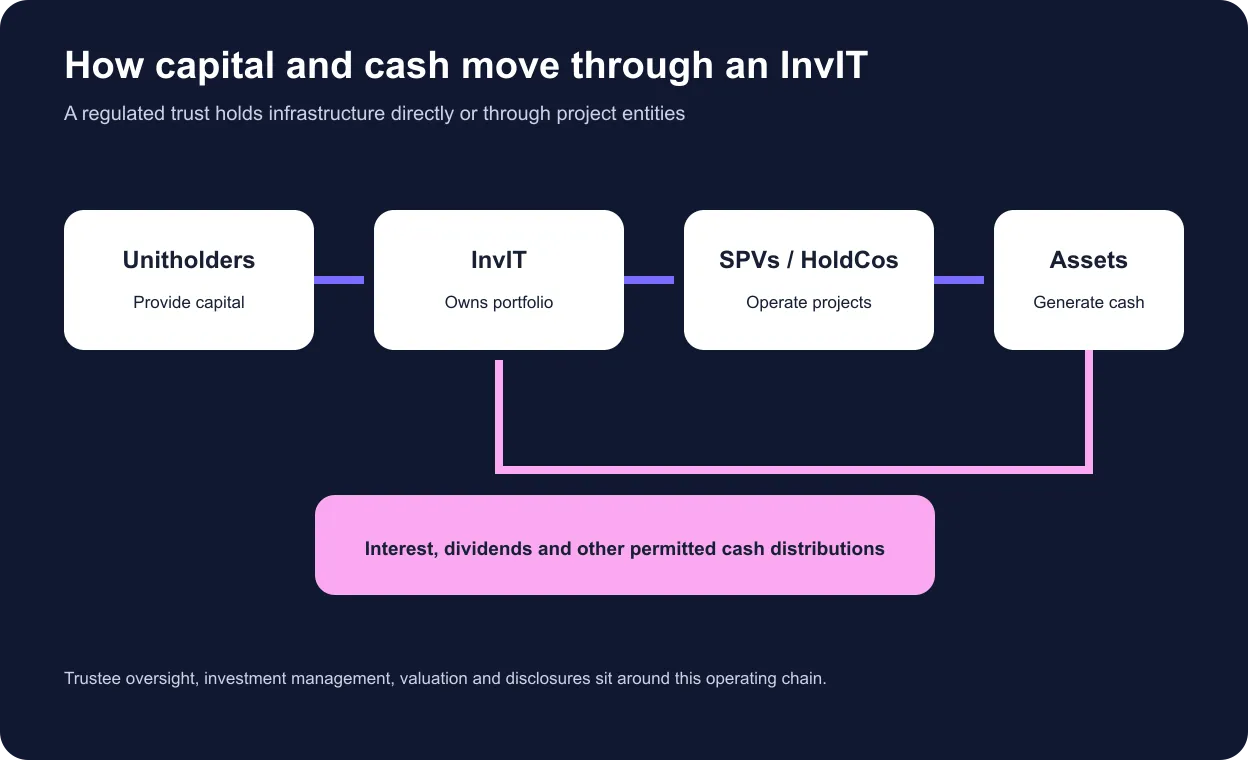
Understanding how InvIT works requires looking through the trust to each asset. A road project may depend on traffic and toll escalation. A transmission asset may earn availability-linked revenue. A pipeline may depend on contracted capacity and counterparties.
Publicly offered InvITs generally concentrate at least 80% of asset value in completed, revenue-generating infrastructure under the regulatory framework, with limits on development exposure and other investments. Privately placed InvITs can follow a different risk and investor-access profile.
The infrastructure investment trust India ecosystem includes listed public vehicles and privately placed trusts. Exchange listing improves access and price discovery, but trading volumes can still be thin and the quoted price can differ from reported NAV.
Where InvITs Invest
Eligible infrastructure spans sectors notified under India’s infrastructure framework. Portfolios can include roads and highways, power transmission, renewable power, telecom infrastructure, pipelines, logistics and other operating assets.
Asset economics differ sharply. Toll roads carry traffic and concession risk. Annuity or availability-based roads may depend more on government counterparties and performance conditions. Transmission assets can have regulated or contracted revenue but remain exposed to availability, counterparty and regulatory decisions.
Renewable portfolios add resource variability, offtaker quality, curtailment and equipment performance. Telecom or data infrastructure may depend on tenancy, technology changes and customer concentration. Sector labels are only the start of due diligence.
A diversified InvIT can reduce dependence on one project, but diversification should be measured by revenue source, counterparty, geography, concession maturity and financing structure. Ten assets exposed to the same payer or regulation may still be concentrated.
How Investors Earn From InvITs
Unitholder return has two components: cash distributions and the change in unit price. Distributions may contain interest, dividends, repayment of debt or other amounts identified by the trust. The composition matters because each component can have a different tax treatment.
SEBI requires the applicable share of net distributable cash flows to be distributed under the regulatory framework. The 2025 master circular states that distribution policy should set a consistent frequency and the first distribution from a period’s NDCF should meet the minimum 90% or 100% requirement applicable to the vehicle, with later compliance assessed cumulatively.
These rules do not promise a fixed payout. NDCF can change with revenue, maintenance, working capital, interest, refinancing and permitted reserves. A high distribution in one period may also include a component that reduces the investor’s economic capital base.
The second source of InvIT returns is unit-price movement. Prices can rise or fall as interest rates, asset performance, leverage, growth plans and required yields change. Investors should calculate total return, not quote the distribution yield alone.
InvIT vs REIT: Key Differences
| Feature | InvIT | REIT |
|---|---|---|
| Primary assets | Infrastructure projects | Income-producing real estate |
| Typical cash drivers | Tolls, tariffs, availability payments, contracted infrastructure revenue | Rent, occupancy, lease escalation and property sales |
| Finite-life exposure | Many concessions have an expiry date | Property ownership may be perpetual, subject to title and redevelopment |
| Key operating risks | Traffic, project performance, regulation and counterparties | Vacancy, tenant quality, supply and property cycles |
| Common valuation focus | Project cash flow, debt and remaining concession life | Net operating income, cap rates and property valuation |
The central InvIT vs REIT distinction is the underlying business model. Both are SEBI-regulated business trusts and can distribute cash, but infrastructure concessions do not behave like office leases.
A road concession can lose value as its remaining term shortens even while it generates cash. A REIT property can require refurbishment or face vacancy but may retain land and redevelopment value. Comparable yields should therefore be adjusted for duration, growth, leverage and risk.
Portfolio construction matters too. An investor already exposed to listed utilities, construction companies and real estate may not gain as much diversification as the labels suggest. Examine economic drivers rather than treating every alternative vehicle as a separate asset class.
Get research like this in your inbox
The week’s research that mattered, in five minutes. Joined by 2L+ investors.
InvIT Returns, Distribution Yield and Valuation
Distribution yield equals annualised cash distribution per unit divided by market price. It is a useful snapshot, but not a forecast. The numerator can change, the price can move and the payout can contain components with different economic and tax effects.
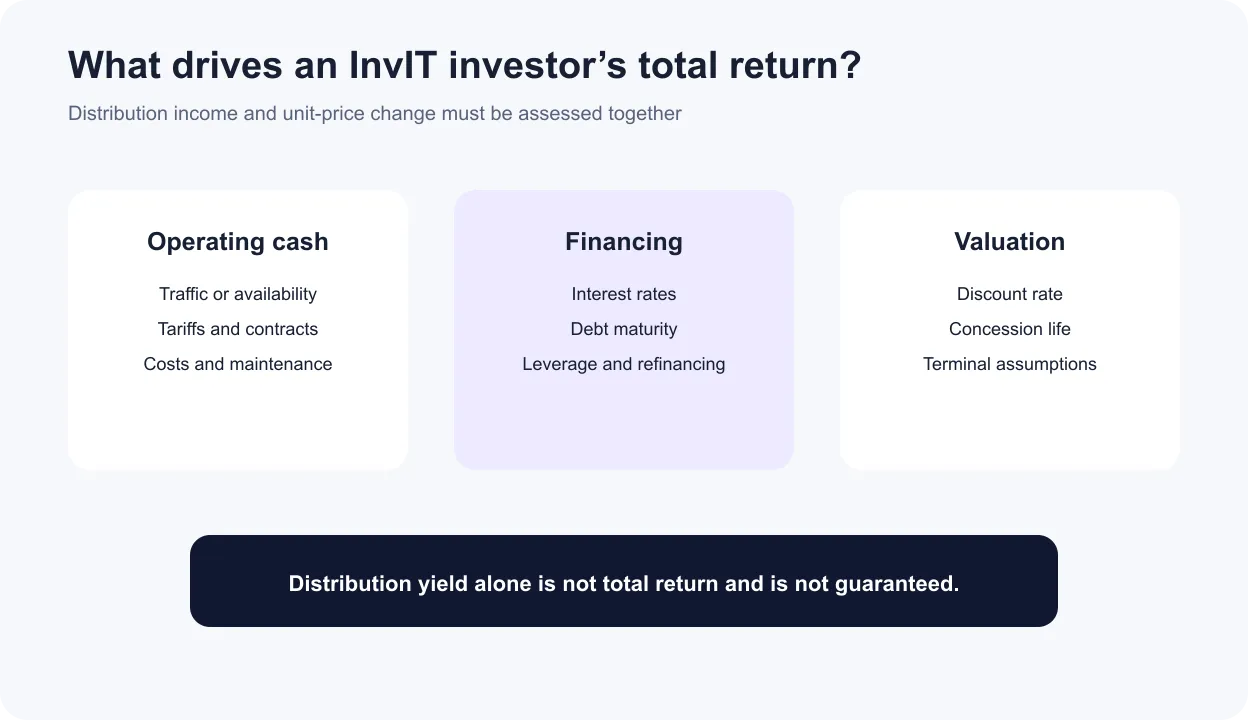
Reported NAV is another reference point, not an assured exit price. Infrastructure valuation often uses discounted cash flow. Small changes in the discount rate, traffic growth, tariff escalation, operating costs or terminal assumptions can materially change estimated value.
Assess InvIT returns across a complete period using distributions, price change and any dilution. Compare the result with the risk taken, not only with a bank deposit rate. Unit prices can fall enough to offset several years of distributions.
Read the NDCF reconciliation, valuation report and debt schedule together. Sustainable cash generation should come from operating assets after realistic maintenance and financing needs. Asset sales, refinancing or one-off receipts may support a payout without repeating every year.
Taxation of InvIT Income and Capital Gains
InvIT taxation India is component-specific. Section 115UA generally preserves the nature and proportion of qualifying pass-through income in the hands of unitholders. The trust’s distribution statement should identify interest, dividend and other components.
Interest passed through from an SPV is generally taxable for a resident individual at the applicable rate. Dividend treatment can depend on whether the SPV opted for the Section 115BAA regime. The Income Tax Department states that dividend from an opted-in SPV is taxable to the unitholder, while qualifying dividend from an SPV that did not opt can be exempt under Section 10(23FD).
Debt repayment or another non-pass-through distribution requires separate treatment under the business-trust rules, including Section 56(2)(xii) and cost adjustments where applicable. Do not label an entire distribution “dividend” merely because cash entered the bank account.
For listed business-trust units sold with the relevant STT conditions, units held for not more than 12 months are generally short-term. Transfers on or after 23 July 2024 generally attract 20% tax under Section 111A. Long-term gains after more than 12 months generally fall under Section 112A at 12.5% above the aggregate annual ₹1.25 lakh threshold, plus applicable surcharge and cess.
Tax rules can change and investor status matters. Use the annual statement, transaction dates and acquisition cost when calculating InvIT taxation India , and obtain professional advice for material transactions or non-resident holdings.
Key Risks: Leverage, Projects, Interest Rates and Governance
Leverage magnifies both outcomes. Debt can improve equity distributions when assets perform, but higher interest expense and refinancing risk can reduce NDCF. Review consolidated net borrowing, fixed versus floating exposure, maturity concentration, covenants and credit ratings.
SEBI’s framework places additional conditions around higher borrowing levels, and in 2026 it clarified permitted uses of fresh borrowing for InvITs whose net borrowing exceeds 49% of asset value. Regulatory permission does not make high leverage suitable for every investor.
Project risk includes construction or expansion delays, maintenance overruns, lower traffic or availability, termination and force majeure. Counterparty risk matters when cash flows depend on one government agency, utility or corporate customer.
Interest rates influence both financing cost and the yield investors demand. A rise in required yield can reduce the market price even if distributions remain stable. This duration-like sensitivity is central to interpreting returns from an InvIT.
Governance risk includes related-party acquisitions, fee structures, valuation judgment and conflicts with sponsors. Read voting notices, independent valuation reports, acquisition funding and whether the sponsor is selling mature assets at terms that benefit existing unitholders.
How to Evaluate an InvIT
Start with the asset map. Record each project, revenue mechanism, concession or contract expiry, counterparty, operating history and ownership percentage. Then reconcile project cash flow to trust-level NDCF and distributions.
| Area | Questions to ask |
|---|---|
| Cash flow | What drives revenue, and how volatile has it been? |
| Asset life | When do concessions or key contracts expire? |
| Debt | What is the borrowing ratio, cost, maturity profile and refinancing plan? |
| Distribution | How much came from recurring operations versus one-offs? |
| Valuation | Which discount-rate, growth and terminal assumptions matter most? |
| Governance | How are related-party acquisitions, fees and conflicts controlled? |
| Liquidity | What are average trading volumes and bid-ask spreads? |
Next, test how InvIT works under stress. Model lower traffic or availability, higher refinancing cost, delayed tariff escalation and major maintenance. Check whether distributions, covenants and valuation remain reasonable.
Compare market price with NAV and enterprise value, but investigate why a discount or premium exists. A high yield may compensate for declining asset life, leverage, weak liquidity or risk to future distributions. A low yield may reflect stronger contracts or simply an expensive price.
For an infrastructure investment trust India allocation, decide its portfolio role. It can provide infrastructure exposure and cash distributions, but it remains a market-linked security. Position size should reflect loss capacity, liquidity needs and existing exposure to similar risks.
Review quarterly results, distributions, valuation updates, credit ratings and material events after investing. The working definition of how InvIT works must be updated when the trust acquires assets, raises debt, issues units or changes distribution policy.
Investors comparing listed alternatives can explore Wright Research alternative investments. A measured allocation to an InvIT should follow due diligence on the assets, financing and governance rather than a headline yield.
Follow this sector’s live moves
Sector-level performance across Indian markets, updated through the day.
FAQ
What is an InvIT?
An InvIT is a SEBI-registered trust that pools investor capital to own and operate infrastructure assets directly or through project entities. The InvIT meaning is therefore an ownership interest in a regulated portfolio structure, not a guaranteed-income instrument. This InvIT meaning also distinguishes units from direct title to an individual project.
How does an Infrastructure Investment Trust work?
Sponsors transfer eligible infrastructure interests to a trust. An investment manager operates the portfolio, a trustee provides oversight, and eligible cash flows can be distributed to unitholders. Understanding how the vehicle works also requires checking project entities, debt and contracts.
What is the difference between InvIT and REIT?
InvITs own infrastructure such as roads, transmission networks and pipelines. REITs primarily own income-producing real estate. A careful InvIT vs REIT comparison examines cash-flow drivers, leases or concessions, asset life, risks and valuation inputs.
How do InvITs generate returns?
Returns can come from cash distributions and changes in the market price of units. Both depend on asset performance, financing, regulation, remaining asset life and valuation. Distribution yield alone is not a complete return measure.
How are InvIT distributions taxed?
Tax depends on each component reported by the trust, such as interest, dividend or another permitted distribution. Investors should use the annual tax statement rather than tax the entire payout as one category.
What are the risks of investing in InvITs?
Risks include leverage, refinancing, traffic or volume changes, project execution, regulation, counterparty exposure, concession expiry, valuation assumptions, governance and limited trading liquidity. Any infrastructure investment trust India allocation should reflect these risks and the investor’s liquidity needs.