


Every option strike is described as in the money, at the money or out of the money. These labels compare the strike price with the current price of the underlying asset. They do not predict the next market move and they do not guarantee that a trade is profitable.
Understanding ITM ATM OTM options is essential because moneyness affects intrinsic value, premium behaviour, sensitivity to the underlying and the chance that an option expires with value. The classification is simple once calls and puts are separated.
This guide explains ITM vs ATM vs OTM with one consistent example. Assume an underlying share or index is at ₹100. Contract specifications, lot size, expiry settlement and liquidity still need to be checked on the relevant exchange before any trade.
What Is Options Moneyness?
Options moneyness identifies whether immediate exercise would produce positive intrinsic value. For a call, intrinsic value is max(spot price minus strike price, 0). For a put, it is max(strike price minus spot price, 0). The option premium can exceed intrinsic value because it may also contain time value.
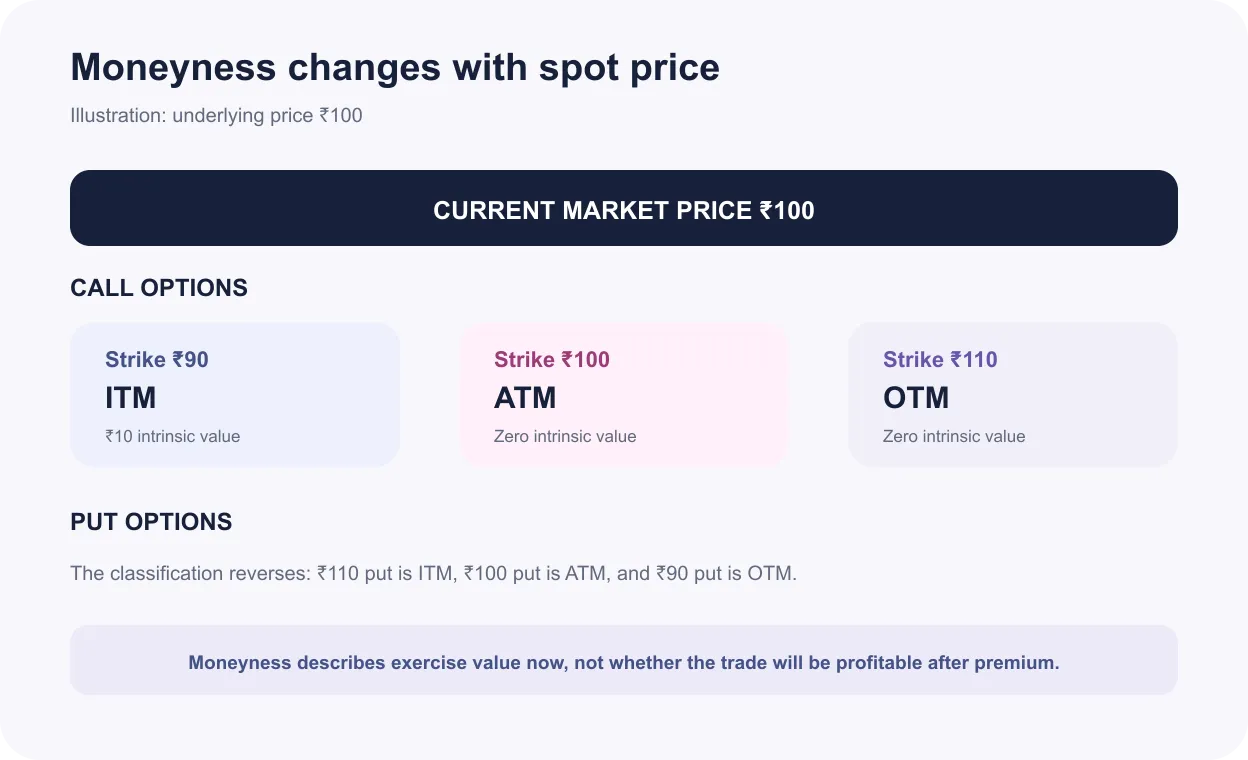
With the underlying at ₹100, a ₹90 call is ITM, a ₹100 call is ATM and a ₹110 call is OTM. For puts, the order reverses: the ₹110 put is ITM, the ₹100 put is ATM and the ₹90 put is OTM. This call-put reversal is the core rule behind ITM ATM OTM options.
Moneyness can change whenever the underlying moves. A ₹105 call that is OTM when spot is ₹100 becomes ATM around ₹105 and ITM above ₹105. Traders therefore monitor the current underlying price rather than relying on the classification shown when the contract was purchased.
When reading an option chain, classify ITM ATM OTM options from the live spot value and strike first. Then evaluate premium, expiry and liquidity as separate decisions.
See what markets are pricing in
Live indices, sector moves and market breadth — the backdrop to every story we publish.
What Are ITM (In-the-Money) Options?
ITM options meaning starts with positive intrinsic value. A call is ITM when spot is above strike. A put is ITM when spot is below strike. With spot at ₹100, the ₹90 call has ₹10 of intrinsic value and the ₹110 put also has ₹10 of intrinsic value.
The premium of an ITM option normally includes intrinsic value plus any remaining time value. It is therefore generally higher than the premium of an otherwise comparable ATM or OTM contract. Higher premium does not mean the position is automatically safer or profitable because the buyer must first recover the premium paid.
Another way to understand ITM options meaning is through price sensitivity. Deeper ITM options usually respond more strongly to changes in the underlying than far OTM contracts, although delta changes over time and is not fixed. They may suit a trader seeking greater directional participation while retaining the buyer's limited-premium risk.
In practical terms, ITM options meaning is about exercise value today. It says nothing by itself about the premium-adjusted return at expiry.
At expiry, an ITM option has intrinsic value under the exchange's settlement rules. Investors must still understand settlement mechanics, applicable charges and the consequences of holding stock options near expiry. The label describes exercise value, not the net result after premium and costs.
What Are ATM (At-the-Money) Options?
ATM options meaning refers to a strike equal or nearest to the current underlying price. If the underlying is at ₹100, the ₹100 call and ₹100 put are ATM. Exact equality may not be available because exchanges list strikes at set intervals.
An ATM option generally has zero intrinsic value. Its premium is time value, which reflects the possibility of moving ITM before expiry. ATM contracts often have high sensitivity to small changes in the underlying and can carry substantial time value when expiry is distant or implied volatility is elevated.
ATM options meaning should not be confused with breakeven. A ₹100 call purchased for ₹6 is ATM at spot ₹100, but its expiry breakeven is ₹106 before charges. Likewise, a ₹100 put bought for ₹6 has an expiry breakeven of ₹94. Moneyness excludes the premium paid.
For comparison screens, ATM options meaning usually refers to the listed strike closest to spot. Check the exchange strike interval when spot lies between two strikes.
For actively traded index options, ATM strikes often attract meaningful trading activity, but liquidity varies by underlying and expiry. Check the bid-ask spread and order-book depth rather than assuming every ATM contract is liquid.
What Are OTM (Out-of-the-Money) Options?
OTM options meaning is the absence of intrinsic value under current market conditions. A call is OTM when spot is below strike. A put is OTM when spot is above strike. With spot at ₹100, a ₹110 call and a ₹90 put are OTM.
An OTM option's premium is entirely time value. It can become ITM if the underlying moves far enough before expiry, but it expires worthless if it remains OTM at expiry. The buyer can therefore lose the entire premium even when the market moves in the expected direction but not far enough.
Low rupee premium can make OTM options appear inexpensive. That is not the same as low risk. Far OTM options may have a lower probability of finishing with intrinsic value, wider percentage swings and rapid time decay near expiry. OTM options meaning must therefore be read alongside days to expiry and implied volatility.
At expiry, OTM options meaning becomes especially direct: there is no intrinsic value to settle. The buyer's paid premium is then lost, apart from any earlier offsetting trade.
Option sellers face a different payoff. The premium received is limited, while an uncovered short option can create substantial or theoretically unlimited loss. Margin requirements do not cap that economic risk.
Get research like this in your inbox
The week’s research that mattered, in five minutes. Joined by 2L+ investors.
ITM vs ATM vs OTM: Key Differences
The practical ITM vs ATM vs OTM comparison is about intrinsic value, premium composition and market sensitivity. The following table uses an underlying price of ₹100 and keeps option type and expiry explicit.
| Feature | ITM | ATM | OTM |
|---|---|---|---|
| Call example | ₹90 strike | ₹100 strike | ₹110 strike |
| Put example | ₹110 strike | ₹100 strike | ₹90 strike |
| Intrinsic value | Positive | Usually zero | Zero |
| Premium, all else equal | Generally highest | Middle | Generally lowest |
| Time value | May be present | Often substantial | Entire premium |
| Expiry outcome if unchanged | Retains intrinsic value | Expires without intrinsic value | Expires worthless |
The table is directional, not a live quote. Different strikes can have different implied volatility and liquidity. The ITM ATM OTM options comparison also changes continuously as spot moves and time passes.
Use the same timestamp when comparing ITM ATM OTM options. A fast underlying move can otherwise make premiums and classifications taken seconds apart internally inconsistent.
A trader comparing ITM vs ATM vs OTM should separate moneyness from profitability. A ₹90 call bought for ₹14 has ₹10 intrinsic value at spot ₹100 but is still ₹4 below its ₹104 expiry breakeven. An option may be ITM while the buyer has a net loss.
How Moneyness Affects Options Premium
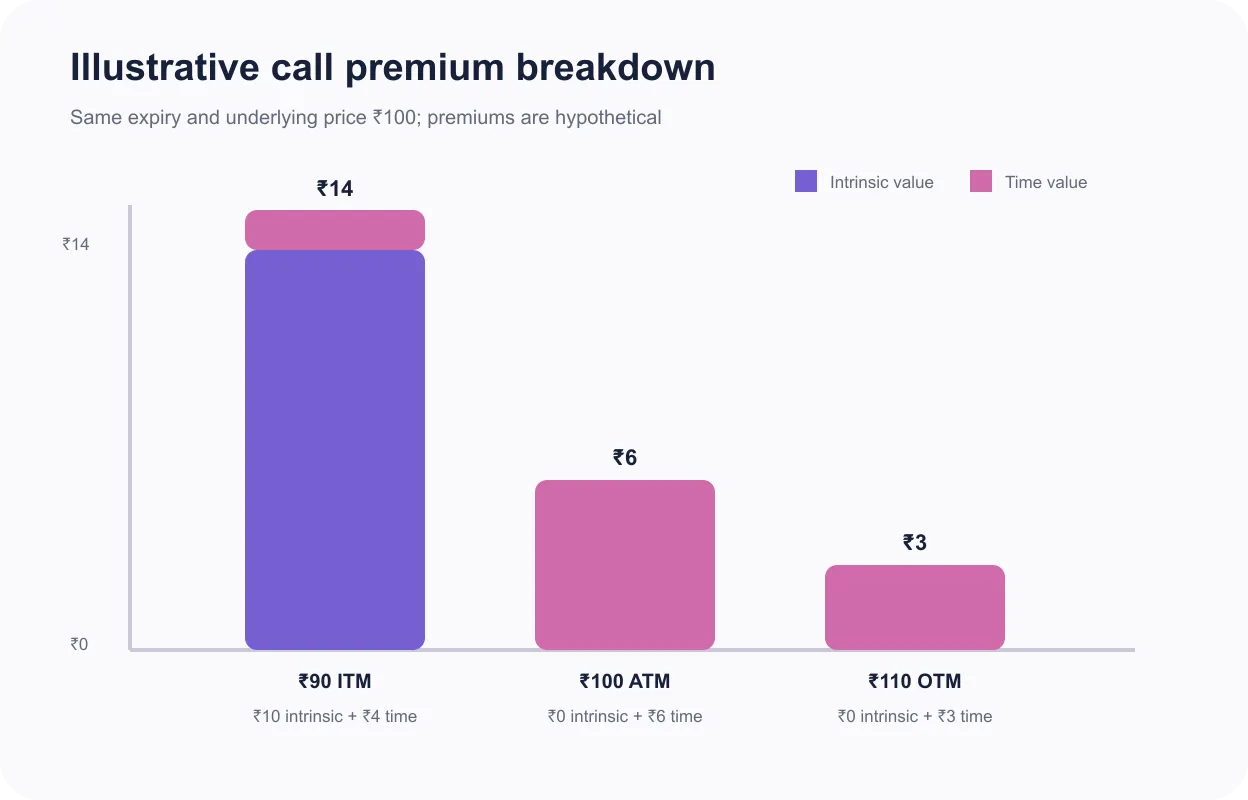
Option premium equals intrinsic value plus time value. ITM contracts have intrinsic value. ATM and OTM contracts do not. Time value reflects the remaining opportunity for a favourable move and is influenced by time to expiry, implied volatility, interest rates, expected dividends and market conditions.
The chart uses hypothetical premiums for same-expiry calls with spot at ₹100. The ₹90 ITM call costs ₹14, made up of ₹10 intrinsic value and ₹4 time value. The ₹100 ATM call costs ₹6, while the ₹110 OTM call costs ₹3, both entirely time value.
Time decay is not uniform. It generally accelerates as expiry approaches, especially for options near the current price. Implied volatility can also lift or reduce premiums without an equivalent move in the underlying. This is why the cheapest-looking strike can still be expensive relative to its probability and remaining time.
In a moneyness review, delta indicates approximate sensitivity to a small underlying-price move, while theta estimates time decay and vega estimates sensitivity to implied volatility. These measures change with market conditions and should be treated as estimates rather than guarantees.
When to Use ITM, ATM or OTM Options
No moneyness category is universally best. ITM options may be considered when a buyer wants stronger directional sensitivity and is willing to pay more premium. ATM options may be useful when the focus is on a near-current strike and a responsive contract. OTM options may be used for lower-premium defined-risk exposure or as a leg in a spread, but they require a larger favourable move.
Start with the objective: hedging, directional exposure or a defined multi-leg payoff. Then compare expiry, strike distance, premium, breakeven, liquidity, implied volatility and maximum loss. The choice of ITM ATM OTM options should follow the payoff needed rather than the cheapest quoted premium.
Risk control matters more than the label. An option buyer can lose 100% of the premium. An uncovered seller can face losses far beyond the premium received. Position size should reflect the maximum plausible loss, not merely the upfront debit or exchange margin.
Before selecting among ITM ATM OTM options, write down the expected move, time horizon, maximum acceptable loss and planned exit. This makes the strike choice testable instead of intuitive.
Beginners studying ITM vs ATM vs OTM should practise mapping calls and puts separately, calculate expiry breakeven, and account for costs before trading. SEBI's FY25 study found that 91% of individual equity-derivatives traders in its sample lost money after transaction costs, with aggregate net losses of ₹1,05,603 crore.
That statistic does not mean every options position loses. It does show why education, liquidity checks and disciplined exposure are necessary. Avoid buying far OTM contracts solely because they look cheap, and avoid selling options without understanding tail risk and settlement obligations.
Finally, compare ITM ATM OTM options within the same underlying and expiry. Mixing weekly and monthly contracts introduces different time values and can invalidate a simple premium comparison.
Is your portfolio built for what’s coming?
Get a free AI-powered review of your holdings — risk, overlap and quality in minutes.
FAQ
What is the difference between ITM, ATM and OTM options?
ITM options have positive intrinsic value, ATM options have a strike at or nearest to the current underlying price, and OTM options have no intrinsic value. The classification reverses between calls and puts.
What does ITM mean in options trading?
ITM means in the money. A call is ITM when the underlying price is above the strike, while a put is ITM when the underlying price is below the strike.
What is the difference between ITM and OTM options?
An ITM option has intrinsic value and is generally more expensive. An OTM option has no intrinsic value, is generally cheaper and requires a favourable price move before expiry to gain intrinsic value.
How does moneyness affect option premium?
Moneyness affects intrinsic value and how much of the premium consists of time value. Premium also depends on time to expiry, implied volatility, interest rates, dividends and market demand.
What is an at-the-money option?
An at-the-money option has a strike equal or closest to the current underlying price. It normally has no intrinsic value and can carry substantial time value before expiry.
Should beginners trade OTM options?
OTM options can lose their entire premium and decay rapidly near expiry. Beginners should first understand payoff, probability, liquidity and position sizing, and should avoid treating a low premium as low risk.