


Gujarat International Finance Tec-City gives fund managers an Indian International Financial Services Centre from which they can pool and deploy foreign-currency capital. For investors, GIFT City Funds can provide access to global securities, India-focused offshore pools and specialised strategies through an IFSCA-regulated structure.
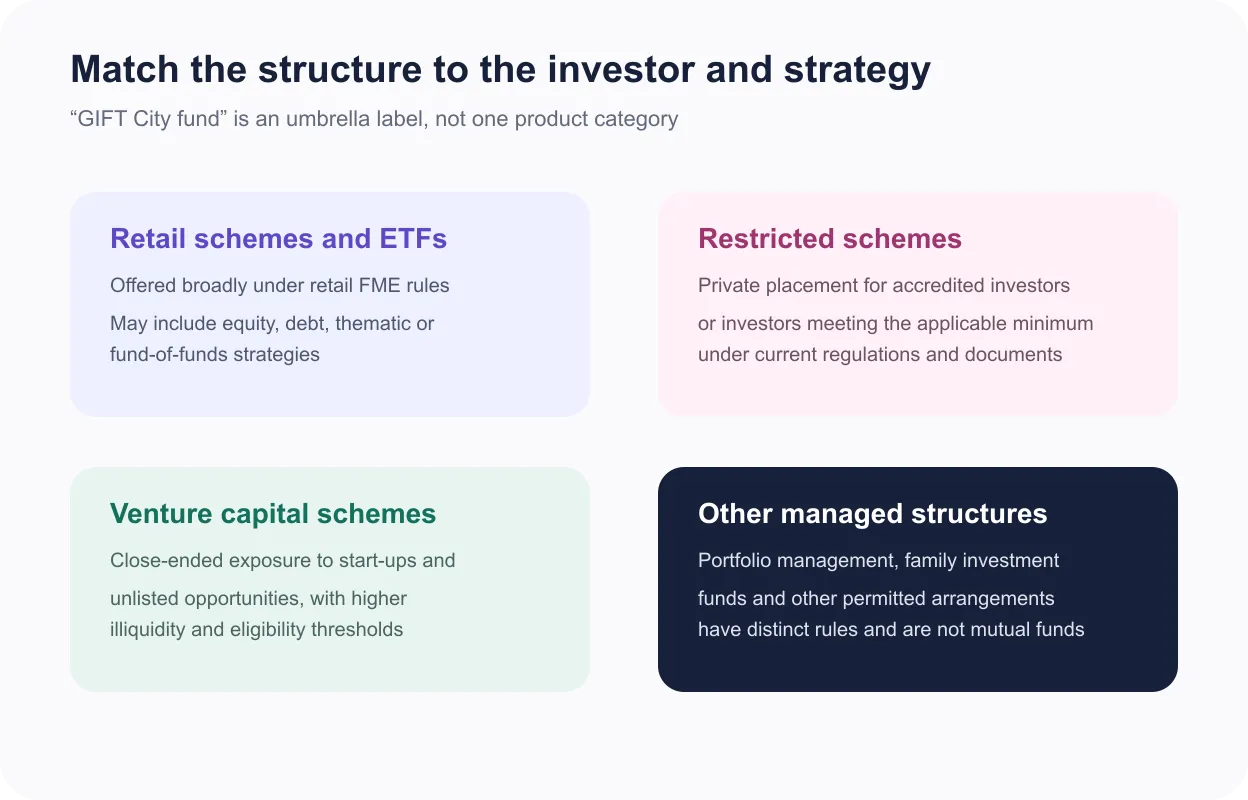
The name can be misleading if treated as one product category. Some schemes are retail funds or ETFs. Others are private-placement restricted schemes, venture-capital pools or specialised managed structures. Eligibility, minimum investment, liquidity, currency and tax treatment vary.
What Are GIFT City Funds?
GIFT City Funds are schemes or funds launched by Fund Management Entities in GIFT IFSC under IFSCA's Fund Management Regulations. The IFSC is treated as a distinct international financial jurisdiction for regulatory and foreign-exchange purposes, even though it is physically located in India.
A fund can invest in securities in the IFSC, India or foreign jurisdictions, subject to its category, regulations and offer document. Strategies may include global equity, debt, ETFs, fund of funds, India-focused portfolios, alternatives, venture capital and sector or thematic mandates.
The phrase GIFT City mutual funds is commonly used for accessible pooled products, but investors should verify the legal form. Restricted schemes and venture-capital schemes should not be assessed as if they were ordinary SEBI-regulated domestic mutual funds.
Run the numbers on your next investment
Project returns on a lumpsum or SIP with our free calculators.
Why GIFT City (IFSC) Exists for Fund Structures
GIFT IFSC was designed to bring international financial activity that might otherwise occur in overseas centres into a regulated Indian hub. IFSCA acts as the unified regulator for financial products, services and institutions in the IFSC.
For fund managers, the framework can support foreign-currency operations, international investors, global custody and cross-border investment strategies. For India-focused funds, it can create a domestic location for pools that previously might have been domiciled offshore.
The ecosystem is now material in scale. IFSCA reported 1,260 registrations and authorisations, more than USD 120 billion in banking assets and over USD 45 billion of cumulative commitments raised by funds as of June 2026.
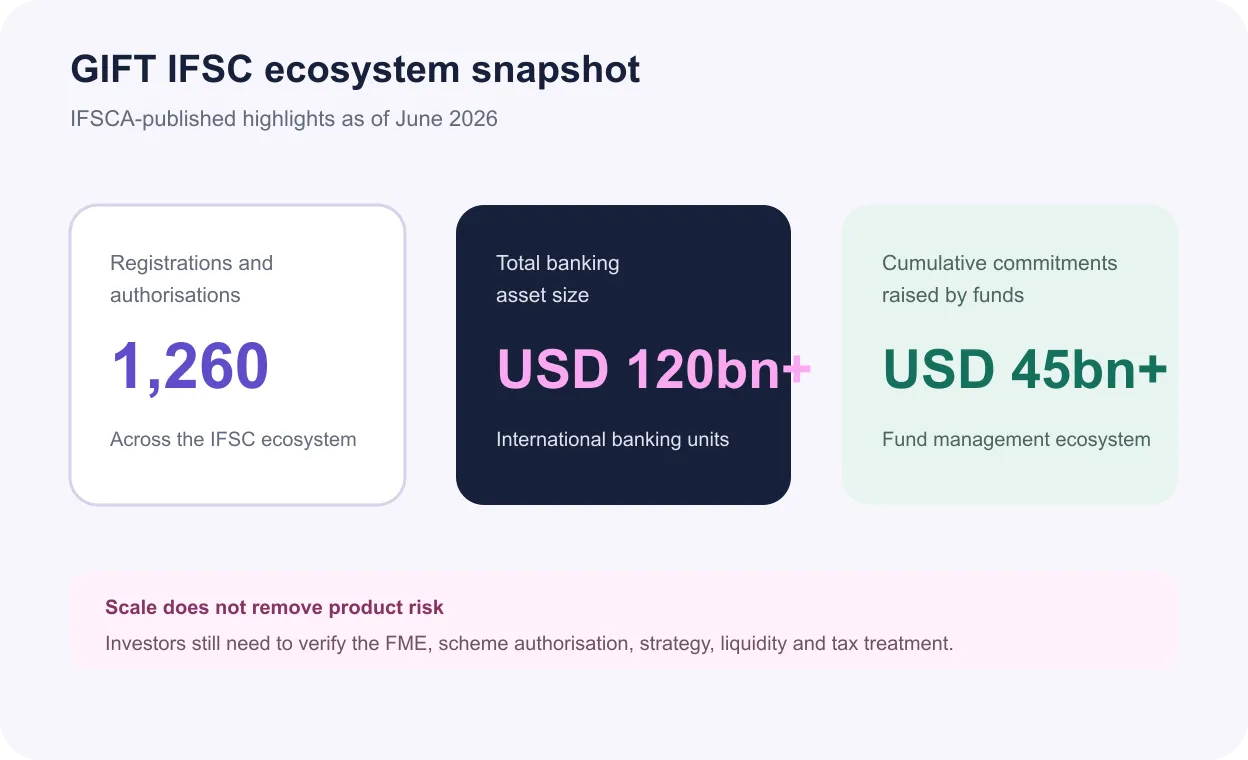
Scale does not make every product suitable. Investors in GIFT City funds India must still examine the manager, scheme authorisation and underlying portfolio.
Types of GIFT City Funds
The 2025 IFSCA regulations, as amended, organise fund management around the FME and scheme type. The main investible categories include retail schemes, exchange-traded funds, restricted schemes and venture-capital schemes.
| Structure | Typical access | Main characteristics |
|---|---|---|
| Retail scheme | All investors or a defined section | Open- or close-ended strategies across permitted asset classes |
| ETF | Eligible exchange investors | Units trade on a recognised IFSC exchange |
| Restricted scheme | Private placement to accredited investors or investors meeting the applicable minimum | Alternative or specialised strategy; investor count and offer rules apply |
| Venture-capital scheme | Accredited or qualifying investors | Close-ended, focused on start-ups or unlisted opportunities |
| Fund of funds | Depends on the parent scheme | Invests through other domestic or overseas funds, adding a layer of fees |
GIFT IFSC funds may also be used for India-focused strategies that register as FPIs when investing in listed Indian securities. Each category has different portfolio, disclosure and governance rules.
Open-ended, close-ended and listed formats
Structure also determines how money enters and leaves. An open-ended retail scheme ordinarily issues and redeems units according to its dealing calendar. A close-ended scheme has a fixed tenure and may offer limited interim liquidity. An ETF trades on an IFSC exchange, so its market price can differ from NAV and investors also need an eligible broker and settlement arrangement.
Restricted and venture-capital pools usually call capital over time and return it as investments are realised. Their cash-flow pattern, valuation frequency and reporting may be very different from GIFT City mutual funds. Investors should map expected capital calls and distributions before committing.
Some GIFT City Funds invest directly in securities. Others allocate through overseas ETFs or underlying funds. A fund-of-funds approach can simplify manager access, but it adds another fee layer and exposes the investor to the liquidity and valuation policies of the underlying vehicles.
Key Benefits of Investing Through GIFT City
The first potential benefit is global access. Depending on the mandate, GIFT City investment funds can hold international equities, bonds, money-market instruments, other funds and permitted derivatives, giving Indian investors another route to geographic and currency diversification.
The second is regulatory proximity. The fund is based in an Indian IFSC under IFSCA rather than an unrelated foreign domicile. Investors can check the IFSCA directory and scheme documents while still obtaining an international product structure.
The third is product range. GIFT City Funds can serve retail investors, accredited investors, institutions, NRIs, OCIs and other eligible participants through different structures. Managers can build India inbound, global outbound and multi-jurisdiction strategies.
Foreign-currency denomination can align the investment with an overseas goal. It also creates currency risk when the investor measures wealth or liabilities in rupees. Currency exposure should be understood rather than described as an automatic advantage.
Tax or operational efficiency may exist for a particular structure, but it is not universal. The benefit must be verified for the specific fund, investor and income stream.
Where the access advantage is most useful
The route can be useful when the desired portfolio is not readily available through a domestic product, such as a specialised global credit mandate, an international sector strategy or an alternative fund aimed at institutional investors. It may also help an NRI or foreign investor access an India strategy through a foreign-currency vehicle governed from the IFSC.
Those advantages should be compared with simpler alternatives. Domestic international funds, Indian ETFs, direct overseas brokerage accounts and conventional offshore funds can provide overlapping exposures. The strongest case for GIFT City funds India is a combination of suitable access, credible management, clear operations and competitive total cost, not the jurisdictional label by itself.
Investors should compare management fee, performance fee, administration, custody, distribution, hedging and underlying-fund expenses. A lower headline tax rate can be outweighed by high recurring costs, wide dealing spreads or unfavourable currency conversion.
Get research like this in your inbox
The week’s research that mattered, in five minutes. Joined by 2L+ investors.
Eligibility and Who Can Invest
Eligibility starts with the offer document. Retail schemes may be offered broadly or to a defined investor segment. Restricted schemes are private placements for accredited investors or investors meeting the applicable regulatory minimum. Under the regulations cited by IFSCA, the restricted-scheme threshold is generally USD 150,000 for a non-accredited investor, subject to current provisions and exemptions.
Venture-capital schemes have their own investor and commitment rules. Employees, directors, accredited investors and other categories can receive specific treatment. A close-ended retail scheme with higher unlisted exposure may also carry a minimum subscription requirement.
Resident Indians must check FEMA and Liberalised Remittance Scheme requirements when capital is remitted to the IFSC. NRIs, OCIs, foreign investors, institutions and family vehicles follow the rules applicable to their status.
Therefore, GIFT City funds India does not mean every Indian resident can enter every scheme at a small ticket size. Confirm residence, accreditation, minimum commitment, permitted currency and source of funds before applying.
How to Invest in GIFT City Funds
The first step in how to invest in GIFT City funds is to define the required exposure. Decide whether the goal is global equity, fixed income, India inbound exposure, alternatives or another mandate. Do not begin with the tax label.
Next, verify that the FME and scheme are authorised under the current IFSCA framework. Read the offer document for investment objective, benchmark, eligible investors, minimum commitment, dealing frequency, lock-in, redemption gates, currency, fees, valuation and conflicts.
Complete KYC, beneficial-owner and tax-residency documentation. A resident may need an IFSC banking channel and Liberalised Remittance Scheme documentation. Subscription may occur through the FME, an authorised distributor, a platform or an exchange for listed units.
Fund the investment in the permitted currency and retain the contract note, account statement and remittance documents. For GIFT City mutual funds , confirm whether NAV dealing, settlement and redemption operate like the domestic process you expect.
Wright Research's guide to international mutual funds for Indian investors helps compare routes, while its mutual fund platform provides a domestic-fund reference point.
Documents and operational checks
Before submitting an application, reconcile the investor name, tax identification number, bank account and remitter details across all forms. Confirm whether the scheme accepts individuals, joint holders, trusts or companies and whether a nominee can be registered. Ask how additional purchases, switches and redemptions are instructed.
For a resident individual, the bank may require the purpose code, declaration and other LRS documentation. Investment limits and prohibited remittances should be checked with the authorised dealer. The fund's base currency and the investor's funding currency may differ, creating conversion spreads at subscription and redemption.
The practical answer to how to invest in GIFT City funds ends only when settlement is understood. Record the dealing cut-off, NAV date, allotment timeline, bank charges, redemption notice and expected credit date. Private funds may require capital-call notices rather than an immediate full subscription.
After allotment, monitor statements, audited financials, portfolio reports and material-event notices. GIFT City Funds should be reviewed against their stated benchmark and currency, not automatically against a domestic rupee index.
Taxation of GIFT City Funds for Indian Investors
Taxation depends on the investor's residence, scheme legal form, underlying assets, source of income, holding period and applicable law. GIFT City Funds do not all receive one investor-level exemption simply because they are based in the IFSC.
The Income-tax Act provides specific exemptions for qualifying specified funds and certain non-resident income streams. Those provisions can be valuable for eligible structures, but they cannot be applied automatically to every resident investor or retail scheme.
A resident Indian may need to report distributions, capital gains, foreign-currency conversion and remittances according to the scheme and tax rules. TCS on a remittance under LRS, if applicable, is generally a collection credit rather than the final tax. The investment may also create disclosure obligations depending on legal ownership and reporting rules.
For GIFT City investment funds , request a written tax note for the specific unit class and investor profile. Independent advice is particularly important for trusts, companies, non-residents and returning Indians because treaty and residency outcomes can differ.
| Question | Why it matters |
|---|---|
| What is the fund's legal and tax classification? | Determines whether specific IFSC provisions may apply |
| Is the investor resident, non-resident or institution? | Changes source, withholding and reporting rules |
| What income is expected? | Interest, dividends, distributions and capital gains can be treated differently |
| Is capital remitted under LRS? | Affects remittance process, limits and possible TCS credit |
| Which currency is used? | Foreign-exchange conversion can affect taxable computation and realised return |
Risks and Points to Check Before Investing
Market and currency risk come first. An overseas portfolio can lose value in its local market, and exchange-rate movement can amplify or reduce the rupee result. Hedged and unhedged classes behave differently.
Liquidity can vary widely. Retail open-ended GIFT City mutual funds may offer periodic dealing, while restricted or venture funds can lock capital for years. Gates, notice periods and side-pocket provisions can delay cash access.
Manager, valuation and custody risk also matter. Review the FME's experience, service providers, independent valuation, audit, conflicts, leverage and derivative use. Fund-of-funds structures may add expense layers and underlying-fund opacity.
Minimum investment does not indicate quality. Some GIFT IFSC funds require large commitments because they are private placements or illiquid, not because returns are safer.
Finally, regulatory and tax rules can change. Verify the September 2026 IFSCA framework, later circulars and the latest tax position at subscription. The right question is not only how to invest in GIFT City funds , but whether the chosen structure improves the investor's total portfolio after fees, tax, liquidity and currency risk.
A due-diligence checklist for the final decision
Confirm the FME registration and scheme authorisation directly through IFSCA. Read the audited track record carefully and separate live performance from backtests or performance earned in a different vehicle. Review concentration limits, borrowing, derivatives, related-party transactions and the procedure for valuing unlisted assets.
Ask who holds the assets, calculates NAV, audits the fund and handles complaints. Check whether redemptions can be suspended and whether the manager can create side pockets. For GIFT City Funds , legal documents take priority over presentations or distributor summaries.
Finally, compare the allocation with the existing portfolio. A global fund may duplicate multinational exposure already present through Indian equities. An India-focused IFSC fund may add little diversification for a resident who already owns broad domestic funds. Suitability depends on the incremental exposure and risk.
See what markets are pricing in
Live indices, sector moves and market breadth — the backdrop to every story we publish.
FAQ
What are GIFT City funds?
They are schemes or funds established in Gujarat International Finance Tec-City’s International Financial Services Centre and managed under the IFSCA fund-management framework. The label covers several structures, not one standard product.
How can I invest in GIFT City mutual funds?
Identify an authorised scheme open to your investor category, review its offer document, complete KYC and banking requirements, and subscribe through the FME, distributor or permitted platform. Resident remittance rules must also be checked.
Are GIFT City funds taxable in India?
Tax depends on investor residence, fund structure, income type, asset location and applicable exemptions or treaty provisions. GIFT status does not create one universal tax outcome for every investor.
What is the difference between GIFT City funds and offshore funds?
A GIFT fund is established in an Indian IFSC and regulated by IFSCA. A conventional offshore fund is established in another jurisdiction and regulated there, although either may invest internationally or into India.
Who can invest in GIFT IFSC funds?
Eligibility depends on the scheme. Retail schemes may be broadly offered, while restricted and venture-capital schemes are aimed at accredited investors or investors meeting applicable minimum commitments.
What is the minimum investment in GIFT City funds?
There is no single minimum for every GIFT fund. Restricted schemes, venture-capital schemes and some close-ended retail schemes have regulatory or offer-document thresholds, while other retail schemes set their own application amount.
GIFT City Funds can expand the opportunity set, but investors should select them by authorised structure and portfolio role. The label alone does not establish eligibility, tax efficiency or suitability.