

On 20 August 2026, India's Directorate General of Foreign Trade opened a tariff rate quota for one million tonnes of raw sugar at zero duty, valid until 31 October. The standing rate on sugar imports was 100 per cent. India is the world's largest sugar consumer and its second-largest producer, and it last imported the commodity for domestic use in 2017-18.
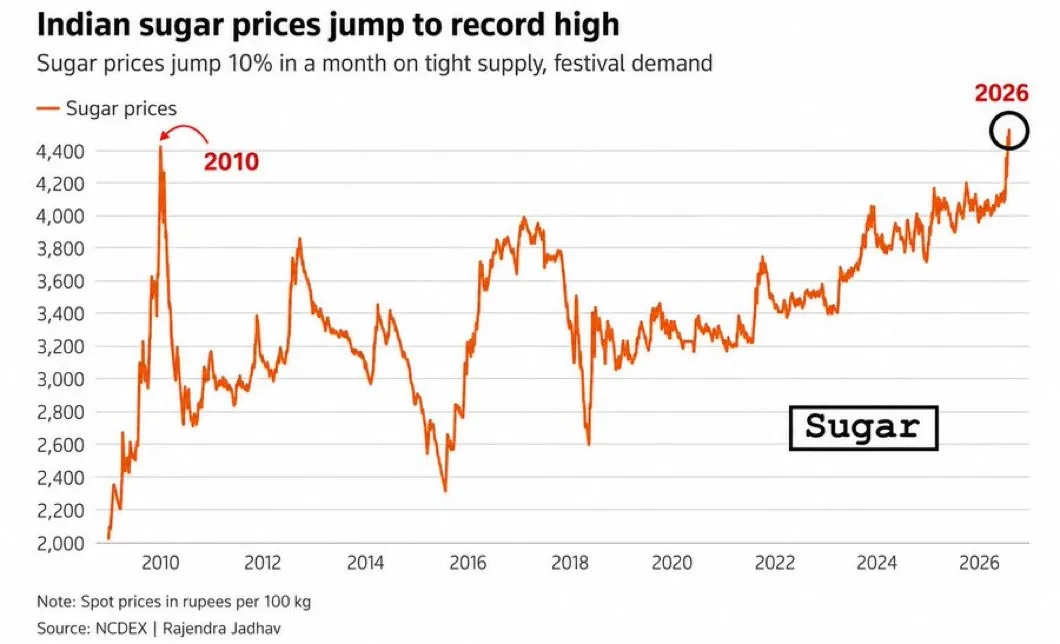
The decision closes a sequence that began in May, when the government banned all sugar exports, and continued through August with stock limits on dealers and bulk buyers. Four instruments were used in four months, all of them aimed at the same problem: a season that produced less sugar than the country consumed, followed by a festival period in which demand peaks.
What did the government actually do in August 2026?
It opened a narrow import window after two rounds of supply-side controls failed to hold prices.
Retail sugar averaged Rs 52.30 a kilogram on 18 August 2026, about 13 per cent above the Rs 46.34 recorded a year earlier, according to consumer affairs ministry data. Prices at the factory gate moved further. The all-India average ex-mill rate reached Rs 5,400 to Rs 5,500 a quintal, against roughly Rs 3,900 twelve months before. Retail rates in parts of Uttar Pradesh and Punjab were reported above Rs 60 a kilogram in mid-August.
The quota itself is tightly drawn. Only companies with in-house refining capacity may apply, applications were open from 21 to 28 August, and the entire refined quantity must be sold inside India by 31 October. Refiners already import duty-free raw sugar under the Advance Authorisation Scheme on condition that it is re-exported after processing. The new measure lets some of that volume be redirected to the domestic market instead. Raw sugar futures in New York rose as much as 4.1 per cent on the announcement before closing close to unchanged, and shares in Indian mills fell the next day.
Table 1: India's sugar interventions, November 2025 to September 2026
Date | Measure | Instrument |
|---|---|---|
Nov 2025 | 1.5 million tonnes of exports released to mills | Export quota |
Feb 2026 | Additional 500,000 tonne export pool opened | Export quota |
13 May 2026 | All sugar exports moved from restricted to prohibited until 30 September | DGFT notification |
1 Aug 2026 | Dealers capped at 30 days of stock and 4,000 quintals, with weekly online declarations | Essential Commodities Act |
20 Aug 2026 | 1 million tonnes of raw sugar at zero duty until 31 October | Tariff rate quota |
1 Sep 2026 | Bulk consumers using over 10 tonnes a month cut to 15 days of stock until 30 November | Essential Commodities Act |
Sources: DGFT notifications, Ministry of Consumer Affairs, Food and Public Distribution, Reuters.
Check the macro backdrop
GDP, inflation, rates and more — India’s key economic indicators in one dashboard.
Why did India run short of sugar?
Three factors combined: a crop that underdelivered, export volumes released against estimates that did not hold, and an ethanol allocation fixed before the season began.
The crop came in well below forecast
The USDA's Foreign Agricultural Service opened the 2025-26 season with a production forecast of 35.2 million tonnes on a raw value basis. By April 2026 it had cut that estimate to 30 million tonnes, a reduction of 14 per cent. Cane production was revised down from 465 to 455 million tonnes after heavy rain across Maharashtra and Karnataka in late August and September 2025 caused waterlogging and damaged ratoon crops. Sugar recovery fell to 8.3 per cent, well under the 10.25 per cent benchmark used to set cane prices. The Indian Sugar and Bio-energy Manufacturers Association put crystal output at 27.2 million tonnes against its own opening estimate of 31 million. However, industry still says that there is no real shortage of sugar this year.
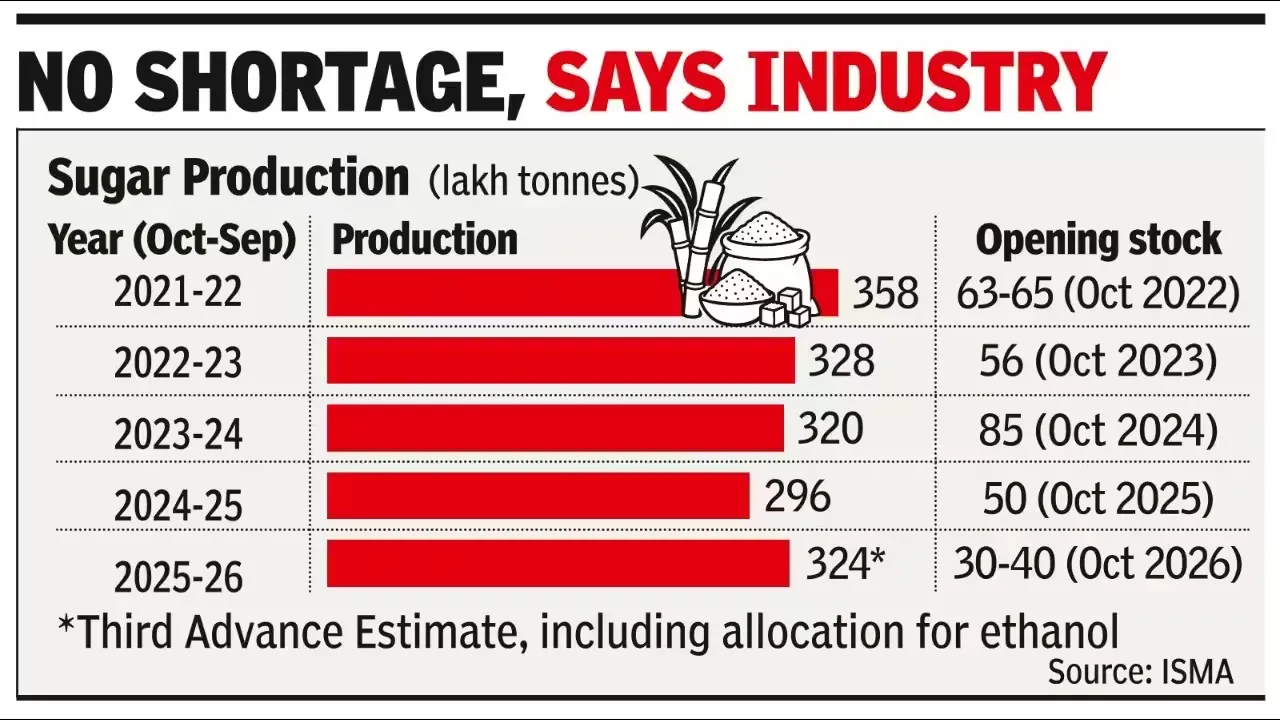
Mills closed early as a result. By the first week of March 2026, 465 of 541 mills had ended crushing operations. A year earlier, 420 mills had closed by late March.
Exports were released on estimates that did not hold
The Food Ministry allowed 1.5 million tonnes of exports in November 2025, based on the production outlook available at that point, and opened a further 500,000 tonne pool in February 2026. On 13 May it reclassified all raw, white and refined sugar exports from restricted to prohibited until 30 September. Roughly 650,000 tonnes had already shipped, with a further 40,000 to 60,000 tonnes contracted and sitting in the physical export pipeline.
Ethanol holds a prior claim on the cane crop
About 3.5 million tonnes of sugar equivalent went to ethanol in 2025-26. India reached 20 per cent ethanol blending in petrol during the 2025-26 supply year, five years ahead of the original target, and E20 became mandatory across all states in April 2026. From 1 November 2025 the government permitted every sugarcane-derived feedstock, including juice, syrup and both B-heavy and C-heavy molasses, to be used for ethanol.
Maize now supplies close to half of India's ethanol, so cane accounts for a smaller share of the blending programme than it once did. The relevant feature is timing rather than volume. Diversion targets are set administratively before crushing begins, which means the quantity of sucrose committed to fuel stays fixed even when the crop disappoints. Sugar available to the domestic market absorbs the entire shortfall.
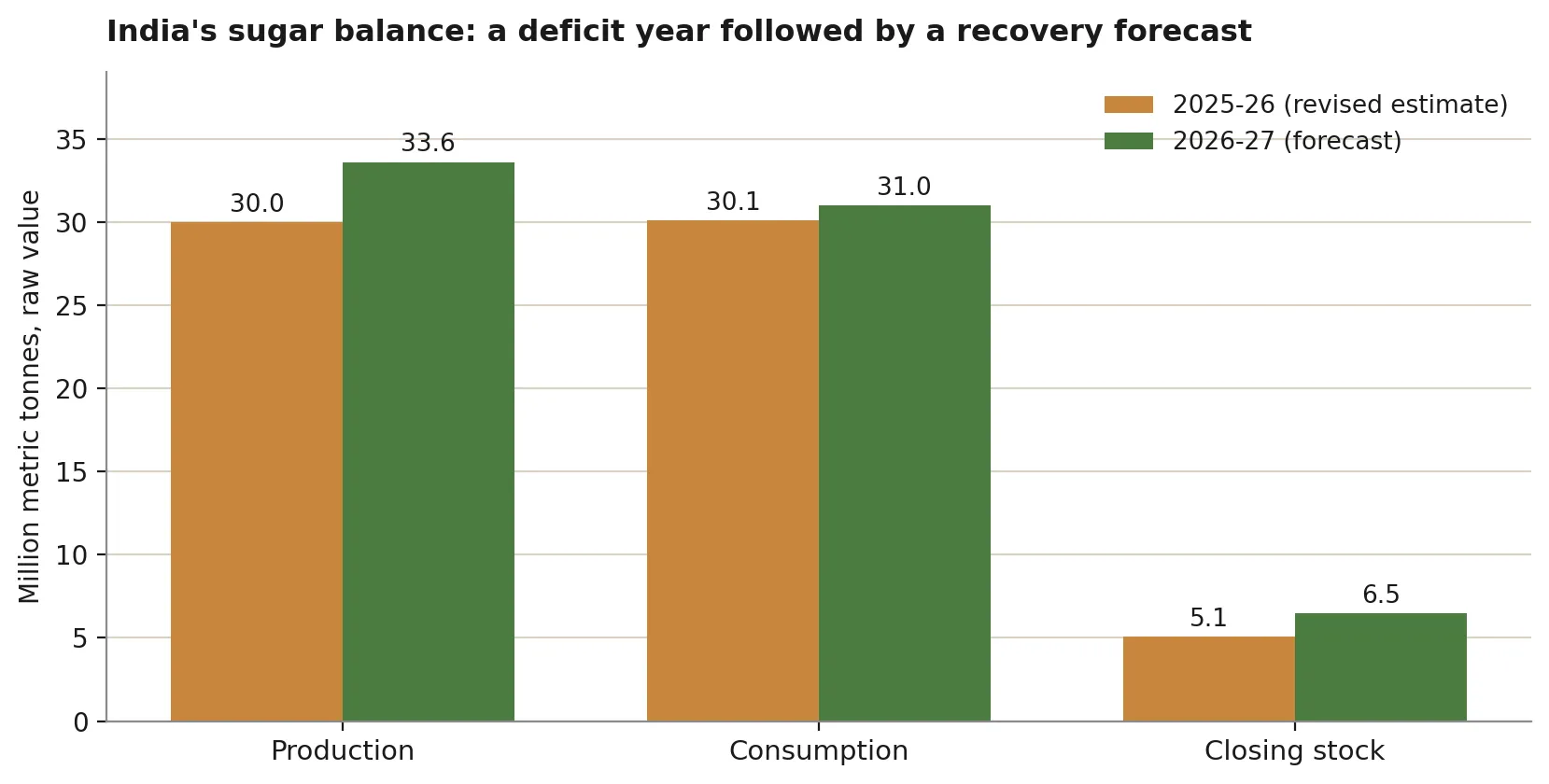
Figure 1: India's sugar balance, 2025-26 and 2026-27
Source: USDA Foreign Agricultural Service, India Sugar Annual, April 2026. Figures are raw value. Industry bodies estimate a lower closing stock of 3 to 3.3 million tonnes of crystal sugar for 2025-26.
Why do these instruments work in only one direction?
Every measure the government used acts on sugar that already exists.
Export bans, stock limits and import quotas redistribute a season's output between exporters, traders, bulk buyers and households. None of them changes how much cane was planted eighteen months earlier or how much sucrose that cane carries. Two of the biggest variables are settled before crushing starts: the Fair and Remunerative Price is fixed by statute, and the ethanol allocation is fixed by policy. What remains adjustable inside a season is where the sugar sits and who may hold it.
The import window makes the limitation visible. Raw sugar has to be contracted, shipped from Brazil, discharged and refined before it reaches a shelf, and the whole quantity must be sold by 31 October. Rahil Shaikh, managing director of MEIR Commodities India, argued that duty-free white sugar would be the faster route to lower prices, because sourcing Brazilian raws and refining them domestically takes time. Mills have separately proposed starting the 2026-27 crushing season 10 to 15 days ahead of the usual early-November opening, which brings supply forward at the cost of lower recovery and reduced cane yields. Industry bodies asked for compensation for those losses, an additional domestic sale quota, or relief on GST for domestic sugar sales.
Get research like this in your inbox
The week’s research that mattered, in five minutes. Joined by 2L+ investors.
What does the pricing structure do to mills and farmers?
It raises one regulated price every year and leaves the other where it was set in 2019.
The Fair and Remunerative Price is the legal minimum mills must pay for cane under the Sugarcane (Control) Order, and non-payment is an offence rather than a commercial dispute. For 2026-27 the Cabinet Committee on Economic Affairs fixed it at Rs 365 a quintal at a 10.25 per cent recovery rate, up from Rs 355. ISMA estimates total cane payments of about Rs 1.3 lakh crore for the coming season across roughly 5 crore cane-growing households. The minimum selling price of sugar, the floor below which mills may not sell, has stood at Rs 3,100 a quintal since February 2019. ISMA has asked for it to be revised to Rs 40 or Rs 41 a kilogram.
The consequence showed up in mill accounts well before it showed up at the till. Industry associations put the pan-India average ex-mill realisation for the season to the end of July 2026 at Rs 40 to Rs 40.5 a kilogram, against an average production cost of around Rs 42. The rally that prompted the August interventions moved realisations above cost for the first time that season. Cane arrears follow the same gap: mills had paid roughly 80 per cent of about $8.9 billion in dues by April 2026, leaving $1.8 billion outstanding, with Karnataka carrying $530 million after two years of clean payment.
Several states add a further layer by setting a State Advised Price above the central FRP, which raises the cane bill in Uttar Pradesh, Punjab, Haryana and Uttarakhand without any corresponding change to the sugar floor. The result is a cost base that ratchets upward on a legislated schedule and a revenue floor that moves only when the Centre chooses to move it.
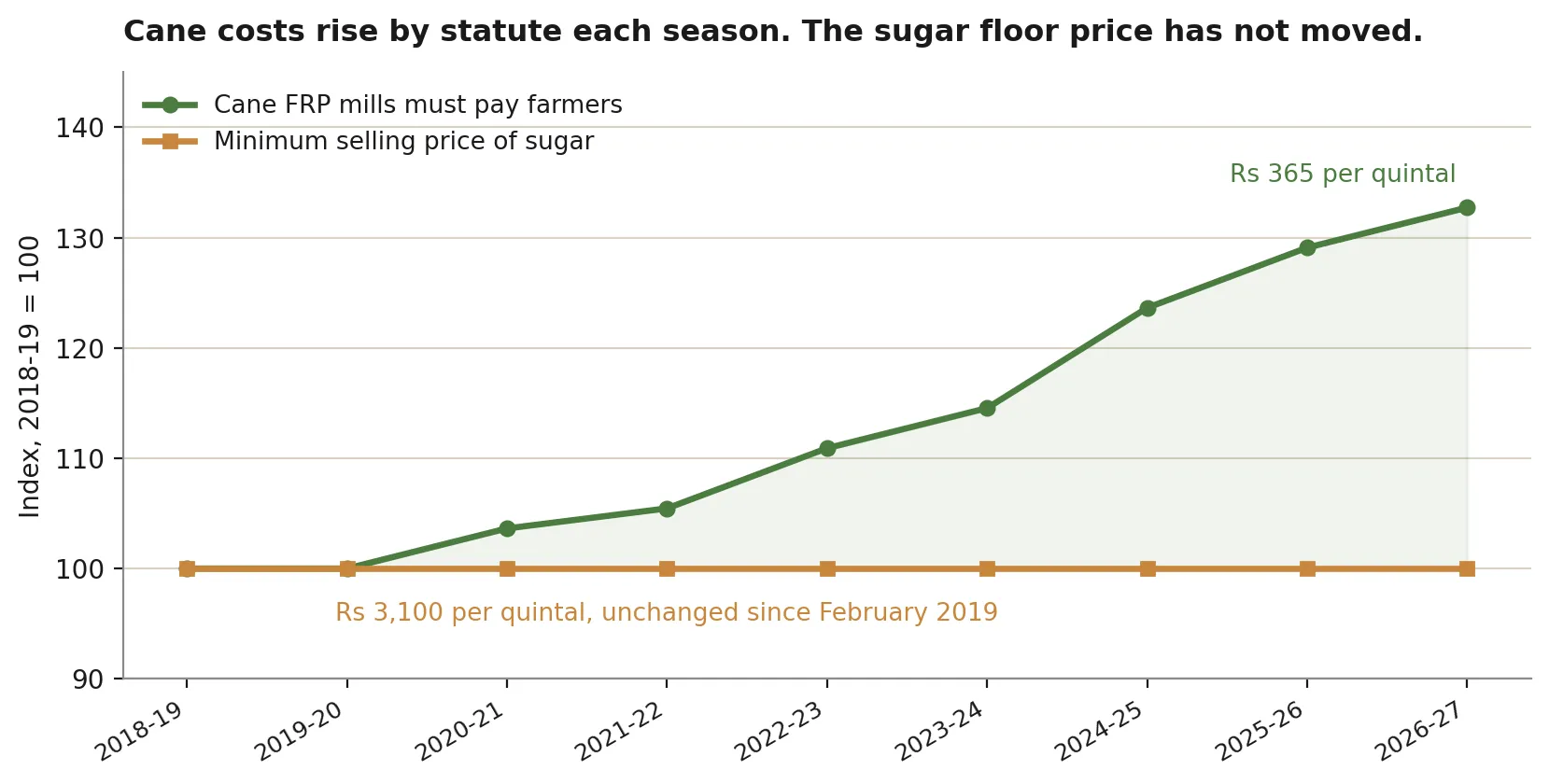
Figure 2: Cane price and sugar floor price, indexed to 2018-19
Sources: Cabinet Committee on Economic Affairs announcements, Department of Food and Public Distribution, USDA FAS.
What does India's shortfall mean for the world market?
It removes a swing supplier at a point when forecasters have already turned negative on the 2026-27 balance.
The estimates differ in size and agree on direction. The International Sugar Organization forecasts world production falling 1.15 per cent to 180 million tonnes in 2026-27, with a deficit of 262,000 tonnes. Green Pool raised its deficit estimate to 3.3 million tonnes in late July, StoneX moved to 1.7 million tonnes, and Covrig Analytics shifted from a small surplus to a 300,000 tonne deficit in early August. Higher crude prices have pushed Brazilian mills toward ethanol, which reduces exportable sugar from the origin that supplies more than half of world trade. London white sugar reached a 16-month high in August 2026.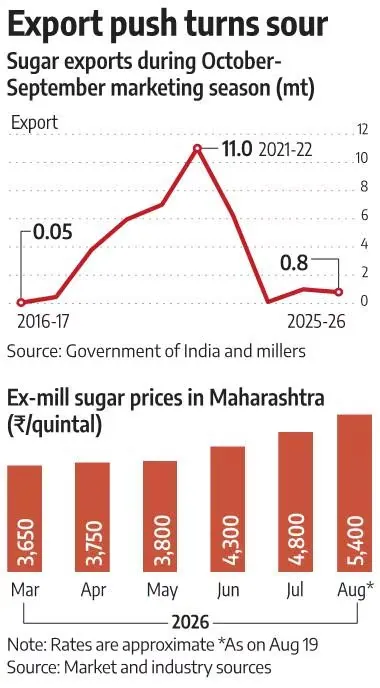
India sits on both sides of that balance. USDA forecasts Indian exports at 3.6 million tonnes for 2026-27, heading mainly to Sudan, Libya and Somalia, alongside 2.4 million tonnes of imports that arrive largely under re-export arrangements. Those flows depend on a domestic balance that the government has spent four months defending, which makes Indian export availability a policy variable as much as an agronomic one. Buyers in Asia and Africa that rely on Indian white sugar have to price that discretion in.
See what markets are pricing in
Live indices, sector moves and market breadth — the backdrop to every story we publish.
What should be watched instead of the retail price?
Four measures give earlier warning than the price at the shop, and all four are already available or easily published.
The first is closing stock. Industry estimates put the carryover on 30 September 2026 at 3 to 3.3 million tonnes of crystal sugar, among the lowest in decades and short of the three to four months of consumption cover treated as a working norm. The Centre ordered physical verification of mill stocks in late July, completed the exercise by 14 August, and has not released the figures. Publishing verified stock data would remove much of the uncertainty that speculative trading feeds on.
The second is the gap between the cane bill and mill realisation, which determines whether farmers can be paid on time without a price spike doing the work. The third is the volume of sucrose committed to ethanol before crushing opens, because that allocation stays fixed while the crop does not. The fourth is rainfall in Maharashtra, Uttar Pradesh and Karnataka, which together account for close to 60 per cent of national output.
On the last point, the 2026-27 outlook is better and conditional. USDA forecasts production at 33.6 million tonnes from 5.9 million hectares at a recovery rate of 9.2 per cent, with domestic output exceeding consumption for the first time in two years. That forecast rests on groundwater restored by two consecutive good monsoons. The 2026 monsoon has run below normal, and Uttar Pradesh recorded a substantial rainfall deficit ahead of planting.
The August decision answered a question about the next two months. The question for the next two seasons is narrower and more useful: how much sugar India can still hold in reserve at the end of a poor year, and which regulated price the system is prepared to move in order to get there.