

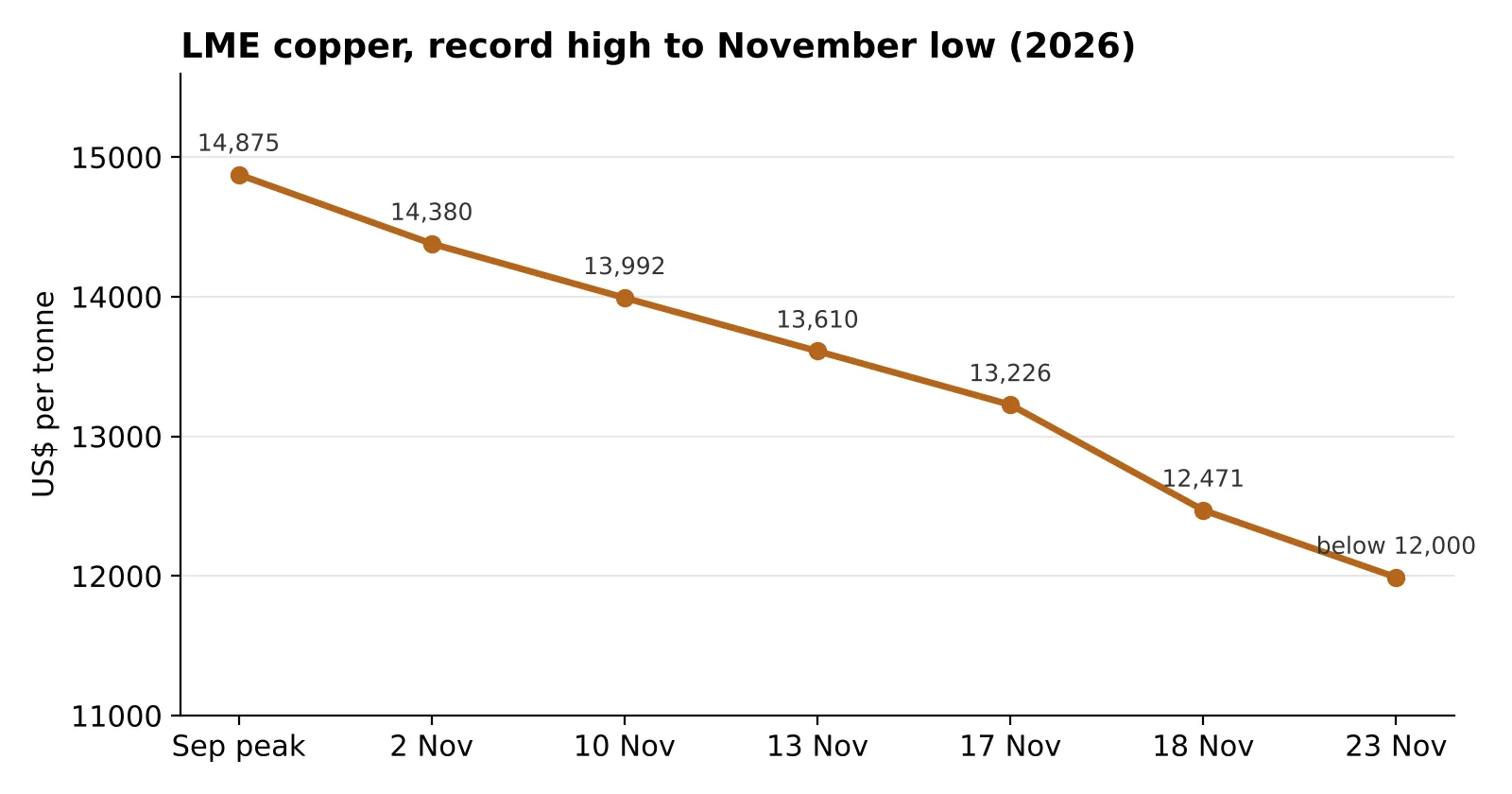
Copper set a record of US$14,875 a tonne on the London Metal Exchange (LME) in September 2026. Ten weeks later it briefly traded below US$12,000. In India, Finolex Cables cut prices on copper-armoured cables by 5% to 6% in November, its second price cut in a month, and other cable makers were expected to follow.
Physical supply and demand changed little over those ten weeks. The fall came from two trades built on top of the physical market: investors using copper as a way to bet on artificial intelligence, and traders moving metal into the United States ahead of a tariff. Both trades are now unwinding. This article explains how they formed, what their reversal says about the global economy, and why India sits on the favourable side of the move.
Why did copper fall so fast in November?
LME copper dropped about 9% in the week to 20 November, its steepest weekly fall in more than 19 months. US copper on Comex lost about 15% over the month and now sits close to where it began the year. On India's MCX, copper fell from above ₹1,400 per kg in early October to ₹1,152.90 on 20 November.
The selling was broad. Aluminium fell about 6% and gold about 9% in the same week. The common cause was US monetary policy. October inflation came in hotter than expected, and markets now treat a Federal Reserve rate increase in December as close to certain. The dollar index reached a 19-month high on 17 November. A stronger dollar raises the cost of metals for buyers paying in other currencies, and higher rates raise borrowing costs for builders and manufacturers.
Monetary policy explains the timing. Two other forces explain the size of the fall.
Check the macro backdrop
GDP, inflation, rates and more — India’s key economic indicators in one dashboard.
When did copper start trading like a technology stock?
Copper has long been read as a gauge of industrial activity. In 2026 it also became a proxy for AI. Data centres need large amounts of electricity, and the cables, transformers and grid connections that deliver it use copper. ING found that from around April 2026 copper moved in step with the S&P 500, the largest US technology stocks and the Philadelphia semiconductor index far more often than before. StoneX reported that copper's correlation with US technology stocks reached its highest level since 2012.
The physical link is smaller than the price link suggested. StoneX estimates that AI and data centres account for under 2% of global copper demand. Kpler puts the AI-specific addition to 2026 demand at roughly 100,000 to 200,000 tonnes, in a market that consumes about 28 million tonnes a year.
When AI stocks fell, copper followed. Nvidia shares dropped as much as 14% on 12 November after Jensen Huang resigned as chief executive. The Democratic victory in the US midterms raised doubts about the pace of data centre construction and the prospect of new regulation. Hedge funds cut their bullish copper positions by nearly two-thirds between late September and 17 November, and Stan Druckenmiller, the most prominent investor linking copper to AI, said he now expects the price to fall.
Our earlier analysis of AI listings described a chain in which investor money flows into AI companies, which pay cloud providers, which buy chips and build data centres. Copper became one more asset priced on how long that chain keeps growing.
How did a tariff that never arrived pull copper into America?
In February 2025 the US opened a national security review of copper imports. Traders expected a tariff of about 25% and shipped refined copper to the US ahead of it. US copper imports rose 80% in 2025 to 1.64 million tonnes. The administration then imposed a 50% tariff on semi-finished copper products, exempted refined copper, and placed a phased tariff of 15% from 2027 and 30% from 2028 under review.
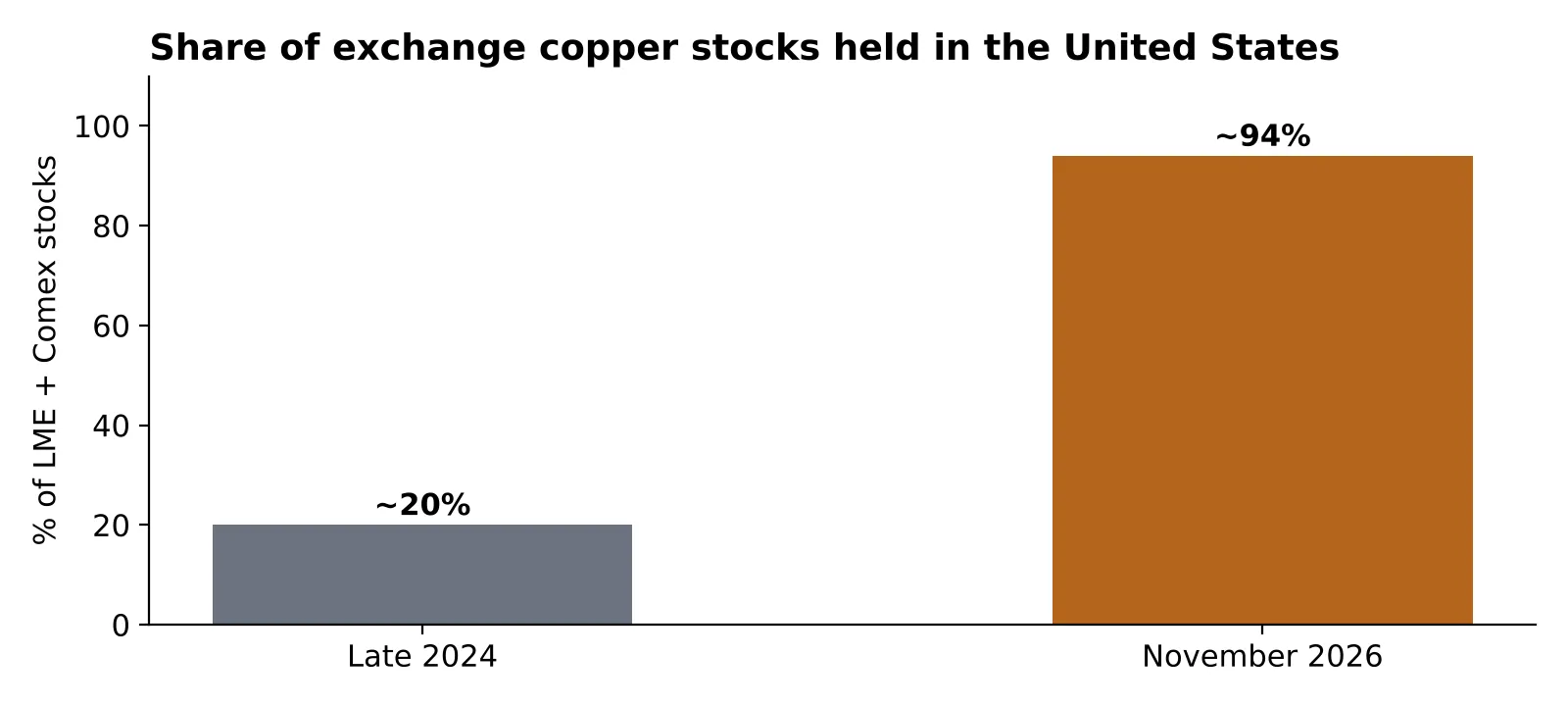
The prospect alone was enough. The US now holds roughly 2 million tonnes of refined copper, about 7% of a year's global consumption. Its share of the copper held in LME and Comex warehouses rose from about 20% two years ago to about 94%.
The rest of the world felt the shortage. China, which uses about half the world's copper, was hit hardest. Copper stocks in Shanghai Futures Exchange warehouses fell to their lowest in almost three years, and Chinese importers paid record premiums over the benchmark price even as demand inside China weakened.
After the midterms, traders began to doubt that the refined copper tariff would happen. The premium on US-delivered copper disappeared and the US price slipped slightly below the global benchmark. Only tens of thousands of tonnes have left the US so far, mostly bound for China. If more of the stockpile flows back, the global market looks well supplied for the coming year.
Our analysis of semiconductor geopolitics found that controls on materials act faster than new factories. Copper shows the same principle from the importing side: an unconfirmed policy moved a large share of the world's tradeable metal into one country in about 18 months.
Get research like this in your inbox
The week’s research that mattered, in five minutes. Joined by 2L+ investors.
Has the long-term case for copper changed?
The long-term case rests on slow supply and rising electrical demand, and both remain in place. An electric vehicle uses about 80 to 90 kg of copper, roughly four times a conventional car. Grids, renewable power and data centres add to that. Ore grades are falling, the easiest deposits have been mined, and a new mine takes around 18 years to develop. BloombergNEF projects a supply gap of 20 million tonnes by 2050, equal to 44% of projected demand.
The near term looks looser. The International Copper Study Group (ICSG) expects a refined copper surplus of about 104,000 tonnes in 2026, widening to 368,000 tonnes in 2027 as smelter output recovers. The binding constraint sits at the mine. Adani's Kutch Copper smelter in Gujarat bought just over a quarter of the ore concentrate it needed between February 2024 and February 2026.
Force | What drove it | Where it stands now |
|---|---|---|
Electrification | EVs, grids, renewables, data centre power; slow new mine supply | Intact; deficits expected after 2027 |
AI proxy trade | Funds bought copper as a bet on data centre spending | Unwinding; hedge fund bullish bets down about two-thirds |
US tariff trade | Traders stockpiled refined copper in the US ahead of a possible duty | Reversing; about 2 million tonnes could return to world markets |
What does cheaper copper say about the global economy?
Copper is responding to tighter money more than to weaker growth. The IMF's October 2026 World Economic Outlook expects world growth of 3.1% this year and 3.4% in 2027, with global inflation at 4.7% after the energy shock linked to the Middle East conflict. Those figures describe a world economy slowing at a moderate pace with an inflation problem that central banks are still fighting.
China remains the weak point. Its property sector continues to drag on construction demand, and some estimates show Chinese copper use contracting this year. A recovery in Chinese buying would absorb much of the metal leaving the US. Its absence would keep prices under pressure into 2027.
Lower copper prices also ease one source of cost inflation. Wiring, motors, transformers and appliances all contain copper, so a lower price reaches manufacturers and consumers with a lag of a few months.
Why is India on the receiving side this time?
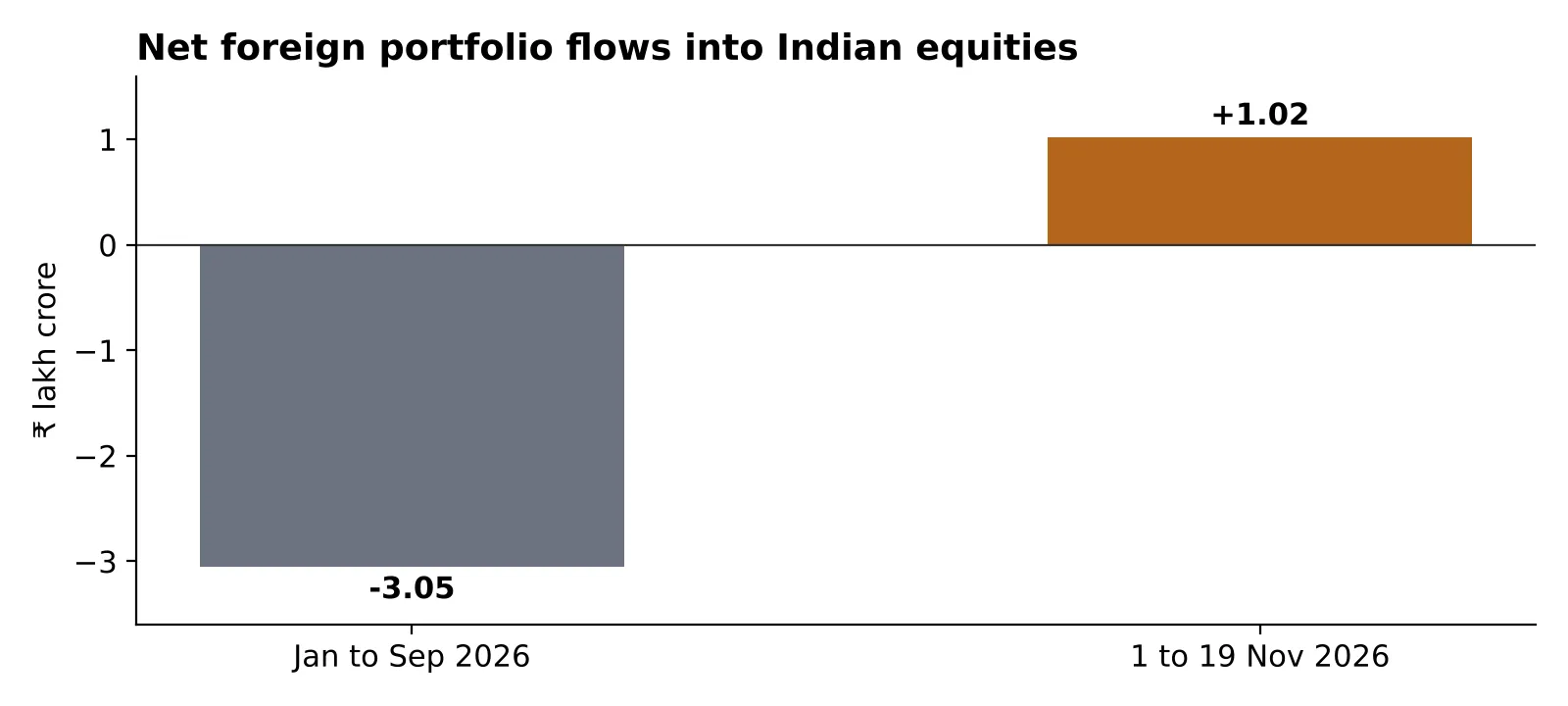
In our October analysis, India was a source of funds for the AI trade. Foreign portfolio investors sold a record ₹3.05 lakh crore of Indian equities in the first nine months of 2026 as global money moved into US technology stocks, Taiwan and South Korea. November reversed that. Foreign investors put more than ₹1 lakh crore into Indian equities by 19 November, after six straight months of selling, while Taiwan and South Korea saw outflows. The Nifty 50 gained 8.6% in the week to 6 November, its strongest week since February 2021.
The same forces that pushed copper down helped India. A retreat from AI-linked assets favoured a market with few AI hardware companies. Cheaper oil eased pressure on inflation, the current account and the rupee, which strengthened to about 93.9 per dollar from 95.4 within a week. Cheaper copper lowers the import bill further.
India depends on imports for its copper. Ore concentrate made up about 85% of its copper imports in 2025, and the country also imports 300,000 to 500,000 tonnes of refined copper a year. Demand is expected to grow about 10% a year, from around 2 million tonnes in 2026 to 3.3 million tonnes by 2030. Every fall in price lowers the cost of power lines, metro rail, housing, electric vehicles and the data centres that Reliance and Adani have announced. The IMF projects Indian growth of 7% in 2026, the fastest among major economies.
Large caps or small caps: who is winning?
Nifty, midcap and smallcap returns from one day to ten years, with the spread and valuation by segment.
Which Indian stocks feel cheaper copper first?
Copper producers take the first hit
Hindustan Copper earns from mining and selling the metal, so its earnings track the price. Its shares fell about 2.6% on 18 November despite a 182% rise in second-quarter profit. Hindalco and Vedanta, which also run copper businesses, fell with the wider Nifty Metal index.
Cable makers face an inventory squeeze
Cable companies pass copper costs to customers under a cost-plus model, so lower prices should support volumes over time. The short-term effect is negative. Dealers built up stock expecting higher prices and may now delay orders, and companies holding high-cost inventory lose margin as selling prices are cut. Shares of Polycab, RR Kabel and Finolex Cables fell 6% to 10% in the week to 19 November. The sector was already under pressure after UltraTech entered the wires market in September.
Copper users gain over several quarters
Power equipment makers, electrical goods companies, EV makers and utilities pay less for a key input. Their gains show up gradually as supply contracts and tenders reprice.
Channel | What is happening | Effect on India |
|---|---|---|
Import bill | Copper and oil prices both lower | Smaller trade deficit, firmer rupee |
Portfolio flows | Global funds trim AI-heavy markets | Over ₹1 lakh crore of FPI buying in November |
Metal producers | Lower realisations on copper sold | Pressure on Hindustan Copper, Hindalco, Vedanta |
Cables and wires | Price cuts and dealer destocking | Near-term margin squeeze, volume support later |
Infrastructure | Cheaper input for grids, EVs, data centres | Lower project costs as demand grows about 10% a year |
Copper's long-term case rests on electricity, and that case still holds. The November fall reflects two financial positions being closed. For India, which buys most of its copper abroad and had been losing capital to AI-heavy markets, the unwinding has delivered cheaper inputs and returning investors at the same time. How long that lasts depends on decisions in Washington and on AI sentiment more than on output at the mines.