


Two financing events this autumn show where global investment capital is heading. Anthropic is preparing a stock market listing that could value the company at up to US$2 trillion before the end of November. OpenAI has pushed its own listing into 2027 and is instead seeking at least US$30 billion in private money at a US$1.4 trillion valuation. Both companies are raising capital to pay for computing commitments measured in hundreds of billions of dollars.
Capital raised for AI has to come from somewhere, and the money that funds these companies leaves other assets and other countries. This article looks at what the two deals reveal about the economics of frontier AI, how they move money through stock indices and the world economy, and why India currently sits on both the paying side and the receiving side of that movement.
What are Anthropic and OpenAI asking investors to fund?
Both companies are selling the same proposition: revenue is growing very quickly, and costs are growing alongside it. Anthropic's prospectus, reported in late September, shows revenue of nearly US$4.6 billion in 2025 and an operating loss of more than US$8 billion. Growth has since accelerated, with revenue of US$11.5 billion in the second quarter of 2026 alone and a second consecutive quarter of adjusted operating profit in sight. Against that, the company lists about US$518 billion in planned spending on cloud, computing and infrastructure in the coming years. Two customers accounted for nearly a quarter of 2025 revenue.
OpenAI closed a US$122 billion round at an US$852 billion valuation in March, backed by SoftBank, Amazon and Nvidia. Its new round, reported by Bloomberg on 29 September, is described as bridge financing in place of an IPO. The company's annualised revenue run rate is approaching US$70 billion.
Table 1: Two routes to the same capital
Anthropic | OpenAI | |
|---|---|---|
Route | Public listing, roadshow planned for the week of 9 November | Private round, IPO deferred to 2027 |
Last completed valuation | US$965bn (May 2026) | US$852bn (March 2026) |
Valuation now sought | US$1.8tn to US$2tn | About US$1.4tn |
Latest revenue signal | US$11.5bn in Q2 2026 | Run rate approaching US$70bn |
Stated compute plans | About US$518bn | About US$1.4tn over eight years (stated in late 2025) |
Main strategic backers | Amazon, Alphabet | SoftBank, Amazon, Nvidia, Microsoft |
Sources: Reuters, Bloomberg, TechCrunch, Fortune, CNBC, company announcements.
The valuation curve has steepened sharply
Anthropic's valuation rose from US$61.5 billion in March 2025 to US$965 billion in May 2026. OpenAI's rose from US$300 billion to US$852 billion over a similar period. The IPO target implies a further doubling for Anthropic within six months. Each step up has been justified by revenue growth, and each step also raises the amount of revenue the companies must eventually earn to support the price.
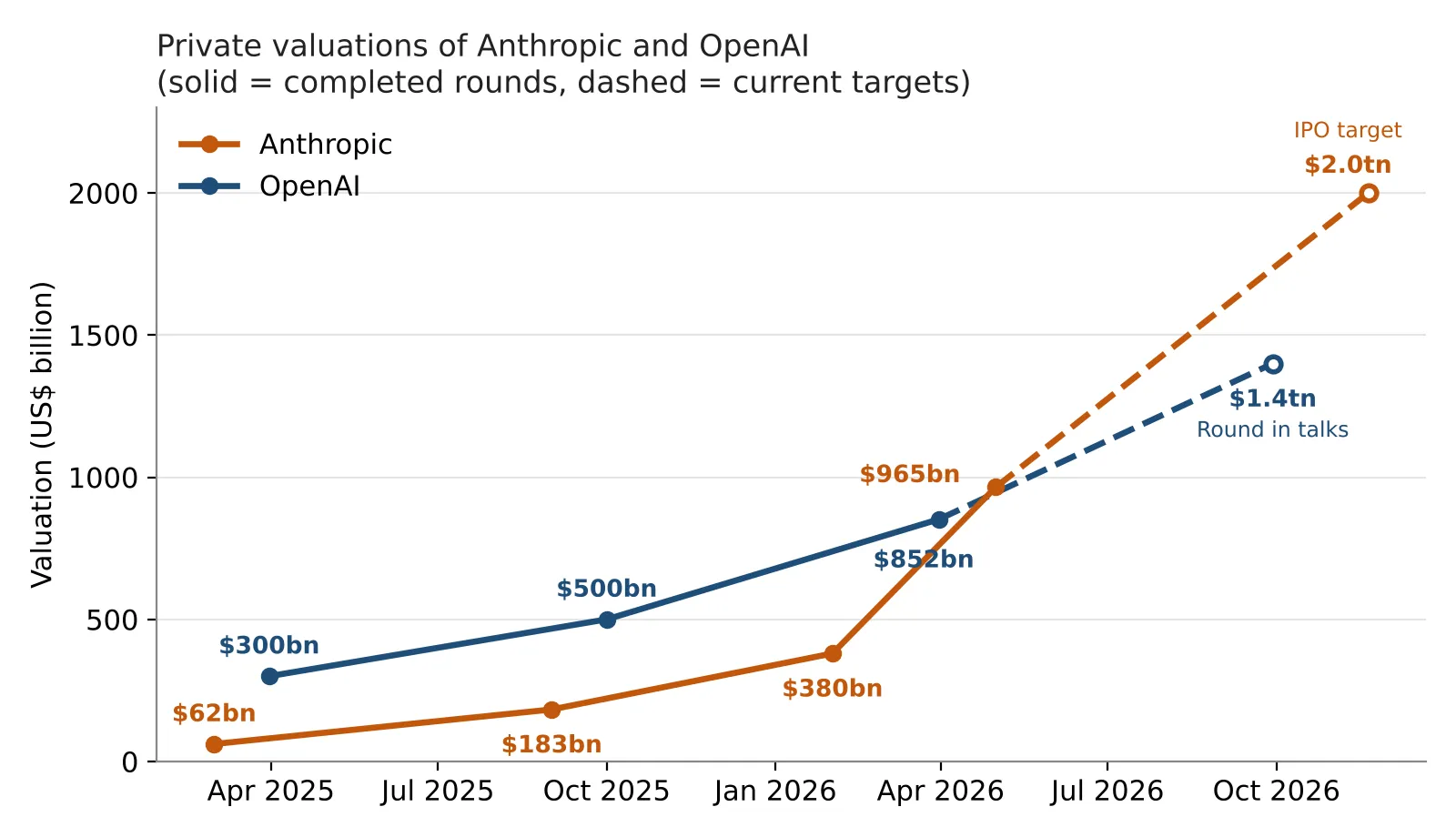
Figure 1: Private valuations of Anthropic and OpenAI, 2025 to 2026
Source: company announcements, Bloomberg, Reuters. Dashed lines show valuations under discussion.
See what markets are pricing in
Live indices, sector moves and market breadth — the backdrop to every story we publish.
Why does one company's listing affect every index investor?
Index rules turn a single IPO into a market-wide reallocation. Nasdaq now allows large new listings to join the Nasdaq-100 within 15 trading days of their debut. Funds that track the index must then buy the new stock, and they fund those purchases by selling what they already hold. JPMorgan has estimated that a US$2 trillion company floating half its shares could force passive funds to sell about US$95 billion of the eight largest technology stocks.
SpaceX provided the first test. It listed on 12 June at US$135 a share, raised about US$75 billion at a valuation of US$1.77 trillion and entered the Nasdaq-100 after 15 trading days. By late July the stock had fallen roughly 50% from its post-listing peak and was trading below its issue price. Index funds bought at the top of the move because the rules required them to.
New stock supply is arriving late in the cycle
SpaceX, Anthropic and, in 2027, OpenAI together represent several trillion dollars of new equity entering public markets within about 18 months. Large share sales tend to cluster when valuations are high, because that is when issuers get the best price. IPO sentiment has already softened: the wearables maker Oura has postponed its offering. A weak debut for Anthropic would test whether investors are willing to absorb this supply at current prices.
Is AI spending now holding up the global economy?
The International Monetary Fund expects global growth of 3.0% in 2026 and 3.4% in 2027, after an oil shock linked to the closure of the Strait of Hormuz earlier in the year. In its July update the Fund credited AI hardware exports and investment for stronger forecasts in economies such as South Korea. It also listed a market correction driven by a reassessment of AI profitability among the main downside risks.
The scale of that investment is visible in corporate guidance. Amazon, Alphabet, Microsoft and Meta plan combined capital expenditure of about US$730 billion in 2026. Alphabet alone has raised its plan twice this year, to roughly double its 2025 figure.
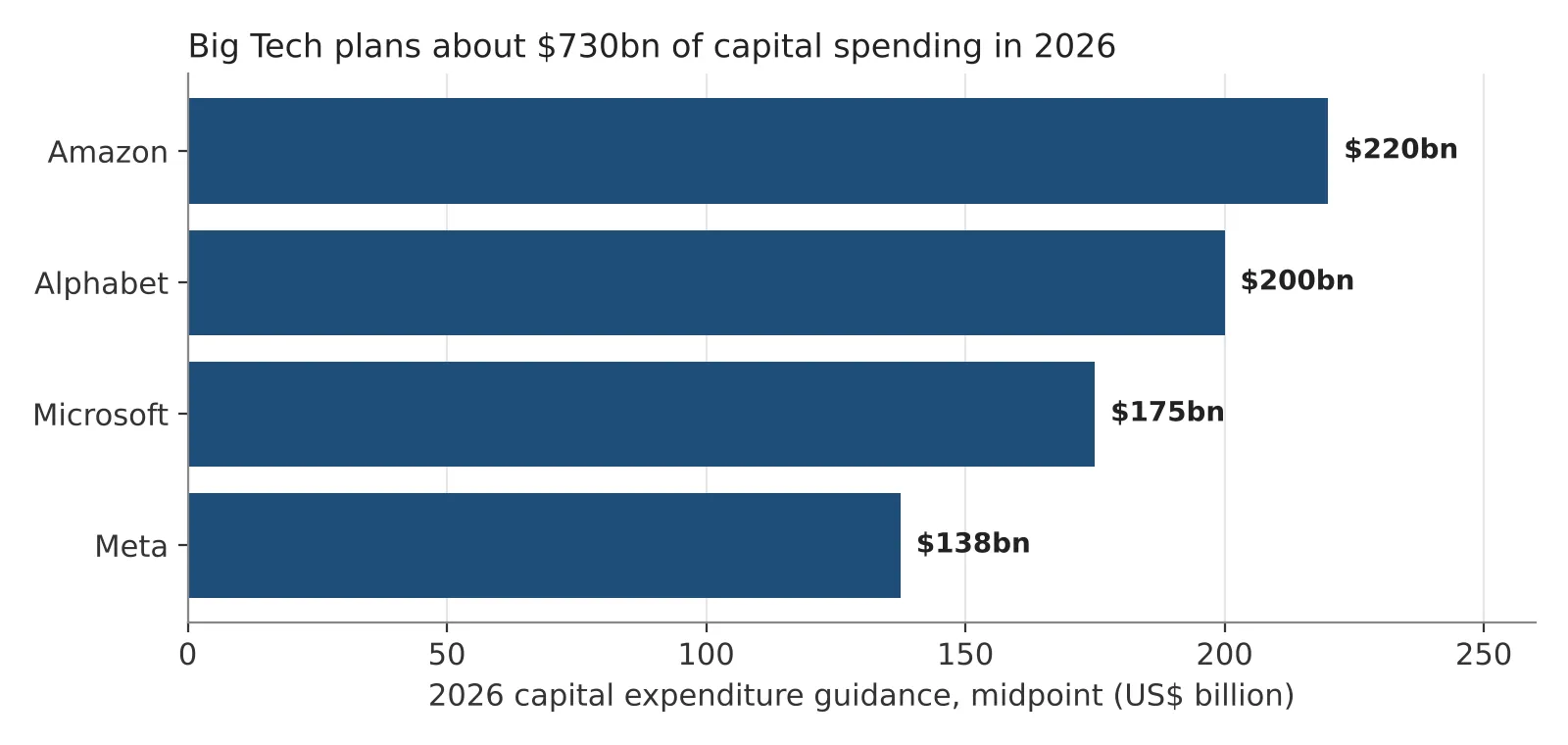
Figure 2: 2026 capital expenditure guidance of the four largest cloud and platform companies
Source: company earnings guidance compiled by Yield Theory, updated 30 September 2026.
The same money appears on several balance sheets
Much of this spending is connected. Amazon and Alphabet are shareholders in Anthropic and also sell it cloud capacity. Nvidia invests in OpenAI and sells it chips. Investor money flows into the AI companies, which pay the cloud providers, which buy chips and build data centres. This chain supports chip sales, construction, power generation and employment across several economies. It also means that a slowdown at the end of the chain, in revenue from AI products, would travel quickly back through every link. The IPO price is, in practical terms, the market's estimate of how long this chain can keep growing.
Get research like this in your inbox
The week’s research that mattered, in five minutes. Joined by 2L+ investors.
Why has India been on the paying side of the AI trade?
Foreign portfolio investors sold a record ₹3.05 lakh crore of Indian equities in the first nine months of 2026, more than in the whole of 2025 or 2024. Higher US bond yields, a strong dollar and expensive crude oil all played a part. A further reason is allocation. Global funds that wanted exposure to AI bought US technology stocks and the chip-heavy markets of Taiwan and South Korea. India has few listed companies that sell AI hardware or frontier models, so it was a natural source of funds.
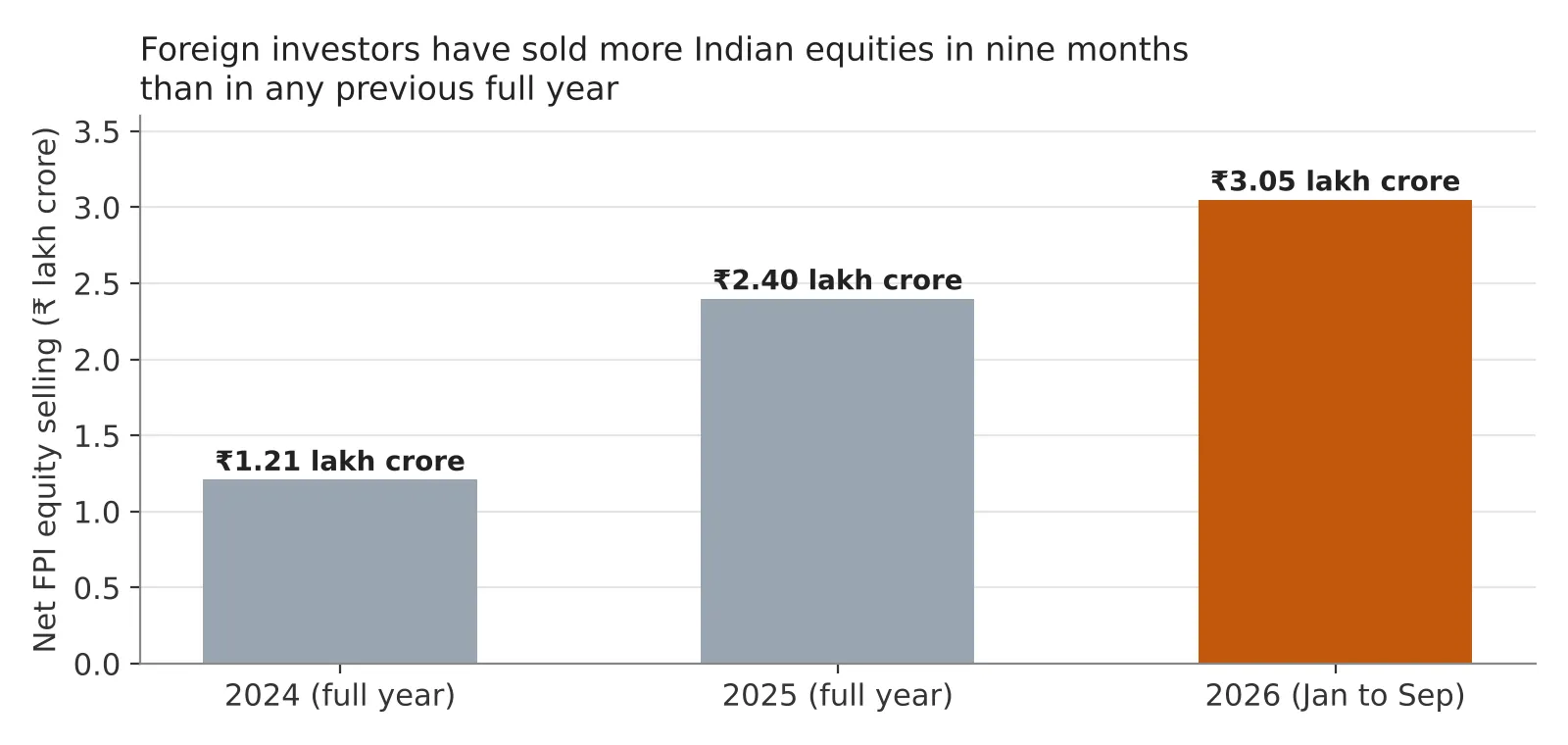
Figure 3: Net foreign portfolio selling of Indian equities
Source: NSDL data via The Economic Times and PTI, October 2026.
The pressure has shown up in prices. The Nifty 50 fell 6.1% in September, its sharpest monthly decline since March. The rupee reached a record low of 96.84 to the dollar in May, after Brent crude touched US$118 a barrel in April. The Reserve Bank of India has sold dollars and opened a special deposit window for non-resident Indians to offset the outflows.
Indian IT services were repriced as AI's first casualty
On 4 February, the day Anthropic released its Claude Cowork agent, the Nifty IT index fell nearly 6% in a single session. The reaction reflected a direct link between the two businesses. Indian IT is a US$300 billion industry employing about five million people, and a large share of its revenue comes from tasks such as testing, documentation, data processing and routine coding. These are the tasks that AI agents are now designed to perform. Once Anthropic is listed, its quarterly disclosures on enterprise adoption will become a regular input into how investors value TCS, Infosys and their peers.
Where does India gain from the same flow of money?
India is also one of the largest users of the products being financed. Anthropic opened its Bengaluru office in February and reported that India had become Claude's second-largest market, with revenue there doubling in four months. Indian companies including Air India, CRED, Swiggy and Razorpay use its models. OpenAI is also expanding its local presence.
The infrastructure commitments are larger still. At the India AI Impact Summit in February, Reliance announced US$109.8 billion of AI and data infrastructure investment over seven years, and the Adani Group committed US$100 billion to renewable-powered data centres by 2035. TCS signed OpenAI as the first customer of its new data centre business. Each AI company's compute budget has to be spent on land, power, buildings and engineers somewhere, and India is competing for a share of that spending. The IMF projects Indian growth of 6.4% in 2026 despite the energy shock.
Table 2: How the AI financing cycle reaches India
Channel | What is happening | Effect on India |
|---|---|---|
Portfolio flows | Global funds favour US tech, Taiwan and South Korea for AI exposure | Record FPI selling and pressure on the rupee |
IT services | AI agents automate outsourced tasks | Lower valuations and slower hiring in a large employer |
Data centres and power | Reliance, Adani and global firms build AI capacity | Capital spending, construction and power demand |
Enterprise adoption | India is Claude's second-largest market | Productivity gains for Indian companies that adopt early |
Domestic listings | Reliance Jio and AI-linked issuers prepare IPOs | Local routes for investors seeking AI exposure in India |
Sources: NSDL, Rest of World, Anthropic, CNBC, Reliance Industries AGM 2026.
Is your portfolio built for what’s coming?
Get a free AI-powered review of your holdings — risk, overlap and quality in minutes.
What would make capital flow back toward India?
The answer depends on how the Anthropic listing trades. A strong debut followed by steady earnings would confirm the case for AI-heavy markets and keep money moving toward the United States, Taiwan and South Korea. A weak debut, or a SpaceX-style fall after listing, would prompt investors to reassess AI valuations more broadly. V K Vijayakumar of Geojit Investments has argued that if AI enthusiasm fades, some of the capital that left India could return.
Domestic factors matter too. Lower crude prices would ease India's import bill and support the rupee. Indian IT firms that show growing revenue from AI implementation work would change how investors classify the sector. Listings such as Reliance Jio would give foreign funds a way to buy Indian exposure to digital and AI infrastructure.