


India does not impose an annual central wealth tax merely because an individual owns a large portfolio, valuable property or other high-value assets. The former levy was abolished from assessment year 2016-17. However, high-net-worth individuals still face income tax, capital-gains tax, surcharges, reporting duties and asset-specific charges.
That distinction matters. A search for wealth tax India rules can otherwise mix an abolished law with taxes that remain active. This guide states the 2026 position and explains where professional advice is essential. Tax treatment depends on residence, entity structure, asset type and transaction facts.
Wealth Tax in India: Is It Still Applicable in 2026?
No annual levy under the Wealth-tax Act applies for assessment year 2016-17 onward. Therefore, wealth tax India is not calculated today on a resident's aggregate net wealth under that former framework.
This does not erase old liabilities. The Income Tax Department still supports Form BB for notices relating to earlier assessment years, including 2014-15 and 2015-16. It also does not prevent Parliament or states from imposing other taxes connected with income, transfers or property.
See what markets are pricing in
Live indices, sector moves and market breadth — the backdrop to every story we publish.
What Was Wealth Tax?
The Wealth-tax Act, 1957 imposed an annual tax on specified net wealth above the prevailing threshold. It applied to covered persons and included specified assets after permitted debts and exemptions. The old regime did not simply tax every rupee of every asset.
Current explanations of wealth tax India should not use that historical asset list as a present filing checklist. It remains relevant only for legacy assessments, notices or litigation for years when the Act applied.
When and Why Wealth Tax Was Abolished
The Finance Act, 2015 abolished the levy from assessment year 2016-17. In the 2015 Budget speech, the government said wealth-tax collection was ₹1,008 crore in 2013-14 and described the levy as high-cost and low-yield. It proposed replacing it with an additional 2% surcharge on taxable income above ₹1 crore.
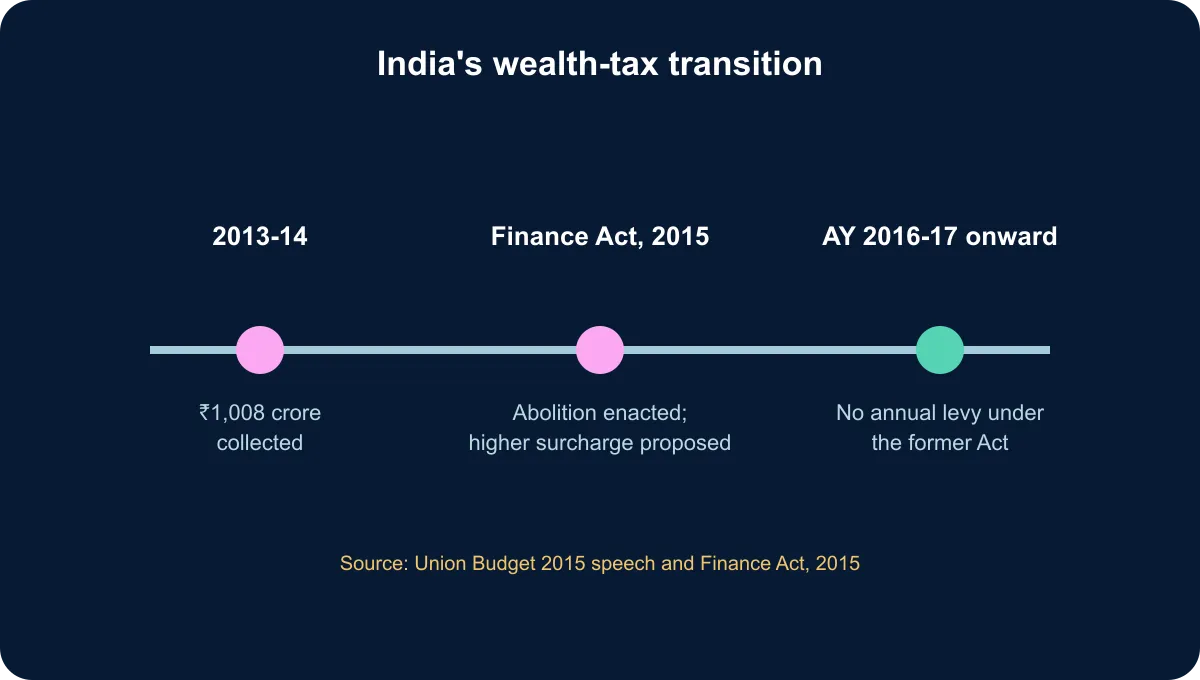
The phrase wealth tax abolished India describes that specific legislative change. It does not mean affluent taxpayers stopped paying more overall, because surcharge and transaction-level taxes continued under income-tax law.
What Taxes HNIs Need to Consider Instead
An HNI's obligations now arise from income, transactions, ownership location and legal structure rather than a single annual net-wealth charge.
| Area | Current relevance | Planning question |
|---|---|---|
| Income and surcharge | Income is taxed by category; surcharge may apply at higher income levels | Which entity earns the income and which regime applies? |
| Capital gains | Sale of shares, funds, property or other capital assets can trigger tax | What are the holding period, cost and exemptions? |
| Dividends and interest | Generally included under applicable income-tax rules | Is tax withholding and estimated tax adequate? |
| Property charges | Stamp duty and registration arise on transfers; municipal taxes depend on location | Has each jurisdiction and transaction been reviewed? |
| Overseas assets | Residents may have foreign-income and Schedule FA reporting duties | Is residential status and disclosure complete? |
This is why wealth tax India should not be used as shorthand for an HNI's total tax exposure.
Get research like this in your inbox
The week’s research that mattered, in five minutes. Joined by 2L+ investors.
Capital Gains, Dividends and Other Investment Taxes
Portfolio returns can be taxed differently depending on instrument, holding period and taxpayer status. Listed equity gains, unlisted shares, debt investments, real estate, dividends and interest do not share one universal rate. Rules and thresholds can also change through a Finance Act.
Before a sale, verify acquisition cost, improvements, corporate actions, holding period, set-off of losses and any available exemption. Wright Research's investment calculators can support scenario analysis, but calculator output is not a tax determination.
HNI Tax Planning: Legal Strategies and Limits
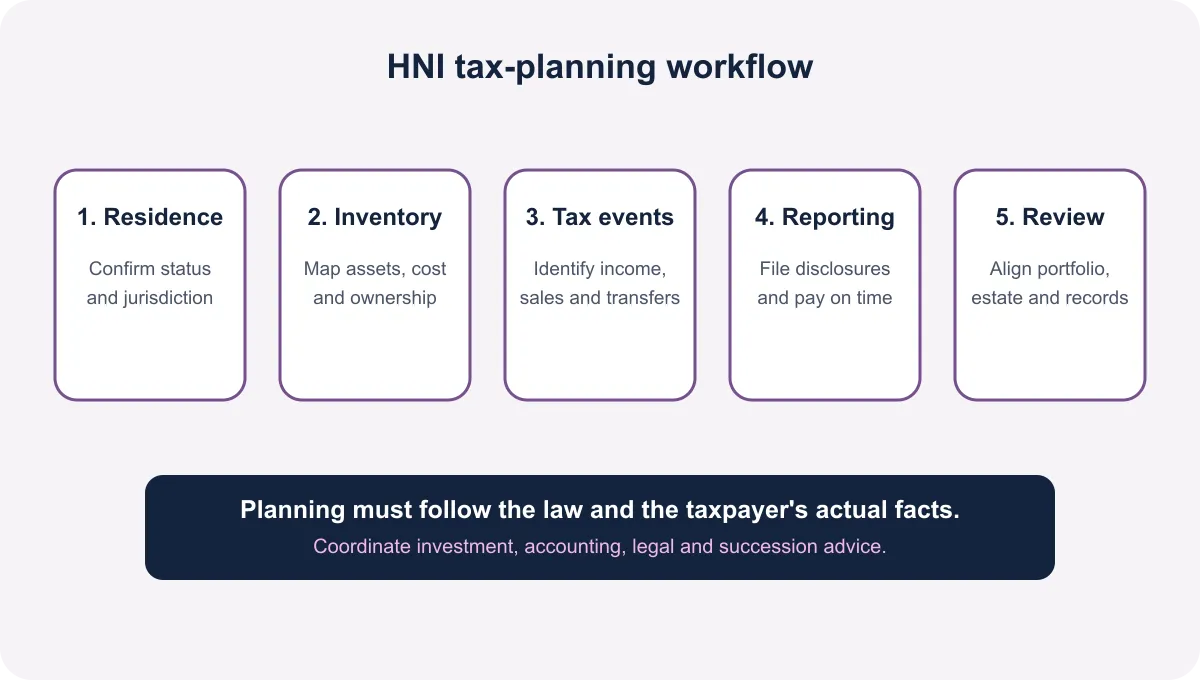
Sound wealth management tax planning starts with accurate records and commercial purpose. It may include timing disposals, using eligible deductions or exemptions, harvesting genuine losses, coordinating advance tax and selecting an appropriate ownership structure.
Avoid arrangements that exist only on paper or conceal beneficial ownership. Tax avoidance doctrines, reporting rules and penalties can override an artificial result. An integrated HNI tax-efficient investment guide can help frame questions, but a chartered accountant or tax lawyer should validate implementation.
Wealth Structuring, Estate Planning and Succession
India currently has no central inheritance or estate duty, but succession is not tax-neutral in every practical sense. Transfers, later sales, trust distributions, stamp duty, foreign jurisdictions and family arrangements can produce legal or tax consequences.
HNIs should maintain an asset register, nominations, wills and ownership records, while aligning business succession and liquidity needs. Trusts, companies and family arrangements have different control, compliance and tax outcomes. A coordinated wealth advisory review can bring investment, insurance and succession decisions together before specialists draft documents.
Common Misconceptions About Wealth Tax
- “Owning a costly home creates annual central wealth tax.” It does not under the abolished Act, although municipal property tax and transaction charges may apply.
- “No wealth tax means no asset reporting.” Incorrect. Resident taxpayers may need Schedule FA and foreign-income disclosures.
- “Gifts and inheritances are always tax-free.” Treatment depends on the relationship, asset, recipient and later transaction.
- “The old exemption rules still guide 2026 portfolios.” They are historical, not a current wealth tax India computation.
Is your portfolio built for what’s coming?
Get a free AI-powered review of your holdings — risk, overlap and quality in minutes.
FAQ
Do NRIs have to pay wealth tax on assets held in India today?
No current annual tax arises under the abolished Wealth-tax Act. NRIs can still owe Indian tax on Indian-source income, capital gains and property transactions, depending on the facts and treaty position.
Are overseas assets subject to separate reporting requirements for Indian tax residents?
Yes. Residents who meet the applicable conditions may need to report foreign assets, accounts, signing authority and foreign income in the relevant return schedules. Residential status and the reporting period must be checked carefully.
Does owning a high-value property automatically create an annual tax liability?
Not under the former central wealth-tax regime. Municipal property tax can apply, while rental income, sale, purchase, stamp duty and registration can create separate obligations.
What records should HNIs maintain for investment tax and estate planning?
Keep acquisition and improvement evidence, valuations, bank and demat statements, tax filings, foreign-asset records, entity documents, gift deeds, nominations, wills and trust or succession papers. Retention periods should reflect applicable law and unresolved proceedings.
The central conclusion on wealth tax India is simple: the annual levy is gone, but HNI compliance is not. Review residence, income, transactions, structures and succession together, and obtain advice for the taxpayer's actual facts.


