

The stock market connects businesses that need capital with investors who want ownership in those businesses. Prices move every trading day, but the system is more than a screen of red and green numbers: it includes issuers, exchanges, brokers, depositories, clearing corporations, regulators and millions of investors.
This guide covers stock market basics in India—from new share issues to order matching and settlement, so that beginners understand both the opportunities and the risks before investing.
What Is the Stock Market?
When people ask what is share market, they usually mean the organised market where ownership shares and other securities are issued and traded. A share represents a fractional ownership interest in a company. Shareholders may benefit from business growth, dividends or a higher market price, but they also bear the risk of loss.
The terms “share market” and “stock market” are often used interchangeably. A complete answer to what is share market also notes that the securities market can include bonds, ETFs and derivatives. Its two core segments are primary and secondary markets.
The main functions of stock market infrastructure are capital formation, price discovery, liquidity, electronic ownership records, clearing and settlement, and regulatory disclosure. These functions do not guarantee profits; they create a formal mechanism through which risk and ownership can change hands.
Among the advantages of share market participation are access to listed businesses, liquidity during market hours, transparent prices and the ability to diversify. Each advantage depends on company quality, valuation, trading liquidity and investor discipline.
See what markets are pricing in
Live indices, sector moves and market breadth — the backdrop to every story we publish.
How the Stock Market Works in India
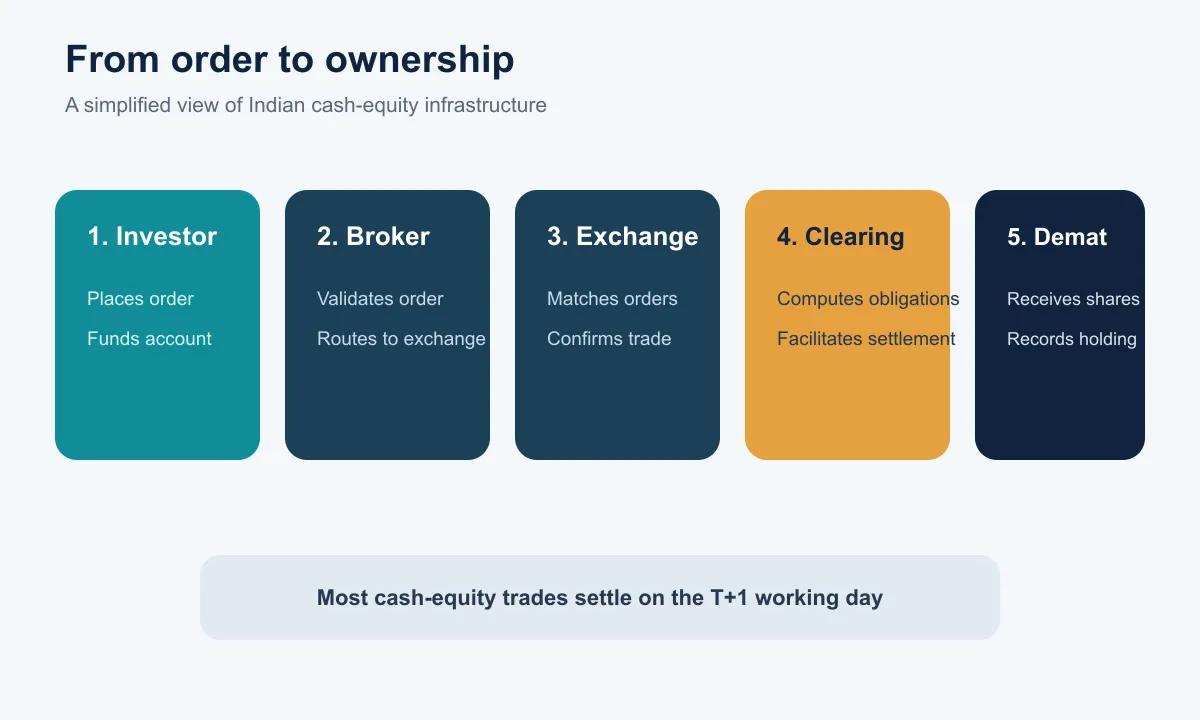
To understand how does the stock market work, follow the institutions involved:
- Companies issue eligible securities and meet listing and disclosure requirements.
- Recognised exchanges such as NSE and BSE provide electronic order books.
- SEBI-registered brokers give investors access to those exchanges.
- Clearing corporations determine obligations and facilitate settlement.
- Depositories—NSDL and CDSL—maintain securities electronically through depository participants.
- SEBI regulates the securities market and intermediaries under the applicable legal framework.
An investor normally needs a bank account, trading account and demat account. The trading account sends instructions, the demat account holds securities, and the bank account handles funds. This three-account link is central to understanding what is share market infrastructure in India.
For most cash-equity trades, India uses a T+1 rolling settlement cycle: a trade executed on day T is generally settled on the next working day. An optional T+0 mechanism also exists for eligible securities and participants, but beginners should verify what their broker and chosen security support.
Primary Market vs Secondary Market
The primary market is where new securities are offered by an issuer. An initial public offering (IPO) brings a company’s shares to public investors for the first time. A further public offer, rights issue or other permitted issuance can raise additional capital later.
In an IPO application, funds may be blocked through ASBA or a supported UPI mandate. If shares are allotted, the relevant amount is debited; if no allotment occurs, the block is released. Listing then makes the shares available for secondary-market trading, subject to exchange rules.
The secondary market lets investors trade with other participants rather than the issuing company. It provides liquidity and price discovery. In explaining what is share market, SEBI identifies NSE, BSE and MSE as secondary-market platforms.
| Feature | Primary market | Secondary market |
|---|---|---|
| Seller | Issuing company or specified holder | Existing investor or market participant |
| Purpose | Raise capital or distribute new securities | Transfer ownership and provide liquidity |
| Price | Offer process determines issue price | Continuous demand and supply determine price |
| Common example | IPO | Buying a listed share on NSE or BSE |
| Investor outcome | Allotment may be full, partial or nil | Execution depends on price and available orders |
Types of Stock Markets and Market Participants
The primary and secondary segments are the most important types of stock market for a beginner. Markets can also be described by instrument or trading mechanism: equity cash markets, equity derivatives, debt markets, SME platforms and auction or block-deal windows.
Participants include retail and institutional investors, companies, brokers, market makers, custodians, depositories, clearing corporations, exchanges, research analysts and investment advisers. Each performs a different role. A broker executes an order; a depository participant services the demat account; a registered adviser provides regulated advice.
Another way to classify the types of stock market is by venue. Exchange-traded transactions occur on recognised platforms with standardised rules and surveillance. Off-market transfers can move securities between demat accounts but are not the same as exchange price discovery.
Beginners should also distinguish the cash market from derivatives. Buying a fully paid share in the cash market creates ownership and generally limits loss to the amount invested if no borrowing is used. Futures, options, margin funding and short selling introduce leverage or obligations that can produce different and sometimes larger risks.
Get research like this in your inbox
The week’s research that mattered, in five minutes. Joined by 2L+ investors.
NSE, BSE, Nifty and Sensex: The Basics
NSE and BSE are recognised Indian stock exchanges. They operate trading platforms, list securities, disseminate market data and enforce exchange rules under SEBI oversight. A company can be listed on one or both exchanges, and its price can differ slightly across order books.
Nifty 50 is associated with NSE, while the S&P BSE Sensex is associated with BSE. Each tracks a defined basket, not every listed security. A beginner learning what is share market should not confuse a calculated index with a directly purchasable share.
Indices are used to benchmark portfolios, describe market direction and serve as underlyings for index funds, ETFs and derivatives. The Wright Research index list helps compare different Indian benchmarks rather than treating “the market” as a single portfolio.
| Term | What it is | What it is not |
|---|---|---|
| NSE/BSE | Stock exchanges | Investment recommendations |
| Nifty/Sensex | Calculated benchmark indices | Every Indian listed company |
| Broker | Exchange-access intermediary | Owner of client shares merely because it provides the app |
| Demat account | Electronic securities-holding account | The order-matching venue |
How Stock Orders Are Executed
In the normal market, NSE rules use price-time priority. The highest-priced eligible buy order is the best bid; the lowest-priced eligible sell order is the best offer. At the same price, the earlier order receives priority. One order may execute against several opposing orders and receive multiple fills.
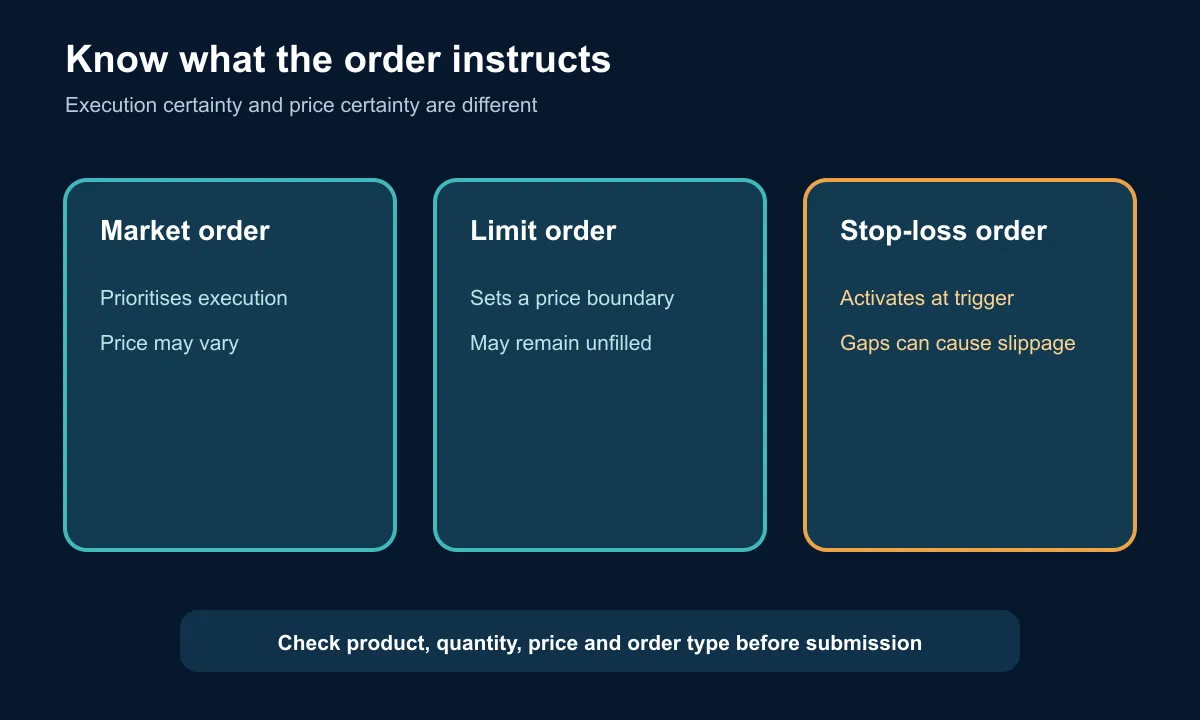
A market order seeks prompt execution at available prices but does not protect the final price. In a thin or rapidly moving stock, fills can differ materially from the last traded price. A limit order sets the maximum price for a buy or minimum price for a sale, providing price control but no guarantee of execution.
Stop-loss orders activate when a trigger is reached and then behave according to their configured market or limit instruction. A gap can skip the intended level, and a stop-limit order may remain unfilled. Understanding these distinctions is essential stock market for beginners knowledge.
After matching, the exchange confirms the trade and clearing calculates obligations. On settlement, funds and securities move through banks, brokers and depositories. This post-trade process is another essential part of what is share market education. Check the contract note, ledger and demat credit.
Investing vs Trading: Key Differences
Investing generally means owning securities based on a multi-year view of business quality, earnings, valuation and portfolio fit. Trading focuses more on shorter-term price movement, catalysts, liquidity and predefined risk controls. The distinction is about process and horizon, not intelligence or certainty.
| Dimension | Investing | Trading |
|---|---|---|
| Typical horizon | Years | Intraday to months |
| Primary research | Business and valuation | Price, volume, events and positioning |
| Turnover | Usually lower | Usually higher |
| Costs and taxes | Less frequent transactions | More sensitive to repeated charges and slippage |
| Main discipline | Allocation and patience | Position sizing and exits |
One of the advantages of share market access is that both approaches are possible through transparent exchanges. However, mixing them creates problems: a failed short-term trade should not become an unresearched “long-term investment.” Wright Research’s stock research platform can support structured company analysis.
Risks Beginners Should Understand
The stock market for beginners can appear simple because opening an account and placing an order are easy. Economic ownership is not simple. Prices respond to earnings, valuation, interest rates, regulation, competition, governance and investor expectations.
Key risks include:
- Business risk: profits or competitive position may deteriorate.
- Valuation risk: a good company bought at an excessive price can deliver weak returns.
- Market risk: broad declines can affect otherwise sound companies.
- Liquidity risk: an investor may not exit quickly near the expected price.
- Concentration risk: one stock or sector can dominate portfolio outcomes.
- Operational risk: incorrect orders, phishing and poor account security can cause losses.
- Leverage risk: borrowed money and derivatives amplify adverse moves.
Beginners should diversify, avoid borrowed-money speculation, use registered intermediaries and never share passwords, OTPs or trading credentials. Read corporate filings and learn common terminology through Wright Research’s quant glossary.
The real answer to how does the stock market work includes uncertainty: prices aggregate many competing views, but no exchange mechanism can turn a weak decision into a guaranteed return.
Is your portfolio built for what’s coming?
Get a free AI-powered review of your holdings — risk, overlap and quality in minutes.
FAQ
How can beginners start investing in the stock market?
Set goals and an emergency reserve, complete KYC, open bank, trading and demat accounts with registered entities, and begin with a diversified, research-led allocation. Review charges and risk capacity before buying individual shares.
What is the difference between a demat account and a trading account?
A trading account sends buy and sell orders through a broker. A demat account, opened through a depository participant linked to NSDL or CDSL, holds securities electronically. The accounts work together but perform different functions.
How does T+1 settlement work after buying shares in India?
T is the trade date. Under T+1 settlement, the buyer’s funds obligation and the seller’s securities obligation are generally completed on the next working day, after which the securities are credited according to the broker and depository process.
What fees and charges should beginners check before placing a stock order?
Check brokerage, Securities Transaction Tax, exchange transaction charges, SEBI fees, GST, stamp duty, demat debit charges and any account-maintenance or margin-related costs. The contract note should show trade-level statutory charges.
Can an investor lose more than the amount invested when buying shares in the cash market?
For fully paid shares purchased without borrowing, the maximum economic loss is generally the purchase amount if the company’s value falls to zero. Margin funding, derivatives, short selling and other leveraged positions can create additional obligations.
Learning what is share market is only the first step. Durable participation comes from understanding market structure, researching securities, diversifying and matching risk to financial goals.