

Dividend investing can turn a shareholding into a stream of cash distributions, but a high displayed yield is not the same as dependable income. The highest dividend paying stocks in India often include commodity producers, public-sector enterprises and mature businesses whose payouts can change with profits, capital spending and government policy.
This guide explains how to screen candidates using trailing dividends, payout ratios, free cash flow and balance-sheet risk. It uses FY2025-26 company disclosures and the NSE Indices dashboard dated 31 October 2026. The companies discussed are research examples, not personalised recommendations or a promise that past dividends will continue.
Indian equity analyst reviewing annual reports, cash-flow charts and a dividend-stock screening checklist
What Counts as a High Dividend-Paying Stock?
Dividend yield equals dividends per share over the relevant trailing period divided by the current share price. If a company paid ₹10 per share and trades at ₹200, its trailing yield is 5%. Because the price is in the denominator, the yield can rise when a stock falls even if the dividend is unchanged.
That is why the highest dividend paying stocks in India should not be defined by one website’s live ranking. A useful screen needs a consistent dividend period, the same price date, adjustment for splits or bonuses, and confirmation that the distribution was paid from recurring cash generation rather than asset sales or extra borrowing.
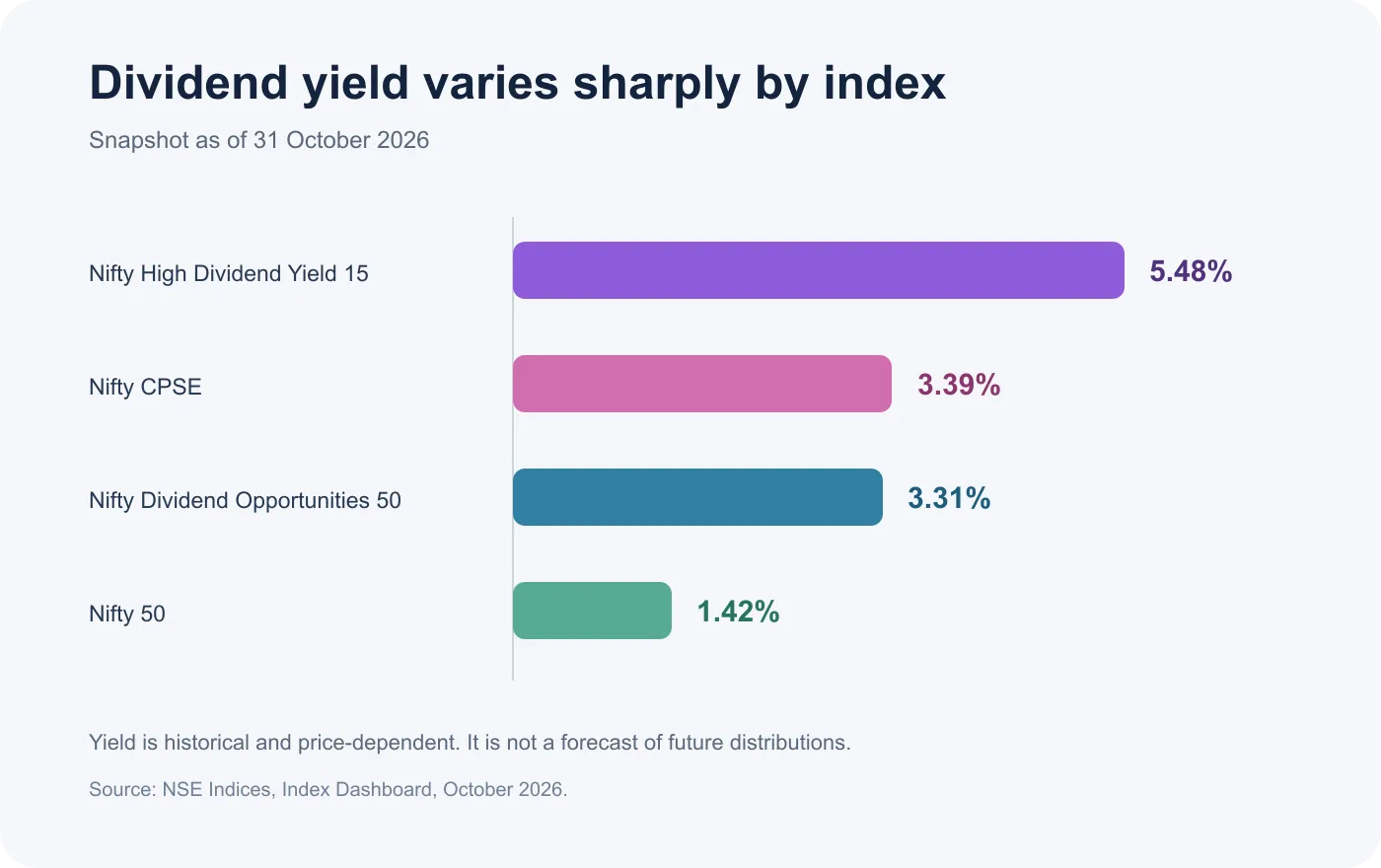
For context, the Nifty High Dividend Yield 15 index showed a 5.48% dividend yield on 31 October 2026, compared with 3.31% for the Nifty Dividend Opportunities 50 and 1.42% for the Nifty 50. These are index-level snapshots, not expected portfolio yields.
See what markets are pricing in
Live indices, sector moves and market breadth — the backdrop to every story we publish.
Highest Dividend Paying Stocks in India: Comparison Table
The table below is a screening shortlist based on audited FY2025-26 disclosures and exchange filings. Dividend per share is not directly comparable across companies because share prices, face values and payout capacity differ. Recalculate trailing yield with the latest price before making any decision.
| Company | Sector | FY2025-26 distribution disclosed | What investors should verify |
|---|---|---|---|
| Vedanta | Diversified metals and resources | ₹34.00 per share | Commodity cycle, group debt, demerger effects and free cash flow |
| ONGC | Oil and gas production | ₹13.25 per share | Crude and gas realisations, production trend, subsidy or policy exposure |
| HPCL | Refining and fuel marketing | ₹24.25 per share, including proposed final dividend | Refining margins, marketing margins, capex and crude-price volatility |
| REC | Power and infrastructure finance | ₹14.00 per share across four interim dividends | Asset quality, funding cost, capital adequacy and borrower concentration |
| Coal India | Coal mining | Multiple interim distributions reported | Auction premiums, volumes, wage costs, capex and energy-transition risk |
| Power Grid | Power transmission | Interim and final distributions reported | Regulated returns, project commissioning, leverage and capital expenditure |
Vedanta reported ₹34 per share for FY2025-26, while ONGC reported ₹13.25 and a payout ratio of about 51%. HPCL proposed ₹19.25 as a final dividend in addition to ₹5 interim. REC’s four FY2025-26 interim dividends totalled ₹14 per share. These facts make them relevant to a dividend stocks list, but not automatically suitable purchases.
Investors can use Wright Research’s stocks research platform to compare price, fundamentals and risk before treating any screen as a portfolio decision. The best dividend stocks in India are those whose total-return prospects and financial resilience fit the investor, not simply those with the largest rupee payout.
Reading Dividend Yield, Payout Ratio and Dividend Growth
Yield answers how much trailing cash distribution the current price represents. Payout ratio answers how much profit was distributed. Cash payout ratio compares dividends with free cash flow, which can be more revealing when accounting profit and cash generation diverge.
Suppose Company A yields 7% but pays 120% of earnings, while Company B yields 4% and pays 55% with growing free cash flow. Company B may have more room to maintain or increase its dividend. A very high payout can still be sensible for a mature, low-capex business, but it leaves less protection against a downturn.
Dividend growth should be studied across a full business cycle. Five-year growth created by one exceptional distribution is less persuasive than regular increases supported by earnings per share. For high dividend stocks in India, calculate the frequency of cuts, the longest gap between payments and the share of cumulative dividends funded by operating cash flow.
Our Screening Method: Consistency, Cash Flow and Debt
A robust process begins with an investible universe, then applies liquidity and profitability filters. NSE’s Dividend Opportunities 50 methodology starts within the top 300 companies by average free-float market capitalisation and turnover, requires at least 90% trading frequency, and requires a profit in the latest audited year. It then ranks eligible companies using dividend yield.
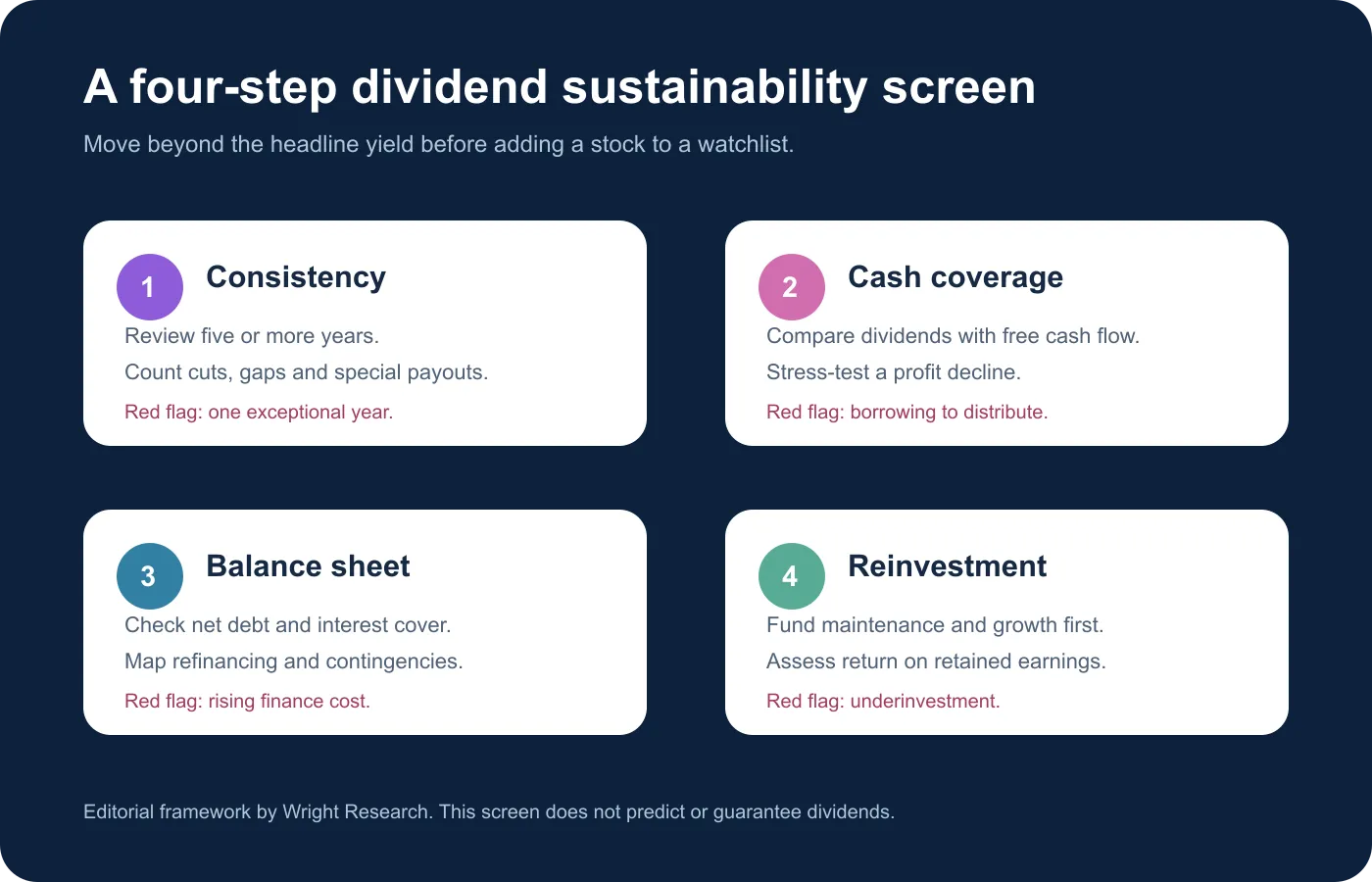
For company research, add four tests. This is particularly important when screening the highest dividend paying stocks in India:
- Consistency: count dividends and cuts over at least five years, adjusting for corporate actions.
- Coverage: compare dividends with net profit and free cash flow, not revenue.
- Balance sheet: examine net debt, interest coverage, refinancing and contingent liabilities.
- Reinvestment: assess whether the company is underinvesting merely to preserve the payout.
This framework narrows dividend yield stocks in India without assuming that yesterday’s yield will repeat. A rules-based portfolio approach can also prevent a watchlist from becoming concentrated in one commodity or public-sector theme.
Dividend Stocks by Sector: Energy, Metals, IT and Consumer
Energy and mining businesses can generate large cash surpluses when commodity prices are favourable. ONGC, Coal India, Vedanta and Hindustan Zinc therefore appear frequently among high dividend stocks in India. The trade-off is cyclicality: profits and distributions can fall when realisations weaken or capital requirements rise. A second group of high dividend stocks in India comes from mature utilities and public-sector financiers.
Power utilities and financiers can offer more visible cash flows, but their risks differ. Regulated utilities depend on allowed returns, commissioning and leverage. Power-sector lenders depend on funding spreads, asset quality and the finances of distribution companies. A similar quoted yield can conceal very different downside scenarios.
IT services companies often combine dividends with buybacks and strong net-cash balance sheets. Consumer companies may provide stable payouts, yet their yields can look modest because their valuations are high. A diversified set of dividend shares should therefore be assessed by sector economics rather than forced through one payout threshold.
Get research like this in your inbox
The week’s research that mattered, in five minutes. Joined by 2L+ investors.
High Dividend Yield vs Sustainable Dividend Income
Sustainable income comes from a repeatable business surplus after operating needs, taxes and essential investment. High yield is only a price-and-distribution ratio. The difference becomes critical after a share-price fall: the historical dividend remains in the numerator even when the market expects profits to decline.
A practical stress test reduces earnings or free cash flow by 20%, raises interest cost and includes committed capex. If dividends would require additional borrowing under that scenario, the yield has little protection. The best dividend stocks in India usually combine adequate coverage, manageable debt, governance discipline and a credible capital-allocation policy.
Total return also matters. A 7% dividend does not compensate for a permanent 30% loss in business value. Compare income with inflation, taxes and opportunity cost, then evaluate whether retained earnings could produce a better return if reinvested.
Risks of Choosing Stocks Only for Dividend Yield
The main risk is a dividend trap: a falling share price pushes the historical yield higher just before the board cuts the payout. Commodity downturns, regulation, litigation, weak receivables or a leveraged acquisition can all reduce distributable cash.
Concentration is another risk. Many dividend paying stocks come from energy, mining, utilities and government-controlled enterprises. A portfolio selected only by yield may end up making one macroeconomic bet. Government ownership can support distributions, but policy priorities and capital expenditure can change.
Tax also reduces realised income. Dividends are generally taxable in the shareholder’s hands at the applicable slab rate, and tax may be deducted at source subject to the law and investor documentation. Investors should use current tax guidance or professional advice rather than compare gross yield with an after-tax alternative.
Key Dates to Track: Declaration, Ex-Dividend and Record Dates
The declaration date is when the board announces an interim dividend or recommends a final dividend. A final dividend normally requires shareholder approval. The record date identifies eligible holders, while the ex-dividend date is the date from which a buyer generally does not receive that declared distribution under the applicable settlement cycle.
Buying immediately before the ex-date does not create free money. The share price can adjust for the cash leaving the company, and taxes and transaction costs still apply. Check the exchange corporate-action notice because dates can change and different distributions may have different conditions.
Also distinguish interim, final and special dividends in any dividend stocks list. A special dividend may arise from an asset sale or surplus cash and should not be annualised. For dividend yield stocks in India, trailing-twelve-month calculations should use only distributions whose ex-dates fall within the chosen period.
How to Build and Monitor a Dividend Stock Watchlist
Start with a broad screen, then record the price date, trailing dividend, yield, payout ratio, free-cash-flow coverage, net debt and five-year cut history. Add the next results date and ex-date. Update the sheet after every result because a static list quickly becomes stale.
Rank quality separately from yield. One useful model gives minimum thresholds to profitability and cash coverage, then uses yield only among companies that pass. This keeps the highest dividend paying stocks in India from outranking stronger businesses solely because their prices fell. Compare valuations and market conditions through Wright Research’s market dashboards before moving from watchlist to allocation.
Finally, define portfolio limits by company and sector. Review why the stock belongs in the portfolio, not only whether it paid. The highest dividend paying stocks in India can contribute income, while the best dividend stocks in India must also protect capital and preserve future earning power.
Is your portfolio built for what’s coming?
Get a free AI-powered review of your holdings — risk, overlap and quality in minutes.
FAQ
Are dividends from Indian stocks taxable for individual investors?
Yes. Dividends are generally included in the investor’s taxable income and taxed at the applicable rate. Tax deducted at source may apply, subject to current thresholds, forms and exemptions. Verify the latest rules for the relevant financial year.
What is the difference between an interim dividend and a final dividend?
An interim dividend is declared by the board during the financial year. A final dividend is recommended after year-end and ordinarily becomes payable after shareholder approval at the annual general meeting.
How soon is a dividend credited after the record date?
The timing depends on the type of dividend and the announced payment schedule. Investors should read the company’s exchange filing and ensure bank, PAN and demat details are current rather than assume a standard number of days.
Can a company declare more than one interim dividend in a financial year?
Yes. A board may declare multiple interim dividends when legally permitted and supported by distributable profits and cash. REC, for example, declared four interim dividends for FY2025-26.
The highest dividend paying stocks in India are best treated as the start of research, not the end. A sound decision weighs payout durability, business quality, valuation, diversification and after-tax total return.
For education only, not investment advice. Company payouts and market prices can change. Consult a SEBI-registered adviser where appropriate.