by Wright Research
Published On March 24, 2026
Quick Answer: What Are Quality Stocks and How Do You Screen for Them?
Quality stocks are shares of companies with consistently strong financial fundamentals. In factor investing, three metrics define them:
Factor | Threshold | Why It Matters |
Return on Equity (ROE) | Above 15% consistently | Indicates efficient capital utilisation |
Debt-to-Equity Ratio | Below 0.5 | Reflects financial stability |
Earnings CAGR (5 Years) | Above 12% | Demonstrates sustainable growth |
Why quality stocks hold up in downturns: During India's Sep 2024–Mar 2025 market correction, the Nifty100 Low Volatility 30 (quality-oriented) fell only -17.52% versus -31.25% for the Nifty200 Momentum 30.
Quality vs Value correlation: -0.06 meaning quality stocks provide genuine diversification when combined with value strategies.
Past performance is not indicative of future returns. Investments are subject to market risk.
Stock market volatility often exposes the weakness of poorly constructed portfolios. Many investors buy stocks based on short-term trends or hype without understanding the financial strength of the underlying businesses. When markets fall, these stocks tend to decline the most, leaving investors with heavy losses.
This is where quality investing plays an important role. Instead of chasing speculative opportunities, this strategy focuses on companies with strong balance sheets, stable earnings growth, and high profitability . Such companies are known as quality stocks, and historically, they have proven to be more resilient during market downturns.
Over the last decade, institutional investors have increasingly relied on factor investing to construct disciplined portfolios. Within this framework, quality factor investing has emerged as one of the most reliable strategies for identifying businesses with strong financial health and sustainable competitive advantages.
In the context of quality investing in India, investors are increasingly looking for financially strong companies capable of delivering consistent returns across market cycles . Building a portfolio of high-quality stocks in India not only provides long-term growth potential but also offers meaningful downside protection during volatile periods.
By systematically identifying quality factor stocks, investors can create a diversified and outperforming quality stock portfolio designed to deliver stable returns. Many professional investors also rely on active portfolio management to continuously rebalance portfolios and maintain exposure to benchmark-beating quality stocks.
For investors seeking stability, this strategy offers an attractive way to identify low-risk investor quality stocks and best quality stocks for long-term wealth creation.
At its core, quality investing focuses on companies with strong financial fundamentals and consistent profitability . However, this strategy goes far beyond simply buying popular companies.
Within the broader framework of factor investing, quality factor investing systematically identifies businesses that demonstrate superior financial strength and operational efficiency. For investors new to this approach, our guide on what factor investing is and how it works provides the foundational context behind quality, value, momentum, and low volatility factors.
Unlike value investing, which focuses primarily on undervalued stocks, quality investing prioritizes financial resilience. A company may appear cheap based on valuation metrics, but if it lacks strong profitability or stable earnings growth, it may not qualify as a quality factor stock.
The goal of quality factor investing is to build a portfolio consisting of financially strong businesses capable of delivering sustainable long-term returns.
For investors exploring factor investing in India, understanding how to identify quality stocks is essential. Companies that meet strict financial criteria are often classified as quality factor stocks and are frequently included in strategies focused on benchmark-beating quality stocks.
This approach is particularly attractive for investors seeking low-risk, high-quality stocks, because companies with strong financial structures are better equipped to handle economic slowdowns.
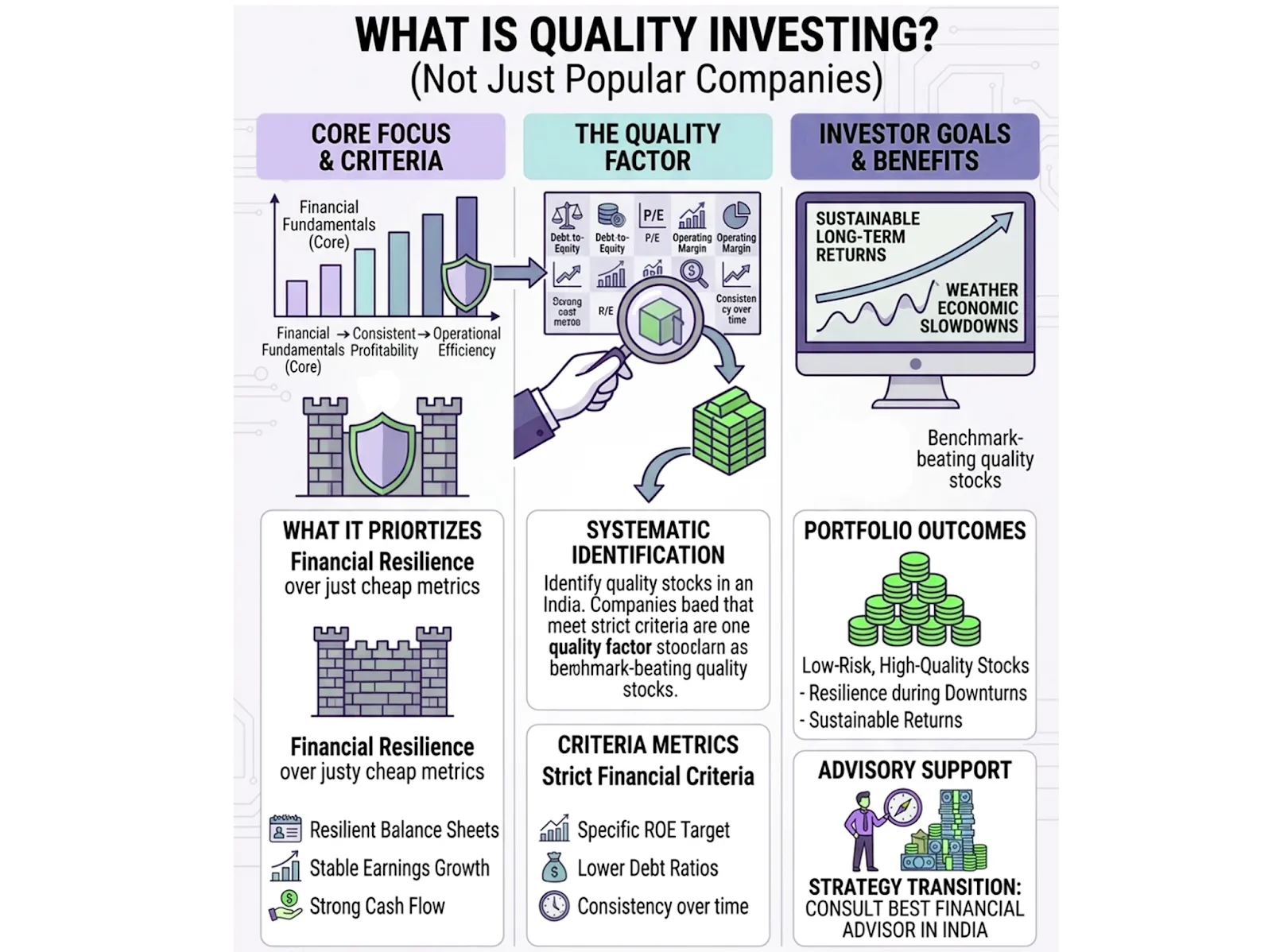
As a result, quality investing in India has gained increasing attention among professional investors who aim to construct portfolios consisting of the best quality stocks for long-term wealth creation.
Also Read : Indian Pharma Q3FY26: Results, Themes, Headwinds, and Key Takeaways
One of the most compelling advantages of quality investing is its ability to perform relatively well during periods of market turbulence.
When markets decline, companies with weak balance sheets and unstable earnings often experience sharp price drops. In contrast, quality stocks typically demonstrate stronger resilience because they possess high profitability, stable cash flows, and manageable debt levels.
This resilience translates into better downside protection for investors.
During the correction between September 2024 and March 2025, market data highlighted the stability of quality-oriented strategies.
Index | Drawdown |
Nifty100 Low Volatility 30 | -17.52% |
Nifty200 Momentum 30 | -31.25% |
The significant difference in drawdowns demonstrates how portfolios containing quality factor stocks tend to experience less volatility compared to momentum-driven portfolios.
Because of their financial strength, benchmark-beating quality stocks are often preferred by institutional investors. These stocks usually demonstrate stable earnings growth, efficient capital allocation, and strong corporate governance.
Investors seeking the best quality stocks for long-term wealth creation often rely on quality factor investing to identify companies capable of generating sustainable returns.
Within the Indian market, quality investing in India has become particularly relevant as investors search for strategies that combine growth potential with downside protection.
Also Read: Why India’s Private Capex Crisis Has Been Falling and Why the Floor May Be Near
To identify quality stocks, investors must evaluate specific financial metrics that reflect the strength of a company’s business model.
Professional investors often rely on quantitative frameworks used in factor investing to screen companies and identify quality factor stocks.
Three key financial indicators are commonly used to identify high-quality stocks in India.
Factor | Threshold | Why It Matters |
Return on Equity (ROE) | Above 15% consistently | Indicates efficient capital utilization |
Debt-to-Equity Ratio | Below 0.5 | Reflects financial stability |
Earnings CAGR (5 Years) | Above 12% | Demonstrates sustainable growth |
Companies meeting these criteria often qualify as quality factor stocks and can be included in portfolios designed to generate stable long-term returns.
Investors who use quality factor investing frameworks often build portfolios containing benchmark-beating quality stocks that demonstrate consistent profitability.
This disciplined screening process helps investors identify low-risk, high-quality stocks and construct portfolios containing the best quality stocks for long-term growth.
For investors exploring factor investing in India, using these financial thresholds can significantly improve the quality of stock selection.
Also Read: Why You Should Review Your Mutual Fund Portfolio for Long-Term Wealth Preservation
Modern portfolio strategies increasingly rely on factor investing, which categorizes stocks based on characteristics such as value, momentum, or quality.
Value investing focuses on undervalued companies trading below their intrinsic value. While this approach can generate strong returns during market recoveries, it may expose investors to businesses with weaker fundamentals.
Momentum investing focuses on stocks that have demonstrated strong recent price performance. While momentum strategies can perform well during bullish phases, they often experience sharp corrections during downturns.
In contrast, quality factor investing focuses on financially strong companies with consistent profitability and stable earnings growth. As a result, quality stocks tend to deliver more stable performance across market cycles.
Interestingly, data from Indian mutual fund research indicates that quality factor stocks and value investing strategies exhibit a negative correlation.
Factor Pair | Correlation |
Quality vs Value | -0.06 |
This negative correlation highlights the diversification benefits of including quality factor stocks in a portfolio. For a deeper look at how factor models are structured and combined, read our guide on factor models and portfolio management in depth , including multi-factor frameworks used by institutional investors.
Professional investors often combine multiple factors through active portfolio management to create diversified portfolios capable of delivering stable returns.
For investors seeking stability, combining factor investing in India with quality factor investing can help create portfolios containing benchmark-beating quality stocks.
Also Read: Decoding the Iran–Israel Conflict for Portfolios: Timeline, Markets, Oil Prices, Macro Transmission
Constructing a successful portfolio of quality stocks requires more than simply identifying good companies. A disciplined framework is necessary to ensure that the portfolio consistently holds businesses with strong financial fundamentals and sustainable growth potential .
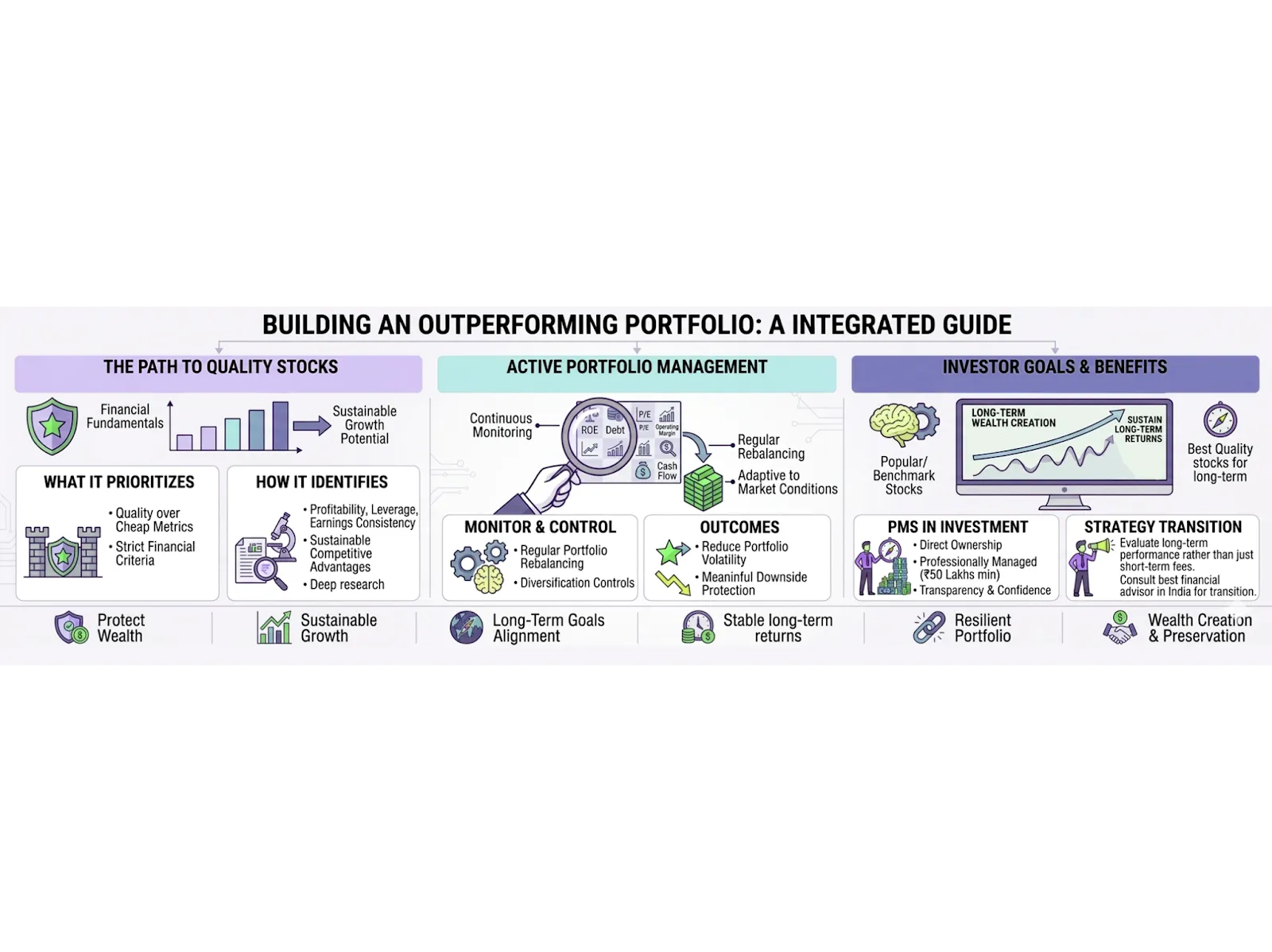
Professional investors often rely on active portfolio management strategies to continuously monitor financial metrics and rebalance portfolios. This approach allows investors to adapt to changing market conditions while ensuring that the portfolio remains aligned with long-term investment objectives.
This disciplined process allows investors to maintain exposure to high-quality stocks in India while removing companies whose financial performance begins to deteriorate. Regular monitoring ensures that only financially strong businesses remain part of the portfolio.
Through structured screening models used in factor investing, investors can identify companies that qualify as quality factor stocks and incorporate them into an outperforming quality stock portfolio. These models typically evaluate profitability, leverage, and earnings consistency.
Institutional investors often build portfolios consisting of benchmark-beating quality stocks that demonstrate strong profitability, low leverage, and consistent earnings growth. These companies tend to show resilience during volatile market conditions.
By combining quality factor investing with active portfolio management, investors can build portfolios containing the best quality stocks for long term growth while maintaining meaningful downside protection during market downturns. Investors seeking a professionally managed implementation of this approach can explore the Wright Factor Fund PMS , a quantitative multi-factor strategy that integrates quality, momentum, value, and growth factors with monthly rebalancing.
Also Read: Who are The Real Winners of the Iran-Israel War? : Sectors, Companies, Countries Gaining from War
Market volatility is inevitable, but portfolio resilience is not accidental; it is built through disciplined strategies such as quality investing.
By focusing on companies with strong balance sheets, consistent earnings growth, and sustainable competitive advantages, investors can construct portfolios consisting of quality stocks that demonstrate long-term resilience.
Within the framework of factor investing has proven to be one of the most reliable approaches for identifying financially strong companies capable of delivering stable returns.
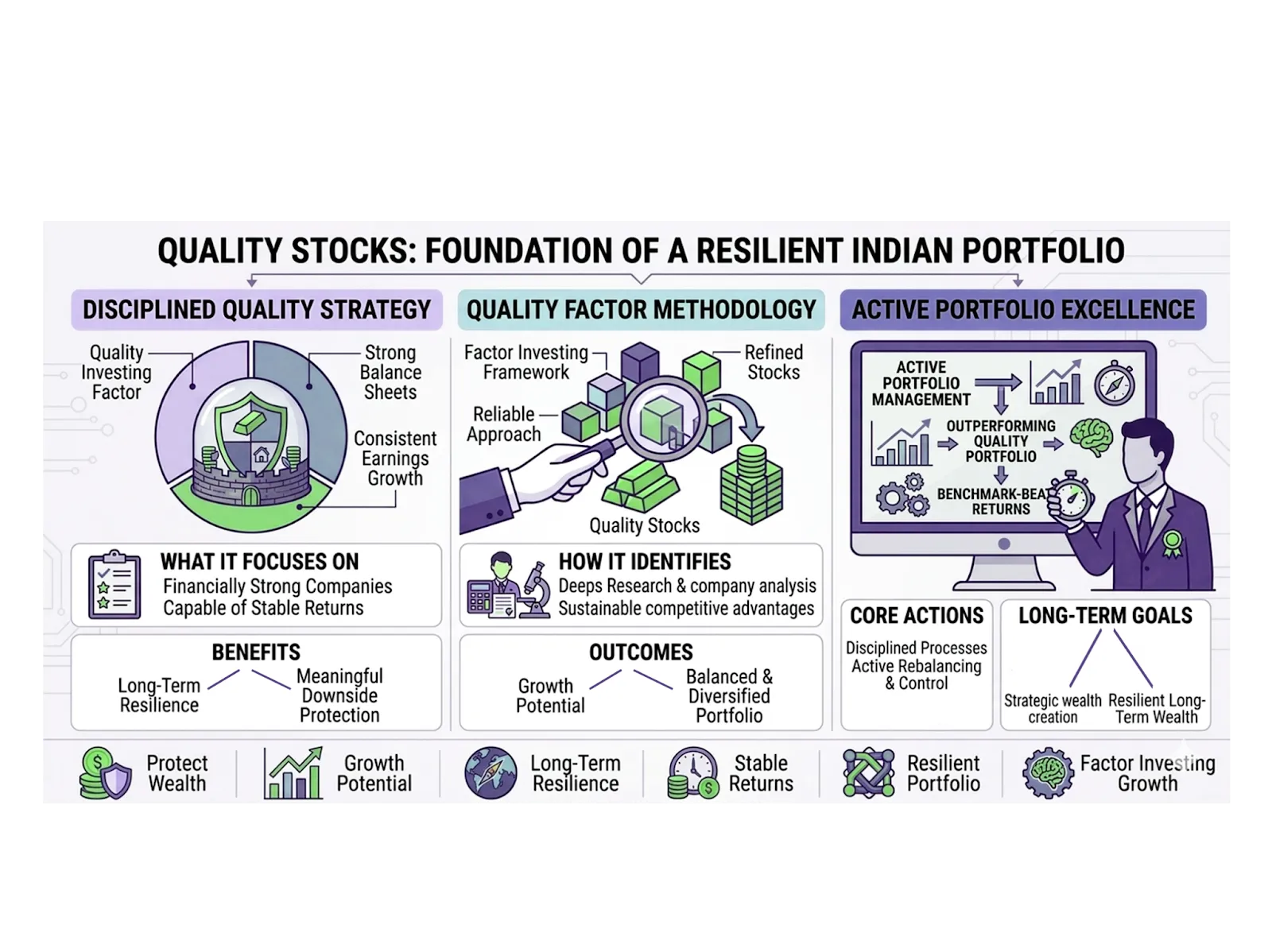
For investors exploring quality investing in India, building portfolios consisting of high-quality stocks in India can provide both growth potential and meaningful downside protection.
When combined with disciplined active portfolio management, investors can construct an outperforming quality stock portfolio consisting of benchmark-beating quality stocks and best quality stocks for long-term wealth creation.
As factor investing in India continues to grow in popularity, strategies focused on quality factor stocks are likely to play an increasingly important role in building resilient investment portfolios.
The seven steps of the portfolio management process include setting investment objectives, assessing risk tolerance, asset allocation, security selection, portfolio construction, monitoring performance, and periodic rebalancing. This structured process helps investors build diversified portfolios, manage risk effectively, and align investments with long-term financial goals.
Some of the best low-risk investment options include government bonds, fixed deposits, high-quality debt mutual funds, balanced mutual funds, and portfolios of financially strong quality stocks. These investments aim to provide stable returns while reducing volatility and protecting capital during uncertain market conditions.
Capital preservation techniques include diversification across asset classes, investing in high-quality stocks, maintaining a balanced asset allocation, focusing on companies with strong balance sheets, and avoiding excessive leverage. Investors also use disciplined portfolio rebalancing and risk management strategies to reduce losses during market downturns.
Quality investing focuses on companies with high profitability, low debt, and stable earnings regardless of valuation. Value investing focuses on buying companies trading below their intrinsic worth. In India, data shows quality and value factors have a -0.06 negative correlation, meaning they tend to outperform in different market environments. Quality stocks protect capital during downturns; value stocks tend to recover faster after corrections. Many institutional investors combine both factors for diversified, resilient portfolios.
Factor investing for retail investors in India works through three vehicles: (1) Factor-based ETFs and index funds tracking indices like Nifty100 Quality 30 or Nifty200 Momentum 30; (2) Smallcase portfolios built around specific factor strategies such as quality, momentum, or multi-factor combinations; (3) PMS strategies that combine multiple factors with active rebalancing for investors with ₹50 lakh or more. Each option offers a systematic, rules-based alternative to both stock-picking and passive index investing.
Discover investment portfolios that are designed for maximum returns at low risk.
Learn how we choose the right asset mix for your risk profile across all market conditions.
Get weekly market insights and facts right in your inbox


It depicts the actual and verifiable returns generated by the portfolios of SEBI registered entities. Live performance does not include any backtested data or claim and does not guarantee future returns.
By proceeding, you understand that investments are subjected to market risks and agree that returns shown on the platform were not used as an advertisement or promotion to influence your investment decisions.
"I was drawn to Wright Research due to its multi-factor approach. Their Balanced MFT is an excellent product."

By Prashant Sharma
CTO, Zydus
By signing up, you agree to our Terms and Privacy Policy
"I was drawn to Wright Research due to its multi-factor approach. Their Balanced MFT is an excellent product."
By Prashant Sharma
CTO, Zydus
Skip Password
By signing up, you agree to our Terms and Privacy Policy
"I was drawn to Wright Research due to its multi-factor approach. Their Balanced MFT is an excellent product."
By Prashant Sharma
CTO, Zydus
"I was drawn to Wright Research due to its multi-factor approach. Their Balanced MFT is an excellent product."
By Prashant Sharma
CTO, Zydus
Log in with Password →
By logging in, you agree to our Terms and Privacy Policy
"I was drawn to Wright Research due to its multi-factor approach. Their Balanced MFT is an excellent product."
By Prashant Sharma
CTO, Zydus
Log in with OTP →
By logging in, you agree to our Terms and Privacy Policy
"I was drawn to Wright Research due to its multi-factor approach. Their Balanced MFT is an excellent product."
By Prashant Sharma
CTO, Zydus
Answer these questions to get a personalized portfolio or skip to see trending portfolios.
Answer these questions to get a personalized portfolio or skip to see trending portfolios.
(You can choose multiple options)
Answer these questions to get a personalized portfolio or skip to see trending portfolios.
Answer these questions to get a personalized portfolio or skip to see trending portfolios.
Answer these questions to get a personalized portfolio or skip to see trending portfolios.
(You can choose multiple options)
Investor Profile Score
We've tailored Portfolio Management services for your profile.
View Recommended Portfolios Restart