


Nuclear energy stocks in India are gaining investor attention as India targets 100 GW of atomic capacity by 2047. Key players include NTPC, BHEL, L&T, and ancillaries benefiting from nuclear expansion. While direct nuclear power stocks India remain limited due to NPCIL's unlisted status, exposure exists through infrastructure stocks, green energy shares, and the top 10 energy sector stocks in India.
Introduction
Every serious investor tracking India's energy transition has a blind spot, and it is glowing faintly in the background while everyone obsesses over solar and wind.
Nuclear power. For years, it sat at the margins of investment conversations. Too complex, too regulated, too slow. But something has shifted. India's government has moved nuclear energy from a policy footnote to a central pillar of its Viksit Bharat 2047 energy strategy. Capacity targets have been tripled. New reactor designs are on the table. And a handful of listed companies, some obvious and many overlooked, are quietly positioning themselves to benefit from what could be one of India's most consequential infrastructure buildouts of the decade.
This blog breaks down what the nuclear push means for investors, which companies carry real exposure, how nuclear fits alongside green energy stocks and renewable plays in a portfolio, and what risks you need to understand before taking a position. Whether you are evaluating the top 10 energy sector stocks in India or building a thematic portfolio around India's power future, this is the context you need.
See what markets are pricing in
Live indices, sector moves and market breadth — the backdrop to every story we publish.
India Nuclear Energy: The 2047 Target and What It Means for Investors
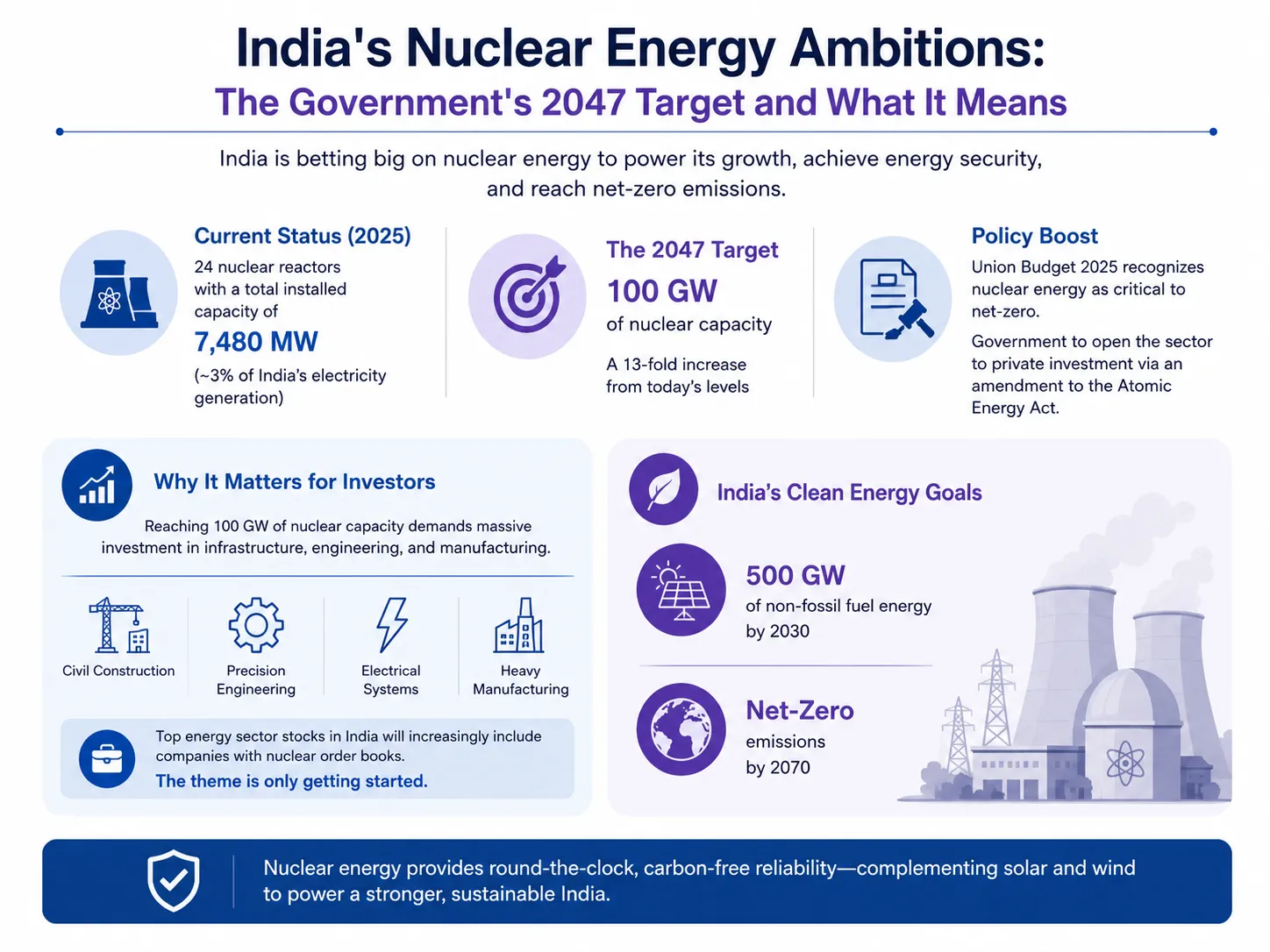
Nuclear energy stocks in India are a proxy for one of the government's most ambitious long-term infrastructure bets. As of 2025, India operates 24 nuclear reactors with a total installed capacity of approximately 7,480 MW, contributing around 3% of the country's electricity generation. That number looks modest. The plan ahead, however, is not.
The Indian government has announced a target of reaching 100 GW of nuclear capacity by 2047, a 13-fold increase from today's levels. The Union Budget 2025 flagged nuclear energy as a critical pillar of India's net-zero strategy, and the government has proposed opening the sector to private investment for the first time through an amendment to the Atomic Energy Act.
Why does this matter for investors? Because 100 GW of nuclear capacity requires a staggering volume of civil construction, precision engineering, electrical systems, and heavy manufacturing, much of which will be executed by listed companies.
India's stated goal is to achieve 500 GW of non-fossil fuel energy by 2030 and net-zero emissions by 2070. Nuclear, being a firm, baseload, carbon-free source of power, plays a role that intermittent green energy stocks simply cannot, providing round-the-clock reliability even when the sun does not shine, and the wind does not blow.
How Nuclear Power Generation Works for Investors
You do not need a physics degree to invest in this theme. Here is what matters for an investor's understanding.
A nuclear reactor generates electricity by splitting uranium atoms in a controlled reaction, a process called fission. This generates intense heat, which converts water into steam, which spins turbines, which produce electricity. The reactors in India are primarily Pressurised Heavy Water Reactors (PHWRs), designed and operated by the Nuclear Power Corporation of India Limited (NPCIL).
What makes nuclear uniquely valuable as an asset class story is its capacity factor. Coal plants typically run at 60-70% capacity. Solar at 20-25%. A nuclear plant runs at 85-90% capacity factor, meaning it produces near-full output almost continuously. For a country like India, where power demand is growing at over 6% annually, that reliability premium is significant.
From an investment lens, the nuclear supply chain has several layers. There are plant operators (currently just NPCIL), civil contractors, and heavy engineering firms that construct facilities, equipment manufacturers supplying turbines, pumps, valves, and electrical components, and fuel cycle entities managing uranium procurement and processing. Each layer offers a different risk-return profile for investors looking at nuclear power stocks India.
Which Indian Companies Have Nuclear Energy Stock Exposure?
Here is where the conversation gets practical. NPCIL, the primary entity that operates India's nuclear plants, is not listed on Indian exchanges. So, direct equity exposure to the operator is not currently available. But the listed universe around it is meaningful and growing.
Company |
Stock |
Nature of Nuclear Exposure |
Listed |
NTPC Ltd |
NSE: NTPC |
Nuclear capacity addition through NTPC Nuclear Energy Ltd (JV with NPCIL) |
Yes |
BHEL |
NSE: BHEL |
Turbine islands, steam generators for nuclear plants |
Yes |
Larsen & Toubro |
NSE: LT |
Civil construction and heavy engineering for nuclear facilities |
Yes |
Tata Consulting Engineers |
Unlisted |
Design and engineering for nuclear projects |
No |
HCC Ltd |
NSE: HCC |
Civil works for nuclear plants (historical exposure) |
Yes |
MIDHANI |
NSE: MIDHANI |
Specialty alloys and materials for nuclear reactors |
Yes |
Thermax |
NSE: THERMAX |
Heat exchange equipment, nuclear-grade components |
Yes |
Among the top nuclear energy stocks in India available to retail investors, NTPC carries the most direct and scaled exposure, particularly through its JV with NPCIL aimed at setting up 14 new reactors. BHEL, with decades of experience supplying turbines to NPCIL plants, stands to benefit from significant order flows as new capacity comes online.
These companies simultaneously qualify as infrastructure stocks and green energy sector stocks , making them candidates for multiple thematic portfolio strategies, not just a pure nuclear play.
NTPC Nuclear and NPCIL: Who Can Participate in Nuclear Power Stocks India
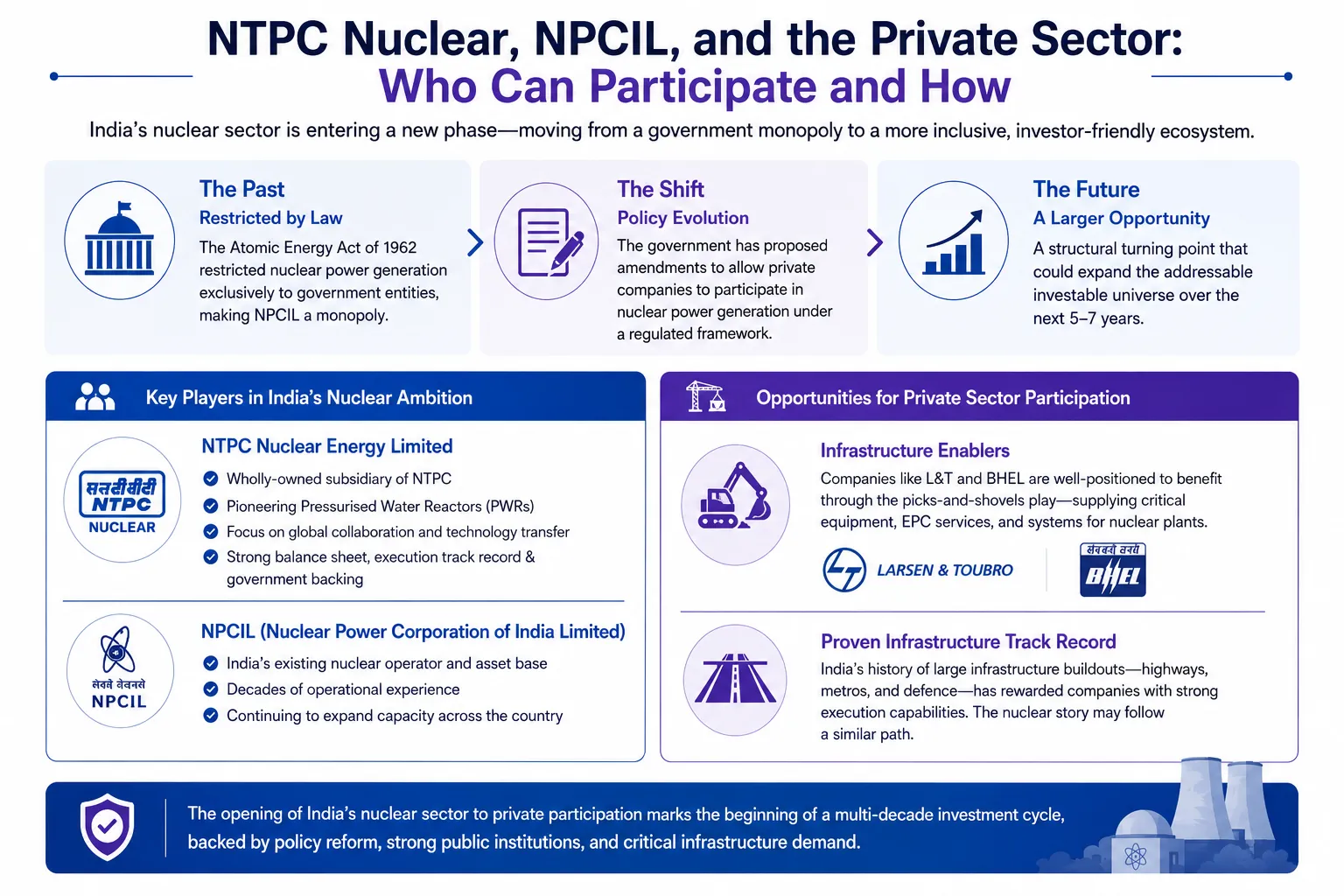
The structure of India's nuclear sector is changing. Historically, the Atomic Energy Act of 1962 restricted nuclear power generation exclusively to government entities, effectively making NPCIL a monopoly. Private participation was categorically off the table.
That is now evolving. The government has proposed amendments that would allow private companies to participate in nuclear power generation under a regulated framework. This is a structural turning point. For investors tracking nuclear energy stocks India, this means the addressable investable universe could expand significantly over the next five to seven years.
NTPC's nuclear push is already underway. NTPC Nuclear Energy Limited, a wholly-owned subsidiary, is working toward establishing Pressurised Water Reactors (PWRs), a technology segment where global knowledge transfer and collaboration are planned..NTPC's balance sheet, project execution track record, and government backing make it arguably the most credible listed proxy for India's nuclear ambition.
For infrastructure investors, companies like L&T and BHEL represent the picks-and-shovels play, supplying the materials and systems regardless of which entity ultimately operates the plant.In India's history, large infrastructure buildouts across highways, metros, and defence have consistently rewarded this approach. The nuclear story may follow a similar pattern.
Get research like this in your inbox
The week’s research that mattered, in five minutes. Joined by 2L+ investors.
Uranium Supply Chain: Why Fuel Security Matters for Investors
Nuclear plants run on uranium, and India's domestic uranium reserves are limited. This is a critical variable that often goes under-discussed in investor conversations about nuclear energy stocks in India.
India imports uranium primarily from Russia, Kazakhstan, Canada, and Australia. The Uranium Corporation of India Limited (UCIL) handles domestic mining, but supply is insufficient to fuel planned expansion. As reactor capacity grows 13-fold, securing long-term uranium supply contracts becomes a strategic imperative and a risk that can meaningfully impact project timelines.
Investors should also be aware of thorium. India holds approximately 25% of the world's thorium reserves, and NPCIL's long-term three-stage nuclear programme envisions transitioning to thorium-based reactors as the final stage. While this is a decades-long horizon, it gives India's nuclear programme a domestic fuel security angle that most countries lack.
For the purposes of portfolio positioning, the uranium supply chain itself is not accessible through domestic listed stocks, but the exposure to uranium price dynamics is an indirect risk factor for companies like NTPC that will operate nuclear plants. This is worth monitoring, especially as global uranium prices have been on an upward trend since 2021.
Nuclear vs Green Energy Stocks: How They Fit in India Energy Mix
Nuclear and renewables are often framed as competitors. They are more accurately partners.
Green energy stocks , particularly solar and wind, have attracted enormous capital over the last decade, and rightly so. India has over 200 GW of renewable energy capacity and is targeting 500 GW by 2030. Companies within the top 20 renewable energy stocks and top 5 green energy stocks have rewarded investors handsomely over the past five years.
But renewables have a fundamental limitation: intermittency. Solar generates power only during daylight hours. Wind is dependent on weather patterns. For India to run a 24x7 economy on clean power, it needs firm baseload capacity, and nuclear is the only clean source that can reliably provide this at scale.
Parameter |
Solar/Wind (Green Energy) |
Nuclear Energy |
Capacity Factor |
20-30% |
85-90% |
Carbon Emissions |
Near Zero |
Near Zero |
Land Requirement |
High |
Low |
Power Reliability |
Intermittent |
Baseload / Continuous |
Gestation Period |
12-24 months |
7-15 years |
Cost Trend |
Declining rapidly |
Stable/Increasing |
Listed Stock Availability |
Abundant |
Limited (indirect) |
Investors who are currently allocated to green energy shares or the best green energy stocks should view nuclear as a complementary theme, not a replacement. A portfolio positioned across the full clean energy spectrum, with green energy sector stocks for growth and nuclear-linked infrastructure stocks for duration, arguably reflects India's actual energy strategy more faithfully than a renewables-only bet.
Key Risks in Nuclear Energy Stocks India
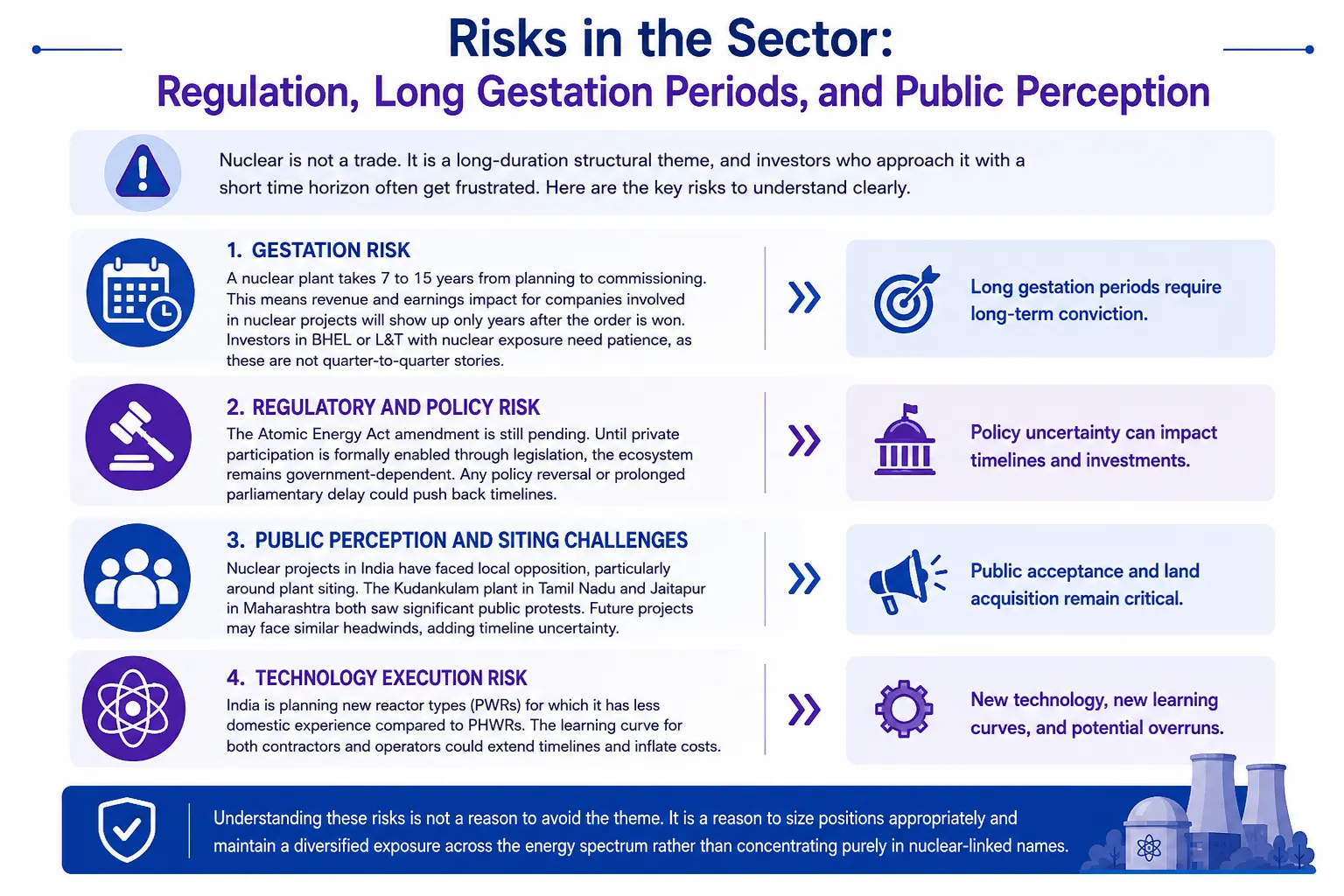
Nuclear is not a trade. It is a long-duration structural theme, and investors who approach it with a short time horizon often get frustrated. Here are the key risks to understand clearly.
Gestation Risk. A nuclear plant takes 7 to 15 years from planning to commissioning. This means revenue and earnings impact for companies involved in nuclear projects will show up only years after the order is won. Investors in BHEL or L&T with nuclear exposure need patience, as these are not quarter-to-quarter stories.
Regulatory and Policy Risk. The Atomic Energy Act amendment is still pending. Until private participation is formally enabled through legislation, the ecosystem remains government-dependent. Any policy reversal or prolonged parliamentary delay could push back timelines.
Public Perception and Siting Challenges. Nuclear projects in India have faced local opposition, particularly around plant siting. The Kudankulam plant in Tamil Nadu and Jaitapur in Maharashtra both saw significant public protests. Future projects may face similar headwinds, adding timeline uncertainty.
Technology Execution Risk. India is planning new reactor types (PWRs) for which it has less domestic experience compared to PHWRs. The learning curve for both contractors and operators could extend timelines and inflate costs.
Understanding these risks is not a reason to avoid the theme. It is a reason to size positions appropriately and maintain a diversified exposure across the energy spectrum rather than concentrating purely in nuclear-linked names.
How to Position Nuclear Stocks in Your Portfolio
The nuclear theme is real, policy-backed, and structurally sound, but it needs the right portfolio architecture.
Here is a practical framework for investors looking to access this theme through listed equities.
Step 1 - Anchor with a Diversified Energy Basket. Rather than making concentrated single-stock bets, consider exposure through a curated basket that spans nuclear-adjacent plays (NTPC, BHEL), top 5 green energy stocks like renewable power generators, and top 10 green energy stocks in India, such as solar EPC companies. This gives you the nuclear upside without all-in concentration.
Step 2 - Look at Infrastructure Stocks with Nuclear Order Books. L&T and BHEL both have confirmed or probable nuclear order pipelines. These are large-cap, diversified companies where nuclear is an additive theme, not the entire business, reducing single-theme risk.
Step 3 - Monitor NPCIL IPO Signals. If and when NPCIL proceeds toward a public listing (which has been discussed, though no firm timeline exists), it would be the most direct way to access top nuclear energy stocks in India. Staying informed about this development is worthwhile.
Step 4 - Use Systematic Investing to Manage Volatility. Long-gestation infrastructure themes often see multi-year price swings before fundamentals show up in earnings. Systematic, phased investing, or using a Smallcase built around India's energy infrastructure theme, helps manage entry-point risk.
Step 5 - Rebalance Regularly. Nuclear is not a buy-and-forget theme. Regulatory developments, uranium prices, and policy updates can shift the calculus. A regularly reviewed portfolio, factoring in both green energy sector stocks and nuclear-adjacent names, will serve investors better than a static allocation.
Conclusion
India's nuclear build-out is one of the most significant infrastructure stories of the next two decades, and understanding which listed companies carry real exposure is half the battle.
Whether you want to explore a curated energy-infrastructure smallcase or evaluate how nuclear fits within a professionally managed PMS portfolio, Wright Research 's quant-driven approach gives you the data and discipline to act smartly.
Follow this sector’s live moves
Sector-level performance across Indian markets, updated through the day.
FAQs
Are there any listed nuclear energy stocks in India?
Directly listed nuclear energy stocks in India are limited because NPCIL, the primary nuclear operator, is a government entity and not publicly traded. However, investors can access the theme indirectly through listed companies like NTPC (via its nuclear JV), BHEL (turbine and equipment supplier), L&T (civil construction), MIDHANI (specialty alloys), and HCC. These qualify as nuclear power stocks India through their order books and project pipelines.
Is nuclear energy a good investment theme in India for the long term?
Yes, with appropriate time horizon expectations. The government's target of 100 GW of nuclear capacity by 2047 represents a structural, policy-backed theme. However, nuclear energy stocks India require patience as gestation periods are long (7–15 years), regulations are evolving, and earnings impact from nuclear projects appears gradually. Investors with a 5–10 year horizon and diversified exposure across the top 10 energy sector stocks in India are best placed.
How does the government's nuclear expansion plan affect energy stocks?
The 100 GW nuclear target creates a multi-decade order pipeline for engineering, construction, and equipment companies. This directly benefits the top 10 energy sector stocks in India, like BHEL and NTPC, while also lifting broader infrastructure stocks with nuclear project exposure. Government amendments to the Atomic Energy Act to allow private participation could further expand the investable universe, potentially creating entirely new nuclear energy stocks India in the listed space.
What is the difference between nuclear energy stocks and renewable energy stocks?
Nuclear energy stocks in India are linked to baseload power generation that runs continuously at high capacity (85–90% capacity factor), with long project gestation and high capital expenditure. Green energy stocks and green energy shares are typically tied to solar and wind assets, faster to build, lower upfront capex, but intermittent in output. Both serve India's clean energy goals. Best green energy stocks and nuclear plays are more complementary than competitive in a well-structured portfolio.
Which Indian companies benefit most from nuclear power expansion?
NTPC benefits most directly through its nuclear subsidiary and JV with NPCIL. BHEL carries the most established track record in supplying turbine islands and steam generators to nuclear plants. L&T stands to gain significantly from civil construction contracts for new reactors. MIDHANI benefits from the demand for specialty materials. Collectively, these represent the most credible set of top nuclear energy stocks in India accessible through NSE/BSE today.