


Quick Answer:What Are the Best Green Energy Stocks in India?
India's top green energy stocks include Adani Green Energy (10.9 GW operational, 45 GW target by 2030), Tata Power (renewables + EV charging + solar EPC), and NTPC Renewables (60 GW target by 2032, PSU stability). The EV ecosystem players include Tata Motors (62% India passenger EV market share) and Exide Industries (lithium-ion battery transition). India must add ~300 GW of clean capacity by 2030 to hit its 500 GW target - the investment case is structural, not cyclical. Key risks: subsidy dependency, interest rate sensitivity on 70:30 debt-financed projects, and execution delays.
See what markets are pricing in
Live indices, sector moves and market breadth — the backdrop to every story we publish.
Why Indian Investors Are Looking at Green Energy Now
If you've been tracking markets for even a few months, you've probably noticed something: green energy stocks are no longer a niche conversation. They're front and centre in every serious investor's portfolio discussion.
And for good reason. India is sitting at the intersection of two massive tailwinds: a government that has committed ₹19.7 lakh crore to the energy transition and a domestic consumption story that refuses to slow down. Electricity demand in India is expected to triple by 2050, and most of that incremental demand will be met by renewables. When the scale of that number sinks in, you start to understand why funds and retail investors alike are scrambling to find the best green energy stocks before the valuations catch up to the opportunity.
But here's the honest problem: the sector is noisy. There are dozens of listed companies with some exposure to renewables, and separating the genuine compounders from the overhyped names is genuinely hard. This blog is an attempt to cut through that.
We'll look at the strongest green energy sector stocks , walk through EV ecosystem plays, flag the real risks you should be pricing in, and explain how Wright Research's Smallcase themes can help you get structured exposure without picking individual stocks yourself.
India's Green Energy Revolution: Renewable Energy Growth & Investment Case
Let's start with the macro picture, because it matters more here than in most sectors.
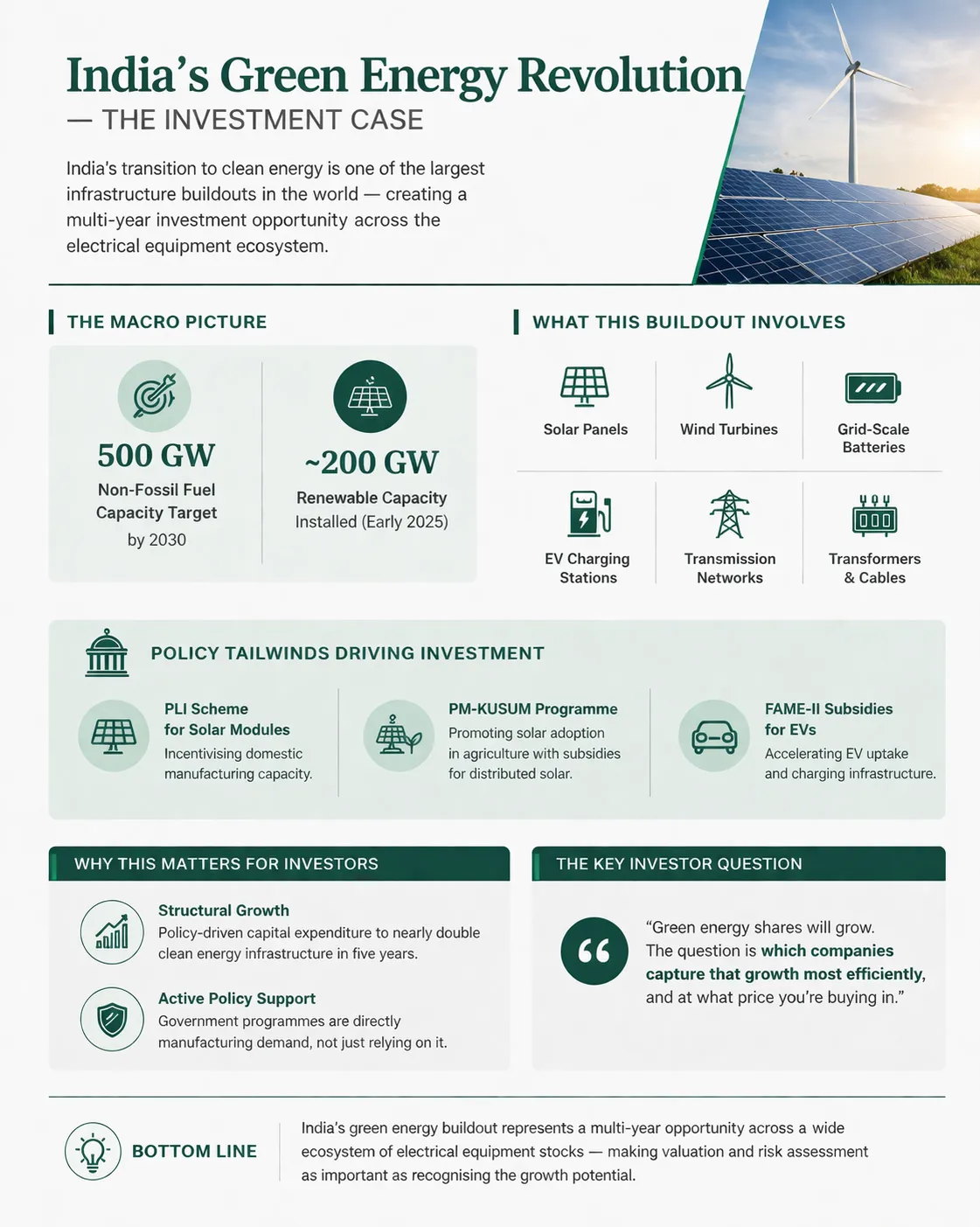
India has pledged 500 GW of non-fossil fuel capacity by 2030. As of early 2025, installed renewable capacity is around 200 GW. That means the country needs to roughly double its clean energy infrastructure in five years, and that buildout involves solar panels, wind turbines, grid-scale batteries, EV charging stations, transmission networks, transformers, cables, and a whole ecosystem of electrical equipment stocks that most casual investors ignore.
The government's Production Linked Incentive (PLI) scheme for solar modules, the PM-KUSUM programme for agricultural solar, and the FAME-II subsidies for EVs are all pushing capital into this space in ways that are structurally different from a typical cyclical upturn. This isn't just about demand; there's an active policy manufacturing the demand.
For investors, the key question isn't whether green energy shares will grow. They will. The question is which companies capture that growth most efficiently, and at what price you're buying in. The green energy stock price across several leading names already reflects a lot of optimism, which is why understanding valuation and risk is just as important as understanding the opportunity.
Top Renewable Energy Stocks in India
1. Adani Green Energy (ADANIGREEN): India's Largest Utility-Scale Solar Stock
Adani Green Energy (ADANIGREEN) is the most prominent name when anyone talks about top green energy stocks in India. With an operational capacity of over 10 GW and a target to reach 45 GW by 2030, the company operates at a scale that very few global peers can match.
The business model is straightforward: long-duration power purchase agreements (PPAs) with state utilities and SECI provide revenue visibility for 20-25 years. That predictability is what justifies the premium valuation. What investors often underestimate is how much of Adani Green's competitive advantage comes from land acquisition at scale and the ability to negotiate EPC contracts at pricing that smaller players simply cannot access.
That said, the green energy stock price of ADANIGREEN trades at a significant premium to its near-term cash flows. The P/E is elevated, and the company carries substantial debt financing its expansion. Anyone adding it to a portfolio should be doing so with a 5-7 year horizon, not expecting quarterly catalysts.
Metric | Adani Green Energy |
Installed Capacity (2025) | ~10.9 GW |
Target Capacity (2030) | 45 GW |
Revenue Model | Long-term PPAs |
Key Risk | Execution at scale, debt levels |
NSE Symbol | ADANIGREEN |
2. Tata Power — Diversified Clean Energy Play
Tata Power offers something different: diversification within the clean energy theme. The company has renewable generation, a rapidly growing EV charging network (Tata Power EZ Charge), and a solar EPC business (TP Solar), all under one roof.
If you're looking for green energy stocks to buy that give you multiple bets on the transition without concentrating risk in a single segment, Tata Power is the name that comes up most often. The EV charging piece is particularly interesting. Tata Power has already deployed over 5,000 public charging points, and that number is growing quarterly.
The balance sheet is healthier than Adani Green's, and the conglomerate backing of the Tata Group provides both reputational capital and financing access. It isn't the highest-growth name in the best renewable energy stocks universe, but it's arguably the most resilient.
3. NTPC Renewables — PSU Green Pivot
NTPC's renewable pivot is one of the more underappreciated stories in green energy sector stocks. NTPC Renewable Energy Limited (NTPC REL), the subsidiary handling the green buildout, has a 60 GW renewable capacity target by 2032. For a company that built its reputation on coal-fired thermal power, that's a significant strategic shift.
The PSU angle provides both advantages and disadvantages. On the positive side, NTPC's balance sheet strength and government relationships mean lower financing costs and easier land acquisition. The dividend yield also makes it attractive for income-oriented investors seeking exposure to renewable energy stocks to buy without sacrificing stability.
The downside is execution pace; large PSUs don't always move with the urgency that markets expect, and the renewable subsidiary's listing trajectory remains a watch item.
Get research like this in your inbox
The week’s research that mattered, in five minutes. Joined by 2L+ investors.
EV Ecosystem Stocks in India: OEMs, Components & Charging
1. Tata Motors EV — Market Leader
Tata Motors holds roughly 60-65% of India's passenger EV market, and the Nexon EV remains the country's best-selling electric car. What makes Tata Motors interesting as a stock isn't just the EV market share; it's the integration of the entire value chain, from battery packs (through Agratas) to charging infrastructure (through Tata Power).
When looking at electric equipment stocks and EV plays together, Tata Motors sits at the top of the funnel. The company's investment in Agratas Energy Storage Solutions, its battery manufacturing JV, signals a clear intent to control margins at the cell level rather than staying dependent on imported battery packs.
The JLR turnaround is an additional tailwind that's easy to forget when discussing the India EV narrative. Strong JLR cash flows are funding the domestic EV buildout in ways that debt alone cannot.
EV Metric | Tata Motors (India Passenger EVs) |
Market Share (2024-25) | ~62% |
Key Models | Nexon EV, Punch EV, Curvv EV |
Battery JV | Agratas Energy Storage |
Charging Network | Via Tata Power EZ Charge |
NSE Symbol | TATAMOTORS |
2. Exide Industries & Battery Supply Chain
Exide Industries is the kind of name that doesn't make headlines, but it shows up in serious portfolios, building top 20 renewable energy stocks exposure across the value chain. As India's largest lead-acid battery manufacturer, Exide is transitioning into lithium-ion batteries through its JV with SVOLT Energy Technology.
The electrical equipment stocks theme plays out through companies like Exide that supply the storage and power management infrastructure underlying both EV adoption and grid-scale renewable integration. You can't charge 5 crore EVs without a serious battery supply chain, and Exide is positioning itself to be a major part of that.
Other names worth watching in the top 5 green energy stocks adjacent space include: Amara Raja Energy & Mobility (battery rival to Exide), KEI Industries (cables and wiring for renewable projects), and ABB India (power and automation for renewable infrastructure).
How to Evaluate Green Energy Stocks in India: Key Metrics
Before buying any green energy shares , there are a few metrics worth anchoring to because standard P/E analysis doesn't always apply to capital-intensive infrastructure businesses.
EV/EBITDA is more useful than P/E for renewable utilities because depreciation distorts net profit figures significantly. A reasonable EV/EBITDA for Indian renewable utilities in 2025 sits in the 15-25x range; anything above 30x needs strong growth justification.
Capacity under construction vs. operational tells you how much of the stock's valuation is priced on future capacity. A company with 5 GW operational but 20 GW "under development" deserves higher scepticism than its revenue multiple suggests.
PPA tariff mix matters because older PPAs locked in at ₹2.50-3.50/unit are increasingly profitable as solar costs have fallen below ₹1.50/unit on a levelised basis, while newer PPAs face tariff pressure from competitive bidding.
Debt-to-equity is critical in this sector. Renewable projects are typically 70:30 debt-equity financed, which means interest rate cycles affect valuations directly.
Metric | What to Look For |
EV/EBITDA | 15–25x is reasonable for renewable utilities |
Capacity Under Construction | Closer to operational = lower execution risk |
Debt/Equity | >3x warrants scrutiny |
PPA Weighted Average Tariff | Higher = more profitable legacy assets |
Promoter Holding | Stability signal in capital-intensive businesses |
Risks of Investing in Green Energy Stocks in India
No discussion of best green energy stocks is complete without an honest look at the risks. There are three that matter most.
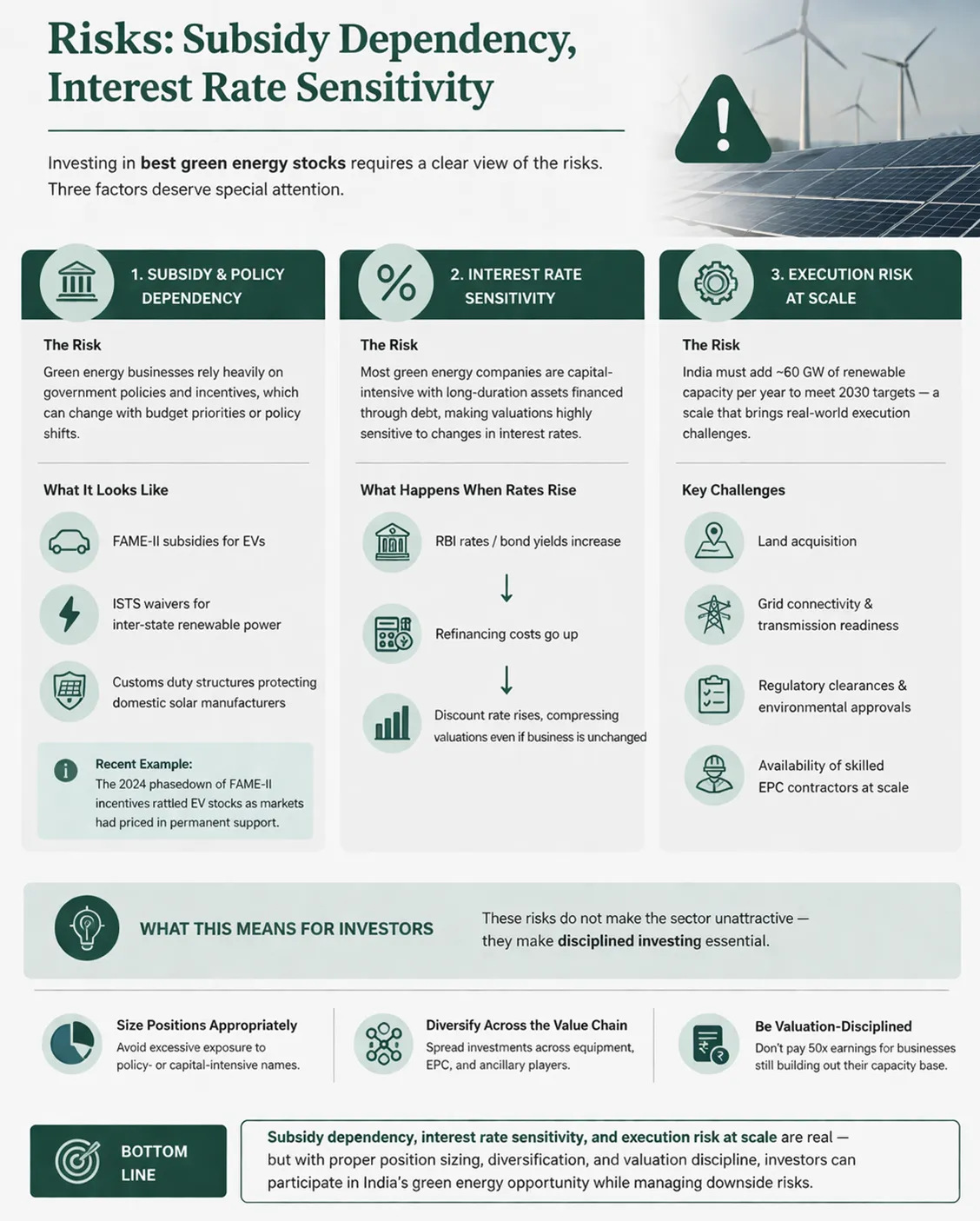
Subsidy and policy dependency are the elephants in the room. FAME-II subsidies for EVs, ISTS waivers for inter-state renewable power, and Customs duty structures protecting domestic solar manufacturers all of these are all government policies, and they can be modified. The 2024 phasedown of FAME-II incentives rattled EV stocks precisely because markets had priced in the subsidy as permanent. They're not.
Interest rate sensitivity affects green energy sector stocks disproportionately because their business model involves long-duration assets financed with debt. When RBI rates rise or bond yields spike, two things happen: refinancing costs increase, and the discount rate used to value long-duration cash flows rises, compressing valuations even if the underlying business hasn't changed.
Execution risk at scale is underappreciated. India needs to add ~60 GW of renewable capacity per year to hit its 2030 targets. That requires land, grid connectivity, regulatory clearances, and skilled EPC contractors in volumes that have never been mobilised in this country before. Delays are not hypothetical; they're already showing up in several developers' project pipelines.
None of this makes the sector uninvestable, far from it. It means you size positions appropriately, diversify across the value chain, and don't pay 50x earnings for businesses that are still building out their capacity base.
Green Smallcase Options on Wright Research
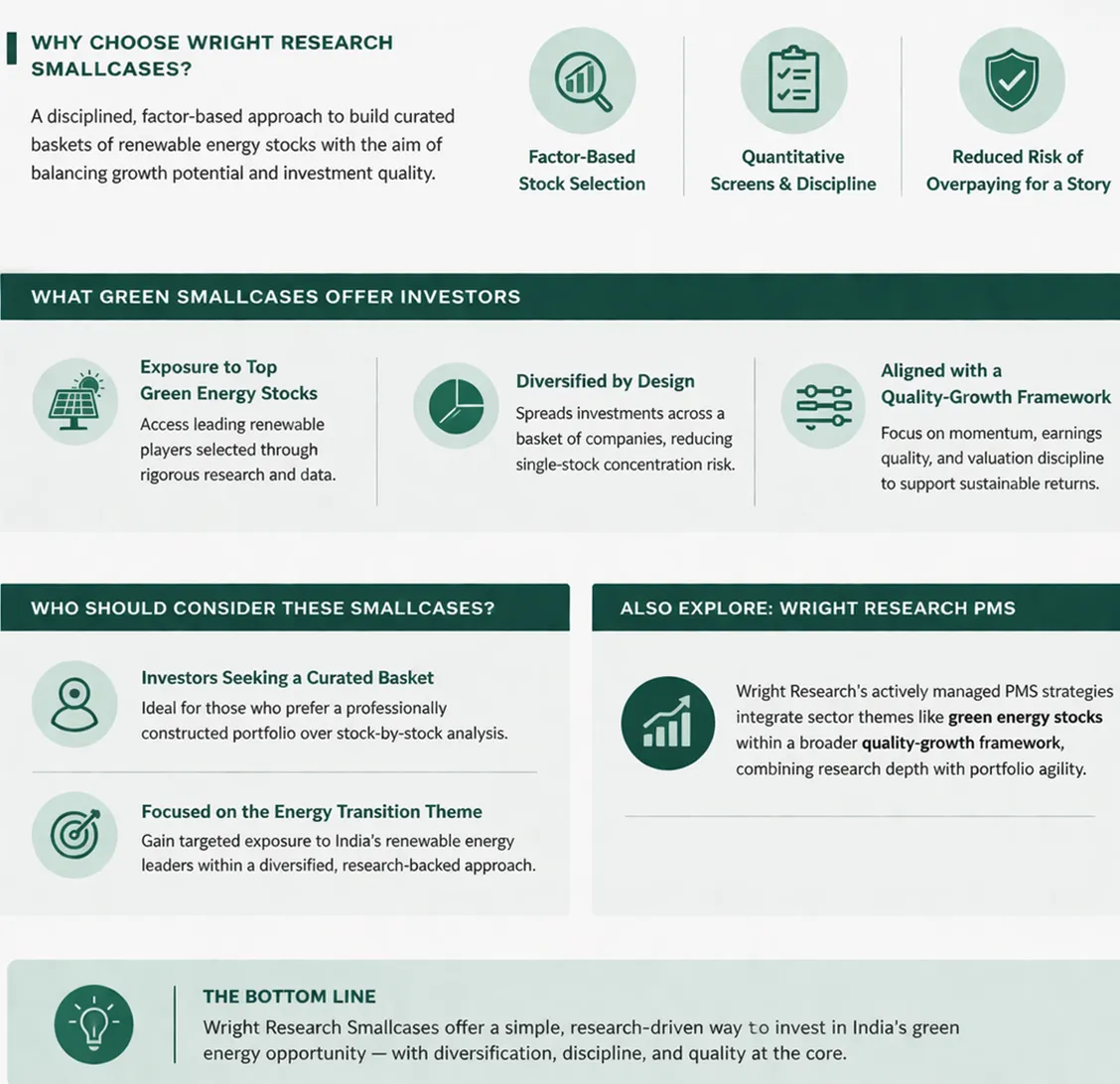
If reading through individual stock analysis makes you think "I'd rather have a curated basket," Wright Research's Smallcase themes offer exactly that.
Wright Research's factor-based approach to portfolio construction means that renewable energy stocks to buy are selected not just on thematic grounds but on quantitative screens, momentum, quality of earnings, and valuation discipline that reduce the risk of overpaying for a story.
For investors specifically interested in the energy transition theme, Wright Research's equity Smallcases give you exposure to a diversified set of top green energy stocks without the concentration risk of holding just one or two names.
Is your portfolio built for what’s coming?
Get a free AI-powered review of your holdings — risk, overlap and quality in minutes.
FAQs About Green Energy Stocks in India
1. What are the best green energy stocks to buy in India in 2026?
The most widely tracked names are Adani Green Energy, Tata Power, NTPC (renewable segment), and SJVN. Each carries a different risk profile: Adani Green for high-growth exposure, Tata Power for diversification, and NTPC for PSU stability with dividend yield.
2. What is the difference between green energy stocks and electrical equipment stocks?
Green energy stocks refer to companies that generate or develop renewable power (solar, wind, hydro). Electrical equipment stocks and electric equipment stocks refer to manufacturers of the infrastructure enabling the energy transition, such as transformers, cables, switchgear, batteries, and EV components. Both are part of the energy transition investment thesis but operate at different points in the value chain.
3. Are green energy shares overvalued in India?
Several leading green energy shares trade at premium valuations relative to current earnings, reflecting future capacity and growth expectations. Whether that's "overvalued" depends on your time horizon and discount rate assumptions. On a 5-7 year view, the growth runway arguably justifies current multiples for the strongest operators.
4. What is the current green energy stock price trend?
Green energy stock prices in India saw significant volatility in 2024 amid interest rate uncertainty and FAME-II subsidy changes. Fundamentally, the medium-term outlook remains positive, but investors should track RBI rate guidance and government policy cycles closely.
5. How can Wright Research help me invest in renewable energy?
Wright Research offers both Smallcase-based thematic investing and Portfolio Management Services (PMS) for investors seeking structured, research-backed exposure to top green energy stocks and the broader energy transition theme.