


Quick Answer: What Is Factor Investing for Capital Protection?
Factor investing for capital protection is a systematic, rules-based equity strategy that selects stocks based on characteristics that have historically limited losses during market corrections - specifically quality, low volatility, value, minimum variance, and dividend yield.
How protective are these factors? India's correction data:
Market Event | Nifty 50 Drawdown | Low Volatility Factor | Recovery Advantage |
COVID-19 Crash (2020) | -40% | -31% | ~9% less decline |
Rate-Hike Selloff (2022) | -18% | Lower | Quality stocks benefited |
Sep 2024–Mar 2025 | -12%+ | -17.52% vs Momentum -31.25% | 13.7% less decline |
The asymmetric mathematics: A ₹5 crore portfolio down 40% needs a 67% gain to break even. Down 20%, it needs only 25%. Factor investing doesn't eliminate losses - it reduces their depth and recovery burden.
Source: NSE Indices, Mirae Asset MF data, Business Standard. Investments are subject to market risk. Past performance is not indicative of future returns.
See what markets are pricing in
Live indices, sector moves and market breadth — the backdrop to every story we publish.
Introduction
Every serious investor has faced the same uncomfortable truth at some point: the market does not move in a straight line. The Nifty 50 declined nearly 40% during the COVID-19 crash of 2020. It shed close to 18% during the 2022 rate-hike selloff. Between September 2024 and early 2025, large-cap indices corrected by over 12%. For investors building wealth over decades, these drawdown episodes are not abstract statistics; they are lived, anxiety-inducing experiences that test conviction and, more often than not, lead to costly decisions.
The question most investors ask after surviving a correction is rarely "how do I maximize returns?" It is far more frequently: "How do I protect what I have already built?"
This is precisely where factor investing and specifically, safe factor portfolios engineered around quality investing and low risk factor portfolios enter the picture.
Factor-based investing is not a new concept in global markets, but in India, most conversations around it have centred on high-return strategies: momentum, alpha, and growth. Very few providers have built a coherent, data-backed case for the capital preservation end of the factor investing in India spectrum. This blog does exactly that and explains how Wright Research's quantitative approach to hedged factor investing is designed to deliver downside protection without abandoning equity growth altogether.
What Is a Safe Factor Portfolio? How Factor Investing Differs from Conventional Equity Investing
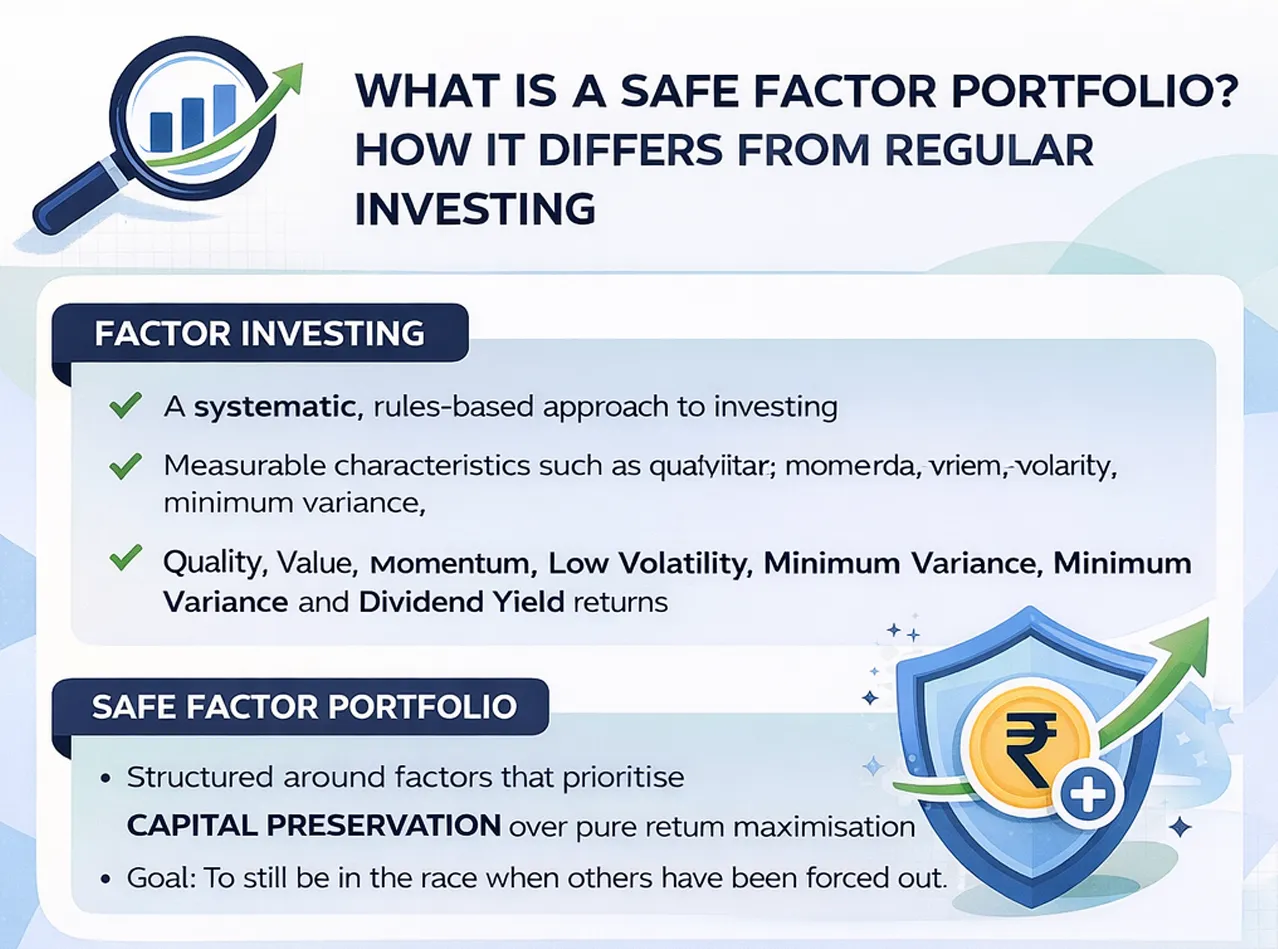
Factor investing is a systematic, rules-based approach to portfolio construction. Rather than relying on analyst intuition or thematic storytelling, factor-based investing identifies specific, measurable characteristics called factors that have historically been associated with superior risk-adjusted returns.
The most widely researched factors include quality, value, momentum, low volatility, minimum variance, and dividend yield. Each factor targets a different risk-return trade-off. Momentum strategies chase the fastest-moving stocks. Alpha-generation strategies seek stocks that consistently outperform their benchmarks.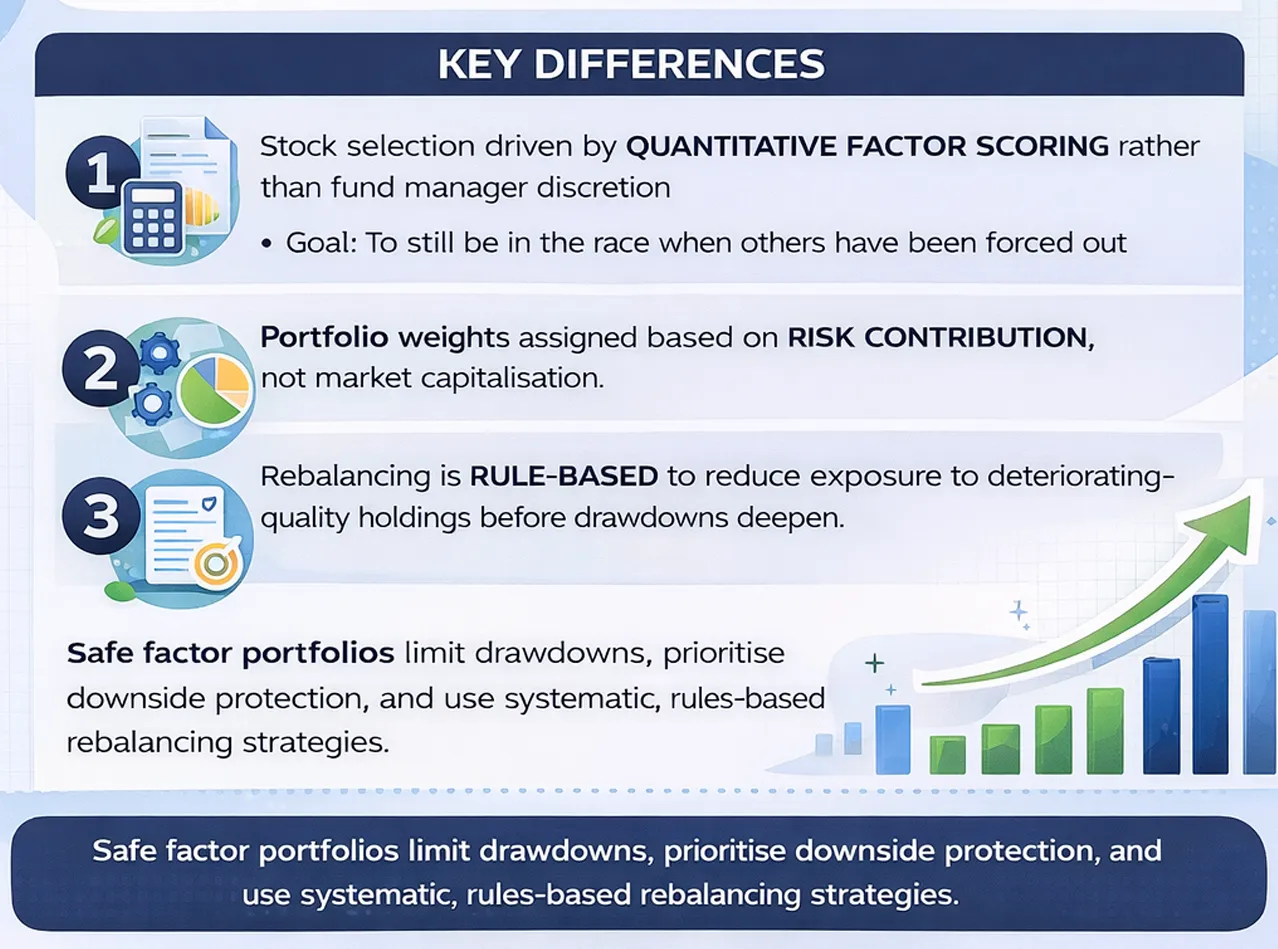
A safe factor portfolio , by contrast, is structured around factors that prioritise capital preservation over raw return maximisation. The goal is not to be first to the finishing line, it is to still be in the race when others have been forced out.
This distinction matters enormously for Indian High Net Worth and Ultra High Net Worth investors (HNIs and UHNIs). A ₹5 crore portfolio that suffers a 40% drawdown requires a subsequent 67% gain just to break even. A portfolio that limits the same correction to 20% needs only a 25% recovery. The mathematics of downside protection is asymmetric, avoiding losses compounds wealth far more powerfully than many investors recognise.
Safe factor portfolios differ from conventional diversified equity funds in three fundamental ways. First, stock selection is driven by systematic quantitative factor scoring rather than fund manager discretion. Second, portfolio weights are assigned based on risk contribution, not market capitalisation. Third, rebalancing is rule-based and designed to reduce exposure to deteriorating-quality holdings before drawdowns deepen.
Also Read: What History Tells Us About Indian Stock Market Corrections?
The 5 Factors That Provide Capital Protection in Indian Markets
Factor investing in India has evolved significantly since NSE introduced its smart beta indices. Five specific quantitative factors have demonstrated consistent downside protection properties in the Indian market context.
1. Quality Factor
The quality factor selects stocks based on three primary metrics: high Return on Equity (ROE), low debt-to-equity ratios, and earnings stability over multiple business cycles. Quality investing filters out capital-intensive companies and highly leveraged businesses that are particularly vulnerable during credit tightening or economic slowdowns.
The Nifty500 Quality 50 Index tracks this factor at scale, selecting companies whose fundamentals provide an inherent margin of safety. During corrections, quality investing stocks tend to hold up better precisely because their balance sheets can absorb shocks that destroy weaker competitors.
2. Low Volatility Factor
The low volatility factor is arguably the most directly aligned with capital preservation objectives. The Nifty100 Low Volatility 30 Index selects the 30 least volatile stocks from the Nifty 100 universe and weights them inversely to their volatility, meaning the calmest stocks receive the heaviest allocations.
Over the past 15 years, this index has generated approximately 15.2% CAGR, outperforming the Nifty 50 on a risk-adjusted basis across most long investment horizons. Crucially, the index has recorded lower drawdowns than the Nifty 100 in 16 out of 19 calendar years since 2006 (Source: NSE Indices, Mirae Asset MF data, Dec 2024).
3. Value Factor
The value factor invests in stocks trading at a discount to their intrinsic worth, identified through metrics like low price-to-earnings ratios, low price-to-book values, and high dividend yields. In the context of a safe factor portfolio, value acts as a natural buffer: stocks that are already cheap have limited downside from further re-rating. The margin of safety embedded in value stocks provides a floor that momentum-chasing portfolios completely lack.
4. Minimum Variance Factor
The minimum variance approach constructs a low-risk factor portfolio by optimising for the lowest possible portfolio volatility given a set of return assumptions, while accounting for correlations between holdings. Unlike simple low-risk investments that may concentrate in a single defensive sector, minimum variance portfolios diversify across multiple uncorrelated holdings. This structural diversification reduces drawdown depth during broad market selloffs.
5. Dividend Yield Factor
Consistent dividend-paying companies demonstrate earnings predictability and management discipline, both hallmarks of capital preservation-oriented stocks. High dividend yield portfolios tend to belong to mature businesses with stable cash flows, providing both income and a valuation cushion during market corrections.
Also Read: Battery Energy Storage Systems: India’s Missing Power Link
Get research like this in your inbox
The week’s research that mattered, in five minutes. Joined by 2L+ investors.
How Safe Factor Portfolios Performed During Indian Market Corrections
The true test of a safe factor portfolio is not its bull-market behaviour; it is how it manages downside protection when markets are in free fall. Three distinct correction periods in recent Indian market history are particularly instructive.
1. The 2020 COVID-19 Crash
Between mid-January 2020 and late March 2020, the Nifty 50 plunged approximately 40% in just 46 trading days, its sharpest quarterly decline since the June 1992 quarter. The Nifty 50 recorded a 29.3% fall for the January–March 2020 quarter (Source: Business Standard, March 2020).
During this same period, the Nifty100 Low Volatility 30 fell approximately 31%, a meaningful outperformance of roughly 7–8 percentage points relative to the broader benchmark. While both indices declined, the asymmetry of recovery matters: mathematically, a 31% drawdown requires a 45% recovery to break even, while a 38–40% drawdown requires 62–67%. Low-risk factor portfolios required significantly less recovery effort to restore capital (Source: Groww Digest analysis).
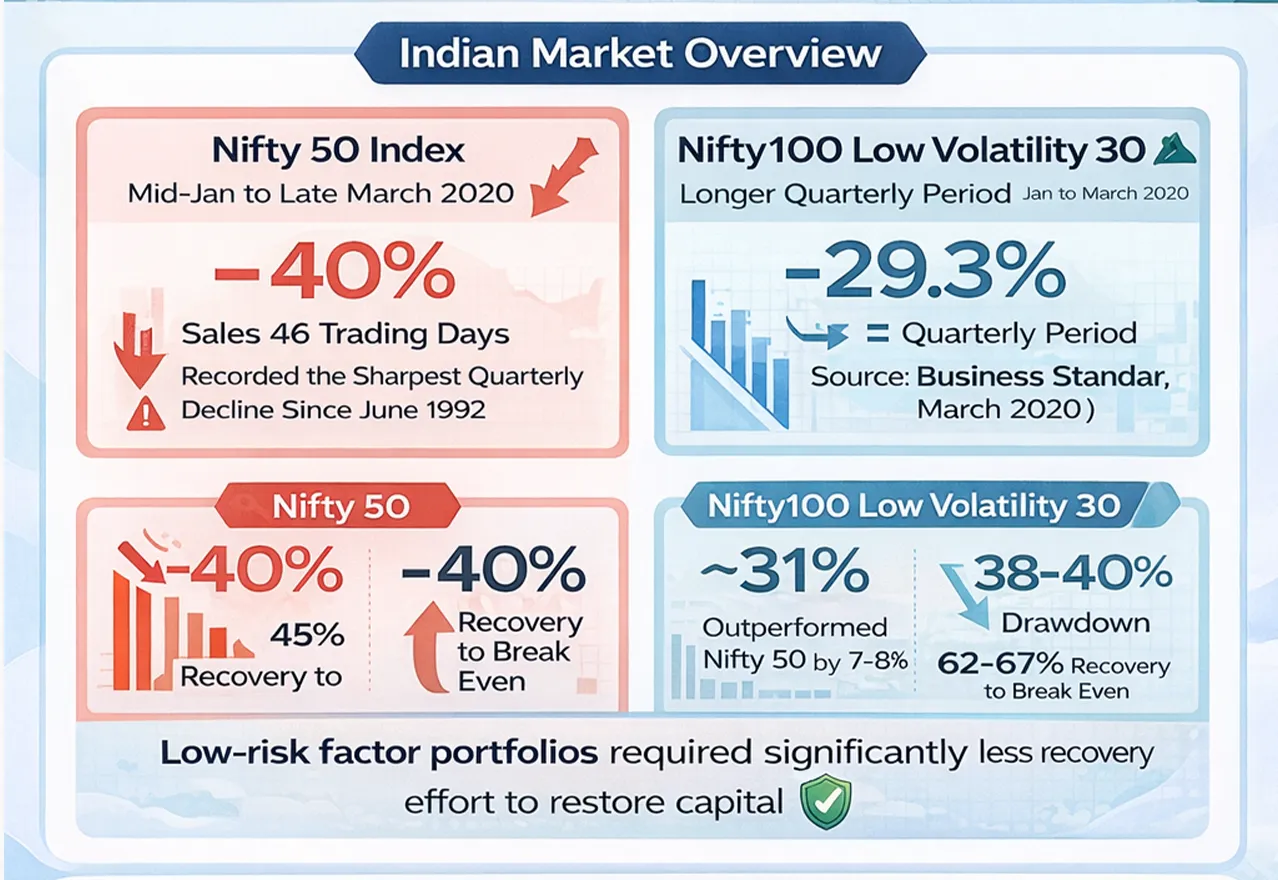
The Nifty 50 Index fell 40% from mid-January to late March 2020, marking the sharpest quarterly decline since 1992, with a 45% recovery required to break even. The Nifty100 Low Volatility 30 index declined 29.3% during the same period. Another section compares drawdowns: Nifty 50 dropped 40% needing 67% recovery, while the low-volatility index dropped around 31%, requiring less recovery effort. A bottom note highlights that low-risk factor portfolios required significantly less effort to restore capital.
Pharma and consumer staples stocks — both natural constituents of quality and low volatility factor investing strategies — declined only 9–11% during the same period (Source: Business Standard, March 2020). This sector-level data illustrates how the quality investing and low volatility factors provide structural downside protection even during systemic shocks.
2. The 2022 Rate-Hike Selloff
The 2022 correction was driven by global inflation and aggressive central bank rate hikes. The Nifty 50 declined approximately 18%, eventually bottoming near 15,183 before beginning a 13-month recovery (Source: Medium/iamClearmind, March 2025). During rate-driven corrections, high-debt companies and growth stocks, precisely the categories excluded by quality investing screens, suffer disproportionately. Low-risk factor portfolios with quality tilts have historically navigated rate cycle headwinds better than market-cap-weighted indices because their holdings carry lower leverage.
3. The September 2024 – Early 2025 Correction
The most recent correction saw the Nifty 50 fall over 12% from its September 2024 peak of approximately 26,277. Large-cap indices fell 13.27%, while Nifty Next 50 declined nearly 21% (Source: Wikipedia, Stock market crashes in India). Small- and mid-cap indices corrected even more severely. In contrast, investors in well-constructed safe factor portfolios with quality and low risk investment characteristics experienced materially smaller drawdowns, a validation of the capital preservation thesis in real-time.
The pattern across all three corrections confirms a structural insight: factor investing built around quality and low volatility factors does not eliminate losses, but it consistently reduces their depth, thereby reducing the recovery burden and protecting compounding trajectories.
Also Read: What the Iran-Israel-US War Means For India's & World's Fertilizer Industry?
Wright Research's Methodology for Building Safe Factor Portfolios
Wright Research is a Portfolio Management Services (PMS) provider and alpha-generating PMS practitioner. The firm's approach to safe and profitable stock picks is grounded in systematic quantitative factor analysis rather than qualitative manager judgment.
1. Multi-Factor Scoring Framework
Wright Research's portfolio construction begins with a quantitative factor scoring process that evaluates each stock across multiple dimensions simultaneously: quality metrics (ROE, debt-to-equity, earnings consistency), low volatility scores (one-year standard deviation of returns), value metrics, and momentum indicators. Stocks are ranked on a composite score that balances return potential with capital preservation characteristics.
This composite approach is central to hedged factor investing — rather than concentrating entirely in a single factor, Wright's methodology diversifies across factors that are complementary in different market environments. When momentum falters during corrections, quality and low volatility factors provide a stabilising offset.
2. Rebalancing and Drawdown Controls
Wright Research employs rule-based rebalancing schedules that systematically reduce exposure to stocks whose quantitative factor scores deteriorate, often well before such deterioration becomes visible in price action. This forward-looking rebalancing is a key differentiator of professional alpha-generating PMS versus passive smart-beta index tracking.
Additionally, portfolio construction incorporates drawdown control mechanisms: maximum sector concentration limits, correlation-based position sizing, and quality screening gates that prevent the inclusion of fundamentally weakening businesses regardless of their recent price performance.
3. Safe and Profitable Stock Picks Through Factor Discipline
The phrase "safe and profitable stock picks" sounds contradictory to many investors conditioned to believe that safety and returns are mutually exclusive. Wright Research's factor-based investing methodology challenges this assumption. By selecting stocks with durable competitive advantages, strong balance sheets, and stable earnings, the portfolio naturally tilts toward businesses that survive downturns and participate meaningfully in recoveries.
This is hedged factor investing in practice: not the use of derivatives to hedge, but the structural hedging that quality and low volatility factors embed into the portfolio's DNA.
Wright Research's PMS and Smallcase products offer investors direct access to these systematic factor investing in India strategies. Each portfolio is managed with transparency, SEBI-compliant disclosures, and a clear investment philosophy available for investor review.
Safe Factor Portfolio vs Conservative Mutual Fund vs Fixed Deposit: A Comparison
For the risk-averse Indian investor, the traditional alternatives to equity have been conservative debt mutual funds and fixed deposits. Understanding how a safe factor portfolio compares across key parameters helps investors make informed decisions aligned with their capital preservation goals.
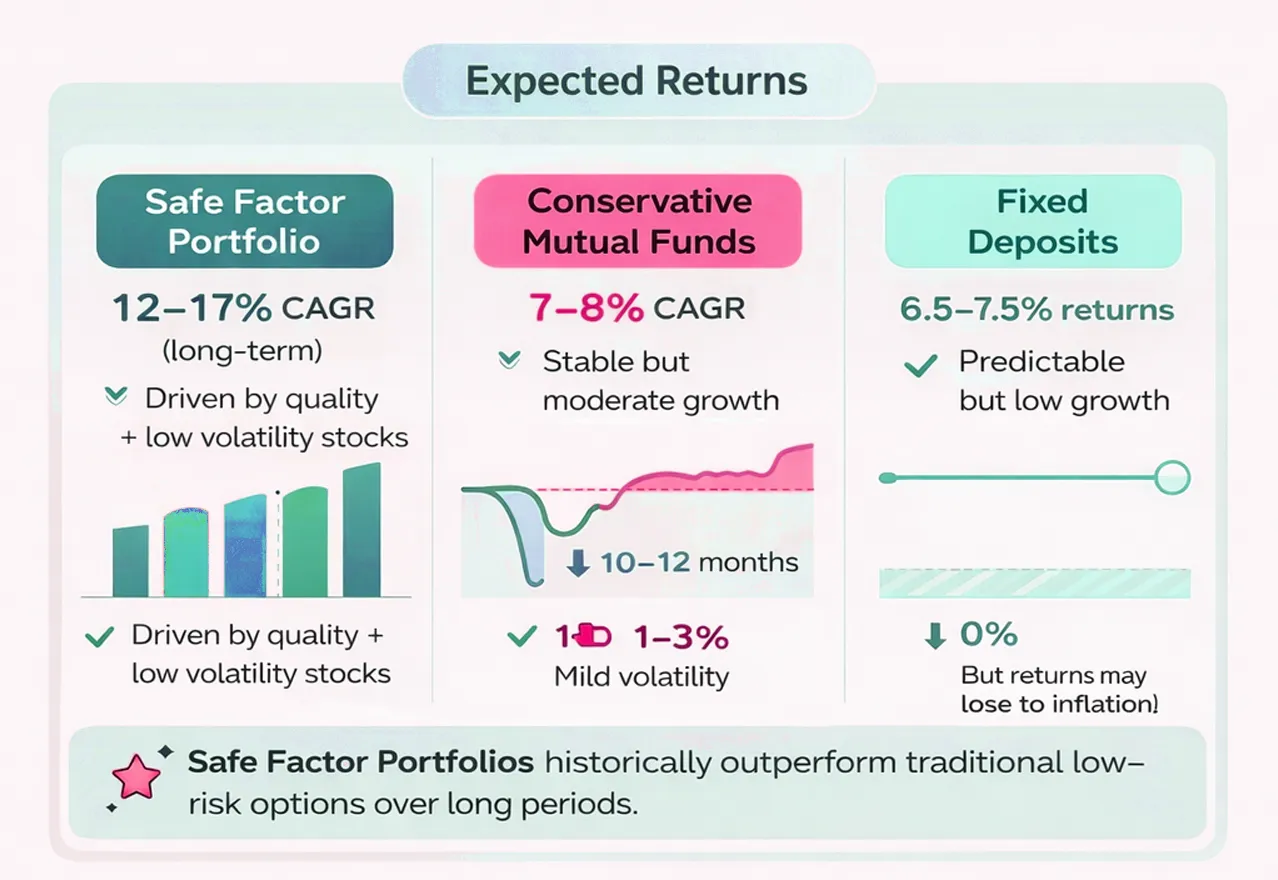
The Safe Factor Portfolio section shows 12–17% long-term CAGR driven by quality and low-volatility stocks. The Mutual Funds section shows 7–8% CAGR with moderate growth and mild volatility. The Fixed Deposits section shows 6.5–7.5% predictable returns but notes that real returns may fall due to inflation. A note at the bottom states that Safe Factor Portfolios historically outperform traditional low-risk options over long periods.
1. Expected Return Potential
A low risk factor portfolio built on quality and low volatility factor investing strategies has historically delivered 12–17% CAGR over long investment horizons (as illustrated by Nifty100 Low Vol 30's 15.2% 15-year CAGR, Source: NSE Indices via Mirae Asset MF). Conservative debt mutual funds typically target a 7–8% CAGR. Fixed deposits in 2025 offer roughly 6.5–7.5% for 1–3 year tenures, depending on the bank.
2. Maximum Historical Drawdown
This is where the capital preservation case becomes most compelling. While a safe factor portfolio experienced drawdowns of approximately 30–35% during the 2020 crash, a well-constructed one recovered fully within 10–12 months alongside the broader market recovery. Conservative mutual funds may experience mild NAV declines of 1–3% during credit events. Fixed deposits carry no market drawdown risk, but their real post-inflation, post-tax return is often negligible or negative.
3. Liquidity
Safe and profitable stock picks held in PMS or Smallcase structures are liquid at market prices, typically with T+2 settlement. Conservative mutual funds offer similarly high liquidity. Fixed deposits carry premature withdrawal penalties.
4. Tax Treatment
Equity-oriented factor investing strategies are taxed at 12.5% Long-Term Capital Gains (LTCG) above ₹1.25 lakh for holdings over one year, and 20% Short-Term Capital Gains (STCG) for holdings under one year (as per current tax rates). Debt mutual fund gains are taxed as per the income slab. Fixed deposit interest is fully taxable at the applicable income tax slab rate — making it the least tax-efficient option for investors in higher brackets.
Who Should Choose a Safe Factor Portfolio? Suitability for Indian HNI Investors
A safe factor portfolio is best suited for HNI investors with a minimum 3–5 year investment horizon, a risk tolerance that can absorb equity drawdowns of 25–35% without panic-driven exits, and a desire for superior after-tax, after-inflation returns compared to traditional low-risk investments. It is not a replacement for emergency funds or short-term liquidity requirements.
Track the factors behind this research
Momentum, value, quality and low-vol — updated factor performance for Indian markets.
Frequently Asked Questions
Q1. What is factor investing in India?
Factor investing in India is a systematic, rules-based investment approach that selects and weights stocks based on specific characteristics called factors, such as quality, low volatility, value, momentum, and dividend yield. In India, NSE has formalised several factor-based investing indices, including the Nifty100 Low Volatility 30, Nifty500 Quality 50, and Nifty100 Alpha 30, providing benchmarks for these strategies.
Q2. What is a safe factor portfolio?
A safe factor portfolio is an equity portfolio constructed primarily around factors that prioritise downside protection and capital preservation over maximum return. It typically emphasises quality stocks (high ROE, low debt), low volatility stocks, and minimum variance constructions. A well-designed safe factor portfolio aims to capture meaningful equity upside while significantly reducing drawdown depth during market corrections.
Q3. Which factor strategy is safest for capital protection in India?
The low volatility factor and the quality investing factor have demonstrated the strongest capital preservation characteristics in the Indian market. The Nifty100 Low Volatility 30 has recorded lower drawdowns than the Nifty 100 in 16 of 19 calendar years since 2006 (Source: NSE Indices). Combined with the quality factor through a hedged factor investing approach, these two factors provide the most robust downside protection in the Indian context.
Q4. Is factor investing better than mutual funds for low-risk investors?
It depends on the specific mandate. A low-risk factor portfolio in a PMS structure offers systematic, transparent factor exposure with professional rebalancing and drawdown controls. Conservative debt mutual funds provide capital safety but with limited long-term return potential. For investors with a minimum 5-year horizon and a desire for inflation-beating capital preservation, a well-managed factor investing strategy typically offers superior risk-adjusted returns compared to conservative mutual funds.
Q5. What is the difference between factor investing and regular stock picking?
Regular stock picking relies on analyst conviction, qualitative narratives, and subjective judgment. Factor-based investing relies on systematic quantitative factor scoring, rules-based selection, and data-driven rebalancing. Safe and profitable stock picks in a factor framework are chosen not for a compelling story, but for measurable characteristics, quality of earnings, balance sheet strength, and price stability that have historically predicted better risk-adjusted outcomes.
Q6. What is downside protection in a factor portfolio?
Downside protection in a factor investing portfolio refers to the portfolio's structural tendency to decline less than the broader market during corrections. This is achieved not through hedging instruments, but through the inherent characteristics of the underlying stocks: stable earnings, low leverage, and price predictability. Hedged factor investing at Wright Research uses factor diversification as its primary protection mechanism.
Q7. How does Wright Research build its factor portfolios?
Wright Research uses a multi-factor quantitative scoring framework that evaluates stocks on quality metrics, low volatility scores, value, and momentum. Stocks are ranked on composite scores, weighted by risk contribution rather than market capitalisation, and rebalanced on a rule-based schedule. Drawdown controls and sector concentration limits are built into the construction process. Wright Research's approach as an alpha-generating PMS provider combines systematic factor investing in India with active rebalancing to optimise the capital preservation and return trade-off.
Q8. Are low-risk factor portfolios suitable for all investors?
Low-risk factor portfolios are most suitable for investors with a minimum 3–5 year investment horizon, a willingness to absorb equity drawdowns of 25–35% during severe market dislocations, and a financial goal that requires inflation-beating returns. They are not suitable as substitutes for emergency funds, short-term savings, or for investors whose risk tolerance is genuinely aligned with fixed-income instruments. Wright Research recommends investors consult a financial advisor to assess suitability before investing.