

Buying gold through a phone can take seconds, but the legal and operational structure behind that screen matters more than the convenience. App-based gold is generally a contractual claim arranged by a platform and a bullion provider—not a SEBI-regulated security held in a demat account.
This guide explains the purchase, storage and redemption process, compares the main gold routes, and incorporates SEBI’s November 2025 warning about counterparty and operational risks.
What Is Digital Gold?
The basic answer to what is digital gold is fractional ownership or entitlement to physical gold bought through an online platform. The customer pays rupees; a partner bullion provider says it buys a corresponding quantity of gold and stores it in a vault. The app records the customer’s balance in grams or value.
Unlike a Gold ETF unit, digital gold is not traded on a recognised stock exchange and is not normally held as a security in a demat account. SEBI stated on 8 November 2025 that such products are neither notified as securities nor regulated as commodity derivatives. They operate outside SEBI’s purview.
That does not mean every offering is fraudulent. It means the investor depends on the platform-provider contract, custody structure and private grievance process rather than securities-market protections. Anyone asking what is digital gold should therefore examine who actually owes the gold, where it is stored and how it can be recovered.
Check the macro backdrop
GDP, inflation, rates and more — India’s key economic indicators in one dashboard.
How Digital Gold Works Through Apps
The app is usually the customer interface, while a bullion company supplies, safeguards and repurchases the metal. The platform collects the order and displays the balance. Providers often describe the backing as allocated 24-karat gold held with an independent custodian and checked by a trustee or auditor, but the exact arrangement varies.
The sequence below shows how digital gold works in a typical transaction:
- The customer completes platform onboarding and chooses a rupee amount or quantity.
- The quoted price includes the provider’s live rate and applicable GST.
- The payment is processed and a fractional gram balance appears in the account.
- The provider states that matching physical gold is stored in an identified vault.
- The customer later sells through the platform or requests delivery, subject to terms.
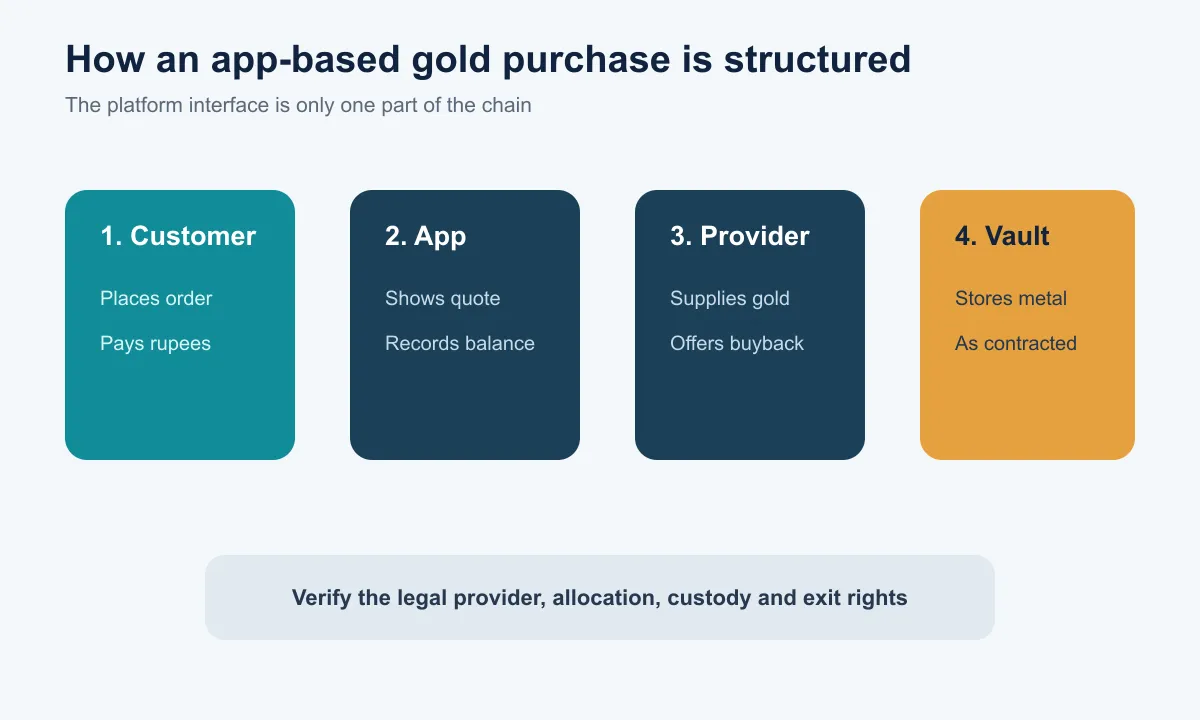
Ownership wording is crucial. Some agreements describe the customer as owner of specifically allocated gold; others create a more general contractual entitlement. Read the terms instead of assuming the app balance has the same legal character as metal held personally.
How to Buy, Sell and Redeem Digital Gold
To buy digital gold online, select an amount, review the purchase quote and check how many grams will be credited after tax and spread. Confirm the named bullion provider before paying. Save invoices, transaction IDs and account statements outside the app.
When selling, the platform typically displays a separate buyback price. It may be lower than the purchase price even if the reference gold price is unchanged. The difference reflects GST paid on purchase, provider spread and other costs. Sale proceeds are normally transferred to the linked bank account after identity and payment checks.
Physical redemption converts the recorded balance into a coin or bar. Minimum delivery quantities, fabrication charges, insurance, shipping and address restrictions can apply. Delivery removes ongoing platform exposure but creates physical storage, purity-verification and resale concerns.
Before deciding to buy digital gold online, test the sale and redemption screens with a small amount. Confirm settlement time, minimum balance, maximum storage period and what happens when the stated free-storage period ends.
Costs, Storage and Purity
Gold under tariff heading 7108 is subject to 3% GST, split as 1.5% CGST and 1.5% SGST for an intra-state transaction. This tax creates an immediate gap between the amount paid and the underlying pre-tax metal value. Platforms may also embed a spread rather than display it as a fee.
| Cost or feature | What to verify |
|---|---|
| Purchase GST | Amount charged and grams credited |
| Buy-sell spread | Difference between simultaneous quoted rates |
| Storage | Free period, later fee and maximum holding term |
| Delivery | Minimum grams, minting, insurance and shipping charges |
| Purity | Stated fineness, refiner and assay documentation |
| Buyback | Who provides liquidity and when settlement occurs |
Providers commonly advertise 24-karat gold of 99.5% or 99.99% purity. Purity alone does not resolve custody or counterparty risk. Ask whether the gold is allocated, insured, independently audited and bankruptcy-remote, and whether reports identify the vault and metal balance rather than offer only a generic assurance.
Get research like this in your inbox
The week’s research that mattered, in five minutes. Joined by 2L+ investors.
Digital Gold vs Physical Gold vs Gold ETF
The right route depends on purpose. Jewellery serves consumption; bars and coins provide possession; app balances offer small-ticket convenience; Gold ETFs provide regulated market exposure through exchange-traded units.
| Feature | App-based gold | Physical gold | Gold ETF |
|---|---|---|---|
| Form | Platform record backed by claimed vault gold | Coin, bar or jewellery | Exchange-traded mutual fund unit |
| Regulation | Outside SEBI securities framework | Consumer and bullion-market rules | SEBI-regulated mutual fund |
| Storage | Arranged by provider | Investor’s responsibility | Fund-appointed custodian |
| Purchase GST | Generally 3% | Generally 3% | No GST on purchase of ETF units |
| Trading | Platform buy/sell window | Dealer or jeweller | Stock exchange during market hours |
| Main extra risk | Platform/provider and custody | Theft, purity and resale deduction | Market liquidity, tracking error and expense ratio |
The digital gold vs gold ETF comparison is especially important for investors rather than gift buyers. ETFs have regulated disclosures, NAV reporting and securities-market grievance mechanisms, but usually require a demat and trading account and charge an expense ratio. App-based gold can start with tiny amounts, yet carries protections that depend largely on private arrangements.
For a deeper product comparison, see Wright Research’s guide to Gold ETFs versus gold mutual funds. Investors can also review broader alternative investment research before deciding how gold fits their allocation.
Is Digital Gold Safe? Risks and Investor Protections
Safety is not binary. Gold-price risk exists regardless of route: prices can fall and may underperform other assets. App-based holdings add operational and counterparty layers.
SEBI’s 2025 caution says these products may expose buyers to significant counterparty and operational risks and do not receive investor-protection mechanisms available under the securities-market framework. That distinction affects regulatory supervision, disclosures and dispute resolution.
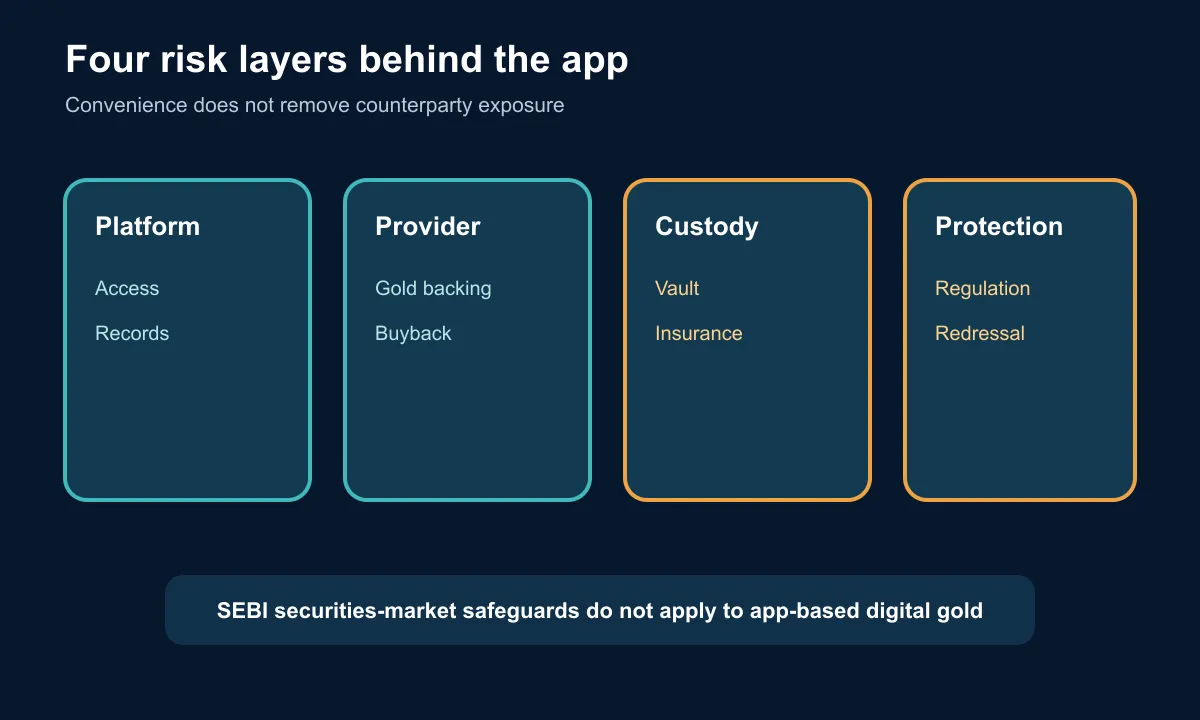
Key risks include:
- The bullion provider may fail to maintain or return the promised metal.
- Vault, insurance or audit arrangements may be unclear or change.
- The app can shut down, lose its provider relationship or suffer a cyber incident.
- Buyback liquidity and spreads are controlled by the provider rather than an exchange order book.
- Terms may impose storage deadlines, compulsory sale or delivery conditions.
- Complaints may fall outside SEBI SCORES and securities-market dispute mechanisms.
Regulated alternatives named by SEBI include Gold ETFs, exchange-traded commodity derivative contracts and Electronic Gold Receipts. A mutual-fund route can be explored through Wright Research’s mutual fund platform.
Taxation of Digital Gold
Buying app-based gold generally attracts 3% GST on the gold value. GST is a transaction tax and is distinct from income tax on any later gain.
For capital-gains purposes, gold held for more than 24 months is generally treated as a long-term capital asset under the post-July 2024 framework. Long-term gains are generally taxed at 12.5% without indexation; gains on a holding of 24 months or less are generally short-term and taxed at the investor’s applicable slab rate. Surcharge and cess may apply.
The exact result can depend on the transaction date, legal character of the holding, residency, whether activity constitutes a business, and changes in law. Delivery into physical form or transfers between arrangements can also raise cost-basis and documentation questions. Retain invoices and consult a tax professional rather than relying only on an app summary.
What to Check Before Using a Digital Gold Platform
Use this due-diligence list before placing money:
- Identify both the app operator and the legal bullion provider.
- Read whether the gold is allocated to customers and segregated from company assets.
- Find the vault operator, insurer, trustee or auditor and latest reconciliation report.
- Compare the live purchase and sale quotes to measure the spread.
- Check free-storage duration, later fees and forced-exit provisions.
- Review physical-delivery quantities and all fabrication and shipping charges.
- Understand what happens if the app, provider, vault or trustee fails.
- Confirm the complaint channel and governing jurisdiction.
- Export transaction records and invoices regularly.
- Compare the product with a regulated Gold ETF for the same objective.
The most important digital gold vs gold ETF decision is not which interface feels easier. It is whether convenience compensates for weaker regulatory protection, purchase GST, spreads and reliance on private counterparties.
See what markets are pricing in
Live indices, sector moves and market breadth — the backdrop to every story we publish.
FAQ
What is the minimum amount needed to start investing in digital gold?
Minimums are set by each platform and can be very small—sometimes ₹1 or a fraction of a gram. A low entry amount does not reduce structural risk, and the credited gold value will reflect GST and the provider’s quote.
Who stores the gold backing digital-gold purchases made through an app?
Usually a bullion provider appoints a third-party vault or custodian. The app may only distribute the product. Check the customer agreement and audit reports for the provider, vault, insurance, allocation method and the party legally responsible for returning the gold.
What happens to digital-gold holdings if a platform shuts down?
The outcome depends on whether the bullion provider can continue servicing customers, whether records are reconciled, and how the contract handles platform failure. Do not assume automatic access. Save statements and verify a direct provider contact and wind-down procedure before purchasing.
Can digital gold be transferred between platforms?
Usually not as a simple account-to-account transfer. Platforms can use different providers and ledgers. A customer may need to sell on one platform and repurchase elsewhere, potentially incurring spread, GST and tax consequences, or redeem physical gold where permitted.
Understanding how digital gold works means looking past the app interface to custody, contracts and exit rights. Small-ticket convenience can be useful, but it should not be confused with SEBI-regulated protection.