

Crude oil affects transport, inflation, currencies and corporate margins. Buying an oil-producing company is not the same as taking exposure to oil itself. The most direct regulated route for crude oil trading India participants is an MCX futures contract.
This guide explains crude oil trading India participants can access, how contract values and margins work, what moves prices and why leverage demands strict risk control. It is educational material, not a recommendation to trade. Contract specifications and margins can change, so verify the current MCX circular and broker terminal before placing an order.
Crude Oil as an Investment and Trading Asset
Crude oil is both a physical commodity and a financial benchmark. Refiners buy it as an input; producers sell it; airlines and other businesses may hedge fuel-related exposure; traders take views on price. The two global reference grades are West Texas Intermediate (WTI) and Brent. MCX crude-oil futures use NYMEX WTI as their international reference.
Oil does not produce earnings or dividends, and a futures position expires. Returns depend on price, contract selection, currency conversion and costs. A long position benefits from a rise; a short position benefits from a fall.
Investors who want broader context can monitor Wright Research's India macro indicators alongside oil. Inflation, the rupee and industrial activity often help explain why a global crude move matters domestically.
What’s the market feeling today?
Our India Fear & Greed index tracks sentiment so you don’t trade on headlines.
How Crude Oil Trading Works on MCX
The practical answer to how to trade crude oil in India begins with a SEBI-registered broker that enables commodity derivatives. Complete KYC, activate the segment, read the risk disclosure, fund the account and select the correct symbol and expiry.
An MCX futures order creates an obligation, not ownership of physical barrels. Positions are marked to market daily: profits are credited and losses debited. A margin shortfall can require more funds or trigger position reduction.
Trading generally runs from 9:00 a.m. to 11:30 p.m. or 11:55 p.m., depending on US daylight-saving time. Confirm the intended contract month before ordering. These are essential checks when learning how to trade crude oil in India.
Crude Oil Contract Types, Lot Size and Margin
For 2026 expiries, MCX lists a standard CRUDEOIL futures contract and a smaller CRUDEOILM contract. The official MCX crude oil lot size is 100 barrels for the standard contract and 10 barrels for mini. Both quote rupees per barrel and use a ₹1 minimum price movement.
| Feature | MCX Crude Oil | MCX Crude Oil Mini |
|---|---|---|
| Trading unit | 100 barrels | 10 barrels |
| Quotation | ₹ per barrel | ₹ per barrel |
| Minimum tick | ₹1 | ₹1 |
| Value of one tick per lot | ₹100 | ₹10 |
| Initial margin in specification | Minimum 10% or SPAN, whichever is higher | Minimum 10% or SPAN, whichever is higher |
| Settlement | Cash | Cash |
At ₹6,500 per barrel, one standard lot represents ₹6,50,000; one mini lot represents ₹65,000. Margin is collateral, not the maximum loss. Additional margins may apply when volatility rises.
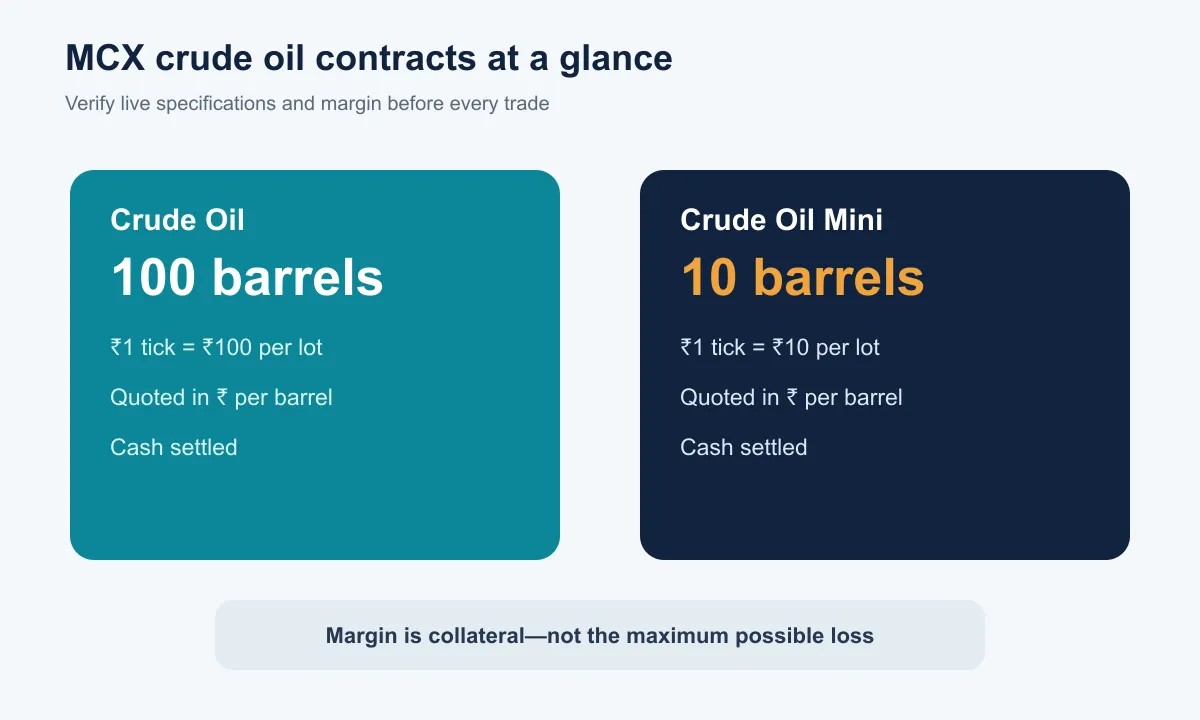
This distinction is central to MCX crude oil trading. A smaller cash deposit controls a much larger notional exposure. Size the position using the potential loss to the stop, not the margin displayed by the broker.
How Crude Oil Prices Are Determined
MCX prices connect a dollar-denominated global benchmark with the rupee. The simplified relationship is:
Indicative Indian price ≈ WTI price in USD × USD/INR, adjusted for contract timing and market basis.
The futures curve also matters. Later contracts above nearby ones indicate contango; lower later contracts indicate backwardation. Rolling an expiring position can therefore create a gain or loss even if spot oil barely changes.
At expiry, the 2026 MCX specifications use the NYMEX WTI front-month settlement converted at the latest available RBI USD/INR reference rate to determine the due-date rate. That makes both oil and currency relevant to crude oil futures India traders.
What Moves Crude Oil Prices in India?
The main crude oil price factors operate globally and locally:
| Driver | Typical transmission to MCX crude oil |
|---|---|
| OPEC+ production decisions | Supply cuts may support prices; higher output may weigh on them |
| US inventories and production | Unexpected stock builds can signal surplus; draws can signal tighter supply |
| Global growth | Stronger activity can raise transport and industrial demand |
| Geopolitics | Sanctions, war or shipping disruption can add a risk premium |
| USD/INR | A weaker rupee can lift the Indian contract even if dollar oil is unchanged |
| Refinery demand and seasonality | Maintenance, travel and heating cycles alter near-term demand |
No list of crude oil price factors works mechanically: a production cut may already be priced in, while weak demand can offset supply restraint. Compare multiple data points. For broader context, see Wright Research's article on gold, silver and copper as macro indicators.
Get research like this in your inbox
The week’s research that mattered, in five minutes. Joined by 2L+ investors.
Trading Strategies and Risk Management Basics
Common approaches include trend following, breakouts, mean reversion and calendar spreads. Before entering a crude oil trading India position, define its invalidation price, maximum rupee loss and exit deadline.
For disciplined crude oil trading India plans:
- Risk only a small, pre-decided share of trading capital on one idea.
- Calculate rupee risk as the stop distance multiplied by barrels per lot and number of lots.
- Keep extra cash for mark-to-market debits and possible margin increases.
- Avoid oversized positions around OPEC meetings, US inventory releases and geopolitical events.
- Use a stop, while recognising that gaps or illiquidity can produce a worse fill.
- Review correlation with existing energy stocks, transport businesses or currency exposure.
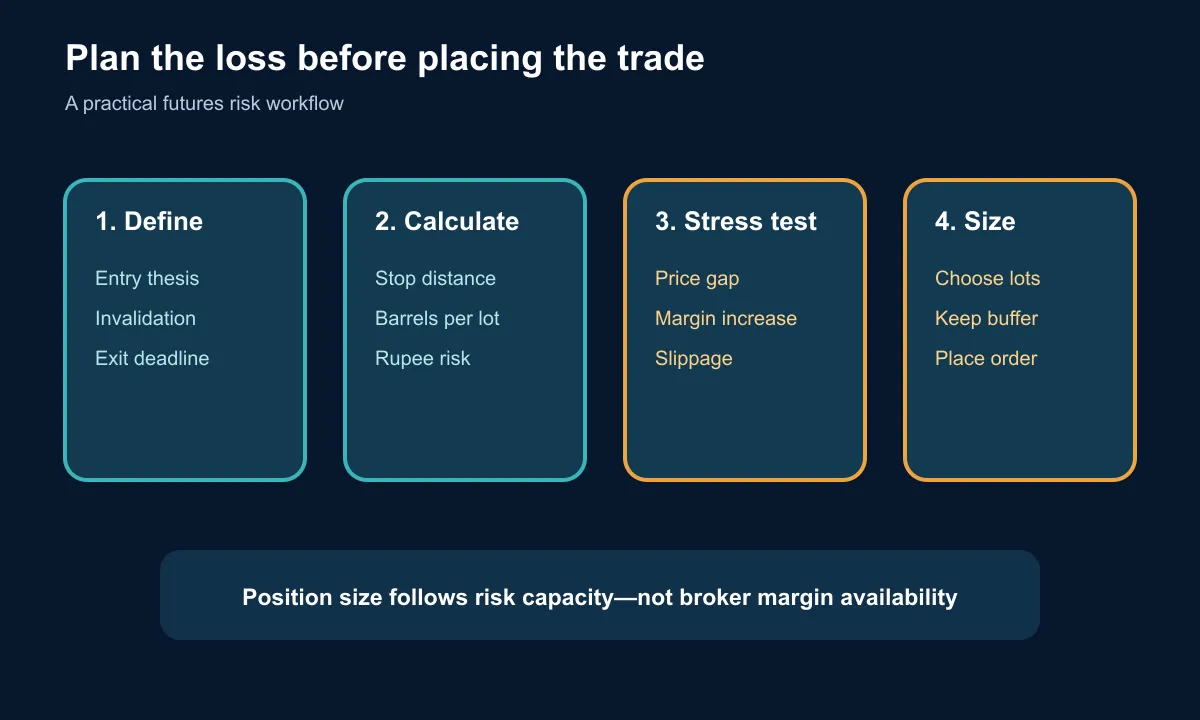
A well-defined loss is more important than a confident forecast. SEBI's risk disclosure warns that leveraged commodity positions can produce losses beyond the initial margin and may be difficult to exit in stressed conditions.
Crude Oil Futures vs Other Ways to Gain Oil Exposure
Futures are not the only route. Indian investors can consider energy-sector equities, diversified funds with energy holdings, overseas products where legally and operationally available, or commodity options offered on recognised exchanges.
| Route | Exposure | Main trade-off |
|---|---|---|
| MCX futures | Direct, leveraged contract exposure | Expiry, margin calls and substantial loss risk |
| MCX options | Asymmetric payoff for buyers | Premium decay, volatility pricing and contract complexity |
| Oil and gas shares | Company earnings plus oil sensitivity | Business, debt, regulation and management also matter |
| Diversified equity fund | Indirect exposure within a portfolio | Oil may be a small or changing allocation |
The Wright Research stock research platform can help assess listed companies, but company analysis is not a pure oil-price view.
Costs, Leverage and Tax Considerations
Costs include brokerage, exchange charges, Commodity Transaction Tax, applicable GST, SEBI fees, stamp duty and the bid-ask spread. Include all of them in the break-even price.
Eligible exchange-traded commodity derivatives are generally treated as non-speculative business income, subject to statutory conditions. Losses have specific set-off, carry-forward, audit and filing rules. Consult a chartered accountant because treatment depends on facts and current law.
Leverage remains the largest practical risk in MCX crude oil trading. The exchange specification states a minimum initial margin, but real-time requirements can be higher. Never assume the amount blocked when entering a trade caps the downside.
Worked Example: A Crude Oil Trade
Suppose a trader buys one crude-oil mini futures lot at ₹6,500 per barrel with a stop at ₹6,440 and a target at ₹6,620.
- Trading unit: 10 barrels
- Notional value: ₹6,500 × 10 = ₹65,000
- Planned risk: ₹60 × 10 = ₹600, before slippage and costs
- Potential gross gain: ₹120 × 10 = ₹1,200
- Stated reward-to-risk ratio: 2:1
If price falls to the stop and the order fills at ₹6,440, the gross loss is ₹600. If a sudden gap fills at ₹6,420, the gross loss becomes ₹800. The same calculation for a 100-barrel standard lot would be ten times larger. This is why the MCX crude oil lot size must be checked before every order.
The example explains mechanics, not a recommendation. Anyone learning how to trade crude oil in India should practise these calculations before risking capital.
Know your risk profile in 2 minutes
A short quiz that maps how much drawdown you can actually live with.
FAQ
How do Brent and WTI prices influence MCX crude oil prices?
MCX crude-oil futures reference NYMEX WTI, so WTI has the more direct contractual link. Brent remains an important global benchmark, and changes in the Brent-WTI spread can reflect regional supply, shipping and refining conditions. USD/INR also affects the rupee price.
What is the difference between crude oil and crude oil mini contracts on MCX?
The primary difference is trading unit: 100 barrels for the standard contract and 10 barrels for mini under the 2026 specifications. The smaller unit reduces tick value and notional exposure, but it remains leveraged and can still generate rapid losses.
What happens to an open crude oil futures position at expiry?
Current crude oil futures India specifications provide cash settlement. The due-date rate is based on NYMEX WTI's front-month settlement converted using the latest available RBI USD/INR reference rate. Brokers may apply earlier square-off policies, so confirm their deadline.
Why can MCX crude oil open with a price gap after global market movements?
Oil trades internationally while MCX is closed. Overnight changes in WTI, geopolitics or USD/INR can therefore be incorporated when MCX reopens. The next available price may jump over a stop level, causing slippage.
For crude oil trading India participants, futures provide transparent global exposure but combine commodity volatility, currency effects, expiry and leverage. Verify specifications and calculate lot-level risk first.