

Gold-linked equities in India include jewellery retailers, gold-loan lenders and a small number of exploration or development businesses. These companies do not provide the same exposure as bullion. Their earnings also depend on inventory, making charges, loan growth, credit costs, project execution and regulation. A useful review of gold stocks India must therefore begin with the business model.
This 2026 guide is a research watchlist, not a recommendation or return ranking. Prices, financial metrics and project status change. Verify current exchange filings and company disclosures before making an investment decision.
What Are Gold Stocks?
Gold stocks are shares of listed companies whose revenue, assets or customer activity has a meaningful relationship with gold. Direct exposure comes from discovering, developing and producing the metal. Indirect exposure includes manufacturing and retailing jewellery, lending against pledged gold and providing related services.
India's listed market is unusual because the country's largest primary producer, Hutti Gold Mines Company, is state-owned and not exchange-listed. Deccan Gold Mines describes itself as India's first and only BSE-listed gold exploration company, but exploration and development risk make it very different from an established producing miner.
Consequently, a search for gold mining stocks India often returns jewellers, diversified metal companies and lenders that do not own producing gold mines. Investors should label exposure accurately before comparing valuations.
See what markets are pricing in
Live indices, sector moves and market breadth — the backdrop to every story we publish.
Gold Stocks vs Gold ETFs vs Physical Gold
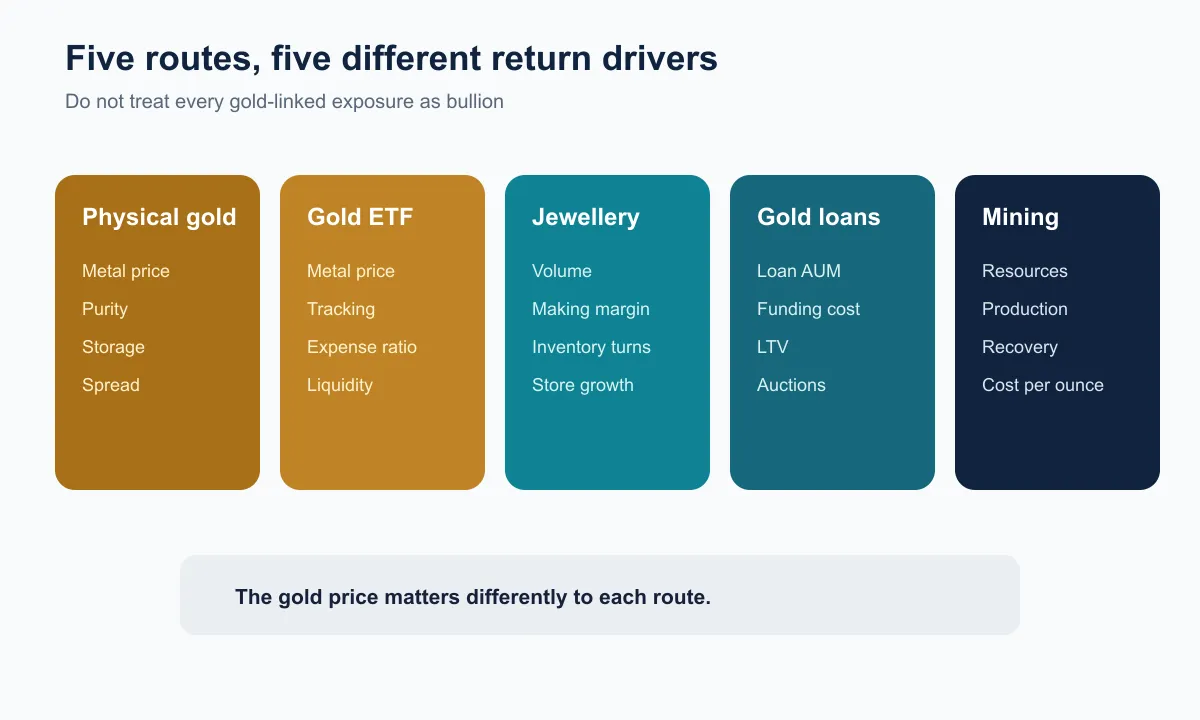
Physical gold and gold ETFs are intended to track the metal, subject to expenses, spreads, storage or tracking difference. A share represents a business. Management decisions, debt, operating costs, taxes and competitive position can cause its return to diverge sharply from the gold price.
| Exposure | Primary return driver | Cash flow | Main risks |
|---|---|---|---|
| Physical gold | Domestic gold price and purity | None | Storage, insurance, making charges and spread |
| Gold ETF | Domestic gold price less costs and tracking difference | None | Tracking, liquidity and fund structure |
| Jewellery company | Revenue, making margin, inventory turns and expansion | Operating business cash flow | Competition, working capital and demand |
| Gold-loan lender | Loan book, yield, funding cost and credit loss | Financial intermediation income | Regulation, auctions, leverage and asset quality |
| Explorer or miner | Resources, production, recovery and gold price | Project or mining cash flow | Geology, permits, capex and execution |
For readers asking how to invest in gold stocks, the first decision is whether they want bullion exposure or equity exposure. Wright Research's guide on how to invest in gold and commodities explains the broader routes. A stock is not a substitute for gold merely because the word “gold” appears in its business description.
Types of Gold-Linked Stocks in India
The listed universe can be organised into four groups:
- Jewellery retailers and manufacturers: Titan, Kalyan Jewellers, Senco Gold, Thangamayil Jewellery, Tribhovandas Bhimji Zaveri and PC Jeweller.
- Gold-loan financiers: Muthoot Finance and Manappuram Finance, plus diversified lenders with a gold-loan product.
- Exploration and development: Deccan Gold Mines, with project, geological and funding risks distinct from mature miners.
- Diversified metals and by-product exposure: Companies may recover precious metals within wider operations, but gold may not be financially material.
This classification prevents gold companies India searches from mixing unrelated economics. The Wright Research stocks platform can support research into gold stocks India, but the analyst must still confirm how much revenue or asset value is actually linked to gold.
Gold Jewellery and Retail Stocks
Jewellers earn from product margin, making charges, design, brand and inventory management rather than from passively holding metal. Higher gold prices can increase reported revenue while reducing grams sold or forcing consumers toward lighter products. Inventory gains may help temporarily, then reverse when prices decline.
Titan is the largest diversified listed jewellery exposure. Its FY2025-26 results said consolidated total income crossed ₹75,000 crore, while the fourth-quarter jewellery portfolio grew 50% year on year excluding bullion and digital-gold sales. Kalyan Jewellers, Senco Gold and regional chains offer different store economics, franchise mixes and geographic concentration.
For gold jewellery stocks, track same-store sales, buyer growth, studded mix, making margin, inventory turns, hedging, store additions and operating cash flow. Expansion funded by supplier credit can lift revenue while increasing working-capital risk. A rise in gold price is helpful only if pricing, volume and inventory are managed well.
Gold Loan and Financing Stocks
Gold-loan companies lend against pledged jewellery. Their earnings depend on assets under management, loan yield, borrowing cost, operating efficiency, auctions and credit losses. Gold provides collateral, but the lender remains a leveraged financial business.
Muthoot Finance and Manappuram Finance are the main listed specialist exposures. Muthoot reported FY2024-25 consolidated loan AUM of ₹1.22 trillion and continued to describe gold loans as its core franchise. Company composition can evolve, so investors should use the latest annual and quarterly data rather than assume every loan remains gold-backed.
Rising gold prices can increase eligible collateral value and customer borrowing capacity. They can also encourage competition. A sharp decline can reduce collateral cover and increase auction risk, especially when loan-to-value ratios are high. Regulation, branch controls, cash handling and funding liquidity matter as much as the metal price.
Get research like this in your inbox
The week’s research that mattered, in five minutes. Joined by 2L+ investors.
Mining and Metal Exposure: What Indian Investors Can Access
Direct listed production exposure is limited. The Ministry of Mines estimated primary gold production of 1,302 kilograms in FY2025-26, with Hutti Gold Mines as the top producer and Karnataka accounting for 92.4%. Hutti is not a listed stock available to ordinary public-market investors.
Deccan Gold Mines is listed, but its risk profile is closer to an explorer and project developer than a mature producer. The company cites Indian projects including Ganajur and international operations and projects. Investors must verify licences, resource estimates, feasibility, financing, construction status, ownership structure and actual attributable production.
Diversified metal companies should not be labelled gold mining stocks India unless gold contribution is material and disclosed. Hindustan Zinc is primarily a zinc, lead and silver company; Hindalco is primarily aluminium and copper. By-product recovery does not create a pure gold exposure.
This scarcity explains why many lists of the best gold stocks india are actually mixed lists of jewellers and lenders. That can be useful, but only when the indirect nature of exposure is explicit.
Key Metrics to Analyse Gold Stocks
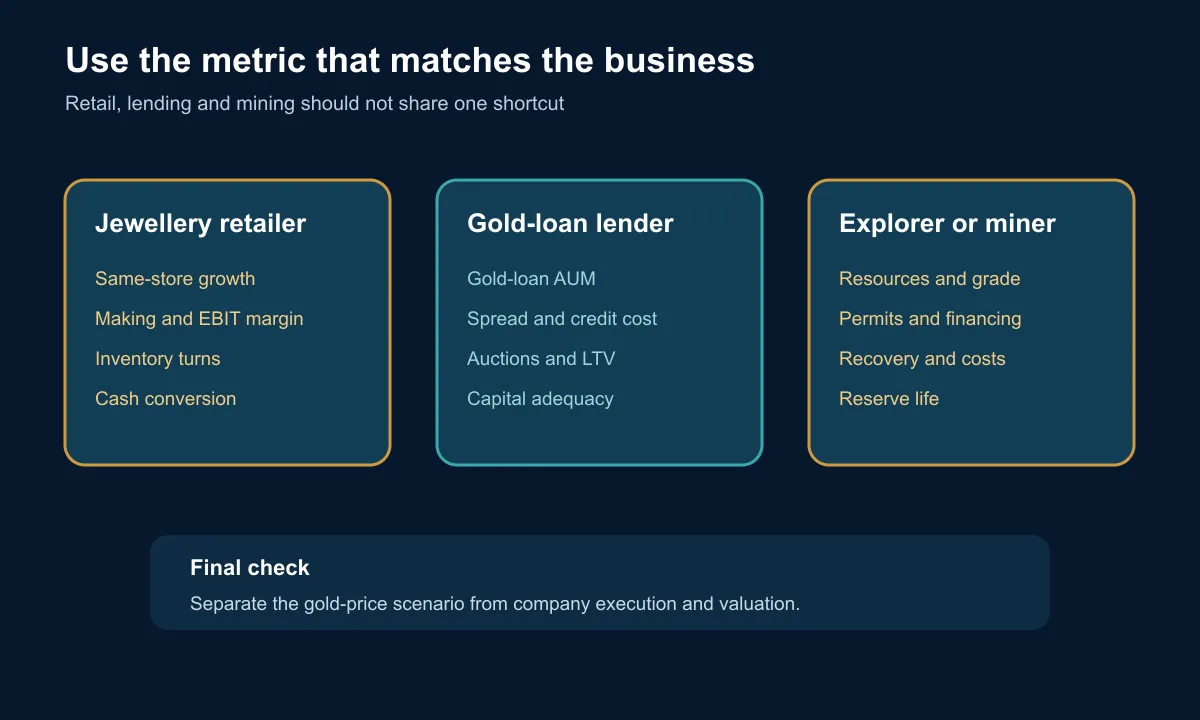
Use metrics appropriate to each model.
| Business model | Core operating metrics | Financial checks |
|---|---|---|
| Jewellery | Same-store growth, grams sold, studded mix, stores, inventory turns | Gross margin, working capital, cash conversion and lease-adjusted leverage |
| Gold loans | Gold-loan AUM, customers, loan-to-value, auctions and branch productivity | Yield, funding cost, spread, credit cost, capital adequacy and liquidity |
| Exploration | Resource grade and tonnes, drilling, permits and feasibility milestones | Cash runway, dilution, project capex and funding plan |
| Mining | Production, grade, recovery, reserve life and all-in sustaining cost | Realised price, free cash flow, debt and sustaining capex |
For gold stocks India, compare valuation only within the correct peer group. Price-to-book and return on equity are relevant to lenders. Enterprise value to EBITDA, store productivity and cash flow suit mature retailers. Net asset value and discounted project economics are more appropriate for a mine developer, but assumptions can be highly uncertain.
Risks of Investing in Gold-Linked Equities
The largest mistake is assuming a perfect positive correlation with gold. Jewellery demand may weaken when prices rise rapidly. A lender can face regulatory or funding pressure. An explorer can suffer permit delays even during a bullion rally.
Other risks include inventory losses, hedging errors, theft, purity disputes, customer concentration, store execution, excessive leases, auctions, liquidity mismatches, environmental approvals and project dilution. Smaller companies may also have limited trading liquidity and greater governance risk.
When learning how to invest in gold stocks, build separate scenarios for the commodity price and the company's operating variables. Stress test volume, margin, funding cost, capex and valuation. Use Wright Research's alternative investments research to compare the equity route with more direct exposure.
2026 Watchlist and Comparison Table
The watchlist below is arranged by exposure, not expected return.
| Company | Exposure | Link to gold | Key metric | Principal risk |
|---|---|---|---|---|
| Titan Company | Jewellery retail | Sales, making margin and inventory | Same-store growth and jewellery EBIT margin | Valuation and execution |
| Kalyan Jewellers India | Jewellery retail | Store and franchise-led jewellery sales | Revenue per store and working capital | Expansion and franchise mix |
| Senco Gold | Jewellery retail | Regional and national jewellery network | Same-store sales and inventory turns | Geographic and working-capital concentration |
| Thangamayil Jewellery | Regional retail | Gold jewellery demand in South India | Store productivity and cash conversion | Regional concentration |
| Muthoot Finance | Gold loans | Lending against pledged gold | Gold-loan AUM, spread and auctions | Funding and regulation |
| Manappuram Finance | Gold loans and diversified finance | Gold-loan book within a wider lender | Gold AUM, credit cost and capital | Diversification and asset quality |
| Deccan Gold Mines | Exploration and development | Gold resources and projects | Permits, funding and attributable milestones | Geological and execution risk |
| Hindustan Zinc | Diversified metals | Precious-metal by-products, primarily silver | Metal mix and production | Not a direct gold proxy |
For a practical gold stocks India watchlist, record the exposure type beside every name. This prevents a retailer's growth multiple from being compared with a lender's price-to-book ratio or an explorer's project value.
The phrase gold mining stocks India should be reserved for companies with genuine exploration, development or production exposure. The gold jewellery stocks and financing names above can benefit from India's gold ecosystem, but their operating returns may move independently of bullion.
Is your portfolio built for what’s coming?
Get a free AI-powered review of your holdings — risk, overlap and quality in minutes.
FAQ
Do gold-linked stocks always rise when gold prices increase?
No. Business performance, valuation, costs, funding and regulation can outweigh the gold-price effect. Rapid price increases may even reduce jewellery volumes or alter customer behaviour.
How are gold-loan companies affected by changes in gold prices?
Higher prices can increase collateral value and borrowing capacity. Falling prices can reduce collateral cover and raise auction risk. Outcomes also depend on loan-to-value ratios, funding cost, asset quality and regulation.
Why can jewellery stocks underperform even when gold prices rise?
Higher prices can discourage purchases, reduce grams sold and increase working-capital needs. Competition, store costs, inventory hedging and an expensive starting valuation can also weaken shareholder returns.
How can investors distinguish direct mining exposure from other gold-linked businesses?
Check whether the company owns attributable mineral resources, permits, mines and production. A jeweller earns retail margins, while a lender earns a financing spread. Neither is direct mining exposure.
For investors evaluating gold stocks India, exposure accuracy matters more than a catchy list. Separate bullion, retail, lending and mining economics, then use business-specific metrics before deciding which route fits the portfolio.
For education only, not investment advice. Project status and financial data change. Consult a SEBI-registered investment adviser where appropriate.