

🚀 Click here to get access to our Free Course on Momentum Investing Strategy 🚀

Best Capital Goods and Infrastructure Stocks in India

by Siddharth Singh Bhaisora

Published On May 11, 2026

In this article

India's capital goods stocks in India and infrastructure stocks are at an inflection point with Rs 12.2 lakh crore in government capex for 2026. This guide covers the best infrastructure sector stocks across roads, railways, ports, and power, along with capital goods electrical equipment stocks, capital goods non electrical equipment stocks, and a curated infrastructure stocks list with selection metrics.

Introduction

Every serious equity investor in India has, at some point, looked at infrastructure stocks and wondered: "Is this the right time?" The sector seems perpetually on the verge of a breakout, yet timing it wrong can mean years of underperformance. At the same time, investors who missed the capital goods rally of 2021 to 2024 are still kicking themselves.

Here's the reality: infrastructure and capital goods are not momentum plays. They are structural plays tied to India's decade-long investment cycle in roads, railways, power, defence manufacturing, and urban infrastructure. If you understand the cycle, the fundamentals, and the stock-selection criteria, you stop second-guessing and start building positions with conviction.

This guide from Wright Research breaks down the best capital goods stocks in India and the most compelling infrastructure sector stocks to watch in 2026, with data, analysis, and a clear framework for decision-making.

Why Capital Goods and Infrastructure Stocks Matter in 2025-26

Capital goods stocks in India represent companies that manufacture machinery, equipment, and tools used in production. They are the backbone of every other sector's growth. When a cement plant needs a new ball mill, when a thermal power plant needs turbines, when a metro rail project needs overhead electrification, all of that demand flows to capital goods and infrastructure sector stocks.

Union Budget 2026: Rs 12.2 Lakh Crore Capex Allocation

The Union Budget for FY2026 allocated Rs 12.2 lakh crore in capital expenditure, the highest in India's history. This is not a one-off. Since FY2020, government capex has grown at over 22% CAGR, and the current administration has made infrastructure the centrepiece of its economic strategy. Roads, railways, renewable energy, defence manufacturing, and digital infrastructure all figure prominently in this spending plan.

For investors in infrastructure stocks, this matters because government capex directly translates into order inflows for construction and engineering companies. When orders are up, revenue visibility improves, margins stabilise, and stock valuations re-rate. The infrastructure cycle is, at its core, a government-spending cycle, and right now, that cycle is firmly in expansion mode.

National Infrastructure Pipeline (NIP): What It Means for Stocks

The National Infrastructure Pipeline, a Rs 111 lakh crore multi-year programme covering over 9,000 projects, is the structural bedrock that makes the best infrastructure stocks a compelling long-term case. NIP covers energy (24%), roads (19%), urban infrastructure (17%), railways (13%), and more. For stock pickers, NIP essentially provides a five-to-ten-year project pipeline visibility for companies embedded in these sectors.

The practical implication: companies with strong NIP-aligned order books are less exposed to revenue uncertainty. When you see an infrastructure company with an order book of 3x to 4x annual revenue and healthy NIP exposure, that is a fundamental quality signal, not just a theme play.

Capital Goods Stocks: Electrical vs Non-Electrical Equipment

Not all capital goods stocks in India are created equal. The sector broadly splits into two categories, each with distinct growth drivers, risk profiles, and leading companies.

Electrical Equipment Stocks: Key Players and Growth Drivers

Capital goods electrical equipment stocks encompass companies that manufacture transformers, switchgear, cables, motors, and power electronics. These are in extraordinary demand right now for three reasons: India's power sector modernisation, the renewable energy boom, and data centre infrastructure growth.

ABB India, Siemens India, Havells, KEI Industries, Polycab India, and Bharat Heavy Electricals (BHEL) represent the core of capital goods electrical equipment stocks on Indian exchanges. Transformer manufacturers like Hitachi Energy and CG Power have seen multi-year order visibility driven by both domestic grid upgrades and export orders from European and Middle Eastern utilities.

The growth driver for capital goods electrical equipment stocks in 2025-26 is twofold: India's target of 500 GW of renewable energy capacity by 2030 requires massive grid infrastructure investments, and the government's PLI scheme for white goods and electronics is driving industrial capex in manufacturing.

Are Infrastructure Stocks Cyclical? What Investors Must Know

The most honest answer is: yes, infrastructure sector stocks are cyclical, but the nature of that cyclicality is often misunderstood.

Government Capex Cycle vs Business Cycle

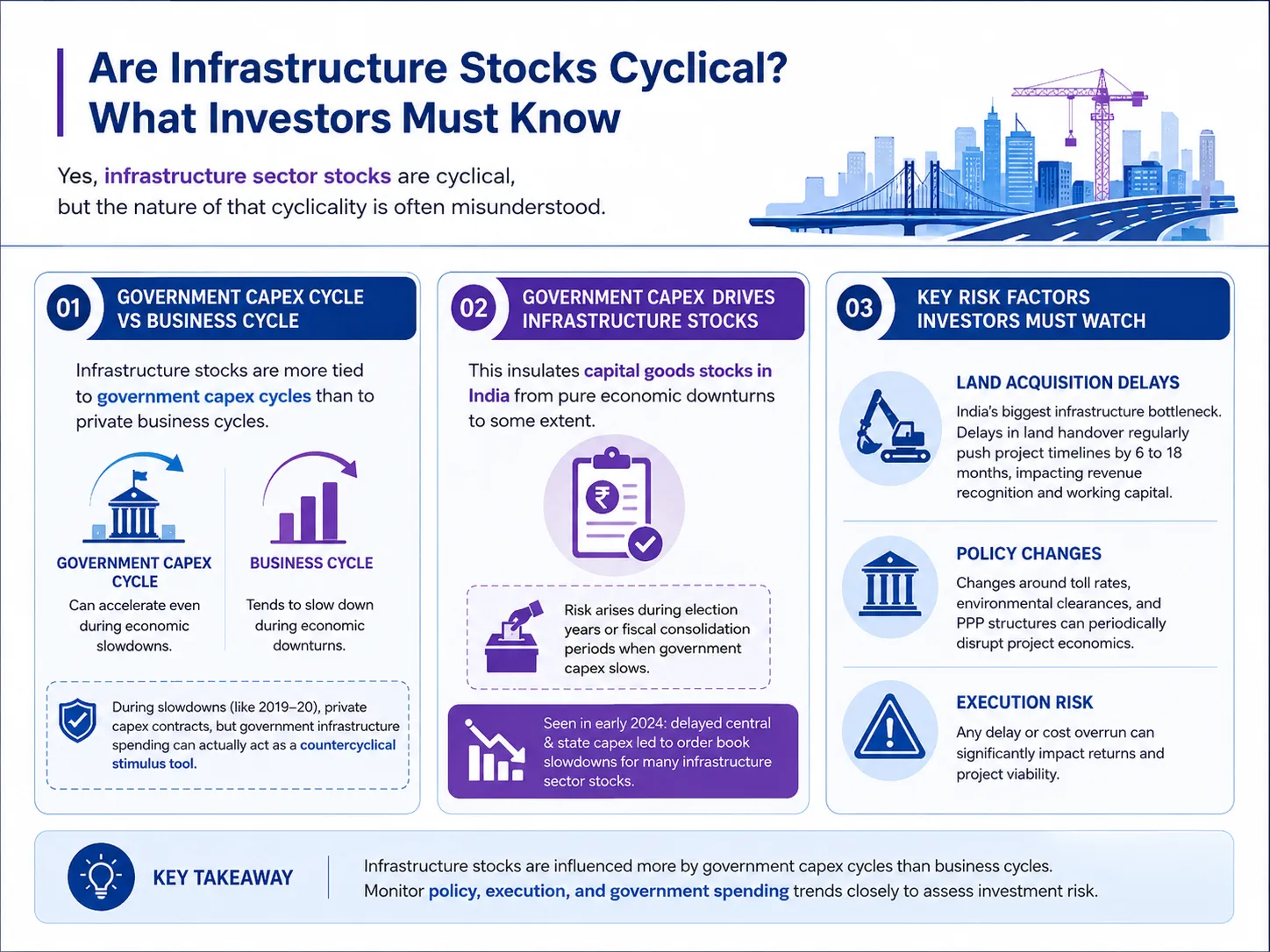
Infrastructure stocks are more tied to government capex cycles than to private business cycles. This is a critical distinction. During a business slowdown (like 2019-20), private sector capex contracts, but government infrastructure spending can actually accelerate as a countercyclical stimulus tool. This insulates capital goods stocks in India from pure economic downturns to some extent.

The risk arises during election years or fiscal consolidation periods when government capex slows, as seen in early 2024, when central and state government capex was delayed, leading to order book slowdowns for many infrastructure sector stocks.

Are infrastructure stocks cyclical: comparing government capex cycles vs business cycles with key investor risks including land acquisition delays and policy changes

India's capital goods stocks in India and infrastructure stocks are at an inflection point with Rs 12.2 lakh crore in government capex for 2026. This guide covers the best infrastructure sector stocks across roads, railways, ports, and power, along with capital goods electrical equipment stocks, capital goods non electrical equipment stocks, and a curated infrastructure stocks list with selection metrics.

Introduction

Every serious equity investor in India has, at some point, looked at infrastructure stocks and wondered: "Is this the right time?" The sector seems perpetually on the verge of a breakout, yet timing it wrong can mean years of underperformance. At the same time, investors who missed the capital goods rally of 2021 to 2024 are still kicking themselves.

Here's the reality: infrastructure and capital goods are not momentum plays. They are structural plays tied to India's decade-long investment cycle in roads, railways, power, defence manufacturing, and urban infrastructure. If you understand the cycle, the fundamentals, and the stock-selection criteria, you stop second-guessing and start building positions with conviction.

This guide from Wright Research breaks down the best capital goods stocks in India and the most compelling infrastructure sector stocks to watch in 2026, with data, analysis, and a clear framework for decision-making.

Why Capital Goods and Infrastructure Stocks Matter in 2025-26

Capital goods stocks in India represent companies that manufacture machinery, equipment, and tools used in production. They are the backbone of every other sector's growth. When a cement plant needs a new ball mill, when a thermal power plant needs turbines, when a metro rail project needs overhead electrification, all of that demand flows to capital goods and infrastructure sector stocks.

Union Budget 2026: Rs 12.2 Lakh Crore Capex Allocation

The Union Budget for FY2026 allocated Rs 12.2 lakh crore in capital expenditure, the highest in India's history. This is not a one-off. Since FY2020, government capex has grown at over 22% CAGR, and the current administration has made infrastructure the centrepiece of its economic strategy. Roads, railways, renewable energy, defence manufacturing, and digital infrastructure all figure prominently in this spending plan.

For investors in infrastructure stocks, this matters because government capex directly translates into order inflows for construction and engineering companies. When orders are up, revenue visibility improves, margins stabilise, and stock valuations re-rate. The infrastructure cycle is, at its core, a government-spending cycle, and right now, that cycle is firmly in expansion mode.

National Infrastructure Pipeline (NIP): What It Means for Stocks

The National Infrastructure Pipeline, a Rs 111 lakh crore multi-year programme covering over 9,000 projects, is the structural bedrock that makes the best infrastructure stocks a compelling long-term case. NIP covers energy (24%), roads (19%), urban infrastructure (17%), railways (13%), and more. For stock pickers, NIP essentially provides a five-to-ten-year project pipeline visibility for companies embedded in these sectors.

The practical implication: companies with strong NIP-aligned order books are less exposed to revenue uncertainty. When you see an infrastructure company with an order book of 3x to 4x annual revenue and healthy NIP exposure, that is a fundamental quality signal, not just a theme play.

Capital Goods Stocks: Electrical vs Non-Electrical Equipment

Not all capital goods stocks in India are created equal. The sector broadly splits into two categories, each with distinct growth drivers, risk profiles, and leading companies.

Electrical Equipment Stocks: Key Players and Growth Drivers

Capital goods electrical equipment stocks encompass companies that manufacture transformers, switchgear, cables, motors, and power electronics. These are in extraordinary demand right now for three reasons: India's power sector modernisation, the renewable energy boom, and data centre infrastructure growth.

ABB India, Siemens India, Havells, KEI Industries, Polycab India, and Bharat Heavy Electricals (BHEL) represent the core of capital goods electrical equipment stocks on Indian exchanges. Transformer manufacturers like Hitachi Energy and CG Power have seen multi-year order visibility driven by both domestic grid upgrades and export orders from European and Middle Eastern utilities.

The growth driver for capital goods electrical equipment stocks in 2025-26 is twofold: India's target of 500 GW of renewable energy capacity by 2030 requires massive grid infrastructure investments, and the government's PLI scheme for white goods and electronics is driving industrial capex in manufacturing.

Are Infrastructure Stocks Cyclical? What Investors Must Know

The most honest answer is: yes, infrastructure sector stocks are cyclical, but the nature of that cyclicality is often misunderstood.

Government Capex Cycle vs Business Cycle

Infrastructure stocks are more tied to government capex cycles than to private business cycles. This is a critical distinction. During a business slowdown (like 2019-20), private sector capex contracts, but government infrastructure spending can actually accelerate as a countercyclical stimulus tool. This insulates capital goods stocks in India from pure economic downturns to some extent.

The risk arises during election years or fiscal consolidation periods when government capex slows, as seen in early 2024, when central and state government capex was delayed, leading to order book slowdowns for many infrastructure sector stocks.

Are infrastructure stocks cyclical: comparing government capex cycles vs business cycles with key investor risks including land acquisition delays and policy changes

How to Pick Infrastructure Stocks: 3 Key Metrics That Matter

Picking from any infrastructure stocks list requires more than sector optimism. Here are the three metrics that matter most.

Order Book Visibility

A company's order book as a multiple of trailing twelve-month revenue is the single most important indicator for infrastructure sector stocks. A 3x to 4x order book provides 3 to 4 years of revenue visibility, even before new orders are won. Companies with shrinking order books relative to revenues are a red flag, regardless of sector tailwinds.

ROCE and Debt Levels

Infrastructure is capital-intensive. The best capital goods stocks in India maintain ROCE (Return on Capital Employed) consistently above their cost of capital, typically above 15% for construction companies and above 12% for regulated utilities. High debt levels (debt/equity above 1.5x for construction companies) erode equity returns and increase refinancing risk, particularly in a rising interest rate environment.

Execution Track Record

Order wins mean nothing if a company cannot execute. Look at revenue CAGR vs order inflow CAGR over 3 to 5 years. Companies where revenue growth consistently lags order inflow growth are signalling execution issues, a frequent problem in the mid-cap segment of infrastructure stocks.

Infrastructure Stocks for Long-Term Portfolio: Large Cap vs Mid Cap

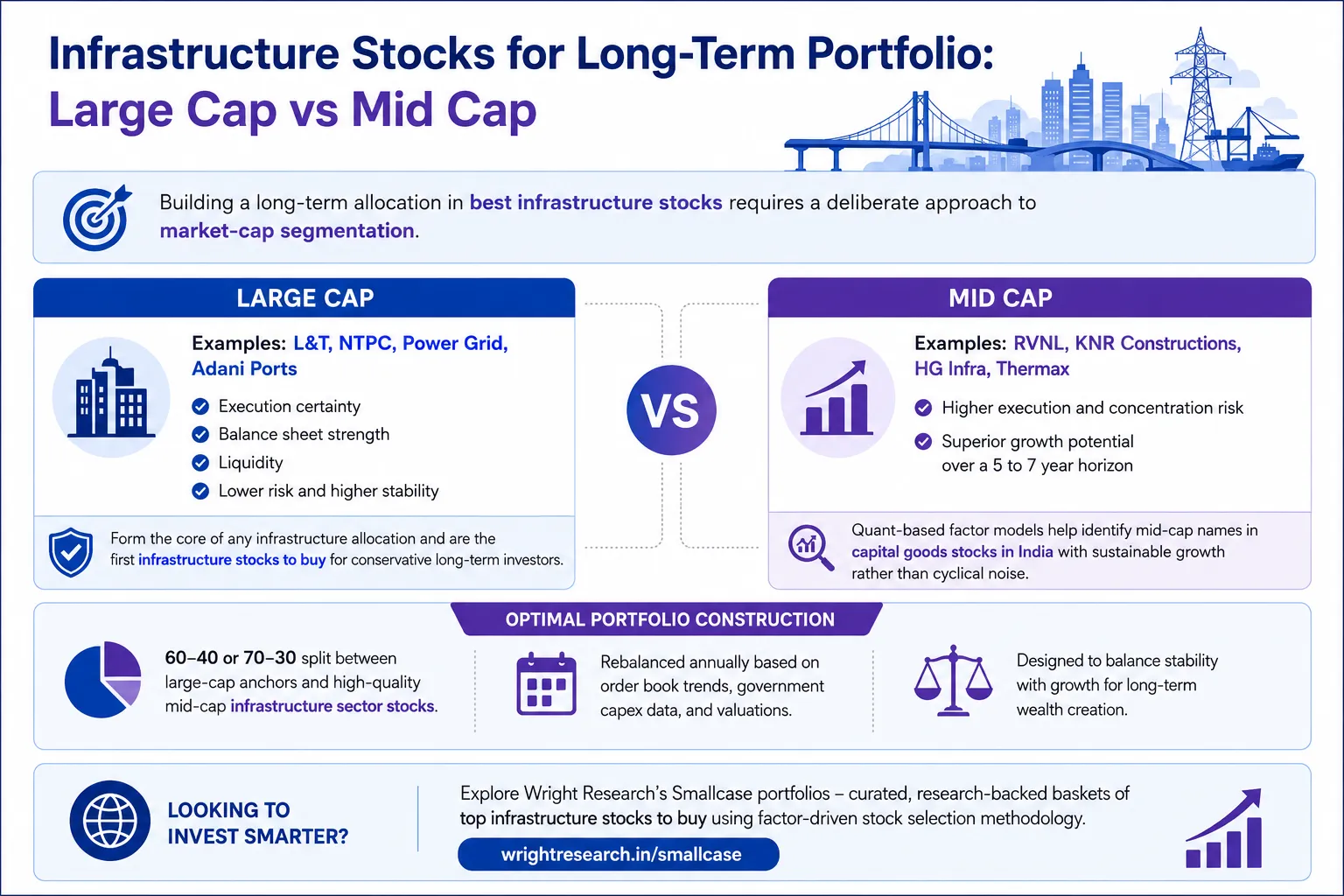
Building a long-term allocation in best infrastructure stocks requires a deliberate approach to market-cap segmentation. Large-caps such as L&T, NTPC, Power Grid, and Adani Ports offer execution certainty, balance sheet strength, and liquidity. They form the core of any infrastructure allocation and are the first infrastructure stocks to buy for conservative long-term investors.

Mid-caps such as RVNL, KNR Constructions, HG Infra, and Thermax carry higher execution and concentration risk but offer superior growth potential over a 5 to 7 year horizon. Wright Research's quant-based factor models specifically evaluate quality scores (balance sheet strength, earnings consistency) alongside momentum signals to identify which mid-cap names in the capital goods stocks in india universe carry sustainable growth rather than cyclical noise.

The optimal portfolio construction, for most investors, is a 60-40 or 70-30 split between large-cap anchors and high-quality mid-cap infrastructure sector stocks, rebalanced annually based on order book trends, government capex data, and valuations.

If you are looking to invest in a curated, research-backed basket of top infrastructure stocks to buy, explore Wright Research's Smallcase portfolios built using factor-driven stock selection methodology at wrightresearch.in/smallcase.

Large cap vs mid cap infrastructure stocks for long term portfolio: stability of L&T and NTPC vs growth potential of RVNL and KNR Constructions

Conclusion

India's infrastructure build-out is not a theme. It is a multi-decade structural story. The combination of record government capex, the National Infrastructure Pipeline, renewable energy targets, and rising manufacturing activity creates a robust multi-year demand environment for both capital goods stocks in India and infrastructure sector stocks. The challenge is not whether to invest. It is knowing how to be invested: which names to own, at what valuations, and for how long.

Wright Research's approach to this space is disciplined and data-driven. Rather than chasing the loudest name on social media, our factor models identify quality compounders within the best infrastructure stocks universe, with strong execution track records, visible order books, and sustainable ROCE profiles. That is the difference between speculating on a sector and systematically building wealth from it.

Frequently Asked Questions

What are the best capital goods stocks to invest in India for 2026?

Among the best capital goods stocks in India for 2026, investors typically consider Siemens India, ABB India, and Thermax in the electrical and automation segment, and L&T, BHEL, and Cummins India in the broader capital goods space. Selection should be based on order book strength, ROCE, and valuation comfort rather than short-term price momentum. Consult a SEBI-registered advisor before investing.

How does government capex affect infrastructure stocks in India?

Government capex directly drives order inflows for infrastructure sector stocks, especially in roads, railways, and power. Higher capex means more project awards, better revenue visibility for construction companies, and improved margins. Conversely, capex slowdowns during election cycles or fiscal consolidation periods create headwinds for infrastructure stocks, as order announcements slow and companies compete harder for fewer projects.

What is the difference between capital goods, electrical, and non-electrical equipment stocks?

Capital goods electrical equipment stocks include companies making transformers, cables, switchgear, and power electronics, driven primarily by power sector and renewable energy demand. Capital goods non-electrical equipment stocks include manufacturers of compressors, pumps, construction machinery, and industrial tools, more linked to private sector manufacturing capex. Both are cyclical, but electrical equipment has stronger structural tailwinds from India's energy transition.

Are infrastructure stocks safe for long-term investors, or are they cyclical?

Infrastructure stocks are cyclical but with a long-duration government-spending overlay that moderates volatility compared to purely private-sector cyclicals. For long-term investors (5+ year horizon), the best infrastructure stocks with strong execution, low debt, and diversified order books have historically delivered meaningful alpha. Short-term investors must be cautious of election-year capex pauses, land acquisition delays, and interest rate sensitivity on highly leveraged players.

Which infrastructure stocks should I add to my portfolio in 2026 for strong returns?

A balanced infrastructure stocks list for 2026 may include L&T and NTPC as large-cap anchors, RVNL and KNR Constructions as mid-cap growth plays, and Polycab or KEI Industries for capital goods exposure. Always evaluate infrastructure stocks to buy based on order book multiples, ROCE, and debt levels, not just sector headlines. Past performance does not guarantee future returns. Please consult a SEBI-registered advisor.

How to Pick Infrastructure Stocks: 3 Key Metrics That Matter

Picking from any infrastructure stocks list requires more than sector optimism. Here are the three metrics that matter most.

Order Book Visibility

A company's order book as a multiple of trailing twelve-month revenue is the single most important indicator for infrastructure sector stocks. A 3x to 4x order book provides 3 to 4 years of revenue visibility, even before new orders are won. Companies with shrinking order books relative to revenues are a red flag, regardless of sector tailwinds.

ROCE and Debt Levels

Infrastructure is capital-intensive. The best capital goods stocks in India maintain ROCE (Return on Capital Employed) consistently above their cost of capital, typically above 15% for construction companies and above 12% for regulated utilities. High debt levels (debt/equity above 1.5x for construction companies) erode equity returns and increase refinancing risk, particularly in a rising interest rate environment.

Execution Track Record

Order wins mean nothing if a company cannot execute. Look at revenue CAGR vs order inflow CAGR over 3 to 5 years. Companies where revenue growth consistently lags order inflow growth are signalling execution issues, a frequent problem in the mid-cap segment of infrastructure stocks.

Metric

Healthy Range

Red Flag

Order Book / Revenue

3x to 5x

Below 2x or Above 6x

ROCE

Above 15%

Below 10%

Debt / Equity

Below 1x (construction)

Above 2x

Revenue CAGR (3yr)

15% to 25%

Stagnant or declining

Working Capital Days

Below 90

Above 120

Infrastructure Stocks for Long-Term Portfolio: Large Cap vs Mid Cap

Building a long-term allocation in best infrastructure stocks requires a deliberate approach to market-cap segmentation. Large-caps such as L&T, NTPC, Power Grid, and Adani Ports offer execution certainty, balance sheet strength, and liquidity. They form the core of any infrastructure allocation and are the first infrastructure stocks to buy for conservative long-term investors.

Mid-caps such as RVNL, KNR Constructions, HG Infra, and Thermax carry higher execution and concentration risk but offer superior growth potential over a 5 to 7 year horizon. Wright Research's quant-based factor models specifically evaluate quality scores (balance sheet strength, earnings consistency) alongside momentum signals to identify which mid-cap names in the capital goods stocks in India universe carry sustainable growth rather than cyclical noise.

The optimal portfolio construction, for most investors, is a 60-40 or 70-30 split between large-cap anchors and high-quality mid-cap infrastructure sector stocks , rebalanced annually based on order book trends, government capex data, and valuations.

If you are looking to invest in a curated, research-backed basket of top infrastructure stocks to buy, explore Wright Research's Smallcase portfolios built using factor-driven stock selection methodology at wrightresearch.in/smallcase .
Large cap vs mid cap infrastructure stocks for long term portfolio: stability of L&T and NTPC vs growth potential of RVNL and KNR Constructions

Conclusion

India's infrastructure build-out is not a theme. It is a multi-decade structural story. The combination of record government capex, the National Infrastructure Pipeline, renewable energy targets, and rising manufacturing activity creates a robust multi-year demand environment for both capital goods stocks in India and infrastructure sector stocks. The challenge is not whether to invest. It is knowing how to be invested: which names to own, at what valuations, and for how long.

Wright Research 's approach to this space is disciplined and data-driven. Rather than chasing the loudest name on social media, our factor models identify quality compounders within the best infrastructure stocks universe, with strong execution track records, visible order books, and sustainable ROCE profiles. That is the difference between speculating on a sector and systematically building wealth from it.

India's capital goods stocks in India and infrastructure stocks are at an inflection point with Rs 12.2 lakh crore in government capex for 2026. This guide covers the best infrastructure sector stocks across roads, railways, ports, and power, along with capital goods electrical equipment stocks, capital goods non electrical equipment stocks, and a curated infrastructure stocks list with selection metrics.

Introduction

Every serious equity investor in India has, at some point, looked at infrastructure stocks and wondered: "Is this the right time?" The sector seems perpetually on the verge of a breakout, yet timing it wrong can mean years of underperformance. At the same time, investors who missed the capital goods rally of 2021 to 2024 are still kicking themselves.

Here's the reality: infrastructure and capital goods are not momentum plays. They are structural plays tied to India's decade-long investment cycle in roads, railways, power, defence manufacturing, and urban infrastructure. If you understand the cycle, the fundamentals, and the stock-selection criteria, you stop second-guessing and start building positions with conviction.

This guide from Wright Research breaks down the best capital goods stocks in India and the most compelling infrastructure sector stocks to watch in 2026, with data, analysis, and a clear framework for decision-making.

Why Capital Goods and Infrastructure Stocks Matter in 2025-26

Capital goods stocks in India represent companies that manufacture machinery, equipment, and tools used in production. They are the backbone of every other sector's growth. When a cement plant needs a new ball mill, when a thermal power plant needs turbines, when a metro rail project needs overhead electrification, all of that demand flows to capital goods and infrastructure sector stocks.

Union Budget 2026: Rs 12.2 Lakh Crore Capex Allocation

The Union Budget for FY2026 allocated Rs 12.2 lakh crore in capital expenditure, the highest in India's history. This is not a one-off. Since FY2020, government capex has grown at over 22% CAGR, and the current administration has made infrastructure the centrepiece of its economic strategy. Roads, railways, renewable energy, defence manufacturing, and digital infrastructure all figure prominently in this spending plan.

For investors in infrastructure stocks, this matters because government capex directly translates into order inflows for construction and engineering companies. When orders are up, revenue visibility improves, margins stabilise, and stock valuations re-rate. The infrastructure cycle is, at its core, a government-spending cycle, and right now, that cycle is firmly in expansion mode.

National Infrastructure Pipeline (NIP): What It Means for Stocks

The National Infrastructure Pipeline, a Rs 111 lakh crore multi-year programme covering over 9,000 projects, is the structural bedrock that makes the best infrastructure stocks a compelling long-term case. NIP covers energy (24%), roads (19%), urban infrastructure (17%), railways (13%), and more. For stock pickers, NIP essentially provides a five-to-ten-year project pipeline visibility for companies embedded in these sectors.

The practical implication: companies with strong NIP-aligned order books are less exposed to revenue uncertainty. When you see an infrastructure company with an order book of 3x to 4x annual revenue and healthy NIP exposure, that is a fundamental quality signal, not just a theme play.

Capital Goods Stocks: Electrical vs Non-Electrical Equipment

Not all capital goods stocks in India are created equal. The sector broadly splits into two categories, each with distinct growth drivers, risk profiles, and leading companies.

Electrical Equipment Stocks: Key Players and Growth Drivers

Capital goods electrical equipment stocks encompass companies that manufacture transformers, switchgear, cables, motors, and power electronics. These are in extraordinary demand right now for three reasons: India's power sector modernisation, the renewable energy boom, and data centre infrastructure growth.

ABB India, Siemens India, Havells, KEI Industries, Polycab India, and Bharat Heavy Electricals (BHEL) represent the core of capital goods electrical equipment stocks on Indian exchanges. Transformer manufacturers like Hitachi Energy and CG Power have seen multi-year order visibility driven by both domestic grid upgrades and export orders from European and Middle Eastern utilities.

The growth driver for capital goods electrical equipment stocks in 2025-26 is twofold: India's target of 500 GW of renewable energy capacity by 2030 requires massive grid infrastructure investments, and the government's PLI scheme for white goods and electronics is driving industrial capex in manufacturing.

Are Infrastructure Stocks Cyclical? What Investors Must Know

The most honest answer is: yes, infrastructure sector stocks are cyclical, but the nature of that cyclicality is often misunderstood.

Government Capex Cycle vs Business Cycle

Infrastructure stocks are more tied to government capex cycles than to private business cycles. This is a critical distinction. During a business slowdown (like 2019-20), private sector capex contracts, but government infrastructure spending can actually accelerate as a countercyclical stimulus tool. This insulates capital goods stocks in India from pure economic downturns to some extent.

The risk arises during election years or fiscal consolidation periods when government capex slows, as seen in early 2024, when central and state government capex was delayed, leading to order book slowdowns for many infrastructure sector stocks.

Are infrastructure stocks cyclical: comparing government capex cycles vs business cycles with key investor risks including land acquisition delays and policy changes

How to Pick Infrastructure Stocks: 3 Key Metrics That Matter

Picking from any infrastructure stocks list requires more than sector optimism. Here are the three metrics that matter most.

Order Book Visibility

A company's order book as a multiple of trailing twelve-month revenue is the single most important indicator for infrastructure sector stocks. A 3x to 4x order book provides 3 to 4 years of revenue visibility, even before new orders are won. Companies with shrinking order books relative to revenues are a red flag, regardless of sector tailwinds.

ROCE and Debt Levels

Infrastructure is capital-intensive. The best capital goods stocks in India maintain ROCE (Return on Capital Employed) consistently above their cost of capital, typically above 15% for construction companies and above 12% for regulated utilities. High debt levels (debt/equity above 1.5x for construction companies) erode equity returns and increase refinancing risk, particularly in a rising interest rate environment.

Execution Track Record

Order wins mean nothing if a company cannot execute. Look at revenue CAGR vs order inflow CAGR over 3 to 5 years. Companies where revenue growth consistently lags order inflow growth are signalling execution issues, a frequent problem in the mid-cap segment of infrastructure stocks.

Infrastructure Stocks for Long-Term Portfolio: Large Cap vs Mid Cap

Building a long-term allocation in best infrastructure stocks requires a deliberate approach to market-cap segmentation. Large-caps such as L&T, NTPC, Power Grid, and Adani Ports offer execution certainty, balance sheet strength, and liquidity. They form the core of any infrastructure allocation and are the first infrastructure stocks to buy for conservative long-term investors.

Mid-caps such as RVNL, KNR Constructions, HG Infra, and Thermax carry higher execution and concentration risk but offer superior growth potential over a 5 to 7 year horizon. Wright Research's quant-based factor models specifically evaluate quality scores (balance sheet strength, earnings consistency) alongside momentum signals to identify which mid-cap names in the capital goods stocks in india universe carry sustainable growth rather than cyclical noise.

The optimal portfolio construction, for most investors, is a 60-40 or 70-30 split between large-cap anchors and high-quality mid-cap infrastructure sector stocks, rebalanced annually based on order book trends, government capex data, and valuations.

If you are looking to invest in a curated, research-backed basket of top infrastructure stocks to buy, explore Wright Research's Smallcase portfolios built using factor-driven stock selection methodology at wrightresearch.in/smallcase.

Large cap vs mid cap infrastructure stocks for long term portfolio: stability of L&T and NTPC vs growth potential of RVNL and KNR Constructions

Conclusion

India's infrastructure build-out is not a theme. It is a multi-decade structural story. The combination of record government capex, the National Infrastructure Pipeline, renewable energy targets, and rising manufacturing activity creates a robust multi-year demand environment for both capital goods stocks in India and infrastructure sector stocks. The challenge is not whether to invest. It is knowing how to be invested: which names to own, at what valuations, and for how long.

Wright Research's approach to this space is disciplined and data-driven. Rather than chasing the loudest name on social media, our factor models identify quality compounders within the best infrastructure stocks universe, with strong execution track records, visible order books, and sustainable ROCE profiles. That is the difference between speculating on a sector and systematically building wealth from it.

Frequently Asked Questions

What are the best capital goods stocks to invest in India for 2026?

Among the best capital goods stocks in India for 2026, investors typically consider Siemens India, ABB India, and Thermax in the electrical and automation segment, and L&T, BHEL, and Cummins India in the broader capital goods space. Selection should be based on order book strength, ROCE, and valuation comfort rather than short-term price momentum. Consult a SEBI-registered advisor before investing.

How does government capex affect infrastructure stocks in India?

Government capex directly drives order inflows for infrastructure sector stocks, especially in roads, railways, and power. Higher capex means more project awards, better revenue visibility for construction companies, and improved margins. Conversely, capex slowdowns during election cycles or fiscal consolidation periods create headwinds for infrastructure stocks, as order announcements slow and companies compete harder for fewer projects.

What is the difference between capital goods, electrical, and non-electrical equipment stocks?

Capital goods electrical equipment stocks include companies making transformers, cables, switchgear, and power electronics, driven primarily by power sector and renewable energy demand. Capital goods non-electrical equipment stocks include manufacturers of compressors, pumps, construction machinery, and industrial tools, more linked to private sector manufacturing capex. Both are cyclical, but electrical equipment has stronger structural tailwinds from India's energy transition.

Are infrastructure stocks safe for long-term investors, or are they cyclical?

Infrastructure stocks are cyclical but with a long-duration government-spending overlay that moderates volatility compared to purely private-sector cyclicals. For long-term investors (5+ year horizon), the best infrastructure stocks with strong execution, low debt, and diversified order books have historically delivered meaningful alpha. Short-term investors must be cautious of election-year capex pauses, land acquisition delays, and interest rate sensitivity on highly leveraged players.

Which infrastructure stocks should I add to my portfolio in 2026 for strong returns?

A balanced infrastructure stocks list for 2026 may include L&T and NTPC as large-cap anchors, RVNL and KNR Constructions as mid-cap growth plays, and Polycab or KEI Industries for capital goods exposure. Always evaluate infrastructure stocks to buy based on order book multiples, ROCE, and debt levels, not just sector headlines. Past performance does not guarantee future returns. Please consult a SEBI-registered advisor.

Frequently Asked Questions

What are the best capital goods stocks to invest in India for 2026?

Among the best capital goods stocks in India for 2026, investors typically consider Siemens India, ABB India, and Thermax in the electrical and automation segment, and L&T, BHEL, and Cummins India in the broader capital goods space. Selection should be based on order book strength, ROCE, and valuation comfort rather than short-term price momentum. Consult a SEBI-registered advisor before investing.

How does government capex affect infrastructure stocks in India?

Government capex directly drives order inflows for infrastructure sector stocks, especially in roads, railways, and power. Higher capex means more project awards, better revenue visibility for construction companies, and improved margins. Conversely, capex slowdowns during election cycles or fiscal consolidation periods create headwinds for infrastructure stocks, as order announcements slow and companies compete harder for fewer projects.

What is the difference between capital goods, electrical, and non-electrical equipment stocks?

Capital goods electrical equipment stocks include companies making transformers, cables, switchgear, and power electronics, driven primarily by power sector and renewable energy demand. Capital goods non-electrical equipment stocks include manufacturers of compressors, pumps, construction machinery, and industrial tools, more linked to private sector manufacturing capex. Both are cyclical, but electrical equipment has stronger structural tailwinds from India's energy transition.

Are infrastructure stocks safe for long-term investors, or are they cyclical?

Infrastructure stocks are cyclical but with a long-duration government-spending overlay that moderates volatility compared to purely private-sector cyclicals. For long-term investors (5+ year horizon), the best infrastructure stocks with strong execution, low debt, and diversified order books have historically delivered meaningful alpha. Short-term investors must be cautious of election-year capex pauses, land acquisition delays, and interest rate sensitivity on highly leveraged players.

Which infrastructure stocks should I add to my portfolio in 2026 for strong returns?

A balanced infrastructure stocks list for 2026 may include L&T and NTPC as large-cap anchors, RVNL and KNR Constructions as mid-cap growth plays, and Polycab or KEI Industries for capital goods exposure. Always evaluate infrastructure stocks to buy based on order book multiples, ROCE, and debt levels, not just sector headlines. Past performance does not guarantee future returns. Please consult a SEBI-registered advisor.

Our Investment Philosophy

Learn how we choose the right asset mix for your risk profile across all market conditions.

Subscribe to our Newsletter

Get weekly market insights and facts right in your inbox

Subscribe
Newsletter signup