


Here is a scenario worth sitting with. You open a ChatGPT prompt, ask a question, and get an answer in three seconds. Behind that three-second interaction, somewhere in a building the size of three football fields, hundreds of servers fired up simultaneously, drew enough electricity to power a small neighbourhood, and needed cooling systems running at full capacity to stay operational. Multiply that by a billion daily queries, and you start to understand why AI is not just a software story. It is a physical infrastructure story one that involves power grids, cooling systems, high-voltage cables, semiconductors, and land the size of small towns.
India is now squarely inside this story. Hyperscalers like Microsoft, Google, Amazon, and Meta have collectively announced over $30 billion in India data centre investments since 2023. The country's installed data centre capacity crossed 1,300 MW in 2025 and is headed toward 1.7 GW by the end of 2026. For investors who got this right early, those watching data center stocks in India, infrastructure stocks, and green energy stocks, the returns have already been substantial. For those still figuring out how to position, the cycle is not over. It has, if anything, just started showing its real scale.
This blog unpacks the full picture: what is driving this supercycle, which sectors sit at its intersection, what government policy is doing to accelerate it, and how an investor can think clearly about both the opportunity and the risks.
What Is the Digital Infrastructure Supercycle and Why Is India at Its Centre?
A supercycle is not just a strong growth phase. It is a structural, multi-year expansion in demand driven by a convergence of independent factors that reinforce each other. India's current digital infrastructure supercycle has four distinct drivers operating simultaneously.
First is AI adoption. Every AI application, from large language models to computer vision to real-time translation, requires data centres to function. These are not the modest server rooms of 2010. Modern AI data centres require 50–100 MW of power per facility, specialized cooling infrastructure, and uninterrupted high-bandwidth connectivity. India's AI adoption is accelerating across BFSI, healthcare, e-commerce, and government services. Each new adoption wave adds to the demand backlog for compute.
Second is India's own digital economy. With 900 million internet users and growing, and with digital payments processing over 14 billion transactions monthly through UPI, the base demand for domestic data processing is immense before AI even enters the picture. Every payment, every OTT stream, every telemedicine consultation, every tax filing goes through some form of data infrastructure.
Third is India's position as a global technology services hub. Global Capability Centers GCCs now number over 1,700 in India, employing over 1.6 million technology professionals. These GCCs increasingly need data proximity, colocation, and private cloud solutions in India rather than routing through Singapore or Frankfurt. That is another structural layer of demand that feeds data center companies in India.
Fourth is the global shift in supply chains. The push to reduce dependence on single-country manufacturing is sending semiconductor and electronics assembly capacity toward India. Foxconn, Tata Electronics, and Micron are already building out. Each of those facilities adds to power demand, connectivity requirements, and the broader infrastructure stocks story.
This is not one tailwind. It is four independent tailwinds blowing in the same direction.
Follow this sector’s live moves
Sector-level performance across Indian markets, updated through the day.
The AI–Data Centre–Power Triangle: Why Infrastructure Stocks, Power Stocks, and Green Energy Are One Trade
The cleanest way to understand this supercycle's investment implications is through what we at Wright Research call the AI–Data Centre–Power Triangle. Each vertex affects the other two, and the feedback loop is real.
AI demand drives data centre construction. Data centre construction drives power demand. Power demand, at the scale now being projected, cannot be met by the existing grid alone, which is why green energy sector stocks and new power generation capacity have become as relevant to the data centre story as the data centres themselves.
A single hyperscale data centre of 100 MW capacity consumes roughly the same power as a mid-sized Indian city of 200,000 residents. India's planned data centre capacity additions, roughly 400 MW of new capacity being built or contracted right now, will require approximately 4,000–5,000 MW of dedicated power generation capacity to run at full utilization. India's total installed capacity is around 450 GW today. So data centres alone will require roughly 1% of total national generating capacity just for this pipeline.
This is why data centre stocks cannot be evaluated in isolation from power stocks, transformer manufacturers, cable companies, and renewable energy developers. They are the same trade expressed through different companies.
The power requirement also explains why green energy shares are now preferred over coal for new data centre supply. It is not purely a regulatory or ESG story. Economics drove this. Solar and wind power purchase agreements in India are now being signed at ₹2.5–3.5 per unit, making renewable energy cheaper than new coal plants for long-duration contracts. Hyperscalers with global net-zero commitments have a regulatory incentive to use renewables. Together, these factors mean that new data centre capacity in India is predominantly going to be powered by green energy stocks, solar developers, wind asset owners, and green hydrogen players.
Power Semiconductors: Why India's Data Centre Boom Is Creating a New Demand Wave
Semiconductors are the piece of this story that most investors in India are underweight. When a data centre is built, the building, cooling, and generators are visible. The semiconductor content is less visible but equally essential.
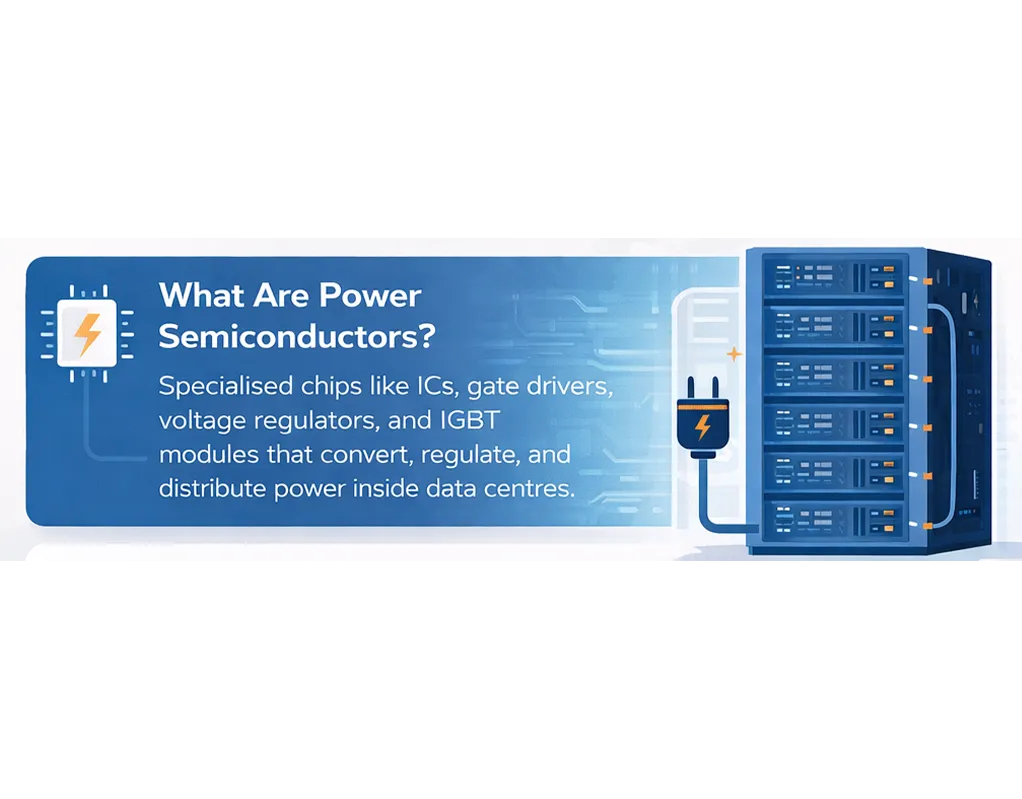
Every server rack inside a data centre contains power management ICs, voltage regulators, gate drivers, and IGBT modules. These are power semiconductors, specialized chips that manage how electrical power is converted, regulated, and distributed throughout the facility. A 100 MW data centre can contain hundreds of thousands of power semiconductor units.
India does not yet manufacture advanced logic chips. But power semiconductors are a different story. The government's PLI scheme for semiconductors is targeting this exact category, and Micron's assembly and test facility in Sanand, operational in late 2025, was the first concrete proof of execution. Renesas, NXP, and several domestic players are now in various stages of setting up or expanding Indian operations.
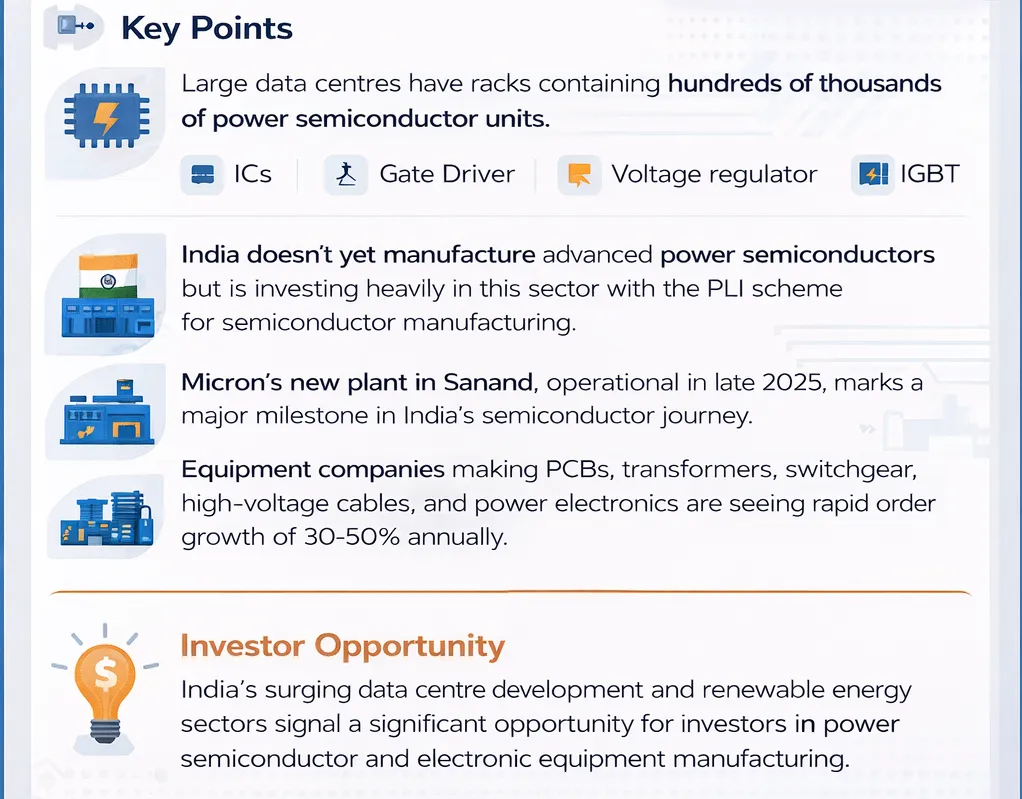
For investors, the more immediate play is not the semiconductor manufacturers themselves, which are largely pre-revenue or early-stage, but the equipment companies, PCB manufacturers, and electrical equipment stocks that supply the Indian electronics manufacturing ecosystem. Companies manufacturing transformers, switchgear, high-voltage cables, and power electronics for data centre and renewable energy applications are seeing order books grow at 30–50% annually. That is the publicly listed, near-term expression of the semiconductor and power theme.
Green Energy Stocks: How Renewable Power Has Become Core Infrastructure for Data Centres
If you had looked at green energy shares in India in 2019, you would have seen a sector still dominated by project developers with inconsistent execution, high leverage, and dependence on government offtake guarantees. The story in 2026 is structurally different.
India crossed 200 GW of installed renewable capacity in 2024 ahead of schedule. Utility-scale solar tariffs are globally competitive. The offshore wind programme, once stalled, has been reactivated with a 1 GW tender in FY26. Green hydrogen policy is moving from aspiration to pilot projects with actual capital deployed. And critically, the buyer mix has changed. Corporate Power Purchase Agreements C-PPAs now account for a meaningful share of new renewable capacity being contracted. Hyperscalers, large manufacturers, and GCCs are all signing long-duration C-PPAs directly with renewable developers.
This matters enormously for how investors should categorize green energy sector stocks . These are no longer just policy-dependent infrastructure plays. They are contracted revenue streams with creditworthy counterparties, sometimes with better credit than the state DISCOMs that historically bought power. That makes the risk profile of the top green energy stocks materially better today than five years ago.
The best green energy stocks in India today broadly fall into three categories. The first is large integrated renewable developers Adani Green, NTPC Renewables, and Torrent Power, who have the balance sheet and execution track record to win large tenders. The second is equipment manufacturers in the solar and wind supply chain, including solar cell and module manufacturers, wind turbine component makers, and inverter manufacturers. The third is the enabling infrastructure layer, grid-scale battery storage companies, high-voltage transmission developers, and smart meter manufacturers, which many investors miss entirely when building exposure to the top 20 renewable energy stocks universe.
Among the top 5 green energy stocks most frequently cited in institutional analysis for FY26–27, the recurring names include Adani Green Energy, NTPC Green, Waaree Energies, Inox Wind, and Greenko (pre-IPO). Each has a different risk-return profile. Adani Green offers scale and diversification but trades at a premium multiple. Waaree has the manufacturing angle and significant PLI benefit. Inox Wind has recovered from its 2020–21 crisis and now has a leaner cost structure and a multi-year order book.
The best green energy sector stocks to buy now in the context of the data centre supercycle are specifically those with corporate PPA exposure and grid-scale storage capability — because that is where the intersection with data centre demand is most direct.
Get research like this in your inbox
The week’s research that mattered, in five minutes. Joined by 2L+ investors.
Key Sectors and Stocks Benefiting from the Supercycle: Power, Cables, Capital Goods
The supercycle does not flow through one sector. It flows through at least six, and investors who understand the full chain are better positioned than those looking only at data center stocks in India.
Power Transmission and Cables
India's power grid needs to be reinforced to carry renewable energy from generation sites predominantly in Rajasthan, Gujarat, and Tamil Nadu to demand centres in Maharashtra, Karnataka, and Delhi. The Central Electricity Authority estimates ₹9.15 lakh crore in transmission investment over the next decade. That is a massive tailwind for high-voltage cable manufacturers and transmission line companies. Among infrastructure stock list candidates, power transmission companies like Power Grid Corporation and Sterlite Power are near-term beneficiaries. Cable manufacturers Polycab, KEI Industries, Havells, and RR Kabel have all reported sustained order book growth driven by grid, real estate, and data centre end markets.
Capital Goods and Electrical Equipment
Transformer shortages are a global story right now, and India is not immune. ABB, Siemens, and CG Power have multi-year order books. Among capital goods stocks in India, this segment is seeing the most consistent earnings upgrades. The reason is simple: every new renewable project, every data centre, every EV charging network, every industrial facility needs transformers and switchgear. Supply has not kept pace with demand, and lead times have stretched from 6 months to 18–24 months in some categories.
Among electric equipment stocks, the standout performers in order book growth include Hitachi Energy (transformers and HVDC), ABB India (process automation and grid solutions), and Thermax (industrial energy systems). These are not small-cap speculative bets. They are established industrial companies with growing order pipelines.
Data Centre Infrastructure
Among data centre-related stocks in India, the directly investable universe remains limited. Most top data center companies in India are either subsidiaries of global players (NTT, Equinix, STT GDC) or private companies (CtrlS, Yotta, Nxtra by Airtel). The publicly listed route to data centre shares in India is largely indirect through real estate companies with data centre exposure, telecom companies building out colocation, and infrastructure trust structures.
The Best Infrastructure Stocks for Supercycle Exposure
Among the top infrastructure stocks most discussed for supercycle exposure in our PMS research, the recurring themes are power transmission, industrial capital goods, specialty cables, and renewable energy developers. The infrastructure stocks list worth monitoring spans Larsen & Toubro (full infrastructure play), Power Grid Corporation, KEC International, Kalpataru Projects, Polycab India, KEI Industries, ABB India, Siemens, Thermax, and CESC.
This is the universe where infrastructure stocks to buy discussions are most grounded in near-term earnings visibility unlike some parts of the data centre or semiconductor space, where revenue is 3–5 years out.
Sector | Representative Stocks | Supercycle Driver |
Power Transmission | Power Grid, KEC International | Grid reinforcement for renewables + data centres |
Capital Goods | ABB India, Siemens, Thermax | Transformer, switchgear, industrial automation demand |
Cables | Polycab, KEI Industries, RR Kabel | Data centre cabling, grid cabling, EV infrastructure |
Renewable Energy | Adani Green, NTPC Green, Waaree | C-PPA demand from hyperscalers and manufacturers |
Real Estate / Infra | L&T, Kalpataru Projects | EPC contracts for data centre and grid projects |
Telecom / Cloud | Airtel (Nxtra), Tata Communications | Colocation, managed cloud for enterprise |
Government Policy as a Catalyst: PLI Schemes, BharatNet & the ₹10 Lakh Crore Capex Push
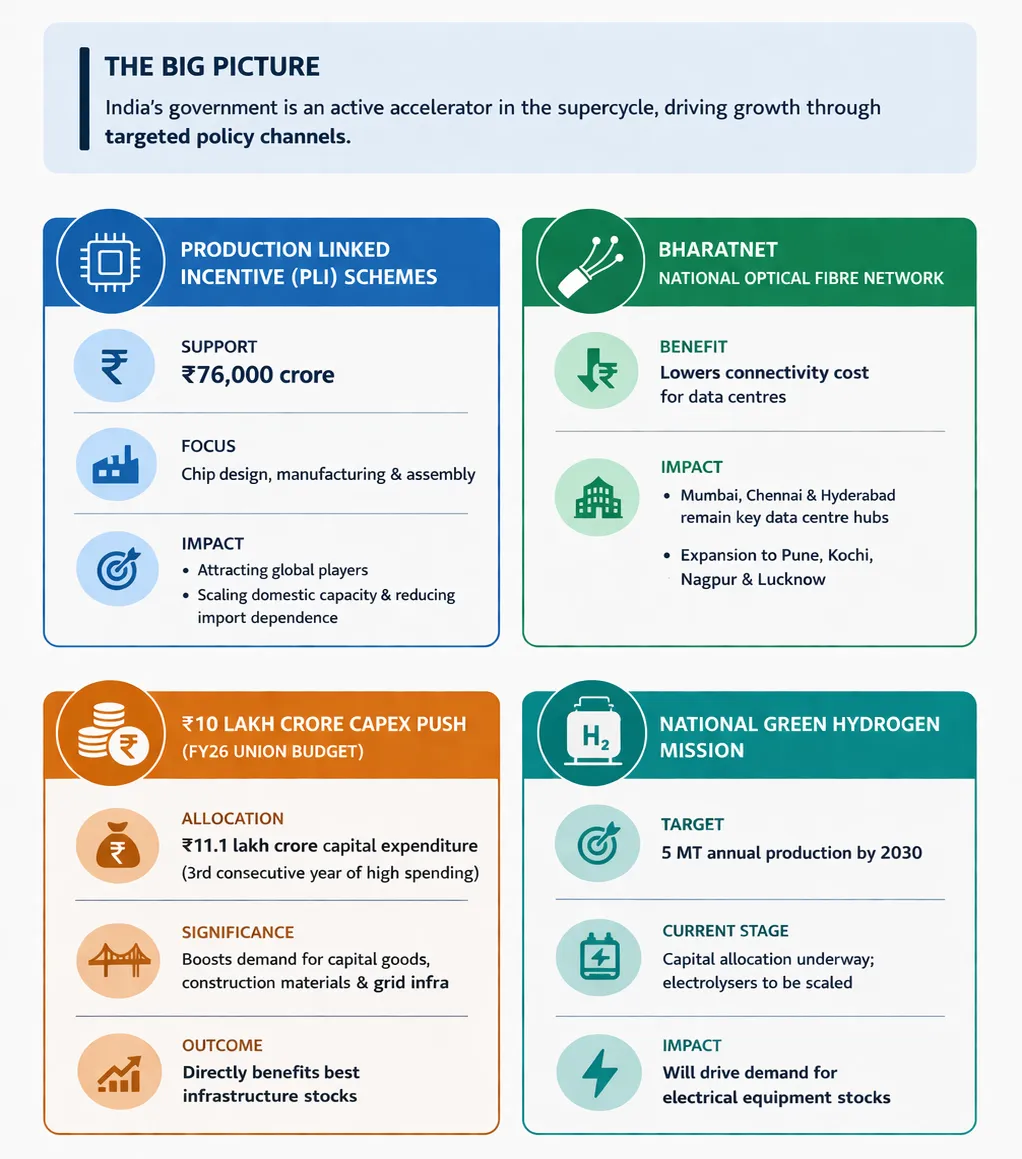
India's government is not a passive observer of this supercycle. It is an active accelerant through several distinct channels.
The Production Linked Incentive scheme for semiconductors has committed ₹76,000 crore in government support for chip design, manufacturing, and assembly. More importantly, it has signalled to global players that India is serious about manufacturing depth, which is what attracted Micron, Tata Electronics, and CG Semi. PLI for solar manufacturing, already in its second round, has helped Waaree and Premier Energies scale domestic manufacturing capacity, reducing India's dependence on Chinese solar imports.
BharatNet, the national optical fibre network programme, is relevant because it lowers the connectivity cost for data centres to locate in Tier II cities. Mumbai, Chennai, and Hyderabad have historically been the concentration points for data centre companies in India, largely because connectivity infrastructure was best there. As BharatNet matures, Pune, Kochi, Nagpur, and Lucknow all become viable data centre locations, distributing the physical build-out more widely.
The Union Budget FY26 maintained capital expenditure at ₹11.1 lakh crore, the third consecutive year of elevated infrastructure spending. This is relevant beyond its direct impact because government capex drives demand for capital goods, construction materials, and grid infrastructure in ways that directly benefit best infrastructure stocks.
The National Green Hydrogen Mission, with a target of 5 MT annual production by 2030, is a slower-burning catalyst. But the policy is real, the capital is being allocated, and hydrogen electrolyzers are going to require significant electrical equipment stocks as projects move to the construction phase.
Risks to the Supercycle: Execution Delays, Import Dependency & Valuation Concerns
The supercycle thesis is structurally sound. But three risks deserve serious attention before converting the macro story into portfolio positions.
1. Execution Risk
India has a long history of large infrastructure announcements followed by slower-than-expected implementation. The PLI semiconductor scheme illustrates this: announced in 2021, the first facility will be operational in late 2025. That is a four-year gap between announcement and production. Investors pricing infrastructure stocks to buy based on FY26 order flows should verify how much of that order flow converts to revenue, and over what timeline. Construction delays, regulatory approvals, and financing bottlenecks can all push timelines out.
2. Import Dependency
India's green energy sector remains partially dependent on Chinese solar modules, despite PLI manufacturing buildout. Indian wind turbines depend on imported rare earth magnets. Data centre server hardware is overwhelmingly imported. These dependencies create vulnerability to supply disruptions and currency fluctuations. A weaker rupee makes imported equipment more expensive, which can affect project economics for renewable developers and data centre operators alike.
3. Valuation
Several infrastructure sector stocks and green energy stocks to buy are trading at significant premiums to historical valuations. The Nifty Infrastructure Index has re-rated sharply over the past two years. Capital goods companies with price-to-earnings ratios of 60–80x are already pricing in several years of strong execution. The risk is not that the supercycle doesn't happen; it very likely will, but that current prices leave little room for execution disappointment. Investors entering at current valuations in the top 10 green energy sector stocks in India or the top infrastructure stocks need to be comfortable with the idea that returns from here may be more moderate than returns over the last two years.
How to Position Your Portfolio for India's Digital Infrastructure Buildout
The question is not whether the digital infrastructure supercycle is real. The data points, the capital commitments, and the policy framework make it real. The question is how to position for it in a way that balances conviction with valuation discipline.
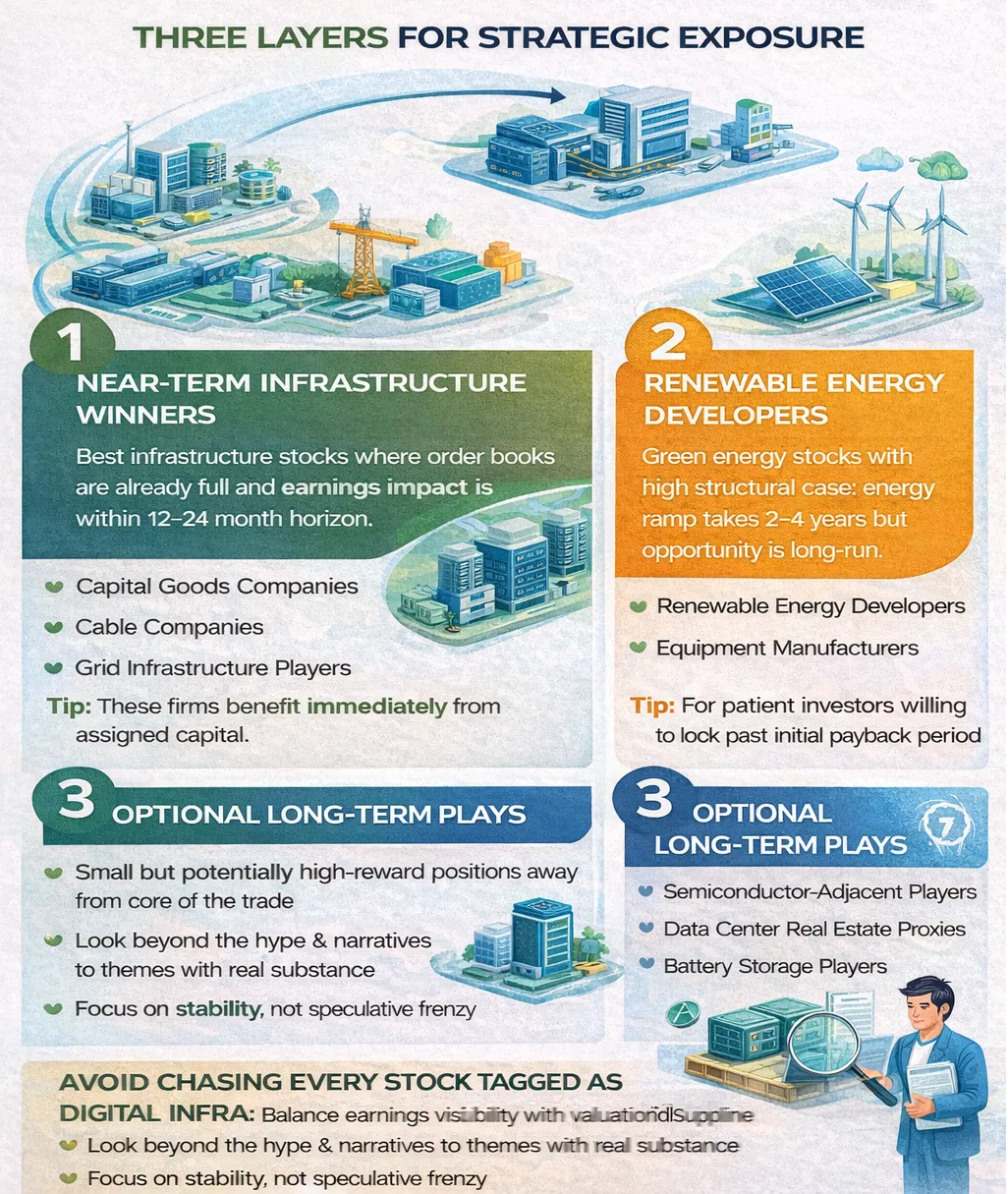
At Wright Research, our approach to this theme across our PMS strategies involves three layers.
The first layer is exposure to companies with near-term, visible earnings impact, typically capital goods manufacturers, cable companies, and grid infrastructure players, where order books are already full, and revenue conversion is largely within a 12–24 month horizon. This is where the best infrastructure stocks discussions are most grounded.
The second layer is exposure to renewable energy developers and equipment manufacturers, where the earnings ramp is 2–4 years out, but the structural case is clear. Green energy stocks to buy in this layer require more patience but offer a longer compounding runway if the thesis holds.
The third layer, and this is where most retail investors get the sizing wrong, is selective, small exposure to higher-risk, higher-upside ideas: semiconductor-adjacent companies, data centre real estate proxies, and battery storage players. These are not the core of the trade. They are the optionality layer, sized accordingly.
What we do not recommend is chasing every stock tagged as a data centre or green energy beneficiary without examining earnings visibility, balance sheet strength, and the actual mechanism through which the supercycle benefit flows to that specific company. The narrative is strong enough that some stocks will get caught up in the theme without having a real earnings story to back it up.
If you want a portfolio built around India's structural growth themes — including this digital infrastructure supercycle with rigorous quantitative discipline on stock selection, Wright Research's PMS strategies are built specifically for this.
See what markets are pricing in
Live indices, sector moves and market breadth — the backdrop to every story we publish.
FAQs
1. What are the best green energy stocks to invest in India right now?
The best green energy sector stocks to buy now with near-term earnings visibility include Adani Green Energy, Waaree Energies, Inox Wind, Torrent Power, and NTPC Green. Each has a different risk profile. Adani Green and NTPC offer scale and stability; Waaree has a manufacturing angle with PLI benefits; Inox Wind has a high-growth order book. Valuation discipline matters given recent re-ratings. This is not investment advice consult a SEBI-registered advisor for personalized recommendations.
2. Which data center companies in India are listed on the stock exchange?
Directly listed data center stocks in India are limited. Most major players like CtrlS, Yotta, and Nxtra are private. The listed route to data center shares in India is largely through Airtel (which owns Nxtra), Tata Communications, and real estate companies with data center development mandates. Indirectly, capital goods and cable companies supplying data centre construction also count as data center-related stocks in India.
3. What is the top 20 renewable energy stocks list for India?
A top 20 renewable energy stocks list for India typically includes Adani Green Energy, NTPC Green, Torrent Power, Tata Power Renewable, CESC, Waaree Energies, Premier Energies, Inox Wind, Suzlon Energy, Sterling and Wilson Renewable, Greenko (pre-IPO), ReNew Energy (listed on NASDAQ), KPI Green Energy, Borosil Renewables, Websol Energy, REC Limited, PTC India, SJVN, NHPC, and Power Grid Corporation.
4. What are the top infrastructure stocks in India to watch for the data centre supercycle?
Top infrastructure stocks most directly connected to the data centre supercycle include Power Grid Corporation (transmission infrastructure), KEC International and Kalpataru Projects (EPC for grid and power), Polycab India and KEI Industries (cables), ABB India and Siemens (transformers and switchgear), Larsen & Toubro (large-scale project execution), and Thermax (industrial energy systems).
5. What is the infrastructure stocks list for the capital goods sector?
The infrastructure stocks list for capital goods in India includes L&T, ABB India, Siemens India, Bharat Heavy Electricals (BHEL), Thermax, Cummins India, Kirloskar Electric, CG Power and Industrial Solutions, Hitachi Energy India, and Voltamp Transformers. Among capital goods stocks in India, the transformer and switchgear segment is currently seeing the most aggressive order book growth.
6. Are green energy stocks a good investment for 2026–27?
Green energy shares in India are structurally well-positioned for 2026–27. India's renewable capacity addition is running ahead of government targets, corporate PPA demand from GCCs and hyperscalers is growing, and PLI support has improved manufacturing economics. The caution is valuation: several top 5 green energy stocks and top 10 green energy sector stocks in India are already trading at premium multiples. Entry timing and stock selection within the sector matter more than a blanket sector bet.
Disclaimer: This blog is for informational and educational purposes only. It does not constitute investment advice. Wright Research is a SEBI-registered portfolio manager (INP000007979). Investments in securities are subject to market risk. Past performance is not a guarantee of future results. Please read the disclosure document carefully before investing.