


Quick Answer: What Is an All-Weather Portfolio and How Do You Build One?
An all-weather portfolio is a multi-asset strategy designed to deliver consistent returns across all four phases of the market cycle - expansion, peak, contraction, and trough - by holding assets that perform in different economic environments.
4-Pillar Framework for Indian Investors:
Pillar | Allocation | Role |
Quality Equities | 35–40% | Core long-term growth |
Debt / Short Duration Funds | 30–35% | Stability and liquidity |
Low Volatility Factor Equities | 15–20% | Bear market drawdown reduction |
Gold / Real Assets | 10–15% | Portfolio insurance and inflation hedge |
Why it works: During India's Sep 2024–Mar 2025 correction, the low volatility component (Nifty100 Low Vol 30) fell only -17.52% versus -31.25% for a momentum portfolio - demonstrating how factor-based diversification limits losses.
Rebalancing rule: Review quarterly. Rebalance only when any allocation drifts beyond ±5% from target.
Investments are subject to market risk. Past performance is not indicative of future returns. This is for informational purposes only. Consult a SEBI-registered investment advisor before making investment decisions.
See what markets are pricing in
Live indices, sector moves and market breadth — the backdrop to every story we publish.
Introduction
Markets don’t move in straight lines. They expand, peak, contract, and recover often unpredictably. For most investors, the real challenge isn’t chasing returns, but building a stable portfolio for all market cycles that can grow wealth while protecting it during downturns. This is where thoughtful portfolio construction becomes critical, because without a structured approach, even strong investments can struggle during volatility.
An all-weather portfolio is specifically designed to deliver stability and consistency across economic phases such as growth, recession, inflation, and deflation. It achieves this by diversifying across uncorrelated assets like equities, debt instruments, and commodities, ensuring that no single environment can significantly damage your wealth.
Globally proven frameworks show how disciplined portfolio construction can help investors create a truly stable portfolio for all market cycles.
For Indian investors, adapting this approach with the right mix of equities, debt, and alternatives, along with carefully selected low-risk investment options in India, can significantly reduce volatility while maintaining long-term growth . By incorporating low-risk investment options, investors can achieve better downside protection without sacrificing returns.
In fact, integrating low-risk investment options in India, such as short-duration funds, high-quality bonds, and gold, into your portfolio construction is one of the most effective ways to build a resilient, stable portfolio for all market cycles.
If you’ve ever felt anxious during a market correction or confused about where to allocate your money, this guide will give you a clear, actionable framework rooted in Indian market data, helping you design a stable portfolio for all market cycles using proven portfolio construction strategies and the right blend of low risk investment options and low risk investment options in India.
What Does 'Performing Across Market Cycles' Really Mean?
Most investors benchmark their portfolio against the Nifty 50 in bull markets. When markets rise 30%, underperforming feels like failure; when markets fall 25%, smaller losses feel like success. But real investing isn’t about short-term comparisons; it’s about whether your stable portfolio for all market cycles can survive every phase and still compound over time. This is where disciplined portfolio construction becomes essential.
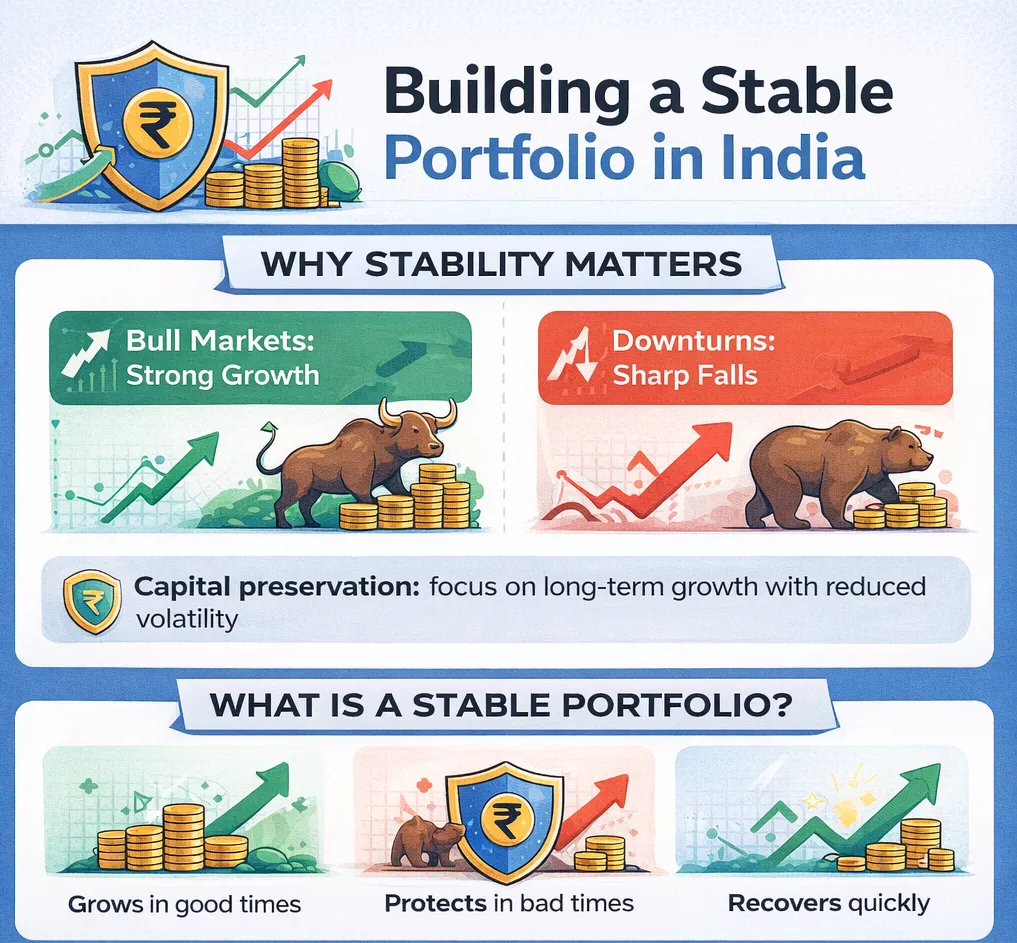
Image Title: Building a Stable Investment Portfolio in India
Alt Text: Infographic explaining how to build a stable portfolio in India, highlighting bull vs bear markets, capital preservation, and key benefits like growth in good times, protection in downturns, and quick recovery.
A stable portfolio for all market cycles is not meant to outperform every year. It is designed to limit drawdowns, recover faster, and deliver consistent returns across full market cycles. The focus is on cycle-adjusted returns, which requires strong portfolio construction and the inclusion of low-risk investment options to reduce volatility.
For Indian investors, this is even more important. While the Nifty 50 delivers ~12–13% CAGR, actual investor returns are lower due to poor timing. A well-built stable portfolio for all market cycles helps close this gap by reducing panic-driven decisions. Integrating low-risk investment options in India strengthens portfolio construction and improves long-term outcomes.
In simple terms, a stable portfolio for all market cycles should grow in bull markets, protect capital in downturns, and recover quickly. This is why capital preservation matters as much as returns. Without low-risk investment options, portfolios remain vulnerable during volatility.
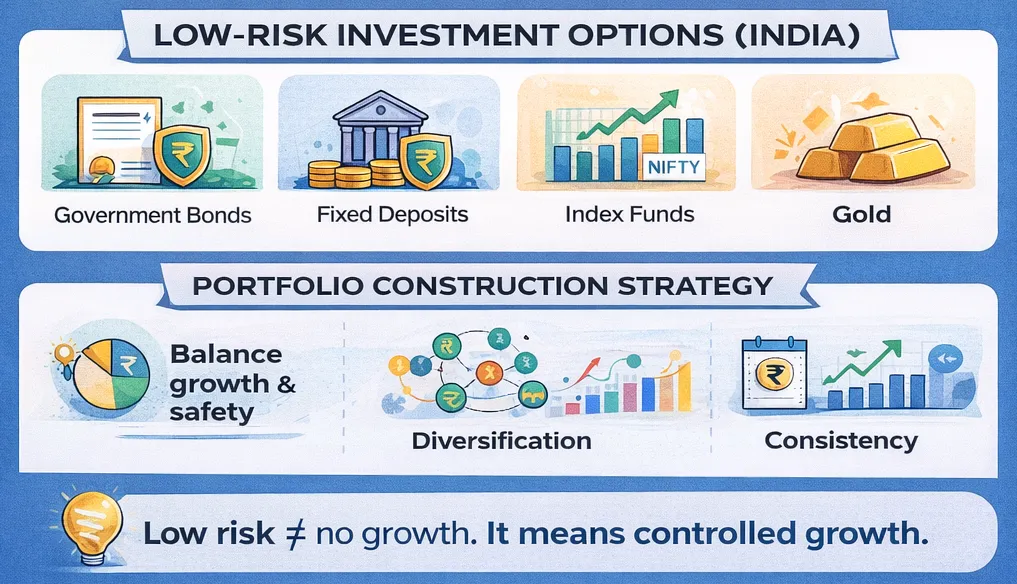 Image Title: Low-Risk Investment Options and Portfolio Strategy in India
Alt Text: Infographic featuring low-risk investment options in India such as government bonds, fixed deposits, index funds, and gold, along with portfolio strategies like diversification, balance, and consistency.
Effective portfolio construction balances growth with low-risk investment options in India, creating a resilient structure. By consistently using low-risk investment options, investors can build a portfolio that sustains and compounds wealth across all market conditions.
Also Read: What the Iran-Israel-US War Means For India's & World's Fertilizer Industry?
The 4 Phases of Market Cycles and How Each Affects Your All-Weather Portfolio
Effective portfolio construction starts with understanding market cycles. Markets move through four phases: expansion, peak, contraction, and trough, each with different asset behavior. Recognizing this is key to building balanced portfolios that adapt to changing conditions while ensuring capital preservation and consistent growth.
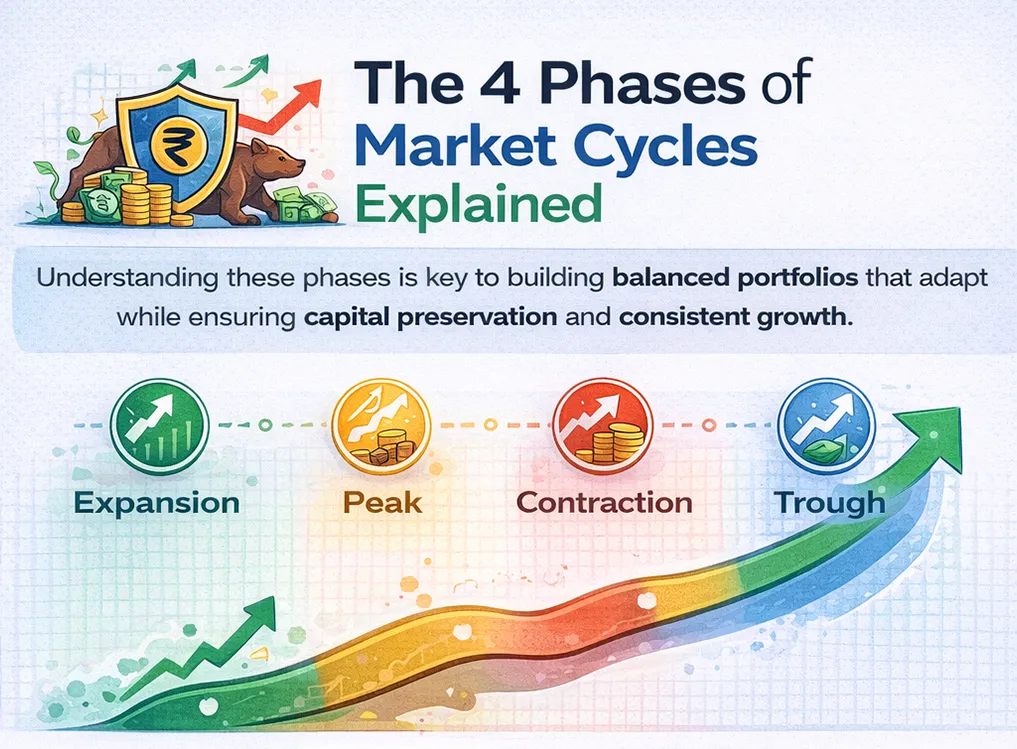 Image Title: The 4 Phases of Market Cycles Explained
Alt Text: Infographic showing the four phases of market cycles—expansion, peak, contraction, and trough—with a rising trend line and icons representing growth, decline, and recovery in financial markets.
Expansion feels like a normal bull market, with strong earnings and rising equities. High-beta stocks outperform, but ignoring downside protection at this stage can create risk later. Strong, balanced portfolios prepare for all phases, not just growth.
Peak is difficult to identify in real time. Valuations stretch, and leadership shifts toward quality stocks. Investors focusing on capital preservation and gradually allocating to capital preservation mutual funds can reduce risk. Strengthening downside protection here helps cushion the next phase.
Contraction is where weak portfolios suffer. Equities fall, while gold and debt outperform. This highlights the importance of capital preservation mutual funds, robust downside protection, and disciplined balanced portfolios. Investors prioritizing capital preservation can limit losses and stay invested.
Through marks recovery, though sentiment remains weak. Quality assets rebound first, rewarding disciplined investors. This phase underscores the importance of balanced portfolios, capital preservation, and the consistent use of capital-preservation mutual funds with downside protection.
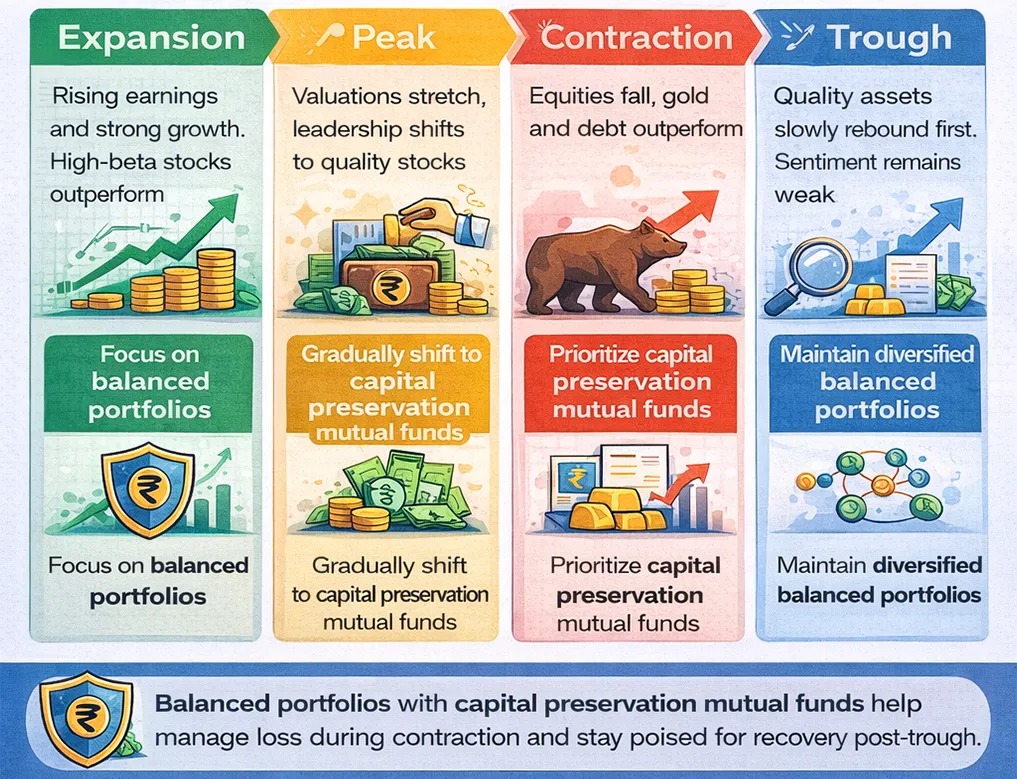 Alt Text: Market cycle phases infographic showing expansion, peak, contraction, and trough with portfolio strategies focused on balanced and capital preservation mutual funds.
Image Title: Investment Strategy Across Market Cycles: Expansion to Trough
Understanding these phases is the foundation of smart portfolio construction, not to predict markets, but to stay prepared.
Market Phase | Economic Condition | Equity Performance | Debt Performance | Gold Performance |
Expansion | Growth rising | Strong | Moderate | Weak |
Peak | Overheating | Volatile | Stable | Moderate |
Contraction | Slowdown/recession | Weak | Strong | Strong |
Trough | Recovery begins | Rebounding | Moderate | Stable |
Most investors fail by reacting emotionally, buying at peaks and selling during downturns. A structured approach focused on capital preservation, strong, balanced portfolios, the use of capital-preservation mutual funds, and built-in downside protection helps avoid this cycle.
Also Read: From Coal to Cloud: Mapping India’s Shift from Conventional Power to Sustainable Infrastructure
Common Mistakes in Portfolio Construction That Investors Should Avoid
Many investors underperform not because of market conditions, but due to poor portfolio construction decisions. Ignoring risk, overreacting to trends, and failing to build balanced portfolios often lead to inconsistent returns and unnecessary losses. Avoiding these mistakes is essential for achieving long-term capital preservation and sustainable growth.
1. Overexposure to Equities Without Downside Planning
One of the most common mistakes is allocating too heavily to equities, especially during bull markets. While equities drive growth, excessive exposure without adequate downside protection can lead to sharp drawdowns during corrections. Investors who ignore capital preservation principles often see significant erosion of wealth in volatile phases. Strong, balanced portfolios ensure that equity exposure is complemented by defensive assets to maintain stability.
2. Ignoring Low-Risk and Capital Preservation Instruments
Many investors underestimate the importance of debt and defensive assets. Avoiding capital preservation mutual funds and other low-risk instruments can make portfolios highly vulnerable during downturns. These funds play a crucial role in maintaining liquidity and reducing volatility. Incorporating capital preservation mutual funds helps strengthen downside protection, while also supporting long-term capital preservation objectives.
3. Lack of Diversification Across Assets and Factors
Concentrated portfolios, whether in a single asset class, sector, or strategy, can significantly increase risk. Without diversification, portfolios fail to qualify as true balanced portfolios. A well-diversified approach that includes equities, debt, and alternatives improves downside protection and enhances resilience. Diversification is not just about spreading investments, but about aligning them with capital preservation and risk management goals.
4. Absence of a Rebalancing Strategy
Failing to rebalance regularly can distort your allocation over time. For example, during a bull run, equity exposure may increase beyond intended levels, weakening downside protection. Without periodic adjustments, even well-designed, balanced portfolios can become risky. Rebalancing ensures alignment with your original portfolio construction strategy and supports consistent capital preservation.
5. Chasing Trends Instead of Following Discipline
Many investors chase momentum, investing in what has already performed well rather than sticking to a disciplined strategy. This behavior often leads to buying at peaks and exiting during downturns. Ignoring structured approaches like capital preservation mutual funds and diversified allocations weakens downside protection. True success comes from maintaining balanced portfolios that prioritize capital preservation over short-term gains.
Avoiding these common mistakes allows investors to build stronger, more resilient portfolios. By focusing on capital preservation, maintaining balanced portfolios, strategically using capital preservation mutual funds, and ensuring consistent downside protection, investors can navigate market cycles with greater confidence and stability.
Also Read: Who are The Real Winners of the Iran-Israel War? : Sectors, Companies, Countries Gaining from War
Get research like this in your inbox
The week’s research that mattered, in five minutes. Joined by 2L+ investors.
A Practical All-Weather Portfolio Strategy for Indian Investors
No single asset class can deliver consistent returns across all phases of the market cycle. Building a stable portfolio for all market cycles requires a structured, multi-asset approach where each component plays a defined role. Wright Research’s quant-driven, system portfolio management framework combines diversification, factor investing , and disciplined allocation to create a resilient strategy that performs across conditions.
1. Quality Equities (35–40%): The Core Growth Engine
Quality equities form the foundation of a long-term mutual fund portfolio, focusing on companies with strong balance sheets, high return on equity, and consistent earnings. The Nifty 200 Quality 30 index has historically outperformed broader indices with lower risk, proving that resilience drives returns. These stocks also strengthen a defensive portfolio for market downturns, as they tend to fall less during corrections while maintaining long-term growth.
2. Debt & Short Duration Instruments (30–35%): Stability and Liquidity
Debt instruments such as short-duration funds and corporate bond funds provide income, liquidity, and risk reduction. They are a key pillar of a long-term mutual fund portfolio, delivering steady returns with lower volatility. This allocation supports defensive investment strategies and allows investors to rebalance effectively during market corrections, making it essential for a defensive portfolio for market downturns.
3. Low Volatility Factor (15–20%): Reducing Drawdowns
Low volatility equities play a critical role in limiting losses during market stress. The Nifty100 Low Vol 30 index has demonstrated significantly lower drawdowns compared to high-momentum strategies. This makes it a vital component of a bear market portfolio, ensuring stability without exiting equities. Integrating this factor enhances defensive investment positioning and strengthens overall portfolio resilience.
4. Gold & Real Assets (10–15%): Portfolio Insurance
Gold, REITs, and similar real assets act as hedges during uncertainty. Gold’s low or negative correlation with equities makes it highly effective in a bear market portfolio, offering protection during contractions. These assets provide diversification and income, making them essential for building a defensive portfolio for market downturns and maintaining balance across cycles.
Why This Framework Works?
This four-part allocation, Quality Equities, Debt, Low Volatility, and Gold/REITs, creates a robust structure for long-term investing. It integrates factor-based strategies with system portfolio management, ensuring adaptability across market phases. A well-executed multifactor portfolio built on this approach enhances defensive investment capabilities, stabilizes a bear market portfolio, and drives consistent compounding within a long-term mutual fund portfolio.
Also Read: Decoding the Iran–Israel Conflict for Portfolios: Timeline, Markets, Oil Prices, Macro Transmission
Why Quality and Low Volatility Factors Are the Backbone of Stable Portfolios?
Factor investing is not just about returns; it’s about building resilience. For Indian investors, Quality and Low Volatility are essential for creating a defensive portfolio for market downturns while integrating low-risk investments into equities.
The Quality factor focuses on companies with strong fundamentals, high ROE, low debt, and stable earnings. These businesses hold up better during stress, making them key to a defensive portfolio for market downturns and a core part of any multifactor portfolio.
The Low Volatility factor selects stocks with stable price movements, often from defensive sectors. This helps reduce drawdowns and supports investors seeking low-risk investments without exiting equities. It further strengthens a defensive portfolio for market downturns.
Combining these factors in a multifactor portfolio improves resilience. With low correlation between factors, portfolios avoid extreme swings and deliver better downside protection. This approach, driven by system portfolio management, ensures adaptability across cycles.
Real data supports this. During the Sep 2024–Mar 2025 correction, Nifty100 Low Vol 30 fell -17.52% vs -31.25% for Nifty200 Momentum 30, highlighting the role of system portfolio management in reducing risk and embedding low-risk investments within equities.
Over time, this combination delivers lower drawdowns and consistent compounding . A well-structured multifactor portfolio, powered by system portfolio management, offers a smarter way to build low-risk investments and maintain stability across market cycles.
Also Read: Why India’s Private Capex Crisis Has Been Falling and Why the Floor May Be Near
How Often Should You Rebalance an All-Weather Portfolio?
Rebalancing is a critical part of portfolio construction, yet many investors either ignore it or do it inefficiently. The goal is simple: keep your allocation aligned without increasing costs or risk.
 Alt Text: All-weather portfolio rebalancing infographic showing annual vs threshold-based strategies, benefits, and importance of maintaining aligned asset allocation.
Image Title: How Often Should You Rebalance an All-Weather Portfolio?
There are two common approaches. Annual rebalancing is easy to follow but often poorly timed, especially in volatile markets. In contrast, threshold-based rebalancing (±5% drift) is more dynamic. It adjusts only when allocations meaningfully deviate, making it better suited for a multifactor portfolio built for real-world conditions.
In Indian markets, threshold-based rebalancing has proven more effective because it captures inefficiencies, maintains optimal allocation, and supports low-risk investments by avoiding unnecessary trades. Selling assets only when they exceed risk limits helps preserve upside while controlling concentration risk.
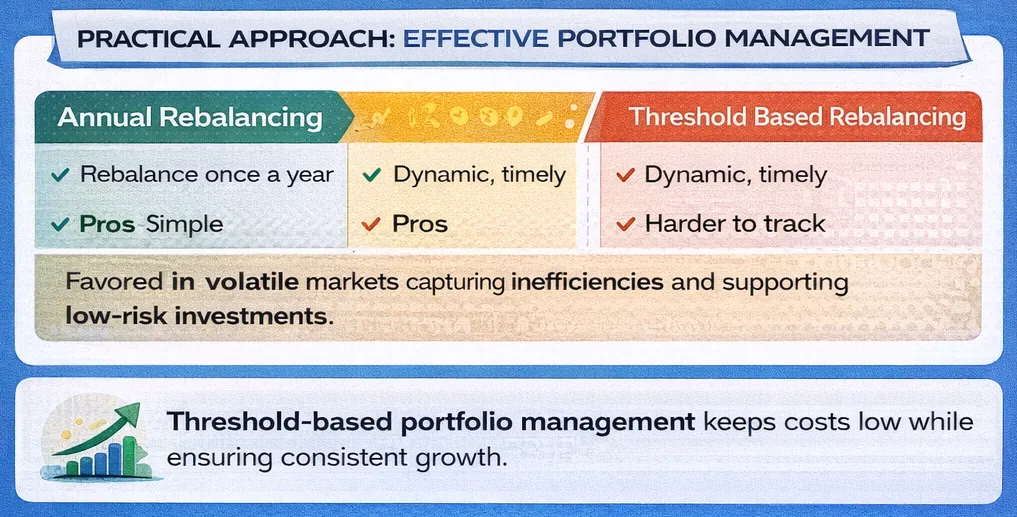 Image Title: Annual vs Threshold-Based Portfolio Rebalancing Strategies
Alt Text: Comparison of annual rebalancing and threshold-based portfolio rebalancing highlighting simplicity, timing, and suitability in volatile markets.
This is where system portfolio management becomes essential. Instead of reacting emotionally or following rigid timelines, a rules-based approach ensures discipline. If any allocation drifts beyond 5%, it is reset, keeping the multifactor portfolio aligned with its original design.
Additionally, factor indices like Low Volatility naturally rebalance semi-annually, embedding system portfolio management within the portfolio itself. This reduces manual intervention while maintaining exposure to low-risk investments within equities.
The practical approach is simple: review quarterly, rebalance only when thresholds are breached, and let factor-based strategies handle internal adjustments. This keeps costs low, strengthens low-risk investments, and ensures your portfolio remains consistent across market cycles.
Also Read: Why You Should Review Your Mutual Fund Portfolio for Long-Term Wealth Preservation
Conclusion
A stable portfolio for all market cycles is not built overnight; it requires discipline, structure, and a deep understanding of risk. By combining smart portfolio construction, proven low-risk investment options in India, factor-based strategies, and dynamic rebalancing, investors can build a portfolio that not only grows but also survives market volatility.
In today’s uncertain environment, the focus should not be just on returns, but on resilience, and that is what truly defines long-term investing success.
Is your portfolio built for what’s coming?
Get a free AI-powered review of your holdings — risk, overlap and quality in minutes.
Frequently Asked Questions
1. What are the 7 steps of the portfolio process?
Define goals, assess risk tolerance, choose asset allocation, select investments, build the portfolio, monitor performance, and rebalance periodically. This structured approach ensures disciplined portfolio construction and alignment with long-term financial objectives.
2. What are the best low-risk investment options?
Fixed deposits, government bonds, treasury bills, short-duration mutual funds, and high-quality corporate bond funds are among the best low-risk investment options. In India, these provide stable returns, liquidity, and help reduce overall portfolio volatility.
3. What are the techniques of capital preservation?
Diversification, asset allocation, investing in low-risk instruments, using capital preservation mutual funds, maintaining liquidity, and regular rebalancing are key techniques. These strategies reduce downside risk and protect wealth during market downturns while ensuring steady long-term growth.